SUBSCRIBE TO OUR FREE NEWSLETTER
Daily news & progressive opinion—funded by the people, not the corporations—delivered straight to your inbox.
5
#000000
#FFFFFF
To donate by check, phone, or other method, see our More Ways to Give page.
Daily news & progressive opinion—funded by the people, not the corporations—delivered straight to your inbox.
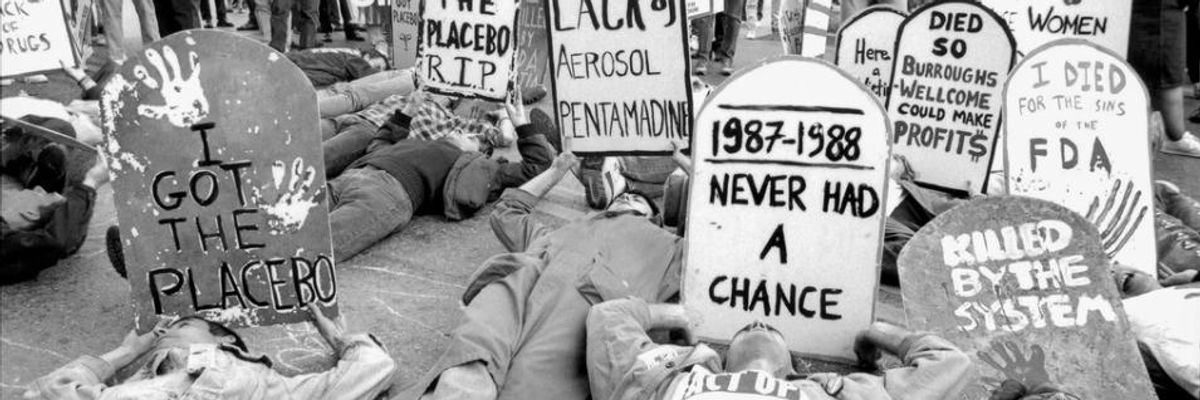
An ACT UP protest outside the FDA headquarters in Rockville, Maryland in 1988. (Photo: Peter Ansin/Getty Images)
Larry Kramer, fierce and inspirational activist, founder of ACT UP, and brilliant author, died late last month at age 84. Larry was instrumental in turning the AIDS crisis from a taboo, denied, and individual battle to a national emergency. While his tactics may have been considered controversial to some, his fierce style of activism got results. It wasn't polite or comfortable but it woke up the American public and government to the crisis. Even though billions of lives are at risk, the climate movement has not yet achieved that level of emotional resonance and power but Kramer shows us how we can.
As a clinical psychologist and climate activist, with a background in social anthropology, I approach the climate emergency with these questions: why are we basically ignoring the greatest threat to ourselves, our families, and the entire human family? Why are we committing suicide through our passivity, and how do we stop? I am also keenly aware of how telling the truth, courageously and emotionally, is necessary for transformative change.
"The climate movement must abandon gradualism, euphemism, and half measures."
Kramer exhorted his would-be supporters to feel as much fear as possible--telling crowds of gay men that if they didn't fight back, they would soon be dead. When Kramer founded ACT UP, he said "I knew I wanted it to be based on anger," meaning he was done being confined by the sense of normalcy, decorum, and privacy. He referred to AIDS repeatedly as a "plague" and to the politicians who ignored it as "murderers" and "Nazis." He was fighting for his life, for the lives of his friends, and the lives of strangers all over the world.
Instead of embracing this passionate, zealous defense of life, the climate movement has been dominated by the culture of science, with its hyperrationality and tendency towards avoiding conflict, and adopted some truly terrible ideas along the way. As an example, there is the persistent and hegemonic idea in the climate movement that "climate communications can't scare people" because "fear doesn't work as a motivator" and we must always tell a hopeful story. Larry Kramer faced similar challenges--no one likes the bearer of bad news. Kramer's response was that if scaring people is going to make people pay attention or stop endangering their lives, let them be scared!" The climate movement must ask itself: Do we want to protect people from painful feelings or from the climate emergency itself?
"The climate movement must ask itself: Do we want to protect people from painful feelings or from the climate emergency itself?"ACT UP's slogan, Silence = Death, referred to the government and media's silence on AIDS and also to the cultural silence around homosexuality. At the time, many gay people were closeted, hoping to avoid rejection, discrimination and dehumanization from a homophobic culture. In a very different context today, members of the climate movement worry that talking frequently about the climate emergency will make others feel uncomfortable, sad, helpless, or angry.
Yale Climate Communications's polling has revealed a "Spiral of Silence" in which 59% of Americans say they "rarely" or "never" discuss global warming with family and friends. As social creatures, when we don't hear our peers talking about climate much, it's hard to believe that we are facing a dangerous existential emergency.
If we are silent about the climate emergency, others interpret our silence as a lack of concern, as a sign that things are normal. We need to channel our inner Larry Kramer, and loudly tell the truth to everyone we know. The most energetic, inspiring, and successful climate groups, such as the student strikers and Extinction Rebellion, have done just that. Telling the truth is at the heart of all of my work, and that of The Climate Mobilization.
Dear Common Dreams reader, It’s been nearly 30 years since I co-founded Common Dreams with my late wife, Lina Newhouser. We had the radical notion that journalism should serve the public good, not corporate profits. It was clear to us from the outset what it would take to build such a project. No paid advertisements. No corporate sponsors. No millionaire publisher telling us what to think or do. Many people said we wouldn't last a year, but we proved those doubters wrong. Together with a tremendous team of journalists and dedicated staff, we built an independent media outlet free from the constraints of profits and corporate control. Our mission has always been simple: To inform. To inspire. To ignite change for the common good. Building Common Dreams was not easy. Our survival was never guaranteed. When you take on the most powerful forces—Wall Street greed, fossil fuel industry destruction, Big Tech lobbyists, and uber-rich oligarchs who have spent billions upon billions rigging the economy and democracy in their favor—the only bulwark you have is supporters who believe in your work. But here’s the urgent message from me today. It's never been this bad out there. And it's never been this hard to keep us going. At the very moment Common Dreams is most needed, the threats we face are intensifying. We need your support now more than ever. We don't accept corporate advertising and never will. We don't have a paywall because we don't think people should be blocked from critical news based on their ability to pay. Everything we do is funded by the donations of readers like you. When everyone does the little they can afford, we are strong. But if that support retreats or dries up, so do we. Will you donate now to make sure Common Dreams not only survives but thrives? —Craig Brown, Co-founder |
Margaret Klein Salamon, PhD, is a clinical psychologist turned climate activist and thought leader. Her work helps people face the frightening, painful truths of the climate emergency and empowers all of us to transform despair into effective "emergency mode" action. Her book, Facing the Climate Emergency: How to Transform Yourself with Climate Truth (2023), is a radical self-help guide.
As the Executive Director of the Climate Emergency Fund, Margaret fundraises for and strategically deploys financial resources to high-impact disruptive protest campaigns. Her project Climate Awakening allows people to call into a video chatfrom all over the world and share their climate emotions.
Larry Kramer, fierce and inspirational activist, founder of ACT UP, and brilliant author, died late last month at age 84. Larry was instrumental in turning the AIDS crisis from a taboo, denied, and individual battle to a national emergency. While his tactics may have been considered controversial to some, his fierce style of activism got results. It wasn't polite or comfortable but it woke up the American public and government to the crisis. Even though billions of lives are at risk, the climate movement has not yet achieved that level of emotional resonance and power but Kramer shows us how we can.
As a clinical psychologist and climate activist, with a background in social anthropology, I approach the climate emergency with these questions: why are we basically ignoring the greatest threat to ourselves, our families, and the entire human family? Why are we committing suicide through our passivity, and how do we stop? I am also keenly aware of how telling the truth, courageously and emotionally, is necessary for transformative change.
"The climate movement must abandon gradualism, euphemism, and half measures."
Kramer exhorted his would-be supporters to feel as much fear as possible--telling crowds of gay men that if they didn't fight back, they would soon be dead. When Kramer founded ACT UP, he said "I knew I wanted it to be based on anger," meaning he was done being confined by the sense of normalcy, decorum, and privacy. He referred to AIDS repeatedly as a "plague" and to the politicians who ignored it as "murderers" and "Nazis." He was fighting for his life, for the lives of his friends, and the lives of strangers all over the world.
Instead of embracing this passionate, zealous defense of life, the climate movement has been dominated by the culture of science, with its hyperrationality and tendency towards avoiding conflict, and adopted some truly terrible ideas along the way. As an example, there is the persistent and hegemonic idea in the climate movement that "climate communications can't scare people" because "fear doesn't work as a motivator" and we must always tell a hopeful story. Larry Kramer faced similar challenges--no one likes the bearer of bad news. Kramer's response was that if scaring people is going to make people pay attention or stop endangering their lives, let them be scared!" The climate movement must ask itself: Do we want to protect people from painful feelings or from the climate emergency itself?
"The climate movement must ask itself: Do we want to protect people from painful feelings or from the climate emergency itself?"ACT UP's slogan, Silence = Death, referred to the government and media's silence on AIDS and also to the cultural silence around homosexuality. At the time, many gay people were closeted, hoping to avoid rejection, discrimination and dehumanization from a homophobic culture. In a very different context today, members of the climate movement worry that talking frequently about the climate emergency will make others feel uncomfortable, sad, helpless, or angry.
Yale Climate Communications's polling has revealed a "Spiral of Silence" in which 59% of Americans say they "rarely" or "never" discuss global warming with family and friends. As social creatures, when we don't hear our peers talking about climate much, it's hard to believe that we are facing a dangerous existential emergency.
If we are silent about the climate emergency, others interpret our silence as a lack of concern, as a sign that things are normal. We need to channel our inner Larry Kramer, and loudly tell the truth to everyone we know. The most energetic, inspiring, and successful climate groups, such as the student strikers and Extinction Rebellion, have done just that. Telling the truth is at the heart of all of my work, and that of The Climate Mobilization.
Margaret Klein Salamon, PhD, is a clinical psychologist turned climate activist and thought leader. Her work helps people face the frightening, painful truths of the climate emergency and empowers all of us to transform despair into effective "emergency mode" action. Her book, Facing the Climate Emergency: How to Transform Yourself with Climate Truth (2023), is a radical self-help guide.
As the Executive Director of the Climate Emergency Fund, Margaret fundraises for and strategically deploys financial resources to high-impact disruptive protest campaigns. Her project Climate Awakening allows people to call into a video chatfrom all over the world and share their climate emotions.
Larry Kramer, fierce and inspirational activist, founder of ACT UP, and brilliant author, died late last month at age 84. Larry was instrumental in turning the AIDS crisis from a taboo, denied, and individual battle to a national emergency. While his tactics may have been considered controversial to some, his fierce style of activism got results. It wasn't polite or comfortable but it woke up the American public and government to the crisis. Even though billions of lives are at risk, the climate movement has not yet achieved that level of emotional resonance and power but Kramer shows us how we can.
As a clinical psychologist and climate activist, with a background in social anthropology, I approach the climate emergency with these questions: why are we basically ignoring the greatest threat to ourselves, our families, and the entire human family? Why are we committing suicide through our passivity, and how do we stop? I am also keenly aware of how telling the truth, courageously and emotionally, is necessary for transformative change.
"The climate movement must abandon gradualism, euphemism, and half measures."
Kramer exhorted his would-be supporters to feel as much fear as possible--telling crowds of gay men that if they didn't fight back, they would soon be dead. When Kramer founded ACT UP, he said "I knew I wanted it to be based on anger," meaning he was done being confined by the sense of normalcy, decorum, and privacy. He referred to AIDS repeatedly as a "plague" and to the politicians who ignored it as "murderers" and "Nazis." He was fighting for his life, for the lives of his friends, and the lives of strangers all over the world.
Instead of embracing this passionate, zealous defense of life, the climate movement has been dominated by the culture of science, with its hyperrationality and tendency towards avoiding conflict, and adopted some truly terrible ideas along the way. As an example, there is the persistent and hegemonic idea in the climate movement that "climate communications can't scare people" because "fear doesn't work as a motivator" and we must always tell a hopeful story. Larry Kramer faced similar challenges--no one likes the bearer of bad news. Kramer's response was that if scaring people is going to make people pay attention or stop endangering their lives, let them be scared!" The climate movement must ask itself: Do we want to protect people from painful feelings or from the climate emergency itself?
"The climate movement must ask itself: Do we want to protect people from painful feelings or from the climate emergency itself?"ACT UP's slogan, Silence = Death, referred to the government and media's silence on AIDS and also to the cultural silence around homosexuality. At the time, many gay people were closeted, hoping to avoid rejection, discrimination and dehumanization from a homophobic culture. In a very different context today, members of the climate movement worry that talking frequently about the climate emergency will make others feel uncomfortable, sad, helpless, or angry.
Yale Climate Communications's polling has revealed a "Spiral of Silence" in which 59% of Americans say they "rarely" or "never" discuss global warming with family and friends. As social creatures, when we don't hear our peers talking about climate much, it's hard to believe that we are facing a dangerous existential emergency.
If we are silent about the climate emergency, others interpret our silence as a lack of concern, as a sign that things are normal. We need to channel our inner Larry Kramer, and loudly tell the truth to everyone we know. The most energetic, inspiring, and successful climate groups, such as the student strikers and Extinction Rebellion, have done just that. Telling the truth is at the heart of all of my work, and that of The Climate Mobilization.