SUBSCRIBE TO OUR FREE NEWSLETTER
Daily news & progressive opinion—funded by the people, not the corporations—delivered straight to your inbox.
5
#000000
#FFFFFF
To donate by check, phone, or other method, see our More Ways to Give page.
Daily news & progressive opinion—funded by the people, not the corporations—delivered straight to your inbox.
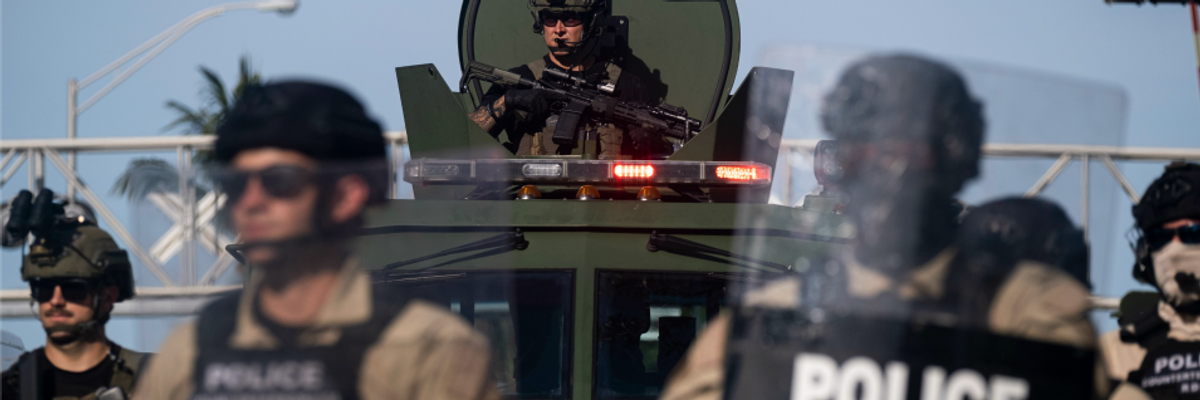
A Miami Police officer watches protestors from an armored vehicle during a rally in Miami, Florida on May 31, 2020 in response to the killing of George Floyd. (Photo: Ricardo Arduengo/AFP via Getty Images)
On Monday, House and Senate Democrats introduced the Justice in Policing Act of 2020. This bill includes much-needed provisions to help end racial profiling, ban chokeholds, create a national database for police misconduct and use-of-force, as well as establish a national use-of-force standard. But this bill fails to fully address issues like police militarization and the use of quick-knock raids. These policing practices are deadly tactics of the drug war, disproportionately used against people of color in drug investigations. This legislative measure is not the bold solution this moment requires.
The increased transfer of equipment through the 1033 program has been shown to increase the number of police killings in communities. For decades, the war on drugs has funded militarized policing through various grant programs including the Department of Defense's "1033 program," which the Justice in Policing Act attempts to reform. The 1033 program was created by Congress in 1990 for the purpose of expanding drug enforcement. Over the years, it has resulted in the transfer of approximately $7.2 billion worth of surplus military equipment to state, local and tribal law enforcement agencies. It has equipped law enforcement agencies with military-grade equipment such as armored vehicles, military-style assault rifles, and explosives, and has funded the creation of special tactical teams for drug investigations.
The increased transfer of equipment through the 1033 program has been shown to increase the number of police killings in communities. It has paved the way for militarized police responses to protests against police violence, like we witnessed in the summer of 2014 in Ferguson, Missouri when people protesting the killing of Michael Brown at the hands of a police officer were met with law enforcement equipped with tanks and riot gear. Moreover, the 1033 program has been notoriously mismanaged. A 2017 federal government oversight report found that the program could not prevent fraudulent applications from acquiring weapons of war from the program.
Reforming this botched program, as the Justice in Policing Act aims to do, is not enough to prevent further harm to communities of color. It must be abolished along with other funding streams that support militarized policing.
The Justice in Policing Act also attempts to reduce the harms of another drug war policing tactic--the serving of warrants. Thousands of "no-knock" warrants are issued to law enforcement every year, allowing law enforcement to forcibly enter a person's home without announcing who they are or their intent. Judges rarely deny these warrants and they have been increasingly permitted by courts in pursuit of the drug war. No-knock warrants are often used in conjunction with SWAT team deployments and have led to numerous tragic killings like that of Breonna Taylor in March 2020.
Similar to no-knock warrants, "quick-knocks" are also used in SWAT responses to drug cases. Like no-knock warrants, quick-knock raids do not give people much time to respond to police presence and can lead to deadly outcomes. According to a 2014 report by the American Civil Liberties Union, the use of SWAT teams to execute search warrants in drug cases has disproportionately targeted African American and Latino individuals, who make up a staggering 61% of the total number of individuals impacted by SWAT raids for drug cases. While the Justice in Policing Act would prohibit no-knock warrants, this bill must go further and also outlaw the use of quick-knock raids to prevent militarized police responses in drug investigations and save lives.
This moment calls for investing in infrastructure that increases public safety such as ensuring all of have equal access to quality education, affordable housing, a living wage, and infusing money in non-carceral responses to social issues like harm reduction programs for people who use drugs problematically.
But the most glaring failing of the Justice in Policing Act is that it neglects to reimagine public safety. It continues to fund police departments rather than redirect resources to communities, particularly Black and Brown communities that have been most harmed by over-policing and the war on drugs. This moment calls for investing in infrastructure that increases public safety such as ensuring all of have equal access to quality education, affordable housing, a living wage, and infusing money in non-carceral responses to social issues like harm reduction programs for people who use drugs problematically. It requires that we end the criminalization of work that people engage in to survive, such as sex work and drug sales.
This moment requires a bold legislative solution and this bill falls short. Even now, as Congress and communities mobilize to demand justice, the Drug Enforcement Administration (DEA) and Customs and Border Patrol (CBP) have been granted more power--which, when used, will ultimately continue to fuel mass incarceration, racial disparities, and other problems exacerbated by the drug war.
Against this backdrop, Congress must do more to ensure a standard for justice, policing and safety in America. Congress must act swiftly on police reform and strengthen this bill--not just for Breonna Taylor and George Floyd--but for the countless Black, Latinx, and Native American lives lost before them, and the countless others that devastatingly will follow if we don't begin to act.
Dear Common Dreams reader, It’s been nearly 30 years since I co-founded Common Dreams with my late wife, Lina Newhouser. We had the radical notion that journalism should serve the public good, not corporate profits. It was clear to us from the outset what it would take to build such a project. No paid advertisements. No corporate sponsors. No millionaire publisher telling us what to think or do. Many people said we wouldn't last a year, but we proved those doubters wrong. Together with a tremendous team of journalists and dedicated staff, we built an independent media outlet free from the constraints of profits and corporate control. Our mission has always been simple: To inform. To inspire. To ignite change for the common good. Building Common Dreams was not easy. Our survival was never guaranteed. When you take on the most powerful forces—Wall Street greed, fossil fuel industry destruction, Big Tech lobbyists, and uber-rich oligarchs who have spent billions upon billions rigging the economy and democracy in their favor—the only bulwark you have is supporters who believe in your work. But here’s the urgent message from me today. It's never been this bad out there. And it's never been this hard to keep us going. At the very moment Common Dreams is most needed, the threats we face are intensifying. We need your support now more than ever. We don't accept corporate advertising and never will. We don't have a paywall because we don't think people should be blocked from critical news based on their ability to pay. Everything we do is funded by the donations of readers like you. When everyone does the little they can afford, we are strong. But if that support retreats or dries up, so do we. Will you donate now to make sure Common Dreams not only survives but thrives? —Craig Brown, Co-founder |
On Monday, House and Senate Democrats introduced the Justice in Policing Act of 2020. This bill includes much-needed provisions to help end racial profiling, ban chokeholds, create a national database for police misconduct and use-of-force, as well as establish a national use-of-force standard. But this bill fails to fully address issues like police militarization and the use of quick-knock raids. These policing practices are deadly tactics of the drug war, disproportionately used against people of color in drug investigations. This legislative measure is not the bold solution this moment requires.
The increased transfer of equipment through the 1033 program has been shown to increase the number of police killings in communities. For decades, the war on drugs has funded militarized policing through various grant programs including the Department of Defense's "1033 program," which the Justice in Policing Act attempts to reform. The 1033 program was created by Congress in 1990 for the purpose of expanding drug enforcement. Over the years, it has resulted in the transfer of approximately $7.2 billion worth of surplus military equipment to state, local and tribal law enforcement agencies. It has equipped law enforcement agencies with military-grade equipment such as armored vehicles, military-style assault rifles, and explosives, and has funded the creation of special tactical teams for drug investigations.
The increased transfer of equipment through the 1033 program has been shown to increase the number of police killings in communities. It has paved the way for militarized police responses to protests against police violence, like we witnessed in the summer of 2014 in Ferguson, Missouri when people protesting the killing of Michael Brown at the hands of a police officer were met with law enforcement equipped with tanks and riot gear. Moreover, the 1033 program has been notoriously mismanaged. A 2017 federal government oversight report found that the program could not prevent fraudulent applications from acquiring weapons of war from the program.
Reforming this botched program, as the Justice in Policing Act aims to do, is not enough to prevent further harm to communities of color. It must be abolished along with other funding streams that support militarized policing.
The Justice in Policing Act also attempts to reduce the harms of another drug war policing tactic--the serving of warrants. Thousands of "no-knock" warrants are issued to law enforcement every year, allowing law enforcement to forcibly enter a person's home without announcing who they are or their intent. Judges rarely deny these warrants and they have been increasingly permitted by courts in pursuit of the drug war. No-knock warrants are often used in conjunction with SWAT team deployments and have led to numerous tragic killings like that of Breonna Taylor in March 2020.
Similar to no-knock warrants, "quick-knocks" are also used in SWAT responses to drug cases. Like no-knock warrants, quick-knock raids do not give people much time to respond to police presence and can lead to deadly outcomes. According to a 2014 report by the American Civil Liberties Union, the use of SWAT teams to execute search warrants in drug cases has disproportionately targeted African American and Latino individuals, who make up a staggering 61% of the total number of individuals impacted by SWAT raids for drug cases. While the Justice in Policing Act would prohibit no-knock warrants, this bill must go further and also outlaw the use of quick-knock raids to prevent militarized police responses in drug investigations and save lives.
This moment calls for investing in infrastructure that increases public safety such as ensuring all of have equal access to quality education, affordable housing, a living wage, and infusing money in non-carceral responses to social issues like harm reduction programs for people who use drugs problematically.
But the most glaring failing of the Justice in Policing Act is that it neglects to reimagine public safety. It continues to fund police departments rather than redirect resources to communities, particularly Black and Brown communities that have been most harmed by over-policing and the war on drugs. This moment calls for investing in infrastructure that increases public safety such as ensuring all of have equal access to quality education, affordable housing, a living wage, and infusing money in non-carceral responses to social issues like harm reduction programs for people who use drugs problematically. It requires that we end the criminalization of work that people engage in to survive, such as sex work and drug sales.
This moment requires a bold legislative solution and this bill falls short. Even now, as Congress and communities mobilize to demand justice, the Drug Enforcement Administration (DEA) and Customs and Border Patrol (CBP) have been granted more power--which, when used, will ultimately continue to fuel mass incarceration, racial disparities, and other problems exacerbated by the drug war.
Against this backdrop, Congress must do more to ensure a standard for justice, policing and safety in America. Congress must act swiftly on police reform and strengthen this bill--not just for Breonna Taylor and George Floyd--but for the countless Black, Latinx, and Native American lives lost before them, and the countless others that devastatingly will follow if we don't begin to act.
On Monday, House and Senate Democrats introduced the Justice in Policing Act of 2020. This bill includes much-needed provisions to help end racial profiling, ban chokeholds, create a national database for police misconduct and use-of-force, as well as establish a national use-of-force standard. But this bill fails to fully address issues like police militarization and the use of quick-knock raids. These policing practices are deadly tactics of the drug war, disproportionately used against people of color in drug investigations. This legislative measure is not the bold solution this moment requires.
The increased transfer of equipment through the 1033 program has been shown to increase the number of police killings in communities. For decades, the war on drugs has funded militarized policing through various grant programs including the Department of Defense's "1033 program," which the Justice in Policing Act attempts to reform. The 1033 program was created by Congress in 1990 for the purpose of expanding drug enforcement. Over the years, it has resulted in the transfer of approximately $7.2 billion worth of surplus military equipment to state, local and tribal law enforcement agencies. It has equipped law enforcement agencies with military-grade equipment such as armored vehicles, military-style assault rifles, and explosives, and has funded the creation of special tactical teams for drug investigations.
The increased transfer of equipment through the 1033 program has been shown to increase the number of police killings in communities. It has paved the way for militarized police responses to protests against police violence, like we witnessed in the summer of 2014 in Ferguson, Missouri when people protesting the killing of Michael Brown at the hands of a police officer were met with law enforcement equipped with tanks and riot gear. Moreover, the 1033 program has been notoriously mismanaged. A 2017 federal government oversight report found that the program could not prevent fraudulent applications from acquiring weapons of war from the program.
Reforming this botched program, as the Justice in Policing Act aims to do, is not enough to prevent further harm to communities of color. It must be abolished along with other funding streams that support militarized policing.
The Justice in Policing Act also attempts to reduce the harms of another drug war policing tactic--the serving of warrants. Thousands of "no-knock" warrants are issued to law enforcement every year, allowing law enforcement to forcibly enter a person's home without announcing who they are or their intent. Judges rarely deny these warrants and they have been increasingly permitted by courts in pursuit of the drug war. No-knock warrants are often used in conjunction with SWAT team deployments and have led to numerous tragic killings like that of Breonna Taylor in March 2020.
Similar to no-knock warrants, "quick-knocks" are also used in SWAT responses to drug cases. Like no-knock warrants, quick-knock raids do not give people much time to respond to police presence and can lead to deadly outcomes. According to a 2014 report by the American Civil Liberties Union, the use of SWAT teams to execute search warrants in drug cases has disproportionately targeted African American and Latino individuals, who make up a staggering 61% of the total number of individuals impacted by SWAT raids for drug cases. While the Justice in Policing Act would prohibit no-knock warrants, this bill must go further and also outlaw the use of quick-knock raids to prevent militarized police responses in drug investigations and save lives.
This moment calls for investing in infrastructure that increases public safety such as ensuring all of have equal access to quality education, affordable housing, a living wage, and infusing money in non-carceral responses to social issues like harm reduction programs for people who use drugs problematically.
But the most glaring failing of the Justice in Policing Act is that it neglects to reimagine public safety. It continues to fund police departments rather than redirect resources to communities, particularly Black and Brown communities that have been most harmed by over-policing and the war on drugs. This moment calls for investing in infrastructure that increases public safety such as ensuring all of have equal access to quality education, affordable housing, a living wage, and infusing money in non-carceral responses to social issues like harm reduction programs for people who use drugs problematically. It requires that we end the criminalization of work that people engage in to survive, such as sex work and drug sales.
This moment requires a bold legislative solution and this bill falls short. Even now, as Congress and communities mobilize to demand justice, the Drug Enforcement Administration (DEA) and Customs and Border Patrol (CBP) have been granted more power--which, when used, will ultimately continue to fuel mass incarceration, racial disparities, and other problems exacerbated by the drug war.
Against this backdrop, Congress must do more to ensure a standard for justice, policing and safety in America. Congress must act swiftly on police reform and strengthen this bill--not just for Breonna Taylor and George Floyd--but for the countless Black, Latinx, and Native American lives lost before them, and the countless others that devastatingly will follow if we don't begin to act.