SUBSCRIBE TO OUR FREE NEWSLETTER
Daily news & progressive opinion—funded by the people, not the corporations—delivered straight to your inbox.
5
#000000
#FFFFFF
To donate by check, phone, or other method, see our More Ways to Give page.
Daily news & progressive opinion—funded by the people, not the corporations—delivered straight to your inbox.
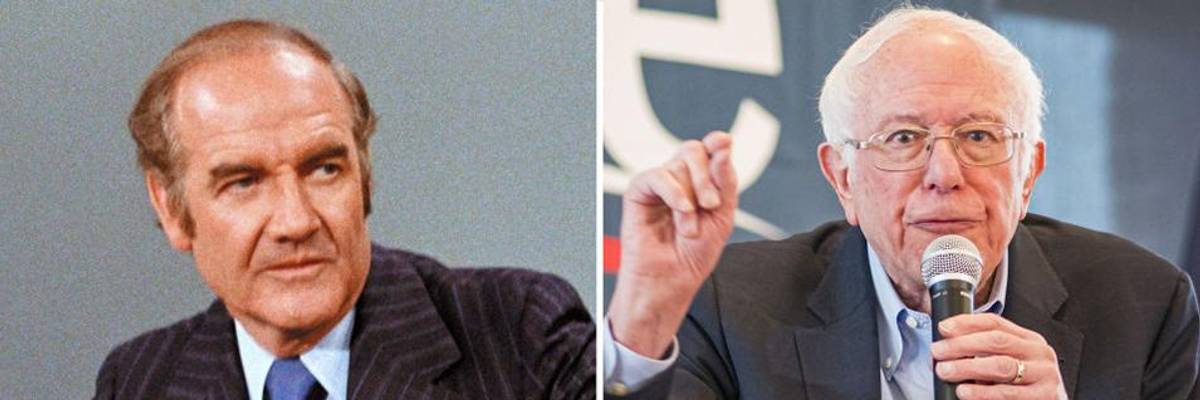
George McGovern & Bernie Sanders
There'll be no fiftieth reunions for the class of '70, it seems. Abruptly thrust out into the world in the uproar following the National Guard's killing of four students at a Kent State University antiwar demonstration, the class now find their return just as abruptly canceled by Covid-19. A scriptwriter could hardly have done the irony any better, but the more interesting set of bookends to the group's half-century in the sun might be their first and last (so far, that is) presidential elections, specifically the campaigns of George McGovern and Bernie Sanders.
There'll be no fiftieth reunions for the class of '70, it seems. Abruptly thrust out into the world in the uproar following the National Guard's killing of four students at a Kent State University antiwar demonstration, the class now find their return just as abruptly canceled by Covid-19. A scriptwriter could hardly have done the irony any better, but the more interesting set of bookends to the group's half-century in the sun might be their first and last (so far, that is) presidential elections, specifically the campaigns of George McGovern and Bernie Sanders. The contrast might have made for interesting talk in some corners of the room at some of those reunions that are not to be.
The immediate response to the May 4, 1970 shootings was massive: perhaps four out of five colleges and an unknown number of high schools saw some type of anti-war protest; as many as a fifth of colleges canceled the remainder of their semesters; and numerous on-campus Reserve Officers Training Corps offices were destroyed in one fashion or another. No subsequent academic year would come to such an unexpected end - until this one. Widespread as they were, however, the 1970 protests did not carry the day, as Richard Nixon remained in the White House unmoved. They did intensify the fervor for evicting him in 1972, though.
The class of '70 would not carry the day in the '72 presidential election either. The anti-Vietnam War movement seems to be rather like what they say about the French Resistance - significantly larger in memory than it actually was at the time. While polls suggested that the newest, youngest voters (including 18-20 year-olds given the vote in a presidential election for the first time) did indeed support the antiwar McGovern, Nixon would actually win the overall under-30 vote by a 52-46% margin, according to the election day exit polls employed for the first time that year. (Still, the McGovern campaign qualified as a youth movement in that his over-sixty vote share was 16% lower than his under-thirty vote, an age gap not surpassed until Barack Obama in 2008.)
History's judgment appears to have been kinder. If the class of 70 didn't carry the day, it did carry the era: Twenty years later, a Gallup poll showed 74% of Americans considering the Vietnam War a mistake, and there's been little subsequent indication of a reversal of that sentiment. As for Nixon-McGovern, by August 1973, an NBC post-Watergate Hearing poll showed McGovern winning a hypothetical re-run, and here again, continued revelations seem to have pretty well cast the verdict in concrete.
Since McGovern fared so poorly in the election, when his campaign is recalled at all it is pretty much remembered as an antiwar candidacy and little more. Actually, there was a lot more. The 1972 party platform supported "universal National Health Insurance," deplored "the increasing concentration of economic power in fewer and fewer hands," and concluded that a "Democratic Administration should pledge itself to combat factors which tend to concentrate wealth." In short, it sounded a lot like the Bernie Sanders campaign, even going it one better in stating that "Full employment--a guaranteed job for all--is the primary economic objective of the Democratic Party." (Full employment and national health insurance actually survived in the next two platforms, until Ronald Reagan's election convinced the Party that it needed to tack right in 1984.)
Today, Sanders has also failed to carry the day electorally, not even advancing to the nomination. Yet he is already widely acknowledged to have permanently altered the era's politics in his 2016 campaign, to the point where four years later he faced multiple candidates backing positions he had introduced to the political mainstream. The country's growing gap in wealth and power he brought to the fore was now widely understood as a problem to be confronted, rather than a fact to be celebrated. Even on health care, where the other candidates almost all did not agree with him, all had to define their position in relation to the Medicare for All proposal that he brought to the presidential debate table. All of this shift accomplished on the strength of a support base skewed toward youth to a degree far surpassing McGovern's (or Obama's): On Super Tuesday, he took 58 percent of under-thirty vote and only15 percent of the over-sixty-five.
In other words, the age cohort of voters that includes the class of '70 - high school and college - once the youthful base of George McGovern's support, has grown up to be the group that stymied Bernie Sanders. Might anyone at those not-to-be reunions have mused that if only everyone in their age group still remembered now what they used to know then, Sanders would be the nominee? Would any have asked how so many could forget so much - learned at such great cost - about disastrous foreign invasions launched under false pretenses, that the Democrats would be on the verge of choosing a Senator who had voted for the Iraq invasion as their nominee for the third time?
As the night went on, might someone cite the irony of their peers supporting a presidential candidate who proposed universal national health insurance in 1972, but opposing the one who promoted Medicare for All in 2020? And what did anyone make of the "Old New Left" leaders of the Students for a Democratic Society pulling together a letter urging the left to back Joe Biden, but never having had anything to say about Sanders? Anyone wonder how many of the people involved in the first Earth Day in 1970 voted for the candidate who supported the Green New Deal in 2020? Might someone have eventually gotten to talkin' 'bout their generation and posing the question of just how well it had "kept the faith" - as it might have been said back then?
And by evening's end, would someone raise a toast to the class of 2020 - and all of today's younger voters - along with a wish that they be blessed with better memories than their elders?
Dear Common Dreams reader, It’s been nearly 30 years since I co-founded Common Dreams with my late wife, Lina Newhouser. We had the radical notion that journalism should serve the public good, not corporate profits. It was clear to us from the outset what it would take to build such a project. No paid advertisements. No corporate sponsors. No millionaire publisher telling us what to think or do. Many people said we wouldn't last a year, but we proved those doubters wrong. Together with a tremendous team of journalists and dedicated staff, we built an independent media outlet free from the constraints of profits and corporate control. Our mission has always been simple: To inform. To inspire. To ignite change for the common good. Building Common Dreams was not easy. Our survival was never guaranteed. When you take on the most powerful forces—Wall Street greed, fossil fuel industry destruction, Big Tech lobbyists, and uber-rich oligarchs who have spent billions upon billions rigging the economy and democracy in their favor—the only bulwark you have is supporters who believe in your work. But here’s the urgent message from me today. It's never been this bad out there. And it's never been this hard to keep us going. At the very moment Common Dreams is most needed, the threats we face are intensifying. We need your support now more than ever. We don't accept corporate advertising and never will. We don't have a paywall because we don't think people should be blocked from critical news based on their ability to pay. Everything we do is funded by the donations of readers like you. When everyone does the little they can afford, we are strong. But if that support retreats or dries up, so do we. Will you donate now to make sure Common Dreams not only survives but thrives? —Craig Brown, Co-founder |
There'll be no fiftieth reunions for the class of '70, it seems. Abruptly thrust out into the world in the uproar following the National Guard's killing of four students at a Kent State University antiwar demonstration, the class now find their return just as abruptly canceled by Covid-19. A scriptwriter could hardly have done the irony any better, but the more interesting set of bookends to the group's half-century in the sun might be their first and last (so far, that is) presidential elections, specifically the campaigns of George McGovern and Bernie Sanders. The contrast might have made for interesting talk in some corners of the room at some of those reunions that are not to be.
The immediate response to the May 4, 1970 shootings was massive: perhaps four out of five colleges and an unknown number of high schools saw some type of anti-war protest; as many as a fifth of colleges canceled the remainder of their semesters; and numerous on-campus Reserve Officers Training Corps offices were destroyed in one fashion or another. No subsequent academic year would come to such an unexpected end - until this one. Widespread as they were, however, the 1970 protests did not carry the day, as Richard Nixon remained in the White House unmoved. They did intensify the fervor for evicting him in 1972, though.
The class of '70 would not carry the day in the '72 presidential election either. The anti-Vietnam War movement seems to be rather like what they say about the French Resistance - significantly larger in memory than it actually was at the time. While polls suggested that the newest, youngest voters (including 18-20 year-olds given the vote in a presidential election for the first time) did indeed support the antiwar McGovern, Nixon would actually win the overall under-30 vote by a 52-46% margin, according to the election day exit polls employed for the first time that year. (Still, the McGovern campaign qualified as a youth movement in that his over-sixty vote share was 16% lower than his under-thirty vote, an age gap not surpassed until Barack Obama in 2008.)
History's judgment appears to have been kinder. If the class of 70 didn't carry the day, it did carry the era: Twenty years later, a Gallup poll showed 74% of Americans considering the Vietnam War a mistake, and there's been little subsequent indication of a reversal of that sentiment. As for Nixon-McGovern, by August 1973, an NBC post-Watergate Hearing poll showed McGovern winning a hypothetical re-run, and here again, continued revelations seem to have pretty well cast the verdict in concrete.
Since McGovern fared so poorly in the election, when his campaign is recalled at all it is pretty much remembered as an antiwar candidacy and little more. Actually, there was a lot more. The 1972 party platform supported "universal National Health Insurance," deplored "the increasing concentration of economic power in fewer and fewer hands," and concluded that a "Democratic Administration should pledge itself to combat factors which tend to concentrate wealth." In short, it sounded a lot like the Bernie Sanders campaign, even going it one better in stating that "Full employment--a guaranteed job for all--is the primary economic objective of the Democratic Party." (Full employment and national health insurance actually survived in the next two platforms, until Ronald Reagan's election convinced the Party that it needed to tack right in 1984.)
Today, Sanders has also failed to carry the day electorally, not even advancing to the nomination. Yet he is already widely acknowledged to have permanently altered the era's politics in his 2016 campaign, to the point where four years later he faced multiple candidates backing positions he had introduced to the political mainstream. The country's growing gap in wealth and power he brought to the fore was now widely understood as a problem to be confronted, rather than a fact to be celebrated. Even on health care, where the other candidates almost all did not agree with him, all had to define their position in relation to the Medicare for All proposal that he brought to the presidential debate table. All of this shift accomplished on the strength of a support base skewed toward youth to a degree far surpassing McGovern's (or Obama's): On Super Tuesday, he took 58 percent of under-thirty vote and only15 percent of the over-sixty-five.
In other words, the age cohort of voters that includes the class of '70 - high school and college - once the youthful base of George McGovern's support, has grown up to be the group that stymied Bernie Sanders. Might anyone at those not-to-be reunions have mused that if only everyone in their age group still remembered now what they used to know then, Sanders would be the nominee? Would any have asked how so many could forget so much - learned at such great cost - about disastrous foreign invasions launched under false pretenses, that the Democrats would be on the verge of choosing a Senator who had voted for the Iraq invasion as their nominee for the third time?
As the night went on, might someone cite the irony of their peers supporting a presidential candidate who proposed universal national health insurance in 1972, but opposing the one who promoted Medicare for All in 2020? And what did anyone make of the "Old New Left" leaders of the Students for a Democratic Society pulling together a letter urging the left to back Joe Biden, but never having had anything to say about Sanders? Anyone wonder how many of the people involved in the first Earth Day in 1970 voted for the candidate who supported the Green New Deal in 2020? Might someone have eventually gotten to talkin' 'bout their generation and posing the question of just how well it had "kept the faith" - as it might have been said back then?
And by evening's end, would someone raise a toast to the class of 2020 - and all of today's younger voters - along with a wish that they be blessed with better memories than their elders?
There'll be no fiftieth reunions for the class of '70, it seems. Abruptly thrust out into the world in the uproar following the National Guard's killing of four students at a Kent State University antiwar demonstration, the class now find their return just as abruptly canceled by Covid-19. A scriptwriter could hardly have done the irony any better, but the more interesting set of bookends to the group's half-century in the sun might be their first and last (so far, that is) presidential elections, specifically the campaigns of George McGovern and Bernie Sanders. The contrast might have made for interesting talk in some corners of the room at some of those reunions that are not to be.
The immediate response to the May 4, 1970 shootings was massive: perhaps four out of five colleges and an unknown number of high schools saw some type of anti-war protest; as many as a fifth of colleges canceled the remainder of their semesters; and numerous on-campus Reserve Officers Training Corps offices were destroyed in one fashion or another. No subsequent academic year would come to such an unexpected end - until this one. Widespread as they were, however, the 1970 protests did not carry the day, as Richard Nixon remained in the White House unmoved. They did intensify the fervor for evicting him in 1972, though.
The class of '70 would not carry the day in the '72 presidential election either. The anti-Vietnam War movement seems to be rather like what they say about the French Resistance - significantly larger in memory than it actually was at the time. While polls suggested that the newest, youngest voters (including 18-20 year-olds given the vote in a presidential election for the first time) did indeed support the antiwar McGovern, Nixon would actually win the overall under-30 vote by a 52-46% margin, according to the election day exit polls employed for the first time that year. (Still, the McGovern campaign qualified as a youth movement in that his over-sixty vote share was 16% lower than his under-thirty vote, an age gap not surpassed until Barack Obama in 2008.)
History's judgment appears to have been kinder. If the class of 70 didn't carry the day, it did carry the era: Twenty years later, a Gallup poll showed 74% of Americans considering the Vietnam War a mistake, and there's been little subsequent indication of a reversal of that sentiment. As for Nixon-McGovern, by August 1973, an NBC post-Watergate Hearing poll showed McGovern winning a hypothetical re-run, and here again, continued revelations seem to have pretty well cast the verdict in concrete.
Since McGovern fared so poorly in the election, when his campaign is recalled at all it is pretty much remembered as an antiwar candidacy and little more. Actually, there was a lot more. The 1972 party platform supported "universal National Health Insurance," deplored "the increasing concentration of economic power in fewer and fewer hands," and concluded that a "Democratic Administration should pledge itself to combat factors which tend to concentrate wealth." In short, it sounded a lot like the Bernie Sanders campaign, even going it one better in stating that "Full employment--a guaranteed job for all--is the primary economic objective of the Democratic Party." (Full employment and national health insurance actually survived in the next two platforms, until Ronald Reagan's election convinced the Party that it needed to tack right in 1984.)
Today, Sanders has also failed to carry the day electorally, not even advancing to the nomination. Yet he is already widely acknowledged to have permanently altered the era's politics in his 2016 campaign, to the point where four years later he faced multiple candidates backing positions he had introduced to the political mainstream. The country's growing gap in wealth and power he brought to the fore was now widely understood as a problem to be confronted, rather than a fact to be celebrated. Even on health care, where the other candidates almost all did not agree with him, all had to define their position in relation to the Medicare for All proposal that he brought to the presidential debate table. All of this shift accomplished on the strength of a support base skewed toward youth to a degree far surpassing McGovern's (or Obama's): On Super Tuesday, he took 58 percent of under-thirty vote and only15 percent of the over-sixty-five.
In other words, the age cohort of voters that includes the class of '70 - high school and college - once the youthful base of George McGovern's support, has grown up to be the group that stymied Bernie Sanders. Might anyone at those not-to-be reunions have mused that if only everyone in their age group still remembered now what they used to know then, Sanders would be the nominee? Would any have asked how so many could forget so much - learned at such great cost - about disastrous foreign invasions launched under false pretenses, that the Democrats would be on the verge of choosing a Senator who had voted for the Iraq invasion as their nominee for the third time?
As the night went on, might someone cite the irony of their peers supporting a presidential candidate who proposed universal national health insurance in 1972, but opposing the one who promoted Medicare for All in 2020? And what did anyone make of the "Old New Left" leaders of the Students for a Democratic Society pulling together a letter urging the left to back Joe Biden, but never having had anything to say about Sanders? Anyone wonder how many of the people involved in the first Earth Day in 1970 voted for the candidate who supported the Green New Deal in 2020? Might someone have eventually gotten to talkin' 'bout their generation and posing the question of just how well it had "kept the faith" - as it might have been said back then?
And by evening's end, would someone raise a toast to the class of 2020 - and all of today's younger voters - along with a wish that they be blessed with better memories than their elders?