SUBSCRIBE TO OUR FREE NEWSLETTER
Daily news & progressive opinion—funded by the people, not the corporations—delivered straight to your inbox.
5
#000000
#FFFFFF
To donate by check, phone, or other method, see our More Ways to Give page.
Daily news & progressive opinion—funded by the people, not the corporations—delivered straight to your inbox.
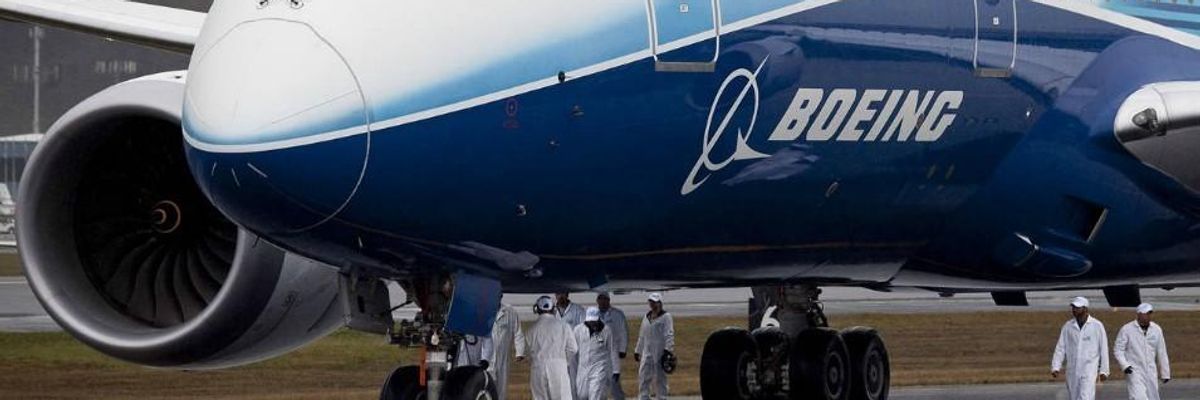
The five biggest U.S. airlines spent 96 percent of their free cash flow over the last decade buying back shares of their own stock to boost executive bonuses and please wealthy investors. (Photo: Getty Images)
With the coronavirus pandemic wreaking havoc on the global economy, here's how massive corporations are shafting the rest of us in order to secure billions of dollars of taxpayer-funded bailouts.
The airline industry demanded a massive bailout of nearly $60 billion in taxpayer dollars, and ended up securing $50 billion - half in loans, half in direct grants that don't need to be paid back.
Airlines don't deserve a cent. The five biggest U.S. airlines spent 96 percent of their free cash flow over the last decade buying back shares of their own stock to boost executive bonuses and please wealthy investors.
Watch:
United was so determined to get its windfall of taxpayer money that it threatened to fire workers if it didn't get its way. Before the Senate bill passed, CEO Oscar Munoz wrote that "if Congress doesn't act on sufficient government support by the end of March, our company will begin to...reduce our payroll...."
Airlines could have renegotiated their debts with their lenders outside court, or file for Chapter 11 bankruptcy protection. They've reorganized under bankruptcy many times before. Either way, they'd keep flying.
The hotel industry says it needs $150 billion. The industry says as many as 4 million workers could lose their jobs in the coming weeks if they don't receive a bailout. Everyone from general managers to housekeepers will be affected. But don't worry - the layoffs won't reach the corporate level.
Hotel chains don't need a bailout. For years, they've been making record profits while underpaying their workers. Marriott, the largest hotel chain in the world, repurchased $2.3 billion of its own stock last year, while raking in nearly $4 billion in profits.
Thankfully, Trump's hotels and businesses, as well as any of his family members' businesses, are barred from receiving anything from the $500 billion corporate bailout money. But the bill is full of loopholes that Trump can exploit to benefit himself and his hotels.
Cruise ships also want to be bailed out, and Trump called them a "prime candidate" to receive a government handout. But they don't deserve it either. The three cruise ship corporations controlling 75 percent of the entire global market are incorporated outside of the United States to avoid paying taxes.
They're floating tax shelters, paying an average U.S. tax rate of just 0.8 percent. Democrats secured key provisions stipulating that companies are only eligible for bailout money if they are incorporated in the United States and have a majority of U.S. employees, so the cruise ship industry likely won't see a dime of relief funding. However, Trump has made it clear he still wants to help them.
The justification I've heard about why all these corporations need to be bailed out is they'll keep workers on their payrolls. But why should we believe big corporations will protect their workers right now?
The $500 billion slush fund included in the Senate's emergency relief package doesn't require corporations to keep paying their workers and has dismally weak restrictions on stock buybacks and executive pay.
Even if the bill did provide worker protections, what's going to happen to these corporations' subcontractors and gig workers? What about worker benefits, pensions and health care? How much of this bailout is going to end up in the pockets of executives and big investors?
The record of Big Business isn't comforting. Amazon, one of the richest corporations in the world, which paid almost no taxes last year, is only offering unpaid time off for workers who are sick and just two weeks paid leave for workers who test positive for the virus. Meanwhile, it demands its employees put in mandatory overtime.
Oh, and these corporations made sure they and other companies with more than 500 employees were exempt from the requirement in the first House coronavirus bill that employers provide paid sick leave.
And now, less than a month into statewide shelter-in-place orders and social distancing restrictions, Wall Streeters and corporate America's chief executives are calling for supposedly "low-risk" groups to be sent back to work to restart the economy.
They're so concerned about protecting their bottom line that they're willing to let people die to preserve their stock portfolios, all while they continue working from the safety and security of their own homes. It's the most repugnant class warfare you can imagine.
Here's the bottom line: no mega-corporation deserves a cent of bailout money. For decades these companies and their billionaire executives have been dodging taxes, getting tax cuts, shafting workers, and bending the rules to enrich themselves. There's no reason to trust them to do the right thing with billions of dollars in taxpayer money.
Every penny we have needs to go to average Americans who desperately need income support and health care, and to hospitals that need life-saving equipment. It's outrageous that the Senate bill gave corporations nearly four times as much money as hospitals on the front lines.
Corporate welfare is bad enough in normal times. Now, in a national emergency, it's morally repugnant. We must stop bailing out corporations. It's time we bail out people.
Dear Common Dreams reader, It’s been nearly 30 years since I co-founded Common Dreams with my late wife, Lina Newhouser. We had the radical notion that journalism should serve the public good, not corporate profits. It was clear to us from the outset what it would take to build such a project. No paid advertisements. No corporate sponsors. No millionaire publisher telling us what to think or do. Many people said we wouldn't last a year, but we proved those doubters wrong. Together with a tremendous team of journalists and dedicated staff, we built an independent media outlet free from the constraints of profits and corporate control. Our mission has always been simple: To inform. To inspire. To ignite change for the common good. Building Common Dreams was not easy. Our survival was never guaranteed. When you take on the most powerful forces—Wall Street greed, fossil fuel industry destruction, Big Tech lobbyists, and uber-rich oligarchs who have spent billions upon billions rigging the economy and democracy in their favor—the only bulwark you have is supporters who believe in your work. But here’s the urgent message from me today. It's never been this bad out there. And it's never been this hard to keep us going. At the very moment Common Dreams is most needed, the threats we face are intensifying. We need your support now more than ever. We don't accept corporate advertising and never will. We don't have a paywall because we don't think people should be blocked from critical news based on their ability to pay. Everything we do is funded by the donations of readers like you. When everyone does the little they can afford, we are strong. But if that support retreats or dries up, so do we. Will you donate now to make sure Common Dreams not only survives but thrives? —Craig Brown, Co-founder |
With the coronavirus pandemic wreaking havoc on the global economy, here's how massive corporations are shafting the rest of us in order to secure billions of dollars of taxpayer-funded bailouts.
The airline industry demanded a massive bailout of nearly $60 billion in taxpayer dollars, and ended up securing $50 billion - half in loans, half in direct grants that don't need to be paid back.
Airlines don't deserve a cent. The five biggest U.S. airlines spent 96 percent of their free cash flow over the last decade buying back shares of their own stock to boost executive bonuses and please wealthy investors.
Watch:
United was so determined to get its windfall of taxpayer money that it threatened to fire workers if it didn't get its way. Before the Senate bill passed, CEO Oscar Munoz wrote that "if Congress doesn't act on sufficient government support by the end of March, our company will begin to...reduce our payroll...."
Airlines could have renegotiated their debts with their lenders outside court, or file for Chapter 11 bankruptcy protection. They've reorganized under bankruptcy many times before. Either way, they'd keep flying.
The hotel industry says it needs $150 billion. The industry says as many as 4 million workers could lose their jobs in the coming weeks if they don't receive a bailout. Everyone from general managers to housekeepers will be affected. But don't worry - the layoffs won't reach the corporate level.
Hotel chains don't need a bailout. For years, they've been making record profits while underpaying their workers. Marriott, the largest hotel chain in the world, repurchased $2.3 billion of its own stock last year, while raking in nearly $4 billion in profits.
Thankfully, Trump's hotels and businesses, as well as any of his family members' businesses, are barred from receiving anything from the $500 billion corporate bailout money. But the bill is full of loopholes that Trump can exploit to benefit himself and his hotels.
Cruise ships also want to be bailed out, and Trump called them a "prime candidate" to receive a government handout. But they don't deserve it either. The three cruise ship corporations controlling 75 percent of the entire global market are incorporated outside of the United States to avoid paying taxes.
They're floating tax shelters, paying an average U.S. tax rate of just 0.8 percent. Democrats secured key provisions stipulating that companies are only eligible for bailout money if they are incorporated in the United States and have a majority of U.S. employees, so the cruise ship industry likely won't see a dime of relief funding. However, Trump has made it clear he still wants to help them.
The justification I've heard about why all these corporations need to be bailed out is they'll keep workers on their payrolls. But why should we believe big corporations will protect their workers right now?
The $500 billion slush fund included in the Senate's emergency relief package doesn't require corporations to keep paying their workers and has dismally weak restrictions on stock buybacks and executive pay.
Even if the bill did provide worker protections, what's going to happen to these corporations' subcontractors and gig workers? What about worker benefits, pensions and health care? How much of this bailout is going to end up in the pockets of executives and big investors?
The record of Big Business isn't comforting. Amazon, one of the richest corporations in the world, which paid almost no taxes last year, is only offering unpaid time off for workers who are sick and just two weeks paid leave for workers who test positive for the virus. Meanwhile, it demands its employees put in mandatory overtime.
Oh, and these corporations made sure they and other companies with more than 500 employees were exempt from the requirement in the first House coronavirus bill that employers provide paid sick leave.
And now, less than a month into statewide shelter-in-place orders and social distancing restrictions, Wall Streeters and corporate America's chief executives are calling for supposedly "low-risk" groups to be sent back to work to restart the economy.
They're so concerned about protecting their bottom line that they're willing to let people die to preserve their stock portfolios, all while they continue working from the safety and security of their own homes. It's the most repugnant class warfare you can imagine.
Here's the bottom line: no mega-corporation deserves a cent of bailout money. For decades these companies and their billionaire executives have been dodging taxes, getting tax cuts, shafting workers, and bending the rules to enrich themselves. There's no reason to trust them to do the right thing with billions of dollars in taxpayer money.
Every penny we have needs to go to average Americans who desperately need income support and health care, and to hospitals that need life-saving equipment. It's outrageous that the Senate bill gave corporations nearly four times as much money as hospitals on the front lines.
Corporate welfare is bad enough in normal times. Now, in a national emergency, it's morally repugnant. We must stop bailing out corporations. It's time we bail out people.
With the coronavirus pandemic wreaking havoc on the global economy, here's how massive corporations are shafting the rest of us in order to secure billions of dollars of taxpayer-funded bailouts.
The airline industry demanded a massive bailout of nearly $60 billion in taxpayer dollars, and ended up securing $50 billion - half in loans, half in direct grants that don't need to be paid back.
Airlines don't deserve a cent. The five biggest U.S. airlines spent 96 percent of their free cash flow over the last decade buying back shares of their own stock to boost executive bonuses and please wealthy investors.
Watch:
United was so determined to get its windfall of taxpayer money that it threatened to fire workers if it didn't get its way. Before the Senate bill passed, CEO Oscar Munoz wrote that "if Congress doesn't act on sufficient government support by the end of March, our company will begin to...reduce our payroll...."
Airlines could have renegotiated their debts with their lenders outside court, or file for Chapter 11 bankruptcy protection. They've reorganized under bankruptcy many times before. Either way, they'd keep flying.
The hotel industry says it needs $150 billion. The industry says as many as 4 million workers could lose their jobs in the coming weeks if they don't receive a bailout. Everyone from general managers to housekeepers will be affected. But don't worry - the layoffs won't reach the corporate level.
Hotel chains don't need a bailout. For years, they've been making record profits while underpaying their workers. Marriott, the largest hotel chain in the world, repurchased $2.3 billion of its own stock last year, while raking in nearly $4 billion in profits.
Thankfully, Trump's hotels and businesses, as well as any of his family members' businesses, are barred from receiving anything from the $500 billion corporate bailout money. But the bill is full of loopholes that Trump can exploit to benefit himself and his hotels.
Cruise ships also want to be bailed out, and Trump called them a "prime candidate" to receive a government handout. But they don't deserve it either. The three cruise ship corporations controlling 75 percent of the entire global market are incorporated outside of the United States to avoid paying taxes.
They're floating tax shelters, paying an average U.S. tax rate of just 0.8 percent. Democrats secured key provisions stipulating that companies are only eligible for bailout money if they are incorporated in the United States and have a majority of U.S. employees, so the cruise ship industry likely won't see a dime of relief funding. However, Trump has made it clear he still wants to help them.
The justification I've heard about why all these corporations need to be bailed out is they'll keep workers on their payrolls. But why should we believe big corporations will protect their workers right now?
The $500 billion slush fund included in the Senate's emergency relief package doesn't require corporations to keep paying their workers and has dismally weak restrictions on stock buybacks and executive pay.
Even if the bill did provide worker protections, what's going to happen to these corporations' subcontractors and gig workers? What about worker benefits, pensions and health care? How much of this bailout is going to end up in the pockets of executives and big investors?
The record of Big Business isn't comforting. Amazon, one of the richest corporations in the world, which paid almost no taxes last year, is only offering unpaid time off for workers who are sick and just two weeks paid leave for workers who test positive for the virus. Meanwhile, it demands its employees put in mandatory overtime.
Oh, and these corporations made sure they and other companies with more than 500 employees were exempt from the requirement in the first House coronavirus bill that employers provide paid sick leave.
And now, less than a month into statewide shelter-in-place orders and social distancing restrictions, Wall Streeters and corporate America's chief executives are calling for supposedly "low-risk" groups to be sent back to work to restart the economy.
They're so concerned about protecting their bottom line that they're willing to let people die to preserve their stock portfolios, all while they continue working from the safety and security of their own homes. It's the most repugnant class warfare you can imagine.
Here's the bottom line: no mega-corporation deserves a cent of bailout money. For decades these companies and their billionaire executives have been dodging taxes, getting tax cuts, shafting workers, and bending the rules to enrich themselves. There's no reason to trust them to do the right thing with billions of dollars in taxpayer money.
Every penny we have needs to go to average Americans who desperately need income support and health care, and to hospitals that need life-saving equipment. It's outrageous that the Senate bill gave corporations nearly four times as much money as hospitals on the front lines.
Corporate welfare is bad enough in normal times. Now, in a national emergency, it's morally repugnant. We must stop bailing out corporations. It's time we bail out people.