SUBSCRIBE TO OUR FREE NEWSLETTER
Daily news & progressive opinion—funded by the people, not the corporations—delivered straight to your inbox.
5
#000000
#FFFFFF
To donate by check, phone, or other method, see our More Ways to Give page.
Daily news & progressive opinion—funded by the people, not the corporations—delivered straight to your inbox.
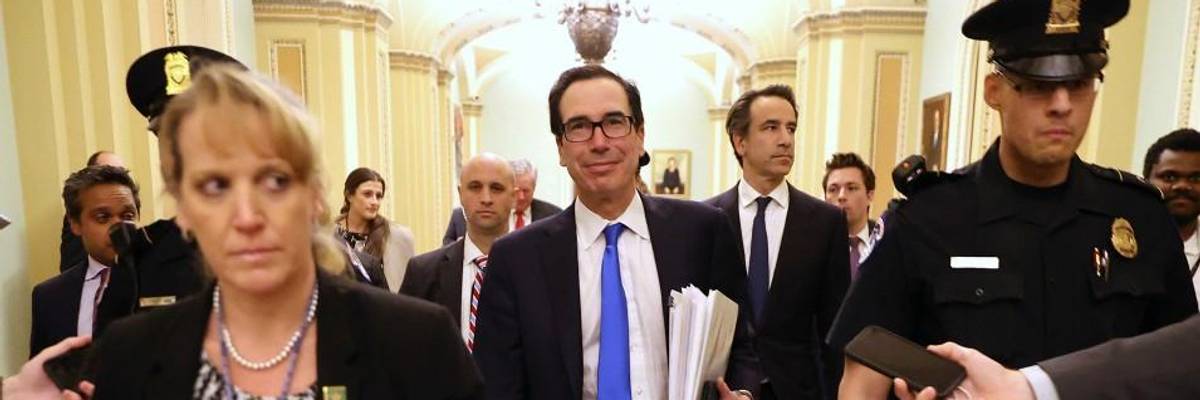
Treasury Secretary Steve Mnuchin leaves the offices of Senate Minority Leader Charles Schumer (D-N.Y.) after negotiations on a $2 trillion economic stimulus plan at the U.S. Capitol March 24, 2020 in Washington, D.C. (Photo: Chip Somodevilla/Getty Images)
Dwell on $2 trillion.
Hand out a dollar every second, and it takes almost two weeks to get to $1 million. It takes about 31 years to hand out $1 billion. And about 30,000 years to hand out $1 trillion.
American taxpayers are now handing out $2 trillion -- 60,000 years' worth of $1 per second. That's what's provided in the CARES Act, signed into law March 27. Ideally, we are handing those dollars back to ourselves in the form of payments to those with no safety net, to those who will quickly run through their savings because they've lost their jobs, to small businesses struggling to keep workers on their payrolls, and to pay for the critical medical supplies and support the front line workers administering the care our nation needs.
"With so much money exiting Washington, D.C., it will be paramount to keep corporate profiteers from siphoning this money into their own wallets."
With so much money exiting Washington, D.C., it will be paramount to keep corporate profiteers from siphoning this money into their own wallets. One would hope these times of world crisis would sober any connivers. As House Speaker Nancy Pelosi noted recently, however, "Where there's money there's also frequently mischief."
As Congress began fashioning the CARES Act, Public Citizen and other groups worked with lawmakers to formulate several oversight mechanisms. Slivers of these proposals made it into the Senate version when Minority Leader Sen. Charles Schumer (D-N.Y.) bargained with the GOP, which was apparently content with President Donald Trump's promise that he would "be the oversight."
The CARES Act provides three oversight bodies: a new Special Inspector General (IG) for Pandemic Recovery (SIGPR); a five-member Congressional Oversight Commission and a Pandemic Response Accountability Committee (PRAC), composed of more than 20 inspectors general of various agencies. Those chosen for those posts must be rigorous in their attention to detail, steeped in financial knowledge and aggressive in their work.
On April 2, Pelosi announced the additional creation of a new congressional committee to oversee the bailout, to be chaired by Rep. James Clyburn (D-S.C). And Rep. Maxine Waters, chair of the House Financial Services Committee, pledged to watch Treasury Secretary Steven Mnuchin carefully. "The Foreclosure King," as critics dubbed him, abused federal assistance during the Wall Street crash when he evicted thousands of mortgages holders of the failed IndyMac that he bottom-fished, then repackaged it as OneWest and resold it for a handsome personal profit.
Mnuchin also will be closely scrutinized by Public Citizen and other government watchdogs. As we look for the relief package's promised transparency on the disbursement of bailout funds, we expect regular, searchable data on which corporate players are getting taxpayer dollars.
The SIGPR and PRAC enjoy subpoena powers, as do congressional committees. As the Mueller and impeachment proceedings demonstrated, the Trump administration may well stonewall these queries. Chillingly, in his signing statement on the CARES Act, Trump explicitly detailed his unwillingness to cooperate with investigators. He called some requirements "not mandatory" and said there would be "presidential supervision" over the SIGPR. The law clearly states the opposite. The SIGPR, by design, is supposed to be independent, not an employee of Trump.
Trump doubled down when he nominated Brian Miller to this post last week. Miller serves as associate in the Office of the White House Counsel. He helped defend the president during the impeachment proceedings. His office undoubtedly worked on the signing statement. He's not independent. Meanwhile, at the same time Trump appointed Miller, he fired the Inspector General of the intelligence community, the person who relayed the whistleblower complaint to Congress about the July 2019 Ukraine call. Clearly, Trump doesn't welcome independent oversight, (which he proved yet again on April 6 when he removed Glenn Fine from his position as the acting IG at the Pentagon effectively removing him from his brand new role as head of the PRAC.)
Robustly implementing this oversight is not enough though; in the next package, lawmakers must close the loopholes.
First, the new Special IG must have subpoena power. To check abuse, they must have ready access to both documents and persons involved in the distribution of the funds. Similarly, both the SIGPR, the Congressional Oversight Commission and the PRAC must be given live access to the computer servers of the Treasury and any agency shoving money out its doors. When someone's hovering over your shoulder, you're less likely to play Minesweeper or Solitaire on the computer, let alone cut a check for a crony.
"Executive pay should be on the hook if the aided companies are found guilty of misconduct. Having the company pay means taxpayers pay for misconduct."
Then there's the so-called Mnuchin-loophole. The Treasury Secretary has power to waive the few conditions placed on aided companies, such as banning dividends and buybacks and curbing some CEO pay. This waiver power must be eliminated.
The whistleblower law must be improved. Workers will be the front line against fraud and abuse of these bailouts and must feel free to come forward. Trump's public abuse of the Ukraine scandal whistleblower portends dark days for these heroes unless Congress steps up protections.
Executive pay should be on the hook if the aided companies are found guilty of misconduct. Having the company pay means taxpayers pay for misconduct.
Finally, we need a tripartite board to oversee each specific corporation or sector that get bailout money. The CARES Act is supposed to protect Americans -- workers suddenly without paychecks, those with no savings, others facing economic misfortune and those sickened by the virus.
Corporations receiving aid must understand that their mission has now changed; no longer can these be profit-maximizing, expense-minimizing enterprises. Instead, they must now be vehicles for paychecks. Hence, they should each be governed by a tripartite board, where a labor envoy serves along with a government and management expert. Such a board, with power to veto investment decisions, can keep the aid straight.
In short, there must be oversight. And more oversight. And oversight of oversight. Any percentage of $2 trillion is an awful lot to squander.
Originally published by Public Citizen.
Dear Common Dreams reader, It’s been nearly 30 years since I co-founded Common Dreams with my late wife, Lina Newhouser. We had the radical notion that journalism should serve the public good, not corporate profits. It was clear to us from the outset what it would take to build such a project. No paid advertisements. No corporate sponsors. No millionaire publisher telling us what to think or do. Many people said we wouldn't last a year, but we proved those doubters wrong. Together with a tremendous team of journalists and dedicated staff, we built an independent media outlet free from the constraints of profits and corporate control. Our mission has always been simple: To inform. To inspire. To ignite change for the common good. Building Common Dreams was not easy. Our survival was never guaranteed. When you take on the most powerful forces—Wall Street greed, fossil fuel industry destruction, Big Tech lobbyists, and uber-rich oligarchs who have spent billions upon billions rigging the economy and democracy in their favor—the only bulwark you have is supporters who believe in your work. But here’s the urgent message from me today. It's never been this bad out there. And it's never been this hard to keep us going. At the very moment Common Dreams is most needed, the threats we face are intensifying. We need your support now more than ever. We don't accept corporate advertising and never will. We don't have a paywall because we don't think people should be blocked from critical news based on their ability to pay. Everything we do is funded by the donations of readers like you. When everyone does the little they can afford, we are strong. But if that support retreats or dries up, so do we. Will you donate now to make sure Common Dreams not only survives but thrives? —Craig Brown, Co-founder |
Dwell on $2 trillion.
Hand out a dollar every second, and it takes almost two weeks to get to $1 million. It takes about 31 years to hand out $1 billion. And about 30,000 years to hand out $1 trillion.
American taxpayers are now handing out $2 trillion -- 60,000 years' worth of $1 per second. That's what's provided in the CARES Act, signed into law March 27. Ideally, we are handing those dollars back to ourselves in the form of payments to those with no safety net, to those who will quickly run through their savings because they've lost their jobs, to small businesses struggling to keep workers on their payrolls, and to pay for the critical medical supplies and support the front line workers administering the care our nation needs.
"With so much money exiting Washington, D.C., it will be paramount to keep corporate profiteers from siphoning this money into their own wallets."
With so much money exiting Washington, D.C., it will be paramount to keep corporate profiteers from siphoning this money into their own wallets. One would hope these times of world crisis would sober any connivers. As House Speaker Nancy Pelosi noted recently, however, "Where there's money there's also frequently mischief."
As Congress began fashioning the CARES Act, Public Citizen and other groups worked with lawmakers to formulate several oversight mechanisms. Slivers of these proposals made it into the Senate version when Minority Leader Sen. Charles Schumer (D-N.Y.) bargained with the GOP, which was apparently content with President Donald Trump's promise that he would "be the oversight."
The CARES Act provides three oversight bodies: a new Special Inspector General (IG) for Pandemic Recovery (SIGPR); a five-member Congressional Oversight Commission and a Pandemic Response Accountability Committee (PRAC), composed of more than 20 inspectors general of various agencies. Those chosen for those posts must be rigorous in their attention to detail, steeped in financial knowledge and aggressive in their work.
On April 2, Pelosi announced the additional creation of a new congressional committee to oversee the bailout, to be chaired by Rep. James Clyburn (D-S.C). And Rep. Maxine Waters, chair of the House Financial Services Committee, pledged to watch Treasury Secretary Steven Mnuchin carefully. "The Foreclosure King," as critics dubbed him, abused federal assistance during the Wall Street crash when he evicted thousands of mortgages holders of the failed IndyMac that he bottom-fished, then repackaged it as OneWest and resold it for a handsome personal profit.
Mnuchin also will be closely scrutinized by Public Citizen and other government watchdogs. As we look for the relief package's promised transparency on the disbursement of bailout funds, we expect regular, searchable data on which corporate players are getting taxpayer dollars.
The SIGPR and PRAC enjoy subpoena powers, as do congressional committees. As the Mueller and impeachment proceedings demonstrated, the Trump administration may well stonewall these queries. Chillingly, in his signing statement on the CARES Act, Trump explicitly detailed his unwillingness to cooperate with investigators. He called some requirements "not mandatory" and said there would be "presidential supervision" over the SIGPR. The law clearly states the opposite. The SIGPR, by design, is supposed to be independent, not an employee of Trump.
Trump doubled down when he nominated Brian Miller to this post last week. Miller serves as associate in the Office of the White House Counsel. He helped defend the president during the impeachment proceedings. His office undoubtedly worked on the signing statement. He's not independent. Meanwhile, at the same time Trump appointed Miller, he fired the Inspector General of the intelligence community, the person who relayed the whistleblower complaint to Congress about the July 2019 Ukraine call. Clearly, Trump doesn't welcome independent oversight, (which he proved yet again on April 6 when he removed Glenn Fine from his position as the acting IG at the Pentagon effectively removing him from his brand new role as head of the PRAC.)
Robustly implementing this oversight is not enough though; in the next package, lawmakers must close the loopholes.
First, the new Special IG must have subpoena power. To check abuse, they must have ready access to both documents and persons involved in the distribution of the funds. Similarly, both the SIGPR, the Congressional Oversight Commission and the PRAC must be given live access to the computer servers of the Treasury and any agency shoving money out its doors. When someone's hovering over your shoulder, you're less likely to play Minesweeper or Solitaire on the computer, let alone cut a check for a crony.
"Executive pay should be on the hook if the aided companies are found guilty of misconduct. Having the company pay means taxpayers pay for misconduct."
Then there's the so-called Mnuchin-loophole. The Treasury Secretary has power to waive the few conditions placed on aided companies, such as banning dividends and buybacks and curbing some CEO pay. This waiver power must be eliminated.
The whistleblower law must be improved. Workers will be the front line against fraud and abuse of these bailouts and must feel free to come forward. Trump's public abuse of the Ukraine scandal whistleblower portends dark days for these heroes unless Congress steps up protections.
Executive pay should be on the hook if the aided companies are found guilty of misconduct. Having the company pay means taxpayers pay for misconduct.
Finally, we need a tripartite board to oversee each specific corporation or sector that get bailout money. The CARES Act is supposed to protect Americans -- workers suddenly without paychecks, those with no savings, others facing economic misfortune and those sickened by the virus.
Corporations receiving aid must understand that their mission has now changed; no longer can these be profit-maximizing, expense-minimizing enterprises. Instead, they must now be vehicles for paychecks. Hence, they should each be governed by a tripartite board, where a labor envoy serves along with a government and management expert. Such a board, with power to veto investment decisions, can keep the aid straight.
In short, there must be oversight. And more oversight. And oversight of oversight. Any percentage of $2 trillion is an awful lot to squander.
Originally published by Public Citizen.
Dwell on $2 trillion.
Hand out a dollar every second, and it takes almost two weeks to get to $1 million. It takes about 31 years to hand out $1 billion. And about 30,000 years to hand out $1 trillion.
American taxpayers are now handing out $2 trillion -- 60,000 years' worth of $1 per second. That's what's provided in the CARES Act, signed into law March 27. Ideally, we are handing those dollars back to ourselves in the form of payments to those with no safety net, to those who will quickly run through their savings because they've lost their jobs, to small businesses struggling to keep workers on their payrolls, and to pay for the critical medical supplies and support the front line workers administering the care our nation needs.
"With so much money exiting Washington, D.C., it will be paramount to keep corporate profiteers from siphoning this money into their own wallets."
With so much money exiting Washington, D.C., it will be paramount to keep corporate profiteers from siphoning this money into their own wallets. One would hope these times of world crisis would sober any connivers. As House Speaker Nancy Pelosi noted recently, however, "Where there's money there's also frequently mischief."
As Congress began fashioning the CARES Act, Public Citizen and other groups worked with lawmakers to formulate several oversight mechanisms. Slivers of these proposals made it into the Senate version when Minority Leader Sen. Charles Schumer (D-N.Y.) bargained with the GOP, which was apparently content with President Donald Trump's promise that he would "be the oversight."
The CARES Act provides three oversight bodies: a new Special Inspector General (IG) for Pandemic Recovery (SIGPR); a five-member Congressional Oversight Commission and a Pandemic Response Accountability Committee (PRAC), composed of more than 20 inspectors general of various agencies. Those chosen for those posts must be rigorous in their attention to detail, steeped in financial knowledge and aggressive in their work.
On April 2, Pelosi announced the additional creation of a new congressional committee to oversee the bailout, to be chaired by Rep. James Clyburn (D-S.C). And Rep. Maxine Waters, chair of the House Financial Services Committee, pledged to watch Treasury Secretary Steven Mnuchin carefully. "The Foreclosure King," as critics dubbed him, abused federal assistance during the Wall Street crash when he evicted thousands of mortgages holders of the failed IndyMac that he bottom-fished, then repackaged it as OneWest and resold it for a handsome personal profit.
Mnuchin also will be closely scrutinized by Public Citizen and other government watchdogs. As we look for the relief package's promised transparency on the disbursement of bailout funds, we expect regular, searchable data on which corporate players are getting taxpayer dollars.
The SIGPR and PRAC enjoy subpoena powers, as do congressional committees. As the Mueller and impeachment proceedings demonstrated, the Trump administration may well stonewall these queries. Chillingly, in his signing statement on the CARES Act, Trump explicitly detailed his unwillingness to cooperate with investigators. He called some requirements "not mandatory" and said there would be "presidential supervision" over the SIGPR. The law clearly states the opposite. The SIGPR, by design, is supposed to be independent, not an employee of Trump.
Trump doubled down when he nominated Brian Miller to this post last week. Miller serves as associate in the Office of the White House Counsel. He helped defend the president during the impeachment proceedings. His office undoubtedly worked on the signing statement. He's not independent. Meanwhile, at the same time Trump appointed Miller, he fired the Inspector General of the intelligence community, the person who relayed the whistleblower complaint to Congress about the July 2019 Ukraine call. Clearly, Trump doesn't welcome independent oversight, (which he proved yet again on April 6 when he removed Glenn Fine from his position as the acting IG at the Pentagon effectively removing him from his brand new role as head of the PRAC.)
Robustly implementing this oversight is not enough though; in the next package, lawmakers must close the loopholes.
First, the new Special IG must have subpoena power. To check abuse, they must have ready access to both documents and persons involved in the distribution of the funds. Similarly, both the SIGPR, the Congressional Oversight Commission and the PRAC must be given live access to the computer servers of the Treasury and any agency shoving money out its doors. When someone's hovering over your shoulder, you're less likely to play Minesweeper or Solitaire on the computer, let alone cut a check for a crony.
"Executive pay should be on the hook if the aided companies are found guilty of misconduct. Having the company pay means taxpayers pay for misconduct."
Then there's the so-called Mnuchin-loophole. The Treasury Secretary has power to waive the few conditions placed on aided companies, such as banning dividends and buybacks and curbing some CEO pay. This waiver power must be eliminated.
The whistleblower law must be improved. Workers will be the front line against fraud and abuse of these bailouts and must feel free to come forward. Trump's public abuse of the Ukraine scandal whistleblower portends dark days for these heroes unless Congress steps up protections.
Executive pay should be on the hook if the aided companies are found guilty of misconduct. Having the company pay means taxpayers pay for misconduct.
Finally, we need a tripartite board to oversee each specific corporation or sector that get bailout money. The CARES Act is supposed to protect Americans -- workers suddenly without paychecks, those with no savings, others facing economic misfortune and those sickened by the virus.
Corporations receiving aid must understand that their mission has now changed; no longer can these be profit-maximizing, expense-minimizing enterprises. Instead, they must now be vehicles for paychecks. Hence, they should each be governed by a tripartite board, where a labor envoy serves along with a government and management expert. Such a board, with power to veto investment decisions, can keep the aid straight.
In short, there must be oversight. And more oversight. And oversight of oversight. Any percentage of $2 trillion is an awful lot to squander.
Originally published by Public Citizen.