SUBSCRIBE TO OUR FREE NEWSLETTER
Daily news & progressive opinion—funded by the people, not the corporations—delivered straight to your inbox.
5
#000000
#FFFFFF
To donate by check, phone, or other method, see our More Ways to Give page.
Daily news & progressive opinion—funded by the people, not the corporations—delivered straight to your inbox.
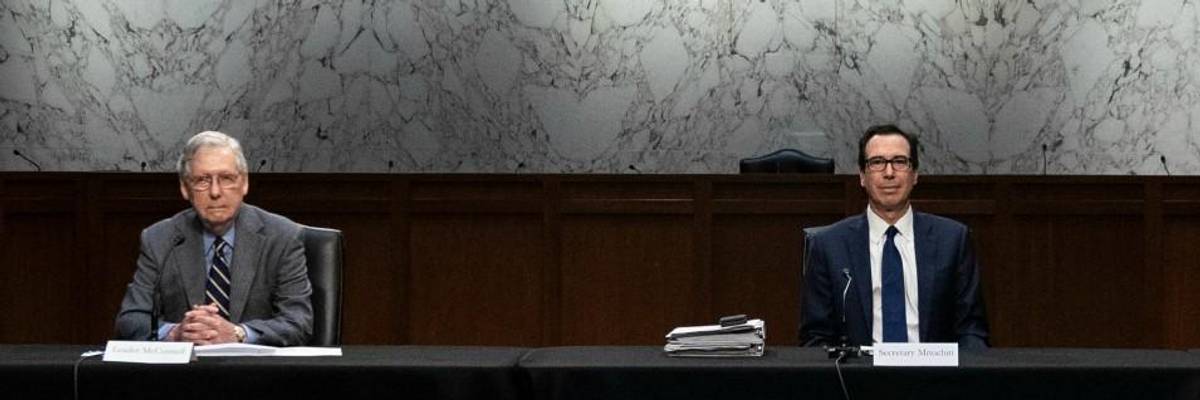
Senate Majority Leader Mitch McConnell (R-Ky.) and Treasury Secretary Steven Mnuchin attend a meeting in the Hart Senate Office Building on Capitol Hill on March 20, 2020 in Washington, D.C. (Photo: Drew Angerer/Getty Images)
Although the ink is now dry on last week's broad economic relief agreement, the so-called Coronavirus Economic Relief and Security (CARES) Act, it's not too late to critique the plan and evaluate who benefits and whether the plan lives up to its promises.
The CARES Act includes rebates to individuals and families, but it also reserves an astonishing amount of tax breaks for wealthy individuals and large businesses. One of these breaks, as noted by the Wall Street Journal's Jesse Drucker last week, would allow married taxpayers with incomes over $500,000 to use losses to help zero out their personal income taxes. This could benefit all types of business owners, from your local florist to a real estate investor or hedge fund manager--as long as their incomes from non-business sources put them in the top 1 percent stratosphere.
This change is the second most expensive tax provision (after the individual tax rebate) in the CARES Act, according to a March 26 analysis from the Joint Committee on Taxation (JCT). It only benefits owners of pass-through businesses (businesses that do not pay the corporate income tax). This provision reverses one of the few meaningful revenue raisers in the 2017 so-called Tax Cuts and Jobs Act (TCJA), which had restricted the use of losses from pass-through businesses to offset more than $500,000 of non-business personal income for married couples, or $250,000 for unmarried taxpayers.
It's worth dwelling on this point: even after the 2017 law's revenue-raiser, a married couple with losses from pass-through businesses could use those losses to offset up to $500,000 of personal income from other sources, such as wages, capital gains or dividends. It's only when non-business income exceeded $500,001 that the post-2017 limit applied, and even then any losses exceeding $500,000 could be carried forward to the next tax year.
In a tax code littered with high-end giveaways, TCJA's pass-through loss limit was a rare example of a rule requiring tax payments by the very best-off Americans. But in crafting legislation to address the current health and economic crises, lawmakers decided repealing that revenue-raiser was the second most important change they could make to the tax code.
JCT estimates that the CARES Act's provision repealing this part of TCJA will cost $169 billion over a decade, but most of that cost will be incurred this year and next year. That's because the provision suspends the TCJA pass-through loss limit for 2020 and retroactively for 2018 and 2019, meaning business owners will amend 2018 returns and 2019 returns that are already filed and will receive refunds from the IRS this year and next year.
The entire federal estate tax only raised $16 billion in 2019, which means this change can be thought of as equivalent to a decade-long estate tax repeal. And, logically, we would expect all or nearly all the benefit to go to the richest 1 percent, just as we would with repeal of the estate tax.
The cost of this provision could eventually be much greater than $169 billion over 10 years. Now that the CARES Act has suspended TCJA's pass-through loss limit, lobbyists and some lawmakers will almost immediately claim that businesses would be harmed if it is ever allowed to go back into effect at all, pushing to extend its repeal or even make it permanent.
At a time when record numbers of Americans are facing unemployment, state and local governments are facing a perfect storm of growing public investment needs and vanishing tax revenues, and small business owners are struggling to avoid even more layoffs, lavishing tax breaks on the top 1 percent in this way shouldn't be in anyone's top 20 list of needed tax changes.
The 2017 tax cut contained few meaningful revenue raisers and even fewer progressive changes. Congress' action last week takes away a provision that was both of these things and turns the 2017 law into even more of a dud than it was as originally enacted.
Dear Common Dreams reader, It’s been nearly 30 years since I co-founded Common Dreams with my late wife, Lina Newhouser. We had the radical notion that journalism should serve the public good, not corporate profits. It was clear to us from the outset what it would take to build such a project. No paid advertisements. No corporate sponsors. No millionaire publisher telling us what to think or do. Many people said we wouldn't last a year, but we proved those doubters wrong. Together with a tremendous team of journalists and dedicated staff, we built an independent media outlet free from the constraints of profits and corporate control. Our mission has always been simple: To inform. To inspire. To ignite change for the common good. Building Common Dreams was not easy. Our survival was never guaranteed. When you take on the most powerful forces—Wall Street greed, fossil fuel industry destruction, Big Tech lobbyists, and uber-rich oligarchs who have spent billions upon billions rigging the economy and democracy in their favor—the only bulwark you have is supporters who believe in your work. But here’s the urgent message from me today. It's never been this bad out there. And it's never been this hard to keep us going. At the very moment Common Dreams is most needed, the threats we face are intensifying. We need your support now more than ever. We don't accept corporate advertising and never will. We don't have a paywall because we don't think people should be blocked from critical news based on their ability to pay. Everything we do is funded by the donations of readers like you. When everyone does the little they can afford, we are strong. But if that support retreats or dries up, so do we. Will you donate now to make sure Common Dreams not only survives but thrives? —Craig Brown, Co-founder |
Although the ink is now dry on last week's broad economic relief agreement, the so-called Coronavirus Economic Relief and Security (CARES) Act, it's not too late to critique the plan and evaluate who benefits and whether the plan lives up to its promises.
The CARES Act includes rebates to individuals and families, but it also reserves an astonishing amount of tax breaks for wealthy individuals and large businesses. One of these breaks, as noted by the Wall Street Journal's Jesse Drucker last week, would allow married taxpayers with incomes over $500,000 to use losses to help zero out their personal income taxes. This could benefit all types of business owners, from your local florist to a real estate investor or hedge fund manager--as long as their incomes from non-business sources put them in the top 1 percent stratosphere.
This change is the second most expensive tax provision (after the individual tax rebate) in the CARES Act, according to a March 26 analysis from the Joint Committee on Taxation (JCT). It only benefits owners of pass-through businesses (businesses that do not pay the corporate income tax). This provision reverses one of the few meaningful revenue raisers in the 2017 so-called Tax Cuts and Jobs Act (TCJA), which had restricted the use of losses from pass-through businesses to offset more than $500,000 of non-business personal income for married couples, or $250,000 for unmarried taxpayers.
It's worth dwelling on this point: even after the 2017 law's revenue-raiser, a married couple with losses from pass-through businesses could use those losses to offset up to $500,000 of personal income from other sources, such as wages, capital gains or dividends. It's only when non-business income exceeded $500,001 that the post-2017 limit applied, and even then any losses exceeding $500,000 could be carried forward to the next tax year.
In a tax code littered with high-end giveaways, TCJA's pass-through loss limit was a rare example of a rule requiring tax payments by the very best-off Americans. But in crafting legislation to address the current health and economic crises, lawmakers decided repealing that revenue-raiser was the second most important change they could make to the tax code.
JCT estimates that the CARES Act's provision repealing this part of TCJA will cost $169 billion over a decade, but most of that cost will be incurred this year and next year. That's because the provision suspends the TCJA pass-through loss limit for 2020 and retroactively for 2018 and 2019, meaning business owners will amend 2018 returns and 2019 returns that are already filed and will receive refunds from the IRS this year and next year.
The entire federal estate tax only raised $16 billion in 2019, which means this change can be thought of as equivalent to a decade-long estate tax repeal. And, logically, we would expect all or nearly all the benefit to go to the richest 1 percent, just as we would with repeal of the estate tax.
The cost of this provision could eventually be much greater than $169 billion over 10 years. Now that the CARES Act has suspended TCJA's pass-through loss limit, lobbyists and some lawmakers will almost immediately claim that businesses would be harmed if it is ever allowed to go back into effect at all, pushing to extend its repeal or even make it permanent.
At a time when record numbers of Americans are facing unemployment, state and local governments are facing a perfect storm of growing public investment needs and vanishing tax revenues, and small business owners are struggling to avoid even more layoffs, lavishing tax breaks on the top 1 percent in this way shouldn't be in anyone's top 20 list of needed tax changes.
The 2017 tax cut contained few meaningful revenue raisers and even fewer progressive changes. Congress' action last week takes away a provision that was both of these things and turns the 2017 law into even more of a dud than it was as originally enacted.
Although the ink is now dry on last week's broad economic relief agreement, the so-called Coronavirus Economic Relief and Security (CARES) Act, it's not too late to critique the plan and evaluate who benefits and whether the plan lives up to its promises.
The CARES Act includes rebates to individuals and families, but it also reserves an astonishing amount of tax breaks for wealthy individuals and large businesses. One of these breaks, as noted by the Wall Street Journal's Jesse Drucker last week, would allow married taxpayers with incomes over $500,000 to use losses to help zero out their personal income taxes. This could benefit all types of business owners, from your local florist to a real estate investor or hedge fund manager--as long as their incomes from non-business sources put them in the top 1 percent stratosphere.
This change is the second most expensive tax provision (after the individual tax rebate) in the CARES Act, according to a March 26 analysis from the Joint Committee on Taxation (JCT). It only benefits owners of pass-through businesses (businesses that do not pay the corporate income tax). This provision reverses one of the few meaningful revenue raisers in the 2017 so-called Tax Cuts and Jobs Act (TCJA), which had restricted the use of losses from pass-through businesses to offset more than $500,000 of non-business personal income for married couples, or $250,000 for unmarried taxpayers.
It's worth dwelling on this point: even after the 2017 law's revenue-raiser, a married couple with losses from pass-through businesses could use those losses to offset up to $500,000 of personal income from other sources, such as wages, capital gains or dividends. It's only when non-business income exceeded $500,001 that the post-2017 limit applied, and even then any losses exceeding $500,000 could be carried forward to the next tax year.
In a tax code littered with high-end giveaways, TCJA's pass-through loss limit was a rare example of a rule requiring tax payments by the very best-off Americans. But in crafting legislation to address the current health and economic crises, lawmakers decided repealing that revenue-raiser was the second most important change they could make to the tax code.
JCT estimates that the CARES Act's provision repealing this part of TCJA will cost $169 billion over a decade, but most of that cost will be incurred this year and next year. That's because the provision suspends the TCJA pass-through loss limit for 2020 and retroactively for 2018 and 2019, meaning business owners will amend 2018 returns and 2019 returns that are already filed and will receive refunds from the IRS this year and next year.
The entire federal estate tax only raised $16 billion in 2019, which means this change can be thought of as equivalent to a decade-long estate tax repeal. And, logically, we would expect all or nearly all the benefit to go to the richest 1 percent, just as we would with repeal of the estate tax.
The cost of this provision could eventually be much greater than $169 billion over 10 years. Now that the CARES Act has suspended TCJA's pass-through loss limit, lobbyists and some lawmakers will almost immediately claim that businesses would be harmed if it is ever allowed to go back into effect at all, pushing to extend its repeal or even make it permanent.
At a time when record numbers of Americans are facing unemployment, state and local governments are facing a perfect storm of growing public investment needs and vanishing tax revenues, and small business owners are struggling to avoid even more layoffs, lavishing tax breaks on the top 1 percent in this way shouldn't be in anyone's top 20 list of needed tax changes.
The 2017 tax cut contained few meaningful revenue raisers and even fewer progressive changes. Congress' action last week takes away a provision that was both of these things and turns the 2017 law into even more of a dud than it was as originally enacted.