SUBSCRIBE TO OUR FREE NEWSLETTER
Daily news & progressive opinion—funded by the people, not the corporations—delivered straight to your inbox.
5
#000000
#FFFFFF
To donate by check, phone, or other method, see our More Ways to Give page.
Daily news & progressive opinion—funded by the people, not the corporations—delivered straight to your inbox.
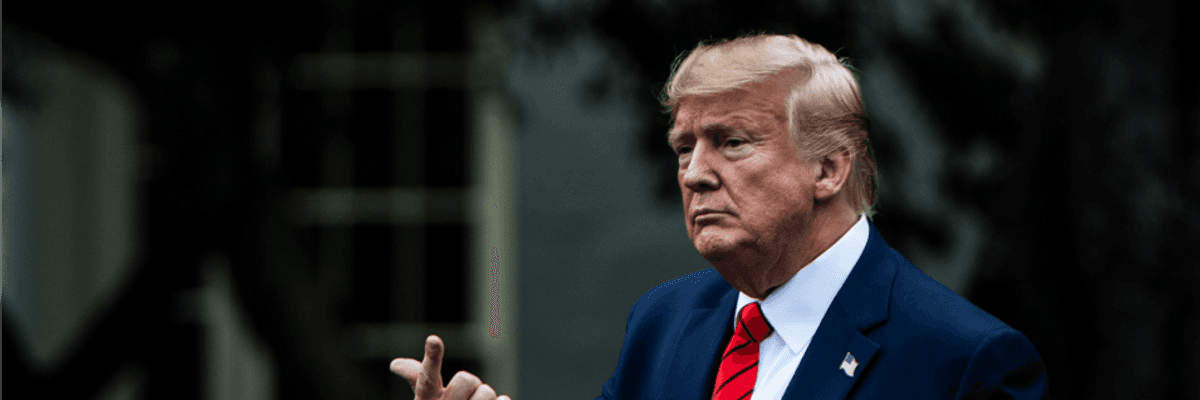
It's not that Trump understands rhetoric. He doesn't. But he's like an idiot savant, in that he has an innate capacity to use rhetoric effectively. (Photo: Jabin Botsford/The Washington Post via Getty Images)
Remember "no collusion," Trump's go-to line on the Mueller investigation? It was brilliant in its own way. Trump's crimes were pretty clear: soliciting aid from a foreign government and obstructing justice--and there was ample evidence that he'd done both. But "no collusion" avoided mentioning criminal behavior, because collusion has no real meaning in strictly legal terms, and it is a word that most people simply don't use.
Many in the media picked it up, led by the conservative bubble news run by Fox and Clear Channel, and in the end, it served Trump well. The crimes seemed vague, and so did the standards his behavior should be judged against. It didn't have to be that way. If Democrats and the media had used words like "illegally soliciting aid from a foreign government" and "receiving illegal contributions of value from a foreign government," the crimes would have seemed more tangible and so would have the attempts to cover them up and obstruct inquiry into them.
Well, Mr. Trump has gone one better with the Ukrainian scandal, with his constant use of quid pro quo. Here again, there are plain and obvious words that describe what Trump did. Committing extortion and blackmail for private gain, using taxpayer money to do it, and compromising national security for his own benefit, pretty much sums up his actions. And each is a clearly an impeachable offense, and each is understood by most people.
But this is Trump's unique genius. Yes, you read that right. He may not be a "stable genius" but he does know how to control the public narrative better than most politicians, and certainly better than the hapless Democrats.
One of the things he does well is to change the subject, by doing or saying something outrageous, a tactic he learned from his mentor, Roy Cohn.
But his use of language is where he really distinguishes himself.
Quid pro quo has now entered the impeachment debate as the operative word. The standard against which all things must be measured. And this time his framing of the issue has broken out of the Fox bubble; the broader press has picked it up and repeated it again and again. But what does it mean? What legal line does it imply? No one knows, because again, it's not a legal term. Moreover, it's not a phrase people use, so even the moral boundaries his crimes cross are obscured by its usage.
For example, on November 11th, the New York Time's lead editorial was a lengthy rebuttal to Trump and his supporters' various attempts to defend themselves against charges of extortion and blackmail - but their entire argument was framed by whether Trump's offense was a quid pro quo. This, just 3 days after 33 writers explained - in an open letter published in the New York Times op-ed page, no less - why the media has to stop using the phrase quid pro quo.
Trump's one real talent is that he's a natural rhetorician. Rhetoric is the "the art of effective speaking or writing." Its three cardinal rules are: 1) use simple words; 2) repeat, repeat, repeat; and 3) use figures of speech such as similes, metaphors, alliteration, hyperbole ... rhetoricians have catalogued some 250 of them.
Rhetoric was developed in ancient Greece for use in legal disputes by the Sophists, from which we get the word sophistry, which means "the use of fallacious arguments, especially with the intention of deceiving."
Trump is constantly using rhetorical devices in the name of sophistry. His conversation with Zelensky was "perfect"--a simple word and an example of hyperbole. His references to Joe Biden as "Sleepy Joe"--a figure of speech based on something called an antonomasia - substitutes a characteristic for the name. Trump used antonomasia to wipe out the entire field of candidates competing with him in the 2015 debates leading up to the 2016 election. Remember "Low energy Jeb" or "Little Marco?" One of his more brilliant recent creations is "Quid Pro Joe," which combines rhyming, simple words, and antonomasia in a virtual Molotov cocktail of deception and distortion.
It's not that Trump understands rhetoric. He doesn't. But he's like an idiot savant, in that he has an innate capacity to use rhetoric effectively.
Sadly, few people are trained in rhetoric these days, including those in the media. If repetition is one of the rhetorical cornerstones of sophistry, then the mainstream media are one of his biggest allies in his deception campaign. Some would argue that their malfeasance is intentional, a result of the media being owned by corporations. Others would suggest that the press just loves to feed controversy, because controversy sells. There's probably an element of truth to both, but an inordinate amount of the media's abysmal coverage of Trump and the impeachment process is a result of ignorance - an ignorance shared in equal measure by the Democratic Party and the press.
When you combine this with the media's and the Democrat's other mutual failing--constantly pitching the idea that the way to win elections is by appealing to centrists, and that progressives are on the political fringe - there's a real danger that this common criminal will not only retain office in the face of impeachment, but could win in 2020. And unlike their clumsy use of language, this particular line is a result of fat cats and corporations buying the party and owning the media.
As long as the media and the Democratic Party allow Trump to impose his rhetorical frame on the impeachment process, the prospect of four more years of Trump remains a clear and present danger.
Dear Common Dreams reader, It’s been nearly 30 years since I co-founded Common Dreams with my late wife, Lina Newhouser. We had the radical notion that journalism should serve the public good, not corporate profits. It was clear to us from the outset what it would take to build such a project. No paid advertisements. No corporate sponsors. No millionaire publisher telling us what to think or do. Many people said we wouldn't last a year, but we proved those doubters wrong. Together with a tremendous team of journalists and dedicated staff, we built an independent media outlet free from the constraints of profits and corporate control. Our mission has always been simple: To inform. To inspire. To ignite change for the common good. Building Common Dreams was not easy. Our survival was never guaranteed. When you take on the most powerful forces—Wall Street greed, fossil fuel industry destruction, Big Tech lobbyists, and uber-rich oligarchs who have spent billions upon billions rigging the economy and democracy in their favor—the only bulwark you have is supporters who believe in your work. But here’s the urgent message from me today. It's never been this bad out there. And it's never been this hard to keep us going. At the very moment Common Dreams is most needed, the threats we face are intensifying. We need your support now more than ever. We don't accept corporate advertising and never will. We don't have a paywall because we don't think people should be blocked from critical news based on their ability to pay. Everything we do is funded by the donations of readers like you. When everyone does the little they can afford, we are strong. But if that support retreats or dries up, so do we. Will you donate now to make sure Common Dreams not only survives but thrives? —Craig Brown, Co-founder |
Remember "no collusion," Trump's go-to line on the Mueller investigation? It was brilliant in its own way. Trump's crimes were pretty clear: soliciting aid from a foreign government and obstructing justice--and there was ample evidence that he'd done both. But "no collusion" avoided mentioning criminal behavior, because collusion has no real meaning in strictly legal terms, and it is a word that most people simply don't use.
Many in the media picked it up, led by the conservative bubble news run by Fox and Clear Channel, and in the end, it served Trump well. The crimes seemed vague, and so did the standards his behavior should be judged against. It didn't have to be that way. If Democrats and the media had used words like "illegally soliciting aid from a foreign government" and "receiving illegal contributions of value from a foreign government," the crimes would have seemed more tangible and so would have the attempts to cover them up and obstruct inquiry into them.
Well, Mr. Trump has gone one better with the Ukrainian scandal, with his constant use of quid pro quo. Here again, there are plain and obvious words that describe what Trump did. Committing extortion and blackmail for private gain, using taxpayer money to do it, and compromising national security for his own benefit, pretty much sums up his actions. And each is a clearly an impeachable offense, and each is understood by most people.
But this is Trump's unique genius. Yes, you read that right. He may not be a "stable genius" but he does know how to control the public narrative better than most politicians, and certainly better than the hapless Democrats.
One of the things he does well is to change the subject, by doing or saying something outrageous, a tactic he learned from his mentor, Roy Cohn.
But his use of language is where he really distinguishes himself.
Quid pro quo has now entered the impeachment debate as the operative word. The standard against which all things must be measured. And this time his framing of the issue has broken out of the Fox bubble; the broader press has picked it up and repeated it again and again. But what does it mean? What legal line does it imply? No one knows, because again, it's not a legal term. Moreover, it's not a phrase people use, so even the moral boundaries his crimes cross are obscured by its usage.
For example, on November 11th, the New York Time's lead editorial was a lengthy rebuttal to Trump and his supporters' various attempts to defend themselves against charges of extortion and blackmail - but their entire argument was framed by whether Trump's offense was a quid pro quo. This, just 3 days after 33 writers explained - in an open letter published in the New York Times op-ed page, no less - why the media has to stop using the phrase quid pro quo.
Trump's one real talent is that he's a natural rhetorician. Rhetoric is the "the art of effective speaking or writing." Its three cardinal rules are: 1) use simple words; 2) repeat, repeat, repeat; and 3) use figures of speech such as similes, metaphors, alliteration, hyperbole ... rhetoricians have catalogued some 250 of them.
Rhetoric was developed in ancient Greece for use in legal disputes by the Sophists, from which we get the word sophistry, which means "the use of fallacious arguments, especially with the intention of deceiving."
Trump is constantly using rhetorical devices in the name of sophistry. His conversation with Zelensky was "perfect"--a simple word and an example of hyperbole. His references to Joe Biden as "Sleepy Joe"--a figure of speech based on something called an antonomasia - substitutes a characteristic for the name. Trump used antonomasia to wipe out the entire field of candidates competing with him in the 2015 debates leading up to the 2016 election. Remember "Low energy Jeb" or "Little Marco?" One of his more brilliant recent creations is "Quid Pro Joe," which combines rhyming, simple words, and antonomasia in a virtual Molotov cocktail of deception and distortion.
It's not that Trump understands rhetoric. He doesn't. But he's like an idiot savant, in that he has an innate capacity to use rhetoric effectively.
Sadly, few people are trained in rhetoric these days, including those in the media. If repetition is one of the rhetorical cornerstones of sophistry, then the mainstream media are one of his biggest allies in his deception campaign. Some would argue that their malfeasance is intentional, a result of the media being owned by corporations. Others would suggest that the press just loves to feed controversy, because controversy sells. There's probably an element of truth to both, but an inordinate amount of the media's abysmal coverage of Trump and the impeachment process is a result of ignorance - an ignorance shared in equal measure by the Democratic Party and the press.
When you combine this with the media's and the Democrat's other mutual failing--constantly pitching the idea that the way to win elections is by appealing to centrists, and that progressives are on the political fringe - there's a real danger that this common criminal will not only retain office in the face of impeachment, but could win in 2020. And unlike their clumsy use of language, this particular line is a result of fat cats and corporations buying the party and owning the media.
As long as the media and the Democratic Party allow Trump to impose his rhetorical frame on the impeachment process, the prospect of four more years of Trump remains a clear and present danger.
Remember "no collusion," Trump's go-to line on the Mueller investigation? It was brilliant in its own way. Trump's crimes were pretty clear: soliciting aid from a foreign government and obstructing justice--and there was ample evidence that he'd done both. But "no collusion" avoided mentioning criminal behavior, because collusion has no real meaning in strictly legal terms, and it is a word that most people simply don't use.
Many in the media picked it up, led by the conservative bubble news run by Fox and Clear Channel, and in the end, it served Trump well. The crimes seemed vague, and so did the standards his behavior should be judged against. It didn't have to be that way. If Democrats and the media had used words like "illegally soliciting aid from a foreign government" and "receiving illegal contributions of value from a foreign government," the crimes would have seemed more tangible and so would have the attempts to cover them up and obstruct inquiry into them.
Well, Mr. Trump has gone one better with the Ukrainian scandal, with his constant use of quid pro quo. Here again, there are plain and obvious words that describe what Trump did. Committing extortion and blackmail for private gain, using taxpayer money to do it, and compromising national security for his own benefit, pretty much sums up his actions. And each is a clearly an impeachable offense, and each is understood by most people.
But this is Trump's unique genius. Yes, you read that right. He may not be a "stable genius" but he does know how to control the public narrative better than most politicians, and certainly better than the hapless Democrats.
One of the things he does well is to change the subject, by doing or saying something outrageous, a tactic he learned from his mentor, Roy Cohn.
But his use of language is where he really distinguishes himself.
Quid pro quo has now entered the impeachment debate as the operative word. The standard against which all things must be measured. And this time his framing of the issue has broken out of the Fox bubble; the broader press has picked it up and repeated it again and again. But what does it mean? What legal line does it imply? No one knows, because again, it's not a legal term. Moreover, it's not a phrase people use, so even the moral boundaries his crimes cross are obscured by its usage.
For example, on November 11th, the New York Time's lead editorial was a lengthy rebuttal to Trump and his supporters' various attempts to defend themselves against charges of extortion and blackmail - but their entire argument was framed by whether Trump's offense was a quid pro quo. This, just 3 days after 33 writers explained - in an open letter published in the New York Times op-ed page, no less - why the media has to stop using the phrase quid pro quo.
Trump's one real talent is that he's a natural rhetorician. Rhetoric is the "the art of effective speaking or writing." Its three cardinal rules are: 1) use simple words; 2) repeat, repeat, repeat; and 3) use figures of speech such as similes, metaphors, alliteration, hyperbole ... rhetoricians have catalogued some 250 of them.
Rhetoric was developed in ancient Greece for use in legal disputes by the Sophists, from which we get the word sophistry, which means "the use of fallacious arguments, especially with the intention of deceiving."
Trump is constantly using rhetorical devices in the name of sophistry. His conversation with Zelensky was "perfect"--a simple word and an example of hyperbole. His references to Joe Biden as "Sleepy Joe"--a figure of speech based on something called an antonomasia - substitutes a characteristic for the name. Trump used antonomasia to wipe out the entire field of candidates competing with him in the 2015 debates leading up to the 2016 election. Remember "Low energy Jeb" or "Little Marco?" One of his more brilliant recent creations is "Quid Pro Joe," which combines rhyming, simple words, and antonomasia in a virtual Molotov cocktail of deception and distortion.
It's not that Trump understands rhetoric. He doesn't. But he's like an idiot savant, in that he has an innate capacity to use rhetoric effectively.
Sadly, few people are trained in rhetoric these days, including those in the media. If repetition is one of the rhetorical cornerstones of sophistry, then the mainstream media are one of his biggest allies in his deception campaign. Some would argue that their malfeasance is intentional, a result of the media being owned by corporations. Others would suggest that the press just loves to feed controversy, because controversy sells. There's probably an element of truth to both, but an inordinate amount of the media's abysmal coverage of Trump and the impeachment process is a result of ignorance - an ignorance shared in equal measure by the Democratic Party and the press.
When you combine this with the media's and the Democrat's other mutual failing--constantly pitching the idea that the way to win elections is by appealing to centrists, and that progressives are on the political fringe - there's a real danger that this common criminal will not only retain office in the face of impeachment, but could win in 2020. And unlike their clumsy use of language, this particular line is a result of fat cats and corporations buying the party and owning the media.
As long as the media and the Democratic Party allow Trump to impose his rhetorical frame on the impeachment process, the prospect of four more years of Trump remains a clear and present danger.