SUBSCRIBE TO OUR FREE NEWSLETTER
Daily news & progressive opinion—funded by the people, not the corporations—delivered straight to your inbox.
5
#000000
#FFFFFF
To donate by check, phone, or other method, see our More Ways to Give page.
Daily news & progressive opinion—funded by the people, not the corporations—delivered straight to your inbox.
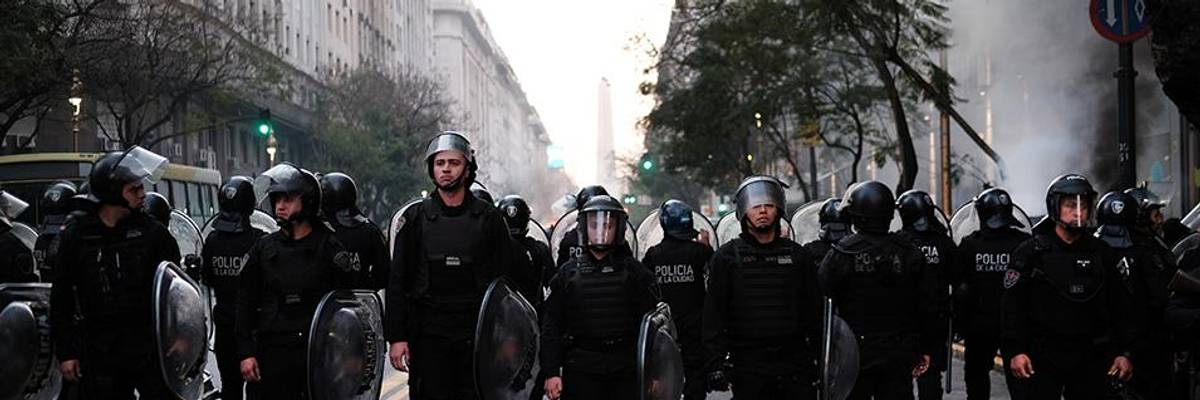
Riot police stand guard as dozens of people gather during a rally to show solidarity with protesters in Chile at the Chilean Consulate General on October 21, 2019 in Buenos Aires, Argentina. President Sebastian Pinera suspended the 3.5% subway fare hike and declared the state of emergency for the first time since the return of democracy in 1990. Protests had begun on Friday and developed into looting and arson, generating chaos in Santiago, Valparaiso and a dozen other cities resulting in at least 8 dead. In Argentina, protesters set fire to dumpsters and briefly clashed with police as tensions throughout the region grow. (Photo by Spencer Platt/Getty Images)
In Latin America several countries are under turmoil, as people cannot even meet their most basics needs. The last few months have seen a remarkable spectacle: hundreds of thousands of citizens are taking to the streets to protest to what they perceive is their governments' attack on their well-being, and the governments' responses have been late and inadequate.
In Latin America several countries are under turmoil, as people cannot even meet their most basics needs. The last few months have seen a remarkable spectacle: hundreds of thousands of citizens are taking to the streets to protest to what they perceive is their governments' attack on their well-being, and the governments' responses have been late and inadequate.
A reason for these failures can be found in an anecdote related by Jean Cocteau. A couple of drivers suffer a car malfunction in a small Chinese town: there is a hole in the gas tank. They find a mechanic that can repair it; he can do an exact replica of the tank in a couple of hours. When they pick up the car they restart the trip when, in the dark hours of the night, they face the same problem. The reason: the mechanic had also copied the hole in the gas tank. Governments, and alas, not only those in Latin America, are trying to solve problems facing them using the same recipe, the one that hadn't succeeded before.
What is happening now is important not only in its dimension, but also in the possibility of a generalized continental chaos with unpredictable consequences. And this is happening after Latin America seemed to be a on a path to sustained development, based on years of high commodity prices. However, governments, rather than taking advantage of this situation, have instead used the remarkable financial resources obtained for their own spurious aims.
The citizenry, tired of false promises, resorts to voting for populist governments that, although they increase the countries' external debt, have at least a policy of redistribution of resources that solves immediate problems and gives people a false sense of security. This has been starkly seen now in Argentina, where Alberto Fernandez and Cristina Fernandez de Kirchner (they are not related) won the country's presidential election although she has more than a dozen criminal cases against her.
Present economic and social crises have special characteristics according to what countries are considered. The common denominator to all is the profound economic inequality which, according to the United Nations, is greater in Latin America than in any other part of the world. The Economic Commission for Latin America and Caribbean states that, although in Chile poverty levels went down three percentage points between 2016 and 2019, one percent of the country's population still owns 26.5 percent of its wealth.
David Konzevik, an Argentine economist and advisor to many governments, has developed the theory called "The revolution of expectations". According to Konzevik, the degree of knowledge and information that exists today makes people aware of possibilities for better living that are unfulfilled. Governments by and large remain deaf to people's demands. "The poor today are rich in information and millionaires in expectations," Konzevik told me recently in New York.
In addition, in almost all countries judicial institutions are weak and as a result widespread corruption remains unpunished. As the worldwide economy has slowed down, governments lack resources to pay for social programs. As a result, the public has become increasingly more vocal in its demands for better services and salaries, and less willing to accept great levels of social inequality.
However, today not only the poor participate in the protests against the governments. Protesting as well are vast sectors of the middle class who also see their quality of life considerably lowered by government policies that favor mainly the rich.
Is there a way out of this morass? The answer may be in the following story told by the Spanish-Mexican historian Juan Maria Alponte. "A man, passing a quarry, saw three stone cutters. He asked the first: 'What do you do?' 'You see, cutting these stones.' The second said: 'I prepare a cornerstone.' The third one simply said, unaffected. 'I build a cathedral.'" We need politicians who want to build a cathedral.
Dear Common Dreams reader, It’s been nearly 30 years since I co-founded Common Dreams with my late wife, Lina Newhouser. We had the radical notion that journalism should serve the public good, not corporate profits. It was clear to us from the outset what it would take to build such a project. No paid advertisements. No corporate sponsors. No millionaire publisher telling us what to think or do. Many people said we wouldn't last a year, but we proved those doubters wrong. Together with a tremendous team of journalists and dedicated staff, we built an independent media outlet free from the constraints of profits and corporate control. Our mission has always been simple: To inform. To inspire. To ignite change for the common good. Building Common Dreams was not easy. Our survival was never guaranteed. When you take on the most powerful forces—Wall Street greed, fossil fuel industry destruction, Big Tech lobbyists, and uber-rich oligarchs who have spent billions upon billions rigging the economy and democracy in their favor—the only bulwark you have is supporters who believe in your work. But here’s the urgent message from me today. It's never been this bad out there. And it's never been this hard to keep us going. At the very moment Common Dreams is most needed, the threats we face are intensifying. We need your support now more than ever. We don't accept corporate advertising and never will. We don't have a paywall because we don't think people should be blocked from critical news based on their ability to pay. Everything we do is funded by the donations of readers like you. When everyone does the little they can afford, we are strong. But if that support retreats or dries up, so do we. Will you donate now to make sure Common Dreams not only survives but thrives? —Craig Brown, Co-founder |
In Latin America several countries are under turmoil, as people cannot even meet their most basics needs. The last few months have seen a remarkable spectacle: hundreds of thousands of citizens are taking to the streets to protest to what they perceive is their governments' attack on their well-being, and the governments' responses have been late and inadequate.
A reason for these failures can be found in an anecdote related by Jean Cocteau. A couple of drivers suffer a car malfunction in a small Chinese town: there is a hole in the gas tank. They find a mechanic that can repair it; he can do an exact replica of the tank in a couple of hours. When they pick up the car they restart the trip when, in the dark hours of the night, they face the same problem. The reason: the mechanic had also copied the hole in the gas tank. Governments, and alas, not only those in Latin America, are trying to solve problems facing them using the same recipe, the one that hadn't succeeded before.
What is happening now is important not only in its dimension, but also in the possibility of a generalized continental chaos with unpredictable consequences. And this is happening after Latin America seemed to be a on a path to sustained development, based on years of high commodity prices. However, governments, rather than taking advantage of this situation, have instead used the remarkable financial resources obtained for their own spurious aims.
The citizenry, tired of false promises, resorts to voting for populist governments that, although they increase the countries' external debt, have at least a policy of redistribution of resources that solves immediate problems and gives people a false sense of security. This has been starkly seen now in Argentina, where Alberto Fernandez and Cristina Fernandez de Kirchner (they are not related) won the country's presidential election although she has more than a dozen criminal cases against her.
Present economic and social crises have special characteristics according to what countries are considered. The common denominator to all is the profound economic inequality which, according to the United Nations, is greater in Latin America than in any other part of the world. The Economic Commission for Latin America and Caribbean states that, although in Chile poverty levels went down three percentage points between 2016 and 2019, one percent of the country's population still owns 26.5 percent of its wealth.
David Konzevik, an Argentine economist and advisor to many governments, has developed the theory called "The revolution of expectations". According to Konzevik, the degree of knowledge and information that exists today makes people aware of possibilities for better living that are unfulfilled. Governments by and large remain deaf to people's demands. "The poor today are rich in information and millionaires in expectations," Konzevik told me recently in New York.
In addition, in almost all countries judicial institutions are weak and as a result widespread corruption remains unpunished. As the worldwide economy has slowed down, governments lack resources to pay for social programs. As a result, the public has become increasingly more vocal in its demands for better services and salaries, and less willing to accept great levels of social inequality.
However, today not only the poor participate in the protests against the governments. Protesting as well are vast sectors of the middle class who also see their quality of life considerably lowered by government policies that favor mainly the rich.
Is there a way out of this morass? The answer may be in the following story told by the Spanish-Mexican historian Juan Maria Alponte. "A man, passing a quarry, saw three stone cutters. He asked the first: 'What do you do?' 'You see, cutting these stones.' The second said: 'I prepare a cornerstone.' The third one simply said, unaffected. 'I build a cathedral.'" We need politicians who want to build a cathedral.
In Latin America several countries are under turmoil, as people cannot even meet their most basics needs. The last few months have seen a remarkable spectacle: hundreds of thousands of citizens are taking to the streets to protest to what they perceive is their governments' attack on their well-being, and the governments' responses have been late and inadequate.
A reason for these failures can be found in an anecdote related by Jean Cocteau. A couple of drivers suffer a car malfunction in a small Chinese town: there is a hole in the gas tank. They find a mechanic that can repair it; he can do an exact replica of the tank in a couple of hours. When they pick up the car they restart the trip when, in the dark hours of the night, they face the same problem. The reason: the mechanic had also copied the hole in the gas tank. Governments, and alas, not only those in Latin America, are trying to solve problems facing them using the same recipe, the one that hadn't succeeded before.
What is happening now is important not only in its dimension, but also in the possibility of a generalized continental chaos with unpredictable consequences. And this is happening after Latin America seemed to be a on a path to sustained development, based on years of high commodity prices. However, governments, rather than taking advantage of this situation, have instead used the remarkable financial resources obtained for their own spurious aims.
The citizenry, tired of false promises, resorts to voting for populist governments that, although they increase the countries' external debt, have at least a policy of redistribution of resources that solves immediate problems and gives people a false sense of security. This has been starkly seen now in Argentina, where Alberto Fernandez and Cristina Fernandez de Kirchner (they are not related) won the country's presidential election although she has more than a dozen criminal cases against her.
Present economic and social crises have special characteristics according to what countries are considered. The common denominator to all is the profound economic inequality which, according to the United Nations, is greater in Latin America than in any other part of the world. The Economic Commission for Latin America and Caribbean states that, although in Chile poverty levels went down three percentage points between 2016 and 2019, one percent of the country's population still owns 26.5 percent of its wealth.
David Konzevik, an Argentine economist and advisor to many governments, has developed the theory called "The revolution of expectations". According to Konzevik, the degree of knowledge and information that exists today makes people aware of possibilities for better living that are unfulfilled. Governments by and large remain deaf to people's demands. "The poor today are rich in information and millionaires in expectations," Konzevik told me recently in New York.
In addition, in almost all countries judicial institutions are weak and as a result widespread corruption remains unpunished. As the worldwide economy has slowed down, governments lack resources to pay for social programs. As a result, the public has become increasingly more vocal in its demands for better services and salaries, and less willing to accept great levels of social inequality.
However, today not only the poor participate in the protests against the governments. Protesting as well are vast sectors of the middle class who also see their quality of life considerably lowered by government policies that favor mainly the rich.
Is there a way out of this morass? The answer may be in the following story told by the Spanish-Mexican historian Juan Maria Alponte. "A man, passing a quarry, saw three stone cutters. He asked the first: 'What do you do?' 'You see, cutting these stones.' The second said: 'I prepare a cornerstone.' The third one simply said, unaffected. 'I build a cathedral.'" We need politicians who want to build a cathedral.