SUBSCRIBE TO OUR FREE NEWSLETTER
Daily news & progressive opinion—funded by the people, not the corporations—delivered straight to your inbox.
5
#000000
#FFFFFF
To donate by check, phone, or other method, see our More Ways to Give page.
Daily news & progressive opinion—funded by the people, not the corporations—delivered straight to your inbox.
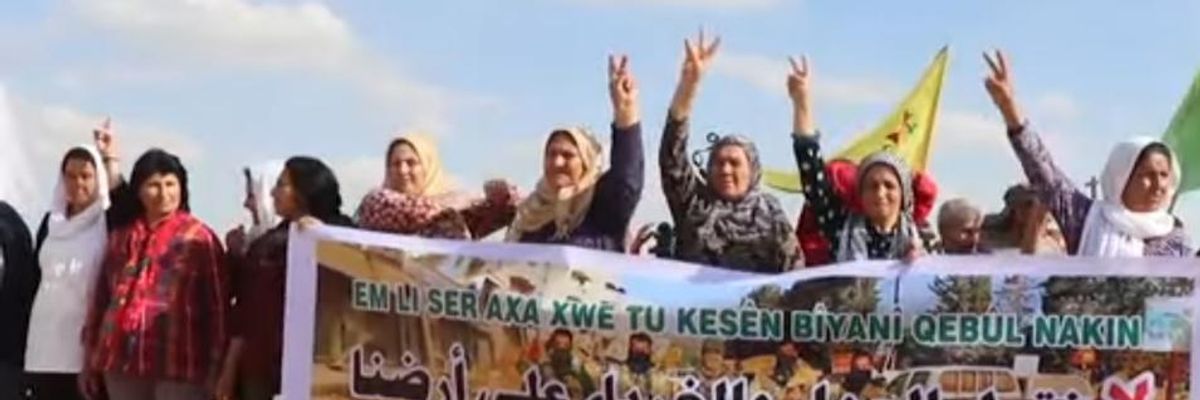
Kurdish protesters demonstrated in the northern Syrian town of Ras al-Ayn on Oct. 7, 2019 against the U.S. troop withdrawal from positions along the border in northeast Syria ahead of an expected Turkish invasion. (Photo: AP/YouTube/screenshot)
A CNN exclusive by Barbara Starr and Ryan Browne reveals that Gen. Mazloum Kobani Abdi told the U.S., "I need to know if you are capable of protecting my people, of stopping these bombs falling on us or not. I need to know, because if you're not, I need to make a deal with Russia and the regime now and invite their planes to protect this region."
Gen. Abdi told William Roebuck, the deputy special envoy to the Global Coalition to Defeat ISIL, "You have given up on us. You are leaving us to be slaughtered."
A close reading of the Russian press, however, shows that a Russian no-fly zone against Turkey in northeast Syria is highly unlikely.
Although U.S. politicians and pundits keep saying that the Turkish invasion benefits Russia, in fact Moscow is clearly very uncomfortable with it. It may end up inadvertently aiding the major Russian ally in Syria, the government of Bashar al-Assad, if it forces the Kurds into Assad's arms. But Russia hasn't connived in it, and its benefits to Moscow are uncertain.
Russian President Vladimir Putin called for all foreign militaries to leave Syria, according to Reuters: "Everyone who is illegitimately on the territory of any state, in this case Syria, must leave this territory. This applies to all states,"
Except we know that Putin was only talking about the United States and Turkey, not about his allies, Iran and Lebanon's Hizbullah.
BBC Monitoring reports that the state-owned Rossiya 1 and NTV complained about the Turkish invasion placing civilians at risk, and were especially scathing about the Sunni Arab auxiliaries fighting alongside Turkish troops as disregarding civilian security. They did not go so far as criticize Turkey directly.
The Russian position is that the Turkish incursion is a legitimate way to safeguard Turkish security, as long as it doesn't go too far.
Last week, Michael Jansen noted that Dmitry Peskov, a spokesman for the Kremlin, admitted that Russia recognizes "Turkey's right to ensure its security," but he cautioned Turkey's government to "refrain from any actions that may create obstacles on the path of a Syrian [political] settlement."
Russia has never controlled the Kurdish-dominated northeast, concentrating on helping the al-Assad regime reassert itself in the rest of the country. So Moscow does not have a dog in the fight in some ways.
Both networks interviewed war correspondent Yevgeny Poddubny, who appears to take a pro-Putin line in his analysis. He says that the Syria Kurds are at least partially responsible for their own predicament. BBC Monitoring translated him as saying, "For the past few years leaders of Kurdish formations have been demonstratively ignoring the interests of Damascus." He criticized Kurdish hyper-nationalism, saying that the Kurds insist they are fighting for their motherland.
He insisted, "the land is not theirs, but Syria's." He did not mention that Syria as far back as the mid-1960s had stripped citizenship from many Kurds, leaving them stateless and with little reason to invest their loyalties in Syria.
He also blamed them for subordinating themselves to the interests of Washington.
Bonus Video: AP: "Syria Kurds protest against US withdrawal"
Dear Common Dreams reader, It’s been nearly 30 years since I co-founded Common Dreams with my late wife, Lina Newhouser. We had the radical notion that journalism should serve the public good, not corporate profits. It was clear to us from the outset what it would take to build such a project. No paid advertisements. No corporate sponsors. No millionaire publisher telling us what to think or do. Many people said we wouldn't last a year, but we proved those doubters wrong. Together with a tremendous team of journalists and dedicated staff, we built an independent media outlet free from the constraints of profits and corporate control. Our mission has always been simple: To inform. To inspire. To ignite change for the common good. Building Common Dreams was not easy. Our survival was never guaranteed. When you take on the most powerful forces—Wall Street greed, fossil fuel industry destruction, Big Tech lobbyists, and uber-rich oligarchs who have spent billions upon billions rigging the economy and democracy in their favor—the only bulwark you have is supporters who believe in your work. But here’s the urgent message from me today. It's never been this bad out there. And it's never been this hard to keep us going. At the very moment Common Dreams is most needed, the threats we face are intensifying. We need your support now more than ever. We don't accept corporate advertising and never will. We don't have a paywall because we don't think people should be blocked from critical news based on their ability to pay. Everything we do is funded by the donations of readers like you. When everyone does the little they can afford, we are strong. But if that support retreats or dries up, so do we. Will you donate now to make sure Common Dreams not only survives but thrives? —Craig Brown, Co-founder |
A CNN exclusive by Barbara Starr and Ryan Browne reveals that Gen. Mazloum Kobani Abdi told the U.S., "I need to know if you are capable of protecting my people, of stopping these bombs falling on us or not. I need to know, because if you're not, I need to make a deal with Russia and the regime now and invite their planes to protect this region."
Gen. Abdi told William Roebuck, the deputy special envoy to the Global Coalition to Defeat ISIL, "You have given up on us. You are leaving us to be slaughtered."
A close reading of the Russian press, however, shows that a Russian no-fly zone against Turkey in northeast Syria is highly unlikely.
Although U.S. politicians and pundits keep saying that the Turkish invasion benefits Russia, in fact Moscow is clearly very uncomfortable with it. It may end up inadvertently aiding the major Russian ally in Syria, the government of Bashar al-Assad, if it forces the Kurds into Assad's arms. But Russia hasn't connived in it, and its benefits to Moscow are uncertain.
Russian President Vladimir Putin called for all foreign militaries to leave Syria, according to Reuters: "Everyone who is illegitimately on the territory of any state, in this case Syria, must leave this territory. This applies to all states,"
Except we know that Putin was only talking about the United States and Turkey, not about his allies, Iran and Lebanon's Hizbullah.
BBC Monitoring reports that the state-owned Rossiya 1 and NTV complained about the Turkish invasion placing civilians at risk, and were especially scathing about the Sunni Arab auxiliaries fighting alongside Turkish troops as disregarding civilian security. They did not go so far as criticize Turkey directly.
The Russian position is that the Turkish incursion is a legitimate way to safeguard Turkish security, as long as it doesn't go too far.
Last week, Michael Jansen noted that Dmitry Peskov, a spokesman for the Kremlin, admitted that Russia recognizes "Turkey's right to ensure its security," but he cautioned Turkey's government to "refrain from any actions that may create obstacles on the path of a Syrian [political] settlement."
Russia has never controlled the Kurdish-dominated northeast, concentrating on helping the al-Assad regime reassert itself in the rest of the country. So Moscow does not have a dog in the fight in some ways.
Both networks interviewed war correspondent Yevgeny Poddubny, who appears to take a pro-Putin line in his analysis. He says that the Syria Kurds are at least partially responsible for their own predicament. BBC Monitoring translated him as saying, "For the past few years leaders of Kurdish formations have been demonstratively ignoring the interests of Damascus." He criticized Kurdish hyper-nationalism, saying that the Kurds insist they are fighting for their motherland.
He insisted, "the land is not theirs, but Syria's." He did not mention that Syria as far back as the mid-1960s had stripped citizenship from many Kurds, leaving them stateless and with little reason to invest their loyalties in Syria.
He also blamed them for subordinating themselves to the interests of Washington.
Bonus Video: AP: "Syria Kurds protest against US withdrawal"
A CNN exclusive by Barbara Starr and Ryan Browne reveals that Gen. Mazloum Kobani Abdi told the U.S., "I need to know if you are capable of protecting my people, of stopping these bombs falling on us or not. I need to know, because if you're not, I need to make a deal with Russia and the regime now and invite their planes to protect this region."
Gen. Abdi told William Roebuck, the deputy special envoy to the Global Coalition to Defeat ISIL, "You have given up on us. You are leaving us to be slaughtered."
A close reading of the Russian press, however, shows that a Russian no-fly zone against Turkey in northeast Syria is highly unlikely.
Although U.S. politicians and pundits keep saying that the Turkish invasion benefits Russia, in fact Moscow is clearly very uncomfortable with it. It may end up inadvertently aiding the major Russian ally in Syria, the government of Bashar al-Assad, if it forces the Kurds into Assad's arms. But Russia hasn't connived in it, and its benefits to Moscow are uncertain.
Russian President Vladimir Putin called for all foreign militaries to leave Syria, according to Reuters: "Everyone who is illegitimately on the territory of any state, in this case Syria, must leave this territory. This applies to all states,"
Except we know that Putin was only talking about the United States and Turkey, not about his allies, Iran and Lebanon's Hizbullah.
BBC Monitoring reports that the state-owned Rossiya 1 and NTV complained about the Turkish invasion placing civilians at risk, and were especially scathing about the Sunni Arab auxiliaries fighting alongside Turkish troops as disregarding civilian security. They did not go so far as criticize Turkey directly.
The Russian position is that the Turkish incursion is a legitimate way to safeguard Turkish security, as long as it doesn't go too far.
Last week, Michael Jansen noted that Dmitry Peskov, a spokesman for the Kremlin, admitted that Russia recognizes "Turkey's right to ensure its security," but he cautioned Turkey's government to "refrain from any actions that may create obstacles on the path of a Syrian [political] settlement."
Russia has never controlled the Kurdish-dominated northeast, concentrating on helping the al-Assad regime reassert itself in the rest of the country. So Moscow does not have a dog in the fight in some ways.
Both networks interviewed war correspondent Yevgeny Poddubny, who appears to take a pro-Putin line in his analysis. He says that the Syria Kurds are at least partially responsible for their own predicament. BBC Monitoring translated him as saying, "For the past few years leaders of Kurdish formations have been demonstratively ignoring the interests of Damascus." He criticized Kurdish hyper-nationalism, saying that the Kurds insist they are fighting for their motherland.
He insisted, "the land is not theirs, but Syria's." He did not mention that Syria as far back as the mid-1960s had stripped citizenship from many Kurds, leaving them stateless and with little reason to invest their loyalties in Syria.
He also blamed them for subordinating themselves to the interests of Washington.
Bonus Video: AP: "Syria Kurds protest against US withdrawal"