

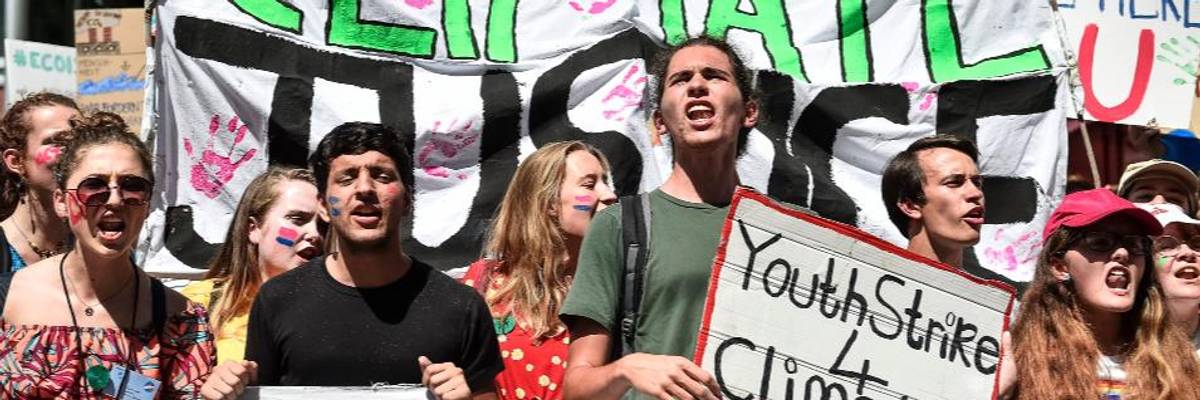
A climate activist holds a sign reading 'Youth strike 4 climate' in front of a banner reading 'Climate justice' during a Fridays For Future strike for climate protection that is part of 'SMILE for Future' event. More than 450 young climate activists from different European countries gathered to attend the summit 'SMILE for Future', that stands for Summer Meeting in Lausanne Europe. (Photo: Nicolo Campo/LightRocket via Getty Images)
Unions: We Must Back the Climate Strike!
Now is the time to show the next generation that unions are the force for progressive change in the 21st Century.
In 1968, workers around the world joined students in taking to the streets to challenge injustice and the complacency of the political establishment. Now, once again, students are leading the way--this time to prevent climate disaster.
They ask adults--and unions--to support them. We must respond by showing that the labour movement is willing to stand for broader interests and support popular movements for change.
The fight for climate action is a fight to put people and planet over profit.
"What we really need is for the union movement to fight for a Global Green New Deal: a wide scale shift in our economies to boost the power of working people and communities and to ensure that our governments protect our natural resources, whether on land or at sea."
For years, labour focused on the concept of Just Transition: to ensure that workers and communities are not negatively impacted in the shift to a zero-carbon world. Yet, in many cases, these programs have morphed into yet another public-funded subsidy for corporations, giving big polluters a chance to green-wash while leaving the system of production which has created the problem largely untouched.
What we really need is for the union movement to fight for a Global Green New Deal: a wide scale shift in our economies to boost the power of working people and communities and to ensure that our governments protect our natural resources, whether on land or at sea.
Despite the evidence, the neoliberal ideologues who have dominated the discourse for decades would have us believe that the market will save us. Those who created the problem obscure the debate and avoid blame by telling us individual consumer choices and the entrepreneurial spirit will save the day. Polluters use full page spreads to convince the public they've seen the light--despite spending decades and millions of dollars burying the truth. They have captured our institutions through obscene political donations and a poisoned revolving door between big business and government. Hence, we have toothless climate agreements which will see species fry.
Deregulation has slashed environmental standards and enabled big polluters; privatisation has handed our energy production over to private interests who extract quick (fossil) profits. Ironically, many of these same ideologues continue to support outrageous public subsidies for the fossil fuel industry and oppose government spending on clean energy solutions.
Meanwhile, corporations such as Exxon and Chevron have been pumping their profits through offshore tax havens, avoiding paying their fair share and depriving governments of the revenue needed to mitigate and adapt to increasing climate catastrophes.
It is too late to tinker around the edges. To avoid climate catastrophe, we need system change.
This is about more than climate. This is a struggle to recover democracy and make our governments serve the people, not the powerful. We will only win if we exert our collective strength, if we grow our power by building strong coalitions between students, campaigners and the labour movement.
For many people, unions are seen as an increasingly defensive or reactive force. Under sustained attacks from the right across the world, we were forced to fight to preserve our achievements rather than expand social justice.
"It is too late to tinker around the edges. To avoid climate catastrophe, we need system change."
The Climate Strike provides an opportunity to break out of our constraints, to reinvigorate our movement, to learn from young people on the front lines and to redefine what is possible. Already unions are taking action. From Germany to New Zealand to South Africa, the labour movement is backing young strikers.
Public Services International--the Global Union Federation of Workers in Public Services--is calling on our affiliates and unions across the world to do all in our power to support the week of action on Climate, including by taking strike action where possible. To build the political will needed to change the system, we must be bolder than ever.
We cannot let the vital idealism of this new generation be poisoned by cynicism and doubt. This is our last chance. They are our last chance. We must stand with them.
An Urgent Message From Our Co-Founder
Dear Common Dreams reader, It’s been nearly 30 years since I co-founded Common Dreams with my late wife, Lina Newhouser. We had the radical notion that journalism should serve the public good, not corporate profits. It was clear to us from the outset what it would take to build such a project. No paid advertisements. No corporate sponsors. No millionaire publisher telling us what to think or do. Many people said we wouldn't last a year, but we proved those doubters wrong. Together with a tremendous team of journalists and dedicated staff, we built an independent media outlet free from the constraints of profits and corporate control. Our mission has always been simple: To inform. To inspire. To ignite change for the common good. Building Common Dreams was not easy. Our survival was never guaranteed. When you take on the most powerful forces—Wall Street greed, fossil fuel industry destruction, Big Tech lobbyists, and uber-rich oligarchs who have spent billions upon billions rigging the economy and democracy in their favor—the only bulwark you have is supporters who believe in your work. But here’s the urgent message from me today. It's never been this bad out there. And it's never been this hard to keep us going. At the very moment Common Dreams is most needed, the threats we face are intensifying. We need your support now more than ever. We don't accept corporate advertising and never will. We don't have a paywall because we don't think people should be blocked from critical news based on their ability to pay. Everything we do is funded by the donations of readers like you. When everyone does the little they can afford, we are strong. But if that support retreats or dries up, so do we. Will you donate now to make sure Common Dreams not only survives but thrives? —Craig Brown, Co-founder |
In 1968, workers around the world joined students in taking to the streets to challenge injustice and the complacency of the political establishment. Now, once again, students are leading the way--this time to prevent climate disaster.
They ask adults--and unions--to support them. We must respond by showing that the labour movement is willing to stand for broader interests and support popular movements for change.
The fight for climate action is a fight to put people and planet over profit.
"What we really need is for the union movement to fight for a Global Green New Deal: a wide scale shift in our economies to boost the power of working people and communities and to ensure that our governments protect our natural resources, whether on land or at sea."
For years, labour focused on the concept of Just Transition: to ensure that workers and communities are not negatively impacted in the shift to a zero-carbon world. Yet, in many cases, these programs have morphed into yet another public-funded subsidy for corporations, giving big polluters a chance to green-wash while leaving the system of production which has created the problem largely untouched.
What we really need is for the union movement to fight for a Global Green New Deal: a wide scale shift in our economies to boost the power of working people and communities and to ensure that our governments protect our natural resources, whether on land or at sea.
Despite the evidence, the neoliberal ideologues who have dominated the discourse for decades would have us believe that the market will save us. Those who created the problem obscure the debate and avoid blame by telling us individual consumer choices and the entrepreneurial spirit will save the day. Polluters use full page spreads to convince the public they've seen the light--despite spending decades and millions of dollars burying the truth. They have captured our institutions through obscene political donations and a poisoned revolving door between big business and government. Hence, we have toothless climate agreements which will see species fry.
Deregulation has slashed environmental standards and enabled big polluters; privatisation has handed our energy production over to private interests who extract quick (fossil) profits. Ironically, many of these same ideologues continue to support outrageous public subsidies for the fossil fuel industry and oppose government spending on clean energy solutions.
Meanwhile, corporations such as Exxon and Chevron have been pumping their profits through offshore tax havens, avoiding paying their fair share and depriving governments of the revenue needed to mitigate and adapt to increasing climate catastrophes.
It is too late to tinker around the edges. To avoid climate catastrophe, we need system change.
This is about more than climate. This is a struggle to recover democracy and make our governments serve the people, not the powerful. We will only win if we exert our collective strength, if we grow our power by building strong coalitions between students, campaigners and the labour movement.
For many people, unions are seen as an increasingly defensive or reactive force. Under sustained attacks from the right across the world, we were forced to fight to preserve our achievements rather than expand social justice.
"It is too late to tinker around the edges. To avoid climate catastrophe, we need system change."
The Climate Strike provides an opportunity to break out of our constraints, to reinvigorate our movement, to learn from young people on the front lines and to redefine what is possible. Already unions are taking action. From Germany to New Zealand to South Africa, the labour movement is backing young strikers.
Public Services International--the Global Union Federation of Workers in Public Services--is calling on our affiliates and unions across the world to do all in our power to support the week of action on Climate, including by taking strike action where possible. To build the political will needed to change the system, we must be bolder than ever.
We cannot let the vital idealism of this new generation be poisoned by cynicism and doubt. This is our last chance. They are our last chance. We must stand with them.
In 1968, workers around the world joined students in taking to the streets to challenge injustice and the complacency of the political establishment. Now, once again, students are leading the way--this time to prevent climate disaster.
They ask adults--and unions--to support them. We must respond by showing that the labour movement is willing to stand for broader interests and support popular movements for change.
The fight for climate action is a fight to put people and planet over profit.
"What we really need is for the union movement to fight for a Global Green New Deal: a wide scale shift in our economies to boost the power of working people and communities and to ensure that our governments protect our natural resources, whether on land or at sea."
For years, labour focused on the concept of Just Transition: to ensure that workers and communities are not negatively impacted in the shift to a zero-carbon world. Yet, in many cases, these programs have morphed into yet another public-funded subsidy for corporations, giving big polluters a chance to green-wash while leaving the system of production which has created the problem largely untouched.
What we really need is for the union movement to fight for a Global Green New Deal: a wide scale shift in our economies to boost the power of working people and communities and to ensure that our governments protect our natural resources, whether on land or at sea.
Despite the evidence, the neoliberal ideologues who have dominated the discourse for decades would have us believe that the market will save us. Those who created the problem obscure the debate and avoid blame by telling us individual consumer choices and the entrepreneurial spirit will save the day. Polluters use full page spreads to convince the public they've seen the light--despite spending decades and millions of dollars burying the truth. They have captured our institutions through obscene political donations and a poisoned revolving door between big business and government. Hence, we have toothless climate agreements which will see species fry.
Deregulation has slashed environmental standards and enabled big polluters; privatisation has handed our energy production over to private interests who extract quick (fossil) profits. Ironically, many of these same ideologues continue to support outrageous public subsidies for the fossil fuel industry and oppose government spending on clean energy solutions.
Meanwhile, corporations such as Exxon and Chevron have been pumping their profits through offshore tax havens, avoiding paying their fair share and depriving governments of the revenue needed to mitigate and adapt to increasing climate catastrophes.
It is too late to tinker around the edges. To avoid climate catastrophe, we need system change.
This is about more than climate. This is a struggle to recover democracy and make our governments serve the people, not the powerful. We will only win if we exert our collective strength, if we grow our power by building strong coalitions between students, campaigners and the labour movement.
For many people, unions are seen as an increasingly defensive or reactive force. Under sustained attacks from the right across the world, we were forced to fight to preserve our achievements rather than expand social justice.
"It is too late to tinker around the edges. To avoid climate catastrophe, we need system change."
The Climate Strike provides an opportunity to break out of our constraints, to reinvigorate our movement, to learn from young people on the front lines and to redefine what is possible. Already unions are taking action. From Germany to New Zealand to South Africa, the labour movement is backing young strikers.
Public Services International--the Global Union Federation of Workers in Public Services--is calling on our affiliates and unions across the world to do all in our power to support the week of action on Climate, including by taking strike action where possible. To build the political will needed to change the system, we must be bolder than ever.
We cannot let the vital idealism of this new generation be poisoned by cynicism and doubt. This is our last chance. They are our last chance. We must stand with them.