
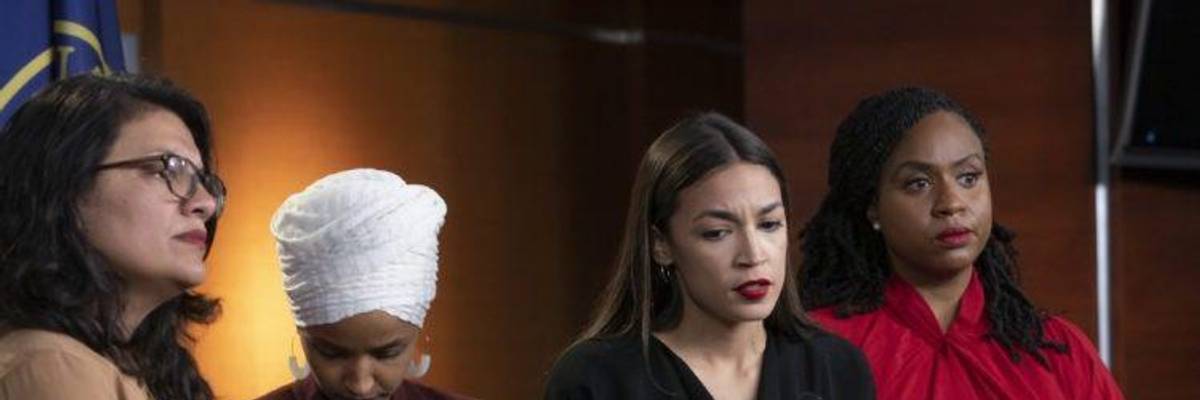
Reps. Rashida Tlaib, left, Ilhan Omar, Alexandria Ocasio-Cortez and Ayanna Pressley respond to remarks by President Donald Trump after his call for the four Democratic congresswomen to go back to their "broken" countries, during a news conference. (Photo: J. Scott Applewhite / AP)
I Know What It's Like to Be Told to 'Go Back' to My Own Country
This president and his enablers are not the exception in our long, shameful history of systemic racism—they simply have no interest in hiding theirs behind platitudes
"Why don't they go back and help fix the totally broken and crime infested places from which they came," asked Donald Trump this weekend, all but certainly targeting Reps. Alexandria Ocasio-Cortez, Ayanna Pressley, Rashida Tlaib and Ilhan Omar. The president's latest tweets came in response to an ongoing public feud between the four progressive women of color--often known as the "Squad"--and Speaker of the House Nancy Pelosi. The episode merely confirmed what The Guardian's Arwa Mahdawi had pointed out prior to his racist screed:
America is becoming an increasingly hostile place for women and for people of color. Pelosi's constant public attacks against the four newly elected women of color aren't just disrespectful, they're dangerous. Whether she means to or not, her repeated insinuations that the Squad are rabble-rousing upstarts who are undermining the Democratic party helps bolster the right's vitriolic narratives about the congresswomen. As America grows increasingly brazen in its bigotry, Pelosi should be aggressively standing up for her freshman colleagues, not trying to tear them down.
Since being smeared by the president with characteristically white nationalist rhetoric, each of the congresswomen has issued a powerful response on social media, as well as held a news conference on Monday.
Let's set aside that Ocasio-Cortez, Tlaib and Pressley were born in the U.S., if only for a moment. Regardless of where you were born, if you're a person of color in America, it's likely that you or someone you love has been told a variation of "Go back to where you came from." I've lost track of how many stories I've heard, but a personal experience immediately springs to mind watching the most powerful man in the country attack four women of color.
Just after the 2016 election, I was home in the U.S. for an extended period to work and visit my family. My partner, brothers and I were driving through rural Illinois, where I was born, to Chicago, after a wedding in Wisconsin when we stopped at a Dunkin' Donuts. There, a group of young white men started making loud comments about how we should "immigrate here legally, and then you could vote for Trump" as, I assume, they just had. It's hard to know if it was my partner's British accent, or the color of my brothers' and my skin that made them assume we were not from the country, let alone that very state, but it struck straight to the core of my frustrations that the U.S. had just elected an unabashed nativist as president.
"I was born here. Not voting for Trump makes me no less of a U.S. citizen than you," I replied through gritted teeth. The kids backed off immediately, and ultimately, they didn't seem intent on attacking us. While I tell myself it could've been worse, and I have indeed heard much worse, their remarks have stayed with me. While I was no stranger to American racism, this was the first time my citizenship status had been openly questioned by a stranger who wasn't a U.S. border patrol officer. (It should be noted that these officials have had no trouble asking me, repeatedly, why I was re-entering the U.S., unwilling to accept my answer that I was born here.)
What became clear to me at that Illinois Dunkin' Donuts, its surrounding roads littered with red Trump/Pence signs, was just how emboldened the most racist and xenophobic elements in the country have come to feel under Trump. Perhaps it's no surprise, then, that counties that have hosted Trump rallies have been seen a 226% rise in hate crimes.
My mother, like several other members of my family on both my Mexican and Iranian sides, was undocumented. I was taught from a young age how "lucky" I was to be born north of the Rio Grande, how much my parents and grandparents had given up for my generation to have more than they could dream of. It's a common narrative among immigrant families, which doesn't mean to say it isn't true. Every day that migrant men, women and children are kept in abhorrent conditions, I'm reminded that had I been born just a few miles south, I, too, might be in a migrant camp right now. With each ICE raid, I have come to fear that a member of my family could be detained, even though we've all been naturalized.
I am not alone in my anxiety. A recent study of Latinx teenagers in California born in the U.S. found that this administration's xenophobic immigration policies are having a very real impact on their mental health:
In this cohort study of 397 US-born adolescents in California, fear and worry about the personal consequences of current US immigration policy were associated with higher anxiety levels, sleep problems, and blood pressure changes. Reported anxiety statistically significantly increased after the 2016 presidential election, particularly among young people in the most vulnerable families.
The study reminded me of my mom, who often tells me about how her mental health suffered for over a decade while her immigration status remained unresolved, fearing at any moment she would be forced to the leave the country she's now lived in longer than her native Mexico.
A powerful epistolary poetry exchange between Latinx writers Ada Limon and Natalie Diaz also captures the pain and fear so many are feeling right now in the U.S. Here is an excerpt from a poem in the series by Limon.
Manuel is in Chicago today, and we've both admitted
that we're travelling with our passports now.
Reports of ICE raids and both of our bloods
are requiring new medication.
Below is part of Diaz's poetic response:
I have my passport with me these days, too, like you and Manuel.
Not because of ICE raids, but because I know
what it's like to want to leave my country. My country--
to say it is half begging, half joke.Lately, I settle for an hour instead of a country.
What joy might be in this hour? I ask myself.And there is much--
Ours is a country that decided at its inception what a U.S. citizen must look like, and it's easy to see now that the founding fathers never had Ocasio-Cortez or Tlaib or Omar or Pressley or me and my family and countless others in mind. This president and his enablers are not the exception in our long, shameful history of systemic racism--they simply have no interest in hiding theirs behind platitudes.
If anything, Trump has exposed "legal citizenship" and "residency" for the constructs they've been all along. A passport, a birth certificate, a green card, a visa--each of these documents can be revoked. One's status is ultimately as fragile as the paper the words are printed on. Just look at Trump's threats to nullify birthright citizenship or his adviser Stephen Miller's plot to deny green cards to immigrants who have received benefits, including Obamacare or food stamps. On several occasions, full U.S. citizens have been detained and deported by immigration officials.
I have a U.S. birth certificate and a passport, yet my own president believes I do not have a right to these documents. He also seems to maintain that there are actions, words, events that could make me "un-American," with all of its McCarthyist implications.
In the end, what do those pieces of paper even really mean? Do they give me more human rights than the 4-month-old child detained somewhere in our purportedly exceptional country? That I even have to ask that is a sign of how clearly our institutions were designed by white hegemonic powers to make us question everyone's humanity, to dehumanize anyone who didn't look or sound or act or think like them.
I leave the U.S. often, ironically, and I have been fortunate to live and study and work abroad in countries from Mexico and Argentina to Spain and the U.K.--experiences that have thrown the good and the bad the U.S. has to offer into high relief. On the days when I read the news, I can't imagine how I can love the country I still, sometimes reluctantly, call home, but I try to remember what the great James Baldwin said in an interview with the Paris Review:
I think that it is a spiritual disaster to pretend that one doesn't love one's country. You may disapprove of it, you may be forced to leave it, you may live your whole life as a battle, yet I don't think you can escape it. There isn't any other place to go--you don't pull up your roots and put them down someplace else. At least not in a single lifetime, or, if you do, you'll be aware of precisely what it means, knowing that your real roots are always elsewhere. If you try to pretend you don't see the immediate reality that formed you I think you'll go blind.
I'm trying not to go blind, even though the tears that come more and more often these days make it harder than ever to see the nation for which my parents gave up so much to call their own.
An Urgent Message From Our Co-Founder
Dear Common Dreams reader, It’s been nearly 30 years since I co-founded Common Dreams with my late wife, Lina Newhouser. We had the radical notion that journalism should serve the public good, not corporate profits. It was clear to us from the outset what it would take to build such a project. No paid advertisements. No corporate sponsors. No millionaire publisher telling us what to think or do. Many people said we wouldn't last a year, but we proved those doubters wrong. Together with a tremendous team of journalists and dedicated staff, we built an independent media outlet free from the constraints of profits and corporate control. Our mission has always been simple: To inform. To inspire. To ignite change for the common good. Building Common Dreams was not easy. Our survival was never guaranteed. When you take on the most powerful forces—Wall Street greed, fossil fuel industry destruction, Big Tech lobbyists, and uber-rich oligarchs who have spent billions upon billions rigging the economy and democracy in their favor—the only bulwark you have is supporters who believe in your work. But here’s the urgent message from me today. It's never been this bad out there. And it's never been this hard to keep us going. At the very moment Common Dreams is most needed, the threats we face are intensifying. We need your support now more than ever. We don't accept corporate advertising and never will. We don't have a paywall because we don't think people should be blocked from critical news based on their ability to pay. Everything we do is funded by the donations of readers like you. When everyone does the little they can afford, we are strong. But if that support retreats or dries up, so do we. Will you donate now to make sure Common Dreams not only survives but thrives? —Craig Brown, Co-founder |
"Why don't they go back and help fix the totally broken and crime infested places from which they came," asked Donald Trump this weekend, all but certainly targeting Reps. Alexandria Ocasio-Cortez, Ayanna Pressley, Rashida Tlaib and Ilhan Omar. The president's latest tweets came in response to an ongoing public feud between the four progressive women of color--often known as the "Squad"--and Speaker of the House Nancy Pelosi. The episode merely confirmed what The Guardian's Arwa Mahdawi had pointed out prior to his racist screed:
America is becoming an increasingly hostile place for women and for people of color. Pelosi's constant public attacks against the four newly elected women of color aren't just disrespectful, they're dangerous. Whether she means to or not, her repeated insinuations that the Squad are rabble-rousing upstarts who are undermining the Democratic party helps bolster the right's vitriolic narratives about the congresswomen. As America grows increasingly brazen in its bigotry, Pelosi should be aggressively standing up for her freshman colleagues, not trying to tear them down.
Since being smeared by the president with characteristically white nationalist rhetoric, each of the congresswomen has issued a powerful response on social media, as well as held a news conference on Monday.
Let's set aside that Ocasio-Cortez, Tlaib and Pressley were born in the U.S., if only for a moment. Regardless of where you were born, if you're a person of color in America, it's likely that you or someone you love has been told a variation of "Go back to where you came from." I've lost track of how many stories I've heard, but a personal experience immediately springs to mind watching the most powerful man in the country attack four women of color.
Just after the 2016 election, I was home in the U.S. for an extended period to work and visit my family. My partner, brothers and I were driving through rural Illinois, where I was born, to Chicago, after a wedding in Wisconsin when we stopped at a Dunkin' Donuts. There, a group of young white men started making loud comments about how we should "immigrate here legally, and then you could vote for Trump" as, I assume, they just had. It's hard to know if it was my partner's British accent, or the color of my brothers' and my skin that made them assume we were not from the country, let alone that very state, but it struck straight to the core of my frustrations that the U.S. had just elected an unabashed nativist as president.
"I was born here. Not voting for Trump makes me no less of a U.S. citizen than you," I replied through gritted teeth. The kids backed off immediately, and ultimately, they didn't seem intent on attacking us. While I tell myself it could've been worse, and I have indeed heard much worse, their remarks have stayed with me. While I was no stranger to American racism, this was the first time my citizenship status had been openly questioned by a stranger who wasn't a U.S. border patrol officer. (It should be noted that these officials have had no trouble asking me, repeatedly, why I was re-entering the U.S., unwilling to accept my answer that I was born here.)
What became clear to me at that Illinois Dunkin' Donuts, its surrounding roads littered with red Trump/Pence signs, was just how emboldened the most racist and xenophobic elements in the country have come to feel under Trump. Perhaps it's no surprise, then, that counties that have hosted Trump rallies have been seen a 226% rise in hate crimes.
My mother, like several other members of my family on both my Mexican and Iranian sides, was undocumented. I was taught from a young age how "lucky" I was to be born north of the Rio Grande, how much my parents and grandparents had given up for my generation to have more than they could dream of. It's a common narrative among immigrant families, which doesn't mean to say it isn't true. Every day that migrant men, women and children are kept in abhorrent conditions, I'm reminded that had I been born just a few miles south, I, too, might be in a migrant camp right now. With each ICE raid, I have come to fear that a member of my family could be detained, even though we've all been naturalized.
I am not alone in my anxiety. A recent study of Latinx teenagers in California born in the U.S. found that this administration's xenophobic immigration policies are having a very real impact on their mental health:
In this cohort study of 397 US-born adolescents in California, fear and worry about the personal consequences of current US immigration policy were associated with higher anxiety levels, sleep problems, and blood pressure changes. Reported anxiety statistically significantly increased after the 2016 presidential election, particularly among young people in the most vulnerable families.
The study reminded me of my mom, who often tells me about how her mental health suffered for over a decade while her immigration status remained unresolved, fearing at any moment she would be forced to the leave the country she's now lived in longer than her native Mexico.
A powerful epistolary poetry exchange between Latinx writers Ada Limon and Natalie Diaz also captures the pain and fear so many are feeling right now in the U.S. Here is an excerpt from a poem in the series by Limon.
Manuel is in Chicago today, and we've both admitted
that we're travelling with our passports now.
Reports of ICE raids and both of our bloods
are requiring new medication.
Below is part of Diaz's poetic response:
I have my passport with me these days, too, like you and Manuel.
Not because of ICE raids, but because I know
what it's like to want to leave my country. My country--
to say it is half begging, half joke.Lately, I settle for an hour instead of a country.
What joy might be in this hour? I ask myself.And there is much--
Ours is a country that decided at its inception what a U.S. citizen must look like, and it's easy to see now that the founding fathers never had Ocasio-Cortez or Tlaib or Omar or Pressley or me and my family and countless others in mind. This president and his enablers are not the exception in our long, shameful history of systemic racism--they simply have no interest in hiding theirs behind platitudes.
If anything, Trump has exposed "legal citizenship" and "residency" for the constructs they've been all along. A passport, a birth certificate, a green card, a visa--each of these documents can be revoked. One's status is ultimately as fragile as the paper the words are printed on. Just look at Trump's threats to nullify birthright citizenship or his adviser Stephen Miller's plot to deny green cards to immigrants who have received benefits, including Obamacare or food stamps. On several occasions, full U.S. citizens have been detained and deported by immigration officials.
I have a U.S. birth certificate and a passport, yet my own president believes I do not have a right to these documents. He also seems to maintain that there are actions, words, events that could make me "un-American," with all of its McCarthyist implications.
In the end, what do those pieces of paper even really mean? Do they give me more human rights than the 4-month-old child detained somewhere in our purportedly exceptional country? That I even have to ask that is a sign of how clearly our institutions were designed by white hegemonic powers to make us question everyone's humanity, to dehumanize anyone who didn't look or sound or act or think like them.
I leave the U.S. often, ironically, and I have been fortunate to live and study and work abroad in countries from Mexico and Argentina to Spain and the U.K.--experiences that have thrown the good and the bad the U.S. has to offer into high relief. On the days when I read the news, I can't imagine how I can love the country I still, sometimes reluctantly, call home, but I try to remember what the great James Baldwin said in an interview with the Paris Review:
I think that it is a spiritual disaster to pretend that one doesn't love one's country. You may disapprove of it, you may be forced to leave it, you may live your whole life as a battle, yet I don't think you can escape it. There isn't any other place to go--you don't pull up your roots and put them down someplace else. At least not in a single lifetime, or, if you do, you'll be aware of precisely what it means, knowing that your real roots are always elsewhere. If you try to pretend you don't see the immediate reality that formed you I think you'll go blind.
I'm trying not to go blind, even though the tears that come more and more often these days make it harder than ever to see the nation for which my parents gave up so much to call their own.
"Why don't they go back and help fix the totally broken and crime infested places from which they came," asked Donald Trump this weekend, all but certainly targeting Reps. Alexandria Ocasio-Cortez, Ayanna Pressley, Rashida Tlaib and Ilhan Omar. The president's latest tweets came in response to an ongoing public feud between the four progressive women of color--often known as the "Squad"--and Speaker of the House Nancy Pelosi. The episode merely confirmed what The Guardian's Arwa Mahdawi had pointed out prior to his racist screed:
America is becoming an increasingly hostile place for women and for people of color. Pelosi's constant public attacks against the four newly elected women of color aren't just disrespectful, they're dangerous. Whether she means to or not, her repeated insinuations that the Squad are rabble-rousing upstarts who are undermining the Democratic party helps bolster the right's vitriolic narratives about the congresswomen. As America grows increasingly brazen in its bigotry, Pelosi should be aggressively standing up for her freshman colleagues, not trying to tear them down.
Since being smeared by the president with characteristically white nationalist rhetoric, each of the congresswomen has issued a powerful response on social media, as well as held a news conference on Monday.
Let's set aside that Ocasio-Cortez, Tlaib and Pressley were born in the U.S., if only for a moment. Regardless of where you were born, if you're a person of color in America, it's likely that you or someone you love has been told a variation of "Go back to where you came from." I've lost track of how many stories I've heard, but a personal experience immediately springs to mind watching the most powerful man in the country attack four women of color.
Just after the 2016 election, I was home in the U.S. for an extended period to work and visit my family. My partner, brothers and I were driving through rural Illinois, where I was born, to Chicago, after a wedding in Wisconsin when we stopped at a Dunkin' Donuts. There, a group of young white men started making loud comments about how we should "immigrate here legally, and then you could vote for Trump" as, I assume, they just had. It's hard to know if it was my partner's British accent, or the color of my brothers' and my skin that made them assume we were not from the country, let alone that very state, but it struck straight to the core of my frustrations that the U.S. had just elected an unabashed nativist as president.
"I was born here. Not voting for Trump makes me no less of a U.S. citizen than you," I replied through gritted teeth. The kids backed off immediately, and ultimately, they didn't seem intent on attacking us. While I tell myself it could've been worse, and I have indeed heard much worse, their remarks have stayed with me. While I was no stranger to American racism, this was the first time my citizenship status had been openly questioned by a stranger who wasn't a U.S. border patrol officer. (It should be noted that these officials have had no trouble asking me, repeatedly, why I was re-entering the U.S., unwilling to accept my answer that I was born here.)
What became clear to me at that Illinois Dunkin' Donuts, its surrounding roads littered with red Trump/Pence signs, was just how emboldened the most racist and xenophobic elements in the country have come to feel under Trump. Perhaps it's no surprise, then, that counties that have hosted Trump rallies have been seen a 226% rise in hate crimes.
My mother, like several other members of my family on both my Mexican and Iranian sides, was undocumented. I was taught from a young age how "lucky" I was to be born north of the Rio Grande, how much my parents and grandparents had given up for my generation to have more than they could dream of. It's a common narrative among immigrant families, which doesn't mean to say it isn't true. Every day that migrant men, women and children are kept in abhorrent conditions, I'm reminded that had I been born just a few miles south, I, too, might be in a migrant camp right now. With each ICE raid, I have come to fear that a member of my family could be detained, even though we've all been naturalized.
I am not alone in my anxiety. A recent study of Latinx teenagers in California born in the U.S. found that this administration's xenophobic immigration policies are having a very real impact on their mental health:
In this cohort study of 397 US-born adolescents in California, fear and worry about the personal consequences of current US immigration policy were associated with higher anxiety levels, sleep problems, and blood pressure changes. Reported anxiety statistically significantly increased after the 2016 presidential election, particularly among young people in the most vulnerable families.
The study reminded me of my mom, who often tells me about how her mental health suffered for over a decade while her immigration status remained unresolved, fearing at any moment she would be forced to the leave the country she's now lived in longer than her native Mexico.
A powerful epistolary poetry exchange between Latinx writers Ada Limon and Natalie Diaz also captures the pain and fear so many are feeling right now in the U.S. Here is an excerpt from a poem in the series by Limon.
Manuel is in Chicago today, and we've both admitted
that we're travelling with our passports now.
Reports of ICE raids and both of our bloods
are requiring new medication.
Below is part of Diaz's poetic response:
I have my passport with me these days, too, like you and Manuel.
Not because of ICE raids, but because I know
what it's like to want to leave my country. My country--
to say it is half begging, half joke.Lately, I settle for an hour instead of a country.
What joy might be in this hour? I ask myself.And there is much--
Ours is a country that decided at its inception what a U.S. citizen must look like, and it's easy to see now that the founding fathers never had Ocasio-Cortez or Tlaib or Omar or Pressley or me and my family and countless others in mind. This president and his enablers are not the exception in our long, shameful history of systemic racism--they simply have no interest in hiding theirs behind platitudes.
If anything, Trump has exposed "legal citizenship" and "residency" for the constructs they've been all along. A passport, a birth certificate, a green card, a visa--each of these documents can be revoked. One's status is ultimately as fragile as the paper the words are printed on. Just look at Trump's threats to nullify birthright citizenship or his adviser Stephen Miller's plot to deny green cards to immigrants who have received benefits, including Obamacare or food stamps. On several occasions, full U.S. citizens have been detained and deported by immigration officials.
I have a U.S. birth certificate and a passport, yet my own president believes I do not have a right to these documents. He also seems to maintain that there are actions, words, events that could make me "un-American," with all of its McCarthyist implications.
In the end, what do those pieces of paper even really mean? Do they give me more human rights than the 4-month-old child detained somewhere in our purportedly exceptional country? That I even have to ask that is a sign of how clearly our institutions were designed by white hegemonic powers to make us question everyone's humanity, to dehumanize anyone who didn't look or sound or act or think like them.
I leave the U.S. often, ironically, and I have been fortunate to live and study and work abroad in countries from Mexico and Argentina to Spain and the U.K.--experiences that have thrown the good and the bad the U.S. has to offer into high relief. On the days when I read the news, I can't imagine how I can love the country I still, sometimes reluctantly, call home, but I try to remember what the great James Baldwin said in an interview with the Paris Review:
I think that it is a spiritual disaster to pretend that one doesn't love one's country. You may disapprove of it, you may be forced to leave it, you may live your whole life as a battle, yet I don't think you can escape it. There isn't any other place to go--you don't pull up your roots and put them down someplace else. At least not in a single lifetime, or, if you do, you'll be aware of precisely what it means, knowing that your real roots are always elsewhere. If you try to pretend you don't see the immediate reality that formed you I think you'll go blind.
I'm trying not to go blind, even though the tears that come more and more often these days make it harder than ever to see the nation for which my parents gave up so much to call their own.