SUBSCRIBE TO OUR FREE NEWSLETTER
Daily news & progressive opinion—funded by the people, not the corporations—delivered straight to your inbox.
5
#000000
#FFFFFF
To donate by check, phone, or other method, see our More Ways to Give page.
Daily news & progressive opinion—funded by the people, not the corporations—delivered straight to your inbox.
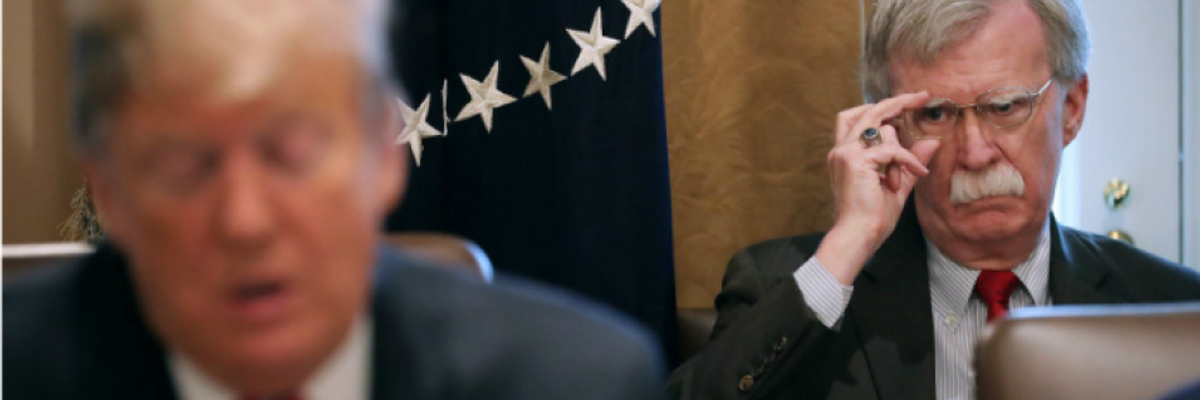
National security advisor John Bolton listens to President Donald Trump talk to reporters during a cabinet meeting at the White House in Washington on Feb. 12. (Photo: Chip Somodevilla/Getty Images)
The Trump administration and its allies are slow-walking the United States into war with Iran, and, with a few notable exceptions, mainstream U.S. media is helping them.
Much of this assistance has been overt. Just like during the run-up to the Iraq war, outlets like CNN, NBC, and the New York Times have in recent weeks simply parroted without scrutiny claims from Bolton and other administration officials of a dire Iranian threat based on intelligence no one has seen (these claims would in turn compel officials within the U.S. intelligence community to tell reporters that the intelligence in question shows nothing new or that it was being blown out of proportion).
But the media is also failing us in other, less overt ways, namely by quoting and promoting those pushing for regime change and/or war and presenting them as, at best, neutral "experts," or at worst, proponents of a "strong" or "tough" U.S. policy vis-a-vis Iran.
In a story earlier this week about how President Trump is showing signs of souring on Bolton, particularly because of Bolton's quest for war with Iran, the Times gave Foundation for Defense of Democracies (FDD) CEO Mark Dubowitz prominent billing to praise Bolton as the one giving Trump the "diplomatic space for him to go back and forth between a very hard-line position and holding talks."
Except the reality is that Dubowitz has no interest in the U.S. holding talks with Iran. In fact, over the past decade or so, he's essentially been the titular head of the pro-regime change/Iran war movement that worked to prevent President Obama from reaching a nuclear agreement with Iran, and subsequently pushed to destroy it.
Dubowitz himself has called for regime change in Iran and the organization he runs, FDD, has been underwritten by right-wing billionaire funders Bernie "I think Iran is the devil" Marcus, and Sheldon Adelson, who's on record calling for the U.S. to nuke Iran. FDD has also been the leader in promoting the false narrative that Iran is in league with al-Qaeda, and its staffers regularly publish op-eds and papers pushing a militaristic approach or outright calling for war with Iran. Indeed, Bolton recruited one of his most hawkish staffers, Richard Goldberg, from FDD. Months before joining the administration, Goldberg wrote a piece urging Trump to attack Iran's Revolutionary Guard.
The Times story mentioned none of this. It actually portrayed FDD somewhat positively, identifying it only as a "group that advocates a tough approach to Iran."
USA Today made a similar mistake this week in a piece about Bolton's relationship with Trump on Iran. The story identified Dubowitz as an "expert" and quoted him praising Bolton's aggressive push toward conflict with Iran as "a well-orchestrated campaign," and downplaying any worries that Bolton has outsize influence over Trump and his Iran policy.
Of course Dubowitz would want to downplay any public perception that Bolton is controlling Trump's Iran policy, not only to calm concerns about a potential war with Iran, but also to placate Trump himself, who has a penchant for firing aides after conventional wisdom emerges that they have more power than he does.
Again, USA Today made no mention that Dubowitz is a regime change proponent or that employees of his organization have called for war. Instead, the piece identified FDD favorably as "a Washington-based foreign policy research institute that supports strong pressure on Iran."
And if "strong pressure on Iran" and a "tough approach to Iran," as the Times put it, are euphemisms for FDD's militaristic positions, why are USA Today and the New York Times portraying a hawkish Iran policy as "strong" and "tough"? Is pushing for regime change in Tehran or war with Iran--one that would likely dwarf the catastrophe that was the invasion of Iraq--a "tough" position? Do we look back on the Iraq war and say George W. Bush's policy was "strong?" Or rather, is it strong and tough to organize and unite a broad international coalition--including U.S. adversaries China and Russia--to pressure Iran into an agreement that boxed in its nuclear program so that it could not build a nuclear weapon?
Unfortunately, reporters quote Dubowitz all the time without providing the proper context as to what he's up to. And it's somewhat understandable. He's the CEO of an influential and well-funded "think tank," a position that gives it, and Dubowitz, a fairly thick veneer of credibility. Moreover, oftentimes reporters don't have time to dig deep into the details of their sourcing, particularly if the source in question is one many of their colleagues turn to, and has seemingly already been vetted.
But the reality is that FDD oozes with bad faith to cover for its subtle push for regime change in Iran. Dubowitz himself famously called for a "nix and fix" strategy with regard to the Iran nuclear deal--in that, he said Trump should withdraw from the agreement and negotiate a better one. While those who closely follow these issues were aware of Dubowitz's disingenuousness at that time, the fact that he's now promoting an astroturfed hashtag on Twitter--likely engineered with the help of FDD--calling for no deal at all should put to rest any notion that he, or FDD, has any interest in diplomacy with Iran.
Dear Common Dreams reader, It’s been nearly 30 years since I co-founded Common Dreams with my late wife, Lina Newhouser. We had the radical notion that journalism should serve the public good, not corporate profits. It was clear to us from the outset what it would take to build such a project. No paid advertisements. No corporate sponsors. No millionaire publisher telling us what to think or do. Many people said we wouldn't last a year, but we proved those doubters wrong. Together with a tremendous team of journalists and dedicated staff, we built an independent media outlet free from the constraints of profits and corporate control. Our mission has always been simple: To inform. To inspire. To ignite change for the common good. Building Common Dreams was not easy. Our survival was never guaranteed. When you take on the most powerful forces—Wall Street greed, fossil fuel industry destruction, Big Tech lobbyists, and uber-rich oligarchs who have spent billions upon billions rigging the economy and democracy in their favor—the only bulwark you have is supporters who believe in your work. But here’s the urgent message from me today. It's never been this bad out there. And it's never been this hard to keep us going. At the very moment Common Dreams is most needed, the threats we face are intensifying. We need your support now more than ever. We don't accept corporate advertising and never will. We don't have a paywall because we don't think people should be blocked from critical news based on their ability to pay. Everything we do is funded by the donations of readers like you. When everyone does the little they can afford, we are strong. But if that support retreats or dries up, so do we. Will you donate now to make sure Common Dreams not only survives but thrives? —Craig Brown, Co-founder |
The Trump administration and its allies are slow-walking the United States into war with Iran, and, with a few notable exceptions, mainstream U.S. media is helping them.
Much of this assistance has been overt. Just like during the run-up to the Iraq war, outlets like CNN, NBC, and the New York Times have in recent weeks simply parroted without scrutiny claims from Bolton and other administration officials of a dire Iranian threat based on intelligence no one has seen (these claims would in turn compel officials within the U.S. intelligence community to tell reporters that the intelligence in question shows nothing new or that it was being blown out of proportion).
But the media is also failing us in other, less overt ways, namely by quoting and promoting those pushing for regime change and/or war and presenting them as, at best, neutral "experts," or at worst, proponents of a "strong" or "tough" U.S. policy vis-a-vis Iran.
In a story earlier this week about how President Trump is showing signs of souring on Bolton, particularly because of Bolton's quest for war with Iran, the Times gave Foundation for Defense of Democracies (FDD) CEO Mark Dubowitz prominent billing to praise Bolton as the one giving Trump the "diplomatic space for him to go back and forth between a very hard-line position and holding talks."
Except the reality is that Dubowitz has no interest in the U.S. holding talks with Iran. In fact, over the past decade or so, he's essentially been the titular head of the pro-regime change/Iran war movement that worked to prevent President Obama from reaching a nuclear agreement with Iran, and subsequently pushed to destroy it.
Dubowitz himself has called for regime change in Iran and the organization he runs, FDD, has been underwritten by right-wing billionaire funders Bernie "I think Iran is the devil" Marcus, and Sheldon Adelson, who's on record calling for the U.S. to nuke Iran. FDD has also been the leader in promoting the false narrative that Iran is in league with al-Qaeda, and its staffers regularly publish op-eds and papers pushing a militaristic approach or outright calling for war with Iran. Indeed, Bolton recruited one of his most hawkish staffers, Richard Goldberg, from FDD. Months before joining the administration, Goldberg wrote a piece urging Trump to attack Iran's Revolutionary Guard.
The Times story mentioned none of this. It actually portrayed FDD somewhat positively, identifying it only as a "group that advocates a tough approach to Iran."
USA Today made a similar mistake this week in a piece about Bolton's relationship with Trump on Iran. The story identified Dubowitz as an "expert" and quoted him praising Bolton's aggressive push toward conflict with Iran as "a well-orchestrated campaign," and downplaying any worries that Bolton has outsize influence over Trump and his Iran policy.
Of course Dubowitz would want to downplay any public perception that Bolton is controlling Trump's Iran policy, not only to calm concerns about a potential war with Iran, but also to placate Trump himself, who has a penchant for firing aides after conventional wisdom emerges that they have more power than he does.
Again, USA Today made no mention that Dubowitz is a regime change proponent or that employees of his organization have called for war. Instead, the piece identified FDD favorably as "a Washington-based foreign policy research institute that supports strong pressure on Iran."
And if "strong pressure on Iran" and a "tough approach to Iran," as the Times put it, are euphemisms for FDD's militaristic positions, why are USA Today and the New York Times portraying a hawkish Iran policy as "strong" and "tough"? Is pushing for regime change in Tehran or war with Iran--one that would likely dwarf the catastrophe that was the invasion of Iraq--a "tough" position? Do we look back on the Iraq war and say George W. Bush's policy was "strong?" Or rather, is it strong and tough to organize and unite a broad international coalition--including U.S. adversaries China and Russia--to pressure Iran into an agreement that boxed in its nuclear program so that it could not build a nuclear weapon?
Unfortunately, reporters quote Dubowitz all the time without providing the proper context as to what he's up to. And it's somewhat understandable. He's the CEO of an influential and well-funded "think tank," a position that gives it, and Dubowitz, a fairly thick veneer of credibility. Moreover, oftentimes reporters don't have time to dig deep into the details of their sourcing, particularly if the source in question is one many of their colleagues turn to, and has seemingly already been vetted.
But the reality is that FDD oozes with bad faith to cover for its subtle push for regime change in Iran. Dubowitz himself famously called for a "nix and fix" strategy with regard to the Iran nuclear deal--in that, he said Trump should withdraw from the agreement and negotiate a better one. While those who closely follow these issues were aware of Dubowitz's disingenuousness at that time, the fact that he's now promoting an astroturfed hashtag on Twitter--likely engineered with the help of FDD--calling for no deal at all should put to rest any notion that he, or FDD, has any interest in diplomacy with Iran.
The Trump administration and its allies are slow-walking the United States into war with Iran, and, with a few notable exceptions, mainstream U.S. media is helping them.
Much of this assistance has been overt. Just like during the run-up to the Iraq war, outlets like CNN, NBC, and the New York Times have in recent weeks simply parroted without scrutiny claims from Bolton and other administration officials of a dire Iranian threat based on intelligence no one has seen (these claims would in turn compel officials within the U.S. intelligence community to tell reporters that the intelligence in question shows nothing new or that it was being blown out of proportion).
But the media is also failing us in other, less overt ways, namely by quoting and promoting those pushing for regime change and/or war and presenting them as, at best, neutral "experts," or at worst, proponents of a "strong" or "tough" U.S. policy vis-a-vis Iran.
In a story earlier this week about how President Trump is showing signs of souring on Bolton, particularly because of Bolton's quest for war with Iran, the Times gave Foundation for Defense of Democracies (FDD) CEO Mark Dubowitz prominent billing to praise Bolton as the one giving Trump the "diplomatic space for him to go back and forth between a very hard-line position and holding talks."
Except the reality is that Dubowitz has no interest in the U.S. holding talks with Iran. In fact, over the past decade or so, he's essentially been the titular head of the pro-regime change/Iran war movement that worked to prevent President Obama from reaching a nuclear agreement with Iran, and subsequently pushed to destroy it.
Dubowitz himself has called for regime change in Iran and the organization he runs, FDD, has been underwritten by right-wing billionaire funders Bernie "I think Iran is the devil" Marcus, and Sheldon Adelson, who's on record calling for the U.S. to nuke Iran. FDD has also been the leader in promoting the false narrative that Iran is in league with al-Qaeda, and its staffers regularly publish op-eds and papers pushing a militaristic approach or outright calling for war with Iran. Indeed, Bolton recruited one of his most hawkish staffers, Richard Goldberg, from FDD. Months before joining the administration, Goldberg wrote a piece urging Trump to attack Iran's Revolutionary Guard.
The Times story mentioned none of this. It actually portrayed FDD somewhat positively, identifying it only as a "group that advocates a tough approach to Iran."
USA Today made a similar mistake this week in a piece about Bolton's relationship with Trump on Iran. The story identified Dubowitz as an "expert" and quoted him praising Bolton's aggressive push toward conflict with Iran as "a well-orchestrated campaign," and downplaying any worries that Bolton has outsize influence over Trump and his Iran policy.
Of course Dubowitz would want to downplay any public perception that Bolton is controlling Trump's Iran policy, not only to calm concerns about a potential war with Iran, but also to placate Trump himself, who has a penchant for firing aides after conventional wisdom emerges that they have more power than he does.
Again, USA Today made no mention that Dubowitz is a regime change proponent or that employees of his organization have called for war. Instead, the piece identified FDD favorably as "a Washington-based foreign policy research institute that supports strong pressure on Iran."
And if "strong pressure on Iran" and a "tough approach to Iran," as the Times put it, are euphemisms for FDD's militaristic positions, why are USA Today and the New York Times portraying a hawkish Iran policy as "strong" and "tough"? Is pushing for regime change in Tehran or war with Iran--one that would likely dwarf the catastrophe that was the invasion of Iraq--a "tough" position? Do we look back on the Iraq war and say George W. Bush's policy was "strong?" Or rather, is it strong and tough to organize and unite a broad international coalition--including U.S. adversaries China and Russia--to pressure Iran into an agreement that boxed in its nuclear program so that it could not build a nuclear weapon?
Unfortunately, reporters quote Dubowitz all the time without providing the proper context as to what he's up to. And it's somewhat understandable. He's the CEO of an influential and well-funded "think tank," a position that gives it, and Dubowitz, a fairly thick veneer of credibility. Moreover, oftentimes reporters don't have time to dig deep into the details of their sourcing, particularly if the source in question is one many of their colleagues turn to, and has seemingly already been vetted.
But the reality is that FDD oozes with bad faith to cover for its subtle push for regime change in Iran. Dubowitz himself famously called for a "nix and fix" strategy with regard to the Iran nuclear deal--in that, he said Trump should withdraw from the agreement and negotiate a better one. While those who closely follow these issues were aware of Dubowitz's disingenuousness at that time, the fact that he's now promoting an astroturfed hashtag on Twitter--likely engineered with the help of FDD--calling for no deal at all should put to rest any notion that he, or FDD, has any interest in diplomacy with Iran.