SUBSCRIBE TO OUR FREE NEWSLETTER
Daily news & progressive opinion—funded by the people, not the corporations—delivered straight to your inbox.
5
#000000
#FFFFFF
To donate by check, phone, or other method, see our More Ways to Give page.
Daily news & progressive opinion—funded by the people, not the corporations—delivered straight to your inbox.
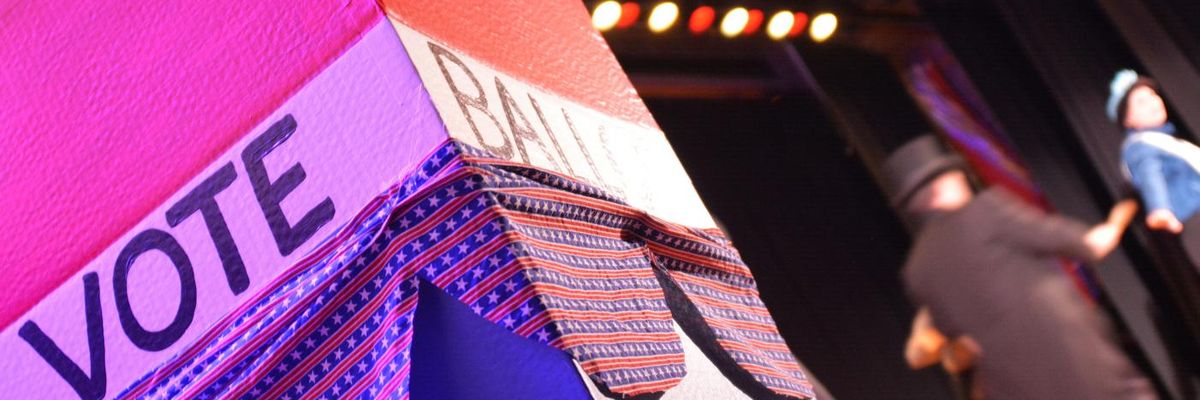
In Wisconsin, Jesse Jackson writes, voter suppression laws have been passed by a conservative Republican legislature despite the fact that there is no evidence of voter fraud to justify them. (Photo: Karie Angell Luc~for Sun-Times Media)
We all have heard about WikiLeaks and Russian interference in the 2016 election. The report of Special Counsel Robert Mueller has once more put that on the front pages. Too often lost in the furor, however, is the far more damaging TrikiLeaks -- the tricks and laws used to suppress the vote by partisans, largely Republicans here at home.
After the Supreme Court's right-wing gang of five gutted key sections of the Voting Rights Act in Shelby v. Holder, Republican-controlled states immediately ramped up efforts to create obstacles for voting, particularly for people of color. They mandated specific forms of state ID, made it harder for students to vote, eliminated same-day registration, reduced early voting days, closed polling booths in African American neighborhoods leading to long delays, purged voters from the rolls, perfected partisan gerrymandering and more. In some cases, as in North Carolina, their discriminatory intent was so public that the laws were overturned in federal court, but in most places, the new barriers were in place in 2016.
Did it make a difference? Voting rights expert Ari Berman says, "absolutely." Overall 14 states had new restrictions in place, passed since the Shelby decision. Look at Wisconsin. Trump won by 22,000 votes. In Wisconsin, 300,000 African American voters didn't have the newly required strict photo ID. Black voter turnout in Milwaukee declined by 51,000 votes from 2012, while as Lawyers Committee President Kristen Clarke noted, voter turnout rates were depressed across the state.
What's clear is that interference with our elections and with the right to vote will come far more from the efforts of domestic politicians than it will come from whatever mischief the Russians plan.
Now we're headed into 2020. Republican bastions like Texas, Tennessee and Arizona witnessed surges of Democratic support in 2018. Not surprisingly, they are launching new efforts to suppress the vote. In Texas, the secretary of state announced a plan to purge 95,000 people from the voter rolls because they weren't citizens. Independent research then demonstrated that in Harris County, which includes Houston, 60 percent of the 30,000 people on the list had received citizenship long ago. Some of the supposed research was 25 years old. Once more citizens had to go to court to try to stop the suppression.
In Texas, state lawmakers are also moving to add criminal penalties for people who improperly fill out voter registration forms, an effort to intimidate nonprofit groups that work to register people to vote. In Arizona, Republicans are making it harder to cast an early ballot. In Tennessee, GOP lawmakers are pushing legislation to fine voter registration groups that submit incomplete forms, even by mistake, up to $10,000. Tequila Johnson, co-founder of the Equity Alliance that focuses on registering people of color, called them out: "We have never seen a bill like this on the floor, until we dared to register 86,000 black and brown people to vote. This screams racism."
Much, much more attention should be paid to this battle. Happily, the new Democratic majority in the House of Representatives has made voting rights a priority. Rep. Elijah Cummings (D-MD.), chair of the House Oversight Committee, has launched an investigation of voter suppression in Georgia in 2018, where the victor, Brian Kemp, oversaw the election as secretary state. And, as Cummings detailed, 1.4 million people were purged from the voting rolls from 2012 to 2016, 53,000 -- 80 percent of them people of color -- had their registrations put on hold; 214 polling places were shuttered, contributing to lines of more than four hours in heavily black precincts.
Some states, happily, are moving to make voting easier and more accessible. Florida citizens passed a historic referendum restoring the right to vote for felons who have paid their debt to society. (Now, Republicans in the legislature are trying to undermine that initiative). Automatic Voting Registration laws have passed in several states. More states are providing longer times for early voting, adding voting booths to reduce long lines and more. Cases to rollback partisan gerrymandering have been successful in federal courts--and now are headed to the Supreme Court. The Brennan Center reports that bills that expand voting rights have seen some movement in 35 states, while those restricting rights have moved in 10 states.
What's clear is that interference with our elections and with the right to vote will come far more from the efforts of domestic politicians than it will come from whatever mischief the Russians plan. It is revealing that the Trump White House has little to say about Russians. It is even more telling that the Justice Department is absent without leave in the fight against voter suppression at home. The right to vote -- the most basic right of a democracy -- is still contested in too many states -- and must be fought, state by state, by citizens of conscience.
Dear Common Dreams reader, It’s been nearly 30 years since I co-founded Common Dreams with my late wife, Lina Newhouser. We had the radical notion that journalism should serve the public good, not corporate profits. It was clear to us from the outset what it would take to build such a project. No paid advertisements. No corporate sponsors. No millionaire publisher telling us what to think or do. Many people said we wouldn't last a year, but we proved those doubters wrong. Together with a tremendous team of journalists and dedicated staff, we built an independent media outlet free from the constraints of profits and corporate control. Our mission has always been simple: To inform. To inspire. To ignite change for the common good. Building Common Dreams was not easy. Our survival was never guaranteed. When you take on the most powerful forces—Wall Street greed, fossil fuel industry destruction, Big Tech lobbyists, and uber-rich oligarchs who have spent billions upon billions rigging the economy and democracy in their favor—the only bulwark you have is supporters who believe in your work. But here’s the urgent message from me today. It's never been this bad out there. And it's never been this hard to keep us going. At the very moment Common Dreams is most needed, the threats we face are intensifying. We need your support now more than ever. We don't accept corporate advertising and never will. We don't have a paywall because we don't think people should be blocked from critical news based on their ability to pay. Everything we do is funded by the donations of readers like you. When everyone does the little they can afford, we are strong. But if that support retreats or dries up, so do we. Will you donate now to make sure Common Dreams not only survives but thrives? —Craig Brown, Co-founder |
We all have heard about WikiLeaks and Russian interference in the 2016 election. The report of Special Counsel Robert Mueller has once more put that on the front pages. Too often lost in the furor, however, is the far more damaging TrikiLeaks -- the tricks and laws used to suppress the vote by partisans, largely Republicans here at home.
After the Supreme Court's right-wing gang of five gutted key sections of the Voting Rights Act in Shelby v. Holder, Republican-controlled states immediately ramped up efforts to create obstacles for voting, particularly for people of color. They mandated specific forms of state ID, made it harder for students to vote, eliminated same-day registration, reduced early voting days, closed polling booths in African American neighborhoods leading to long delays, purged voters from the rolls, perfected partisan gerrymandering and more. In some cases, as in North Carolina, their discriminatory intent was so public that the laws were overturned in federal court, but in most places, the new barriers were in place in 2016.
Did it make a difference? Voting rights expert Ari Berman says, "absolutely." Overall 14 states had new restrictions in place, passed since the Shelby decision. Look at Wisconsin. Trump won by 22,000 votes. In Wisconsin, 300,000 African American voters didn't have the newly required strict photo ID. Black voter turnout in Milwaukee declined by 51,000 votes from 2012, while as Lawyers Committee President Kristen Clarke noted, voter turnout rates were depressed across the state.
What's clear is that interference with our elections and with the right to vote will come far more from the efforts of domestic politicians than it will come from whatever mischief the Russians plan.
Now we're headed into 2020. Republican bastions like Texas, Tennessee and Arizona witnessed surges of Democratic support in 2018. Not surprisingly, they are launching new efforts to suppress the vote. In Texas, the secretary of state announced a plan to purge 95,000 people from the voter rolls because they weren't citizens. Independent research then demonstrated that in Harris County, which includes Houston, 60 percent of the 30,000 people on the list had received citizenship long ago. Some of the supposed research was 25 years old. Once more citizens had to go to court to try to stop the suppression.
In Texas, state lawmakers are also moving to add criminal penalties for people who improperly fill out voter registration forms, an effort to intimidate nonprofit groups that work to register people to vote. In Arizona, Republicans are making it harder to cast an early ballot. In Tennessee, GOP lawmakers are pushing legislation to fine voter registration groups that submit incomplete forms, even by mistake, up to $10,000. Tequila Johnson, co-founder of the Equity Alliance that focuses on registering people of color, called them out: "We have never seen a bill like this on the floor, until we dared to register 86,000 black and brown people to vote. This screams racism."
Much, much more attention should be paid to this battle. Happily, the new Democratic majority in the House of Representatives has made voting rights a priority. Rep. Elijah Cummings (D-MD.), chair of the House Oversight Committee, has launched an investigation of voter suppression in Georgia in 2018, where the victor, Brian Kemp, oversaw the election as secretary state. And, as Cummings detailed, 1.4 million people were purged from the voting rolls from 2012 to 2016, 53,000 -- 80 percent of them people of color -- had their registrations put on hold; 214 polling places were shuttered, contributing to lines of more than four hours in heavily black precincts.
Some states, happily, are moving to make voting easier and more accessible. Florida citizens passed a historic referendum restoring the right to vote for felons who have paid their debt to society. (Now, Republicans in the legislature are trying to undermine that initiative). Automatic Voting Registration laws have passed in several states. More states are providing longer times for early voting, adding voting booths to reduce long lines and more. Cases to rollback partisan gerrymandering have been successful in federal courts--and now are headed to the Supreme Court. The Brennan Center reports that bills that expand voting rights have seen some movement in 35 states, while those restricting rights have moved in 10 states.
What's clear is that interference with our elections and with the right to vote will come far more from the efforts of domestic politicians than it will come from whatever mischief the Russians plan. It is revealing that the Trump White House has little to say about Russians. It is even more telling that the Justice Department is absent without leave in the fight against voter suppression at home. The right to vote -- the most basic right of a democracy -- is still contested in too many states -- and must be fought, state by state, by citizens of conscience.
We all have heard about WikiLeaks and Russian interference in the 2016 election. The report of Special Counsel Robert Mueller has once more put that on the front pages. Too often lost in the furor, however, is the far more damaging TrikiLeaks -- the tricks and laws used to suppress the vote by partisans, largely Republicans here at home.
After the Supreme Court's right-wing gang of five gutted key sections of the Voting Rights Act in Shelby v. Holder, Republican-controlled states immediately ramped up efforts to create obstacles for voting, particularly for people of color. They mandated specific forms of state ID, made it harder for students to vote, eliminated same-day registration, reduced early voting days, closed polling booths in African American neighborhoods leading to long delays, purged voters from the rolls, perfected partisan gerrymandering and more. In some cases, as in North Carolina, their discriminatory intent was so public that the laws were overturned in federal court, but in most places, the new barriers were in place in 2016.
Did it make a difference? Voting rights expert Ari Berman says, "absolutely." Overall 14 states had new restrictions in place, passed since the Shelby decision. Look at Wisconsin. Trump won by 22,000 votes. In Wisconsin, 300,000 African American voters didn't have the newly required strict photo ID. Black voter turnout in Milwaukee declined by 51,000 votes from 2012, while as Lawyers Committee President Kristen Clarke noted, voter turnout rates were depressed across the state.
What's clear is that interference with our elections and with the right to vote will come far more from the efforts of domestic politicians than it will come from whatever mischief the Russians plan.
Now we're headed into 2020. Republican bastions like Texas, Tennessee and Arizona witnessed surges of Democratic support in 2018. Not surprisingly, they are launching new efforts to suppress the vote. In Texas, the secretary of state announced a plan to purge 95,000 people from the voter rolls because they weren't citizens. Independent research then demonstrated that in Harris County, which includes Houston, 60 percent of the 30,000 people on the list had received citizenship long ago. Some of the supposed research was 25 years old. Once more citizens had to go to court to try to stop the suppression.
In Texas, state lawmakers are also moving to add criminal penalties for people who improperly fill out voter registration forms, an effort to intimidate nonprofit groups that work to register people to vote. In Arizona, Republicans are making it harder to cast an early ballot. In Tennessee, GOP lawmakers are pushing legislation to fine voter registration groups that submit incomplete forms, even by mistake, up to $10,000. Tequila Johnson, co-founder of the Equity Alliance that focuses on registering people of color, called them out: "We have never seen a bill like this on the floor, until we dared to register 86,000 black and brown people to vote. This screams racism."
Much, much more attention should be paid to this battle. Happily, the new Democratic majority in the House of Representatives has made voting rights a priority. Rep. Elijah Cummings (D-MD.), chair of the House Oversight Committee, has launched an investigation of voter suppression in Georgia in 2018, where the victor, Brian Kemp, oversaw the election as secretary state. And, as Cummings detailed, 1.4 million people were purged from the voting rolls from 2012 to 2016, 53,000 -- 80 percent of them people of color -- had their registrations put on hold; 214 polling places were shuttered, contributing to lines of more than four hours in heavily black precincts.
Some states, happily, are moving to make voting easier and more accessible. Florida citizens passed a historic referendum restoring the right to vote for felons who have paid their debt to society. (Now, Republicans in the legislature are trying to undermine that initiative). Automatic Voting Registration laws have passed in several states. More states are providing longer times for early voting, adding voting booths to reduce long lines and more. Cases to rollback partisan gerrymandering have been successful in federal courts--and now are headed to the Supreme Court. The Brennan Center reports that bills that expand voting rights have seen some movement in 35 states, while those restricting rights have moved in 10 states.
What's clear is that interference with our elections and with the right to vote will come far more from the efforts of domestic politicians than it will come from whatever mischief the Russians plan. It is revealing that the Trump White House has little to say about Russians. It is even more telling that the Justice Department is absent without leave in the fight against voter suppression at home. The right to vote -- the most basic right of a democracy -- is still contested in too many states -- and must be fought, state by state, by citizens of conscience.