

SUBSCRIBE TO OUR FREE NEWSLETTER
Daily news & progressive opinion—funded by the people, not the corporations—delivered straight to your inbox.
5
#000000
#FFFFFF
To donate by check, phone, or other method, see our More Ways to Give page.
Daily news & progressive opinion—funded by the people, not the corporations—delivered straight to your inbox.
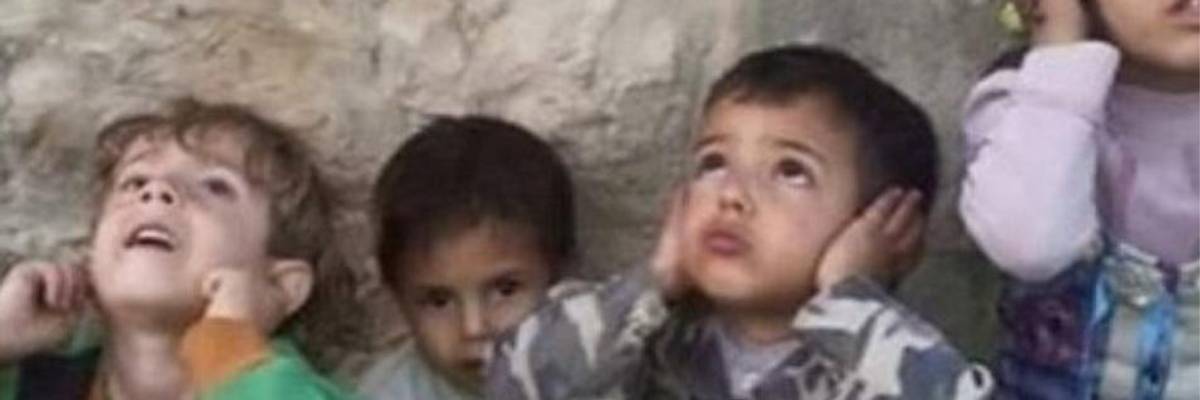
Yemeni children cover their ears as Saudi-allied planes bomb residential neighborhoods, April 2015. (Photo: Felton Davis)
At 9:30 in the morning of March 26, the start of the fifth year of the Saudi-led coalition war against Yemen, the entrance to a rural hospital in the northwest part of the country was teeming as patients waited to be seen and employees arrived at work. Suddenly, missiles from an airstrike hit the hospital, killing seven people, four of them children.
Jason Lee of Save the Children, told The New York Times that the Saudi-led coalition, now in its fifth year of waging war in Yemen, knew the coordinates of the hospital and should have been able to avoid the strike. He called what happened "a gross violation of humanitarian law."
The day before, Save the Children reported that air raids carried out by the Saudi-led coalition have killed at least 226 Yemeni children and injured 217 more in just the last twelve months. "Of these children," the report noted, "210 were inside or close to a house when their lives were torn apart by bombs that had been sold to the coalition by foreign governments."
Last year, an analysis issued by Save the Children estimated that 85,000 children under age five have likely died from starvation or disease since the Saudi-led coalition's 2015 escalation of the war in Yemen.
"Children who die in this way suffer immensely as their vital organ functions slow down and eventually stop," said Tamer Kirolos, Save the Children's Country Director in Yemen. "Their immune systems are so weak they are more prone to infections with some too frail to even cry. Parents are having to witness their children wasting away, unable to do anything about it." Kirolos and others who have continuously reported on the war in Yemen believe these deaths are entirely preventable. They are demanding an immediate suspension of arms sales to all warring parties, an end to blockades preventing distribution of food, fuel and humanitarian aid and the application of full diplomatic pressure to end the war.
The United States, a major supporter of the Saudi-led coalition, has itself been guilty of killing innocent patients and hospital workers by bombing a hospital. On October 3, 2015, U.S. airstrikes destroyed a Medecins Sans Frontieres (Doctors Without Borders) hospital in Kunduz, Afghanistan, killing forty-two people. "Patients burned in their beds," MSF reported, "medical staff were decapitated and lost limbs, and others were shot from the air while they fled the burning building."
"The United States, a major supporter of the Saudi-led coalition, has itself been guilty of killing innocent patients and hospital workers by bombing a hospital."
More recently, on March 23, 2019, eight children were among fourteen Afghan civilians killed by a U.S. airstrike also near Kunduz.
Atrocities of war accumulate, horrifically. We in the United States have yet to realize both the futility and immense consequences of war. We continue to develop, store, sell, and use hideous weapons. We rob ourselves and others of resources needed to meet human needs, including grappling with the terrifying realities of climate change.
We should heed the words and actions of Eglantyne Jebb, who founded Save the Children a century ago. Responding to the British post-war blockade of Germany and Eastern Europe, Jebb participated in a group attempting to deliver food and medical supplies to children who were starving.
In London's Trafalgar Square, she distributed a leaflet showing the emaciated children and declaring: "Our blockade has caused this, - millions of children are starving to death." She was arrested, tried, convicted, and fined. But the judge in the case was moved by her commitment to children and paid her fine. His generosity was Save the Children's first donation.
"Every war," said Jebb, "is a war against children."
Dear Common Dreams reader, It’s been nearly 30 years since I co-founded Common Dreams with my late wife, Lina Newhouser. We had the radical notion that journalism should serve the public good, not corporate profits. It was clear to us from the outset what it would take to build such a project. No paid advertisements. No corporate sponsors. No millionaire publisher telling us what to think or do. Many people said we wouldn't last a year, but we proved those doubters wrong. Together with a tremendous team of journalists and dedicated staff, we built an independent media outlet free from the constraints of profits and corporate control. Our mission has always been simple: To inform. To inspire. To ignite change for the common good. Building Common Dreams was not easy. Our survival was never guaranteed. When you take on the most powerful forces—Wall Street greed, fossil fuel industry destruction, Big Tech lobbyists, and uber-rich oligarchs who have spent billions upon billions rigging the economy and democracy in their favor—the only bulwark you have is supporters who believe in your work. But here’s the urgent message from me today. It's never been this bad out there. And it's never been this hard to keep us going. At the very moment Common Dreams is most needed, the threats we face are intensifying. We need your support now more than ever. We don't accept corporate advertising and never will. We don't have a paywall because we don't think people should be blocked from critical news based on their ability to pay. Everything we do is funded by the donations of readers like you. When everyone does the little they can afford, we are strong. But if that support retreats or dries up, so do we. Will you donate now to make sure Common Dreams not only survives but thrives? —Craig Brown, Co-founder |
At 9:30 in the morning of March 26, the start of the fifth year of the Saudi-led coalition war against Yemen, the entrance to a rural hospital in the northwest part of the country was teeming as patients waited to be seen and employees arrived at work. Suddenly, missiles from an airstrike hit the hospital, killing seven people, four of them children.
Jason Lee of Save the Children, told The New York Times that the Saudi-led coalition, now in its fifth year of waging war in Yemen, knew the coordinates of the hospital and should have been able to avoid the strike. He called what happened "a gross violation of humanitarian law."
The day before, Save the Children reported that air raids carried out by the Saudi-led coalition have killed at least 226 Yemeni children and injured 217 more in just the last twelve months. "Of these children," the report noted, "210 were inside or close to a house when their lives were torn apart by bombs that had been sold to the coalition by foreign governments."
Last year, an analysis issued by Save the Children estimated that 85,000 children under age five have likely died from starvation or disease since the Saudi-led coalition's 2015 escalation of the war in Yemen.
"Children who die in this way suffer immensely as their vital organ functions slow down and eventually stop," said Tamer Kirolos, Save the Children's Country Director in Yemen. "Their immune systems are so weak they are more prone to infections with some too frail to even cry. Parents are having to witness their children wasting away, unable to do anything about it." Kirolos and others who have continuously reported on the war in Yemen believe these deaths are entirely preventable. They are demanding an immediate suspension of arms sales to all warring parties, an end to blockades preventing distribution of food, fuel and humanitarian aid and the application of full diplomatic pressure to end the war.
The United States, a major supporter of the Saudi-led coalition, has itself been guilty of killing innocent patients and hospital workers by bombing a hospital. On October 3, 2015, U.S. airstrikes destroyed a Medecins Sans Frontieres (Doctors Without Borders) hospital in Kunduz, Afghanistan, killing forty-two people. "Patients burned in their beds," MSF reported, "medical staff were decapitated and lost limbs, and others were shot from the air while they fled the burning building."
"The United States, a major supporter of the Saudi-led coalition, has itself been guilty of killing innocent patients and hospital workers by bombing a hospital."
More recently, on March 23, 2019, eight children were among fourteen Afghan civilians killed by a U.S. airstrike also near Kunduz.
Atrocities of war accumulate, horrifically. We in the United States have yet to realize both the futility and immense consequences of war. We continue to develop, store, sell, and use hideous weapons. We rob ourselves and others of resources needed to meet human needs, including grappling with the terrifying realities of climate change.
We should heed the words and actions of Eglantyne Jebb, who founded Save the Children a century ago. Responding to the British post-war blockade of Germany and Eastern Europe, Jebb participated in a group attempting to deliver food and medical supplies to children who were starving.
In London's Trafalgar Square, she distributed a leaflet showing the emaciated children and declaring: "Our blockade has caused this, - millions of children are starving to death." She was arrested, tried, convicted, and fined. But the judge in the case was moved by her commitment to children and paid her fine. His generosity was Save the Children's first donation.
"Every war," said Jebb, "is a war against children."
At 9:30 in the morning of March 26, the start of the fifth year of the Saudi-led coalition war against Yemen, the entrance to a rural hospital in the northwest part of the country was teeming as patients waited to be seen and employees arrived at work. Suddenly, missiles from an airstrike hit the hospital, killing seven people, four of them children.
Jason Lee of Save the Children, told The New York Times that the Saudi-led coalition, now in its fifth year of waging war in Yemen, knew the coordinates of the hospital and should have been able to avoid the strike. He called what happened "a gross violation of humanitarian law."
The day before, Save the Children reported that air raids carried out by the Saudi-led coalition have killed at least 226 Yemeni children and injured 217 more in just the last twelve months. "Of these children," the report noted, "210 were inside or close to a house when their lives were torn apart by bombs that had been sold to the coalition by foreign governments."
Last year, an analysis issued by Save the Children estimated that 85,000 children under age five have likely died from starvation or disease since the Saudi-led coalition's 2015 escalation of the war in Yemen.
"Children who die in this way suffer immensely as their vital organ functions slow down and eventually stop," said Tamer Kirolos, Save the Children's Country Director in Yemen. "Their immune systems are so weak they are more prone to infections with some too frail to even cry. Parents are having to witness their children wasting away, unable to do anything about it." Kirolos and others who have continuously reported on the war in Yemen believe these deaths are entirely preventable. They are demanding an immediate suspension of arms sales to all warring parties, an end to blockades preventing distribution of food, fuel and humanitarian aid and the application of full diplomatic pressure to end the war.
The United States, a major supporter of the Saudi-led coalition, has itself been guilty of killing innocent patients and hospital workers by bombing a hospital. On October 3, 2015, U.S. airstrikes destroyed a Medecins Sans Frontieres (Doctors Without Borders) hospital in Kunduz, Afghanistan, killing forty-two people. "Patients burned in their beds," MSF reported, "medical staff were decapitated and lost limbs, and others were shot from the air while they fled the burning building."
"The United States, a major supporter of the Saudi-led coalition, has itself been guilty of killing innocent patients and hospital workers by bombing a hospital."
More recently, on March 23, 2019, eight children were among fourteen Afghan civilians killed by a U.S. airstrike also near Kunduz.
Atrocities of war accumulate, horrifically. We in the United States have yet to realize both the futility and immense consequences of war. We continue to develop, store, sell, and use hideous weapons. We rob ourselves and others of resources needed to meet human needs, including grappling with the terrifying realities of climate change.
We should heed the words and actions of Eglantyne Jebb, who founded Save the Children a century ago. Responding to the British post-war blockade of Germany and Eastern Europe, Jebb participated in a group attempting to deliver food and medical supplies to children who were starving.
In London's Trafalgar Square, she distributed a leaflet showing the emaciated children and declaring: "Our blockade has caused this, - millions of children are starving to death." She was arrested, tried, convicted, and fined. But the judge in the case was moved by her commitment to children and paid her fine. His generosity was Save the Children's first donation.
"Every war," said Jebb, "is a war against children."

