SUBSCRIBE TO OUR FREE NEWSLETTER
Daily news & progressive opinion—funded by the people, not the corporations—delivered straight to your inbox.
5
#000000
#FFFFFF
To donate by check, phone, or other method, see our More Ways to Give page.
Daily news & progressive opinion—funded by the people, not the corporations—delivered straight to your inbox.
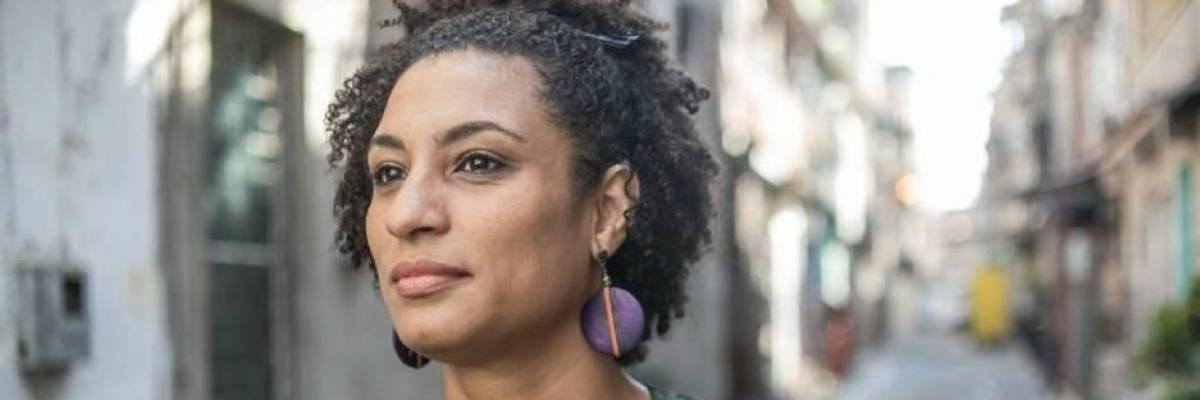
The four bullets that killed Marielle in downtown Rio de Janeiro, which were once owned by the Federal Police of Brazil, have not stopped her from being an empowering source of support for black people and people of color across the world. (Photo: Democracy Now!)
March 14 will mark the first anniversary of Brazilian politician Marielle Franco's assassination--but on Sunday, the second day of Sao Paulo Carnaval, her legacy as a powerful and empowering black, gay, single mother was celebrated without apology. For women of color in Brazil and beyond, this was a demonstration of united strength--not just power.
Hundreds of community members participating in the Vai-Vai parade paid homage to Marielle Sunday morning--a photo of her and the words "Marielle Presente" (Marielle is here) faced the sky in mosaic form. And beneath each of the 32 tiles were bodies full of the healthy energy and force that come from resistance.
Marielle's sister, Anielle Franco, and Marielle's daughter, Luyara Santos, took part in the celebration. Holding back tears at dawn to honor the sparkle and joy the world has seen in the images of Marielle Franco that have circulated this past year, her sister and daughter announced to the world: "Ela estava ao lado do povo negro." She was on the side of the black people. And the four bullets that killed Marielle in downtown Rio de Janeiro, which were once owned by the Federal Police of Brazil, have not stopped her from being an empowering source of support for black people and people of color across the world.
Just months after her death, "artivists" (artist-activists) from Nairobi built an exhibit--"Portraits of Marielle: Creating Bridges between Kenya and Brazil"--held at the Mare Museum to celebrate the legacy of Marielle and to identify her death as a node for south-south solidarity. Throughout the past year, women of color from Dublin to Barcelona have gathered in her name, also recognizing the bridge that needed to be built between Marielle's fight in Brazil and their own. And now, the representation of Marielle at this year's Carnaval is another invitation to consider Marielle's roaring platform as a global one--she was a mother who wanted a better world for her daughter, as can be seen between the lines in an interview she gave in the favela that was once her home.
The day before her assassination, Marielle asked one of the saddest and most relevant questions of our time: "How many more will have to die for this war to end?"
Marielle Franco's face is painted on the walls of Sao Paulo at several intersections. The dark outline of her face reminds passersby of the stakes involved in resistance. The day before her assassination, Marielle asked one of the saddest and most relevant questions of our time: "How many more will have to die for this war to end?" There is no answer in sight for this query. And there is no geographical boundary for it either.
When we speak of the war against dark skin, the war against women, or the war against the dispossessed, the assassination of Marielle Franco is a reminder that the punishment for resisting the parameters imposed by racism, sexism, and persons from low-income sectors that take shape as favelas, slums, and ghettos can always be death, and not simply emotional discomfort. Resistance has consequences.
The name and image of Marielle Franco--an intersectional representation of the many wars being fought--serves as more than just a reminder. Speaking her name, sharing her image is in itself an act of resistance. The people of Vai-Vai were bold Sunday morning--to the people across the globe, there is an obligation to support them.
This article was produced by Globetrotter, a project of the Independent Media Institute.
Dear Common Dreams reader, It’s been nearly 30 years since I co-founded Common Dreams with my late wife, Lina Newhouser. We had the radical notion that journalism should serve the public good, not corporate profits. It was clear to us from the outset what it would take to build such a project. No paid advertisements. No corporate sponsors. No millionaire publisher telling us what to think or do. Many people said we wouldn't last a year, but we proved those doubters wrong. Together with a tremendous team of journalists and dedicated staff, we built an independent media outlet free from the constraints of profits and corporate control. Our mission has always been simple: To inform. To inspire. To ignite change for the common good. Building Common Dreams was not easy. Our survival was never guaranteed. When you take on the most powerful forces—Wall Street greed, fossil fuel industry destruction, Big Tech lobbyists, and uber-rich oligarchs who have spent billions upon billions rigging the economy and democracy in their favor—the only bulwark you have is supporters who believe in your work. But here’s the urgent message from me today. It's never been this bad out there. And it's never been this hard to keep us going. At the very moment Common Dreams is most needed, the threats we face are intensifying. We need your support now more than ever. We don't accept corporate advertising and never will. We don't have a paywall because we don't think people should be blocked from critical news based on their ability to pay. Everything we do is funded by the donations of readers like you. When everyone does the little they can afford, we are strong. But if that support retreats or dries up, so do we. Will you donate now to make sure Common Dreams not only survives but thrives? —Craig Brown, Co-founder |
March 14 will mark the first anniversary of Brazilian politician Marielle Franco's assassination--but on Sunday, the second day of Sao Paulo Carnaval, her legacy as a powerful and empowering black, gay, single mother was celebrated without apology. For women of color in Brazil and beyond, this was a demonstration of united strength--not just power.
Hundreds of community members participating in the Vai-Vai parade paid homage to Marielle Sunday morning--a photo of her and the words "Marielle Presente" (Marielle is here) faced the sky in mosaic form. And beneath each of the 32 tiles were bodies full of the healthy energy and force that come from resistance.
Marielle's sister, Anielle Franco, and Marielle's daughter, Luyara Santos, took part in the celebration. Holding back tears at dawn to honor the sparkle and joy the world has seen in the images of Marielle Franco that have circulated this past year, her sister and daughter announced to the world: "Ela estava ao lado do povo negro." She was on the side of the black people. And the four bullets that killed Marielle in downtown Rio de Janeiro, which were once owned by the Federal Police of Brazil, have not stopped her from being an empowering source of support for black people and people of color across the world.
Just months after her death, "artivists" (artist-activists) from Nairobi built an exhibit--"Portraits of Marielle: Creating Bridges between Kenya and Brazil"--held at the Mare Museum to celebrate the legacy of Marielle and to identify her death as a node for south-south solidarity. Throughout the past year, women of color from Dublin to Barcelona have gathered in her name, also recognizing the bridge that needed to be built between Marielle's fight in Brazil and their own. And now, the representation of Marielle at this year's Carnaval is another invitation to consider Marielle's roaring platform as a global one--she was a mother who wanted a better world for her daughter, as can be seen between the lines in an interview she gave in the favela that was once her home.
The day before her assassination, Marielle asked one of the saddest and most relevant questions of our time: "How many more will have to die for this war to end?"
Marielle Franco's face is painted on the walls of Sao Paulo at several intersections. The dark outline of her face reminds passersby of the stakes involved in resistance. The day before her assassination, Marielle asked one of the saddest and most relevant questions of our time: "How many more will have to die for this war to end?" There is no answer in sight for this query. And there is no geographical boundary for it either.
When we speak of the war against dark skin, the war against women, or the war against the dispossessed, the assassination of Marielle Franco is a reminder that the punishment for resisting the parameters imposed by racism, sexism, and persons from low-income sectors that take shape as favelas, slums, and ghettos can always be death, and not simply emotional discomfort. Resistance has consequences.
The name and image of Marielle Franco--an intersectional representation of the many wars being fought--serves as more than just a reminder. Speaking her name, sharing her image is in itself an act of resistance. The people of Vai-Vai were bold Sunday morning--to the people across the globe, there is an obligation to support them.
This article was produced by Globetrotter, a project of the Independent Media Institute.
March 14 will mark the first anniversary of Brazilian politician Marielle Franco's assassination--but on Sunday, the second day of Sao Paulo Carnaval, her legacy as a powerful and empowering black, gay, single mother was celebrated without apology. For women of color in Brazil and beyond, this was a demonstration of united strength--not just power.
Hundreds of community members participating in the Vai-Vai parade paid homage to Marielle Sunday morning--a photo of her and the words "Marielle Presente" (Marielle is here) faced the sky in mosaic form. And beneath each of the 32 tiles were bodies full of the healthy energy and force that come from resistance.
Marielle's sister, Anielle Franco, and Marielle's daughter, Luyara Santos, took part in the celebration. Holding back tears at dawn to honor the sparkle and joy the world has seen in the images of Marielle Franco that have circulated this past year, her sister and daughter announced to the world: "Ela estava ao lado do povo negro." She was on the side of the black people. And the four bullets that killed Marielle in downtown Rio de Janeiro, which were once owned by the Federal Police of Brazil, have not stopped her from being an empowering source of support for black people and people of color across the world.
Just months after her death, "artivists" (artist-activists) from Nairobi built an exhibit--"Portraits of Marielle: Creating Bridges between Kenya and Brazil"--held at the Mare Museum to celebrate the legacy of Marielle and to identify her death as a node for south-south solidarity. Throughout the past year, women of color from Dublin to Barcelona have gathered in her name, also recognizing the bridge that needed to be built between Marielle's fight in Brazil and their own. And now, the representation of Marielle at this year's Carnaval is another invitation to consider Marielle's roaring platform as a global one--she was a mother who wanted a better world for her daughter, as can be seen between the lines in an interview she gave in the favela that was once her home.
The day before her assassination, Marielle asked one of the saddest and most relevant questions of our time: "How many more will have to die for this war to end?"
Marielle Franco's face is painted on the walls of Sao Paulo at several intersections. The dark outline of her face reminds passersby of the stakes involved in resistance. The day before her assassination, Marielle asked one of the saddest and most relevant questions of our time: "How many more will have to die for this war to end?" There is no answer in sight for this query. And there is no geographical boundary for it either.
When we speak of the war against dark skin, the war against women, or the war against the dispossessed, the assassination of Marielle Franco is a reminder that the punishment for resisting the parameters imposed by racism, sexism, and persons from low-income sectors that take shape as favelas, slums, and ghettos can always be death, and not simply emotional discomfort. Resistance has consequences.
The name and image of Marielle Franco--an intersectional representation of the many wars being fought--serves as more than just a reminder. Speaking her name, sharing her image is in itself an act of resistance. The people of Vai-Vai were bold Sunday morning--to the people across the globe, there is an obligation to support them.
This article was produced by Globetrotter, a project of the Independent Media Institute.