SUBSCRIBE TO OUR FREE NEWSLETTER
Daily news & progressive opinion—funded by the people, not the corporations—delivered straight to your inbox.
5
#000000
#FFFFFF
To donate by check, phone, or other method, see our More Ways to Give page.
Daily news & progressive opinion—funded by the people, not the corporations—delivered straight to your inbox.
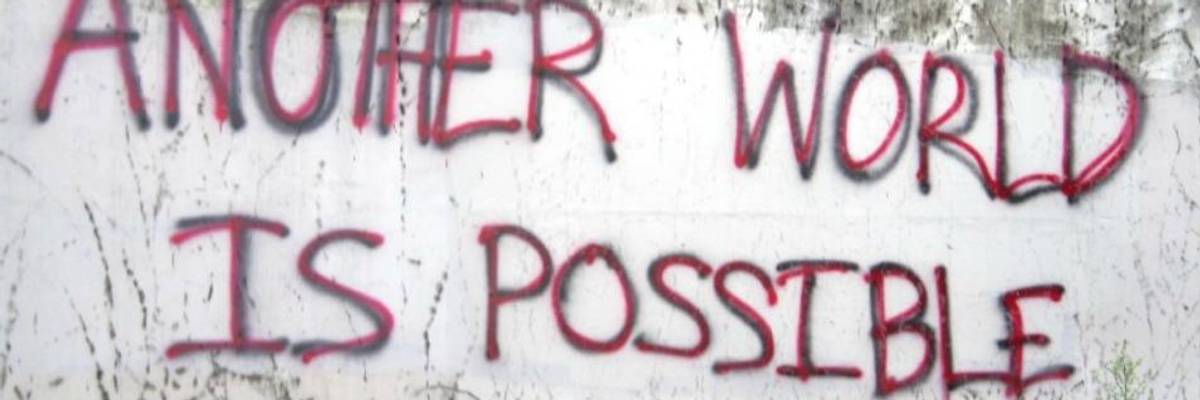
The rise of the World Social Forum gave a permanent home to the phrase, 'Another world is possible.'
The Green New Deal is the most ambitious climate plan in Congress.
Developed through years of grassroots activism and propelled to fame by the rising star of Alexandria Ocasio-Cortez, the proposal has attracted the support of more than 40 members of Congress, Senators from Sanders to Booker, and even 64% of registered Republican voters.
While the details remain unclear, the general outline - a comprehensive, state-led transition to 100% renewable energy, founded on green jobs and economic justice - is both popular and necessary. Without a dramatic overhaul of the American economy, averting climate change will be impossible.
But domestic policies won't be enough.
From the birth of neoliberalism in the 70's through the rapid economic globalization of the 90's, the ruling parties of the Global North have spent decades constructing a global economic system rigged in the interests of capital.
Placing short-term profits for the rich and powerful over the long-term wellbeing of people and planet, this system is specifically designed to undermine national programs like the Green New Deal.
Under this system, capital and corporations (but not people) are allowed to cross borders at will. Powerless to the threat of abandonment, even well-meaning governments are forced to cater to capital's whims, slashing environmental and labor regulations in the hopes of attracting investment. The "global race to the bottom" begins.
Under this system, countries like the United States can feign environmental progress by outsourcing their pollution to the Global South. America regulates a dirty industry. The industry, unfettered by the corporate-friendly global governance that America helped build, moves to a new country and continues to pollute freely. America imports its products and blames the South.
Under this system, Southern nations that try to shield themselves from the whims of the global market and develop self-sufficient, local economies are punished. Institutions like the World Trade Organization (WTO), the International Monetary Fund (IMF), and the World Bank wield their financial weight like a battering ram against protections, demanding cheap goods for export to the North. In the food system, this means forcing small-scale, sustainable farmers to abandon their land to environmentally untenable industrial cash crops.
Under this system, the global elite have exclusive access to shady networks of shell companies and tax havens. Globally, an estimated $32 trillion sits untouched in tax havens. That's over $250 billion in lost tax revenue for programs like the Green New Deal.
Under this system, corporations can even sue national governments for regulating them. Through the Investor-State Dispute Settlement (ISDS) mechanism built into many "free trade" agreements, countries enacting legitimate environmental regulations risk being forced to pay billions in restitution by an opaque, corporate-dominated international court. Ecuador is currently facing just such litigation for ordering Chevron to pay compensation after dumping "billions of gallons of toxic water and [digging] hundreds of open-air oil sludge pits in Ecuador's Amazon, poisoning the communities of some 30,000 Amazon residents."
And under this system, when neoliberal policies reach their inevitably disastrous conclusion, the rich seize on the ensuing crises to further the neoliberal agenda, while right-wing demagogues rise to power scapegoating their victims.
At its root, climate change is a consequence of the power of capital. Neoliberal globalization is one of the greatest power grabs in history.
Domestic policies like the Green New Deal, however necessary, are insufficient. To prevent global climate collapse and the emergent right-wing authoritarianism that lurks in its wings, the global economy must be radically restructured.
Restrict the movement of corporations and capital. End ISDS. Renegotiate "free trade" agreements. Stop tax havens. Dismantle and rebuild alternatives to the WTO, IMF, and World Bank. Reform and strengthen the UN. Empower national governments to regulate corporate interests. Build self-sufficient local economies.
Though the alter-globalization movement that once drew 40,000 to the streets of Seattle to protest the WTO is weaker today than it was 20 years ago, there is much to be learned from its example. In 2004, members of this movement drafted a vision of a global economic system that works for both people and planet. The subtitle of that prescient manifesto reads: "A better world is possible."
It still it is. But only if we look beyond our borders and build a truly global movement to fight for it.
Dear Common Dreams reader, It’s been nearly 30 years since I co-founded Common Dreams with my late wife, Lina Newhouser. We had the radical notion that journalism should serve the public good, not corporate profits. It was clear to us from the outset what it would take to build such a project. No paid advertisements. No corporate sponsors. No millionaire publisher telling us what to think or do. Many people said we wouldn't last a year, but we proved those doubters wrong. Together with a tremendous team of journalists and dedicated staff, we built an independent media outlet free from the constraints of profits and corporate control. Our mission has always been simple: To inform. To inspire. To ignite change for the common good. Building Common Dreams was not easy. Our survival was never guaranteed. When you take on the most powerful forces—Wall Street greed, fossil fuel industry destruction, Big Tech lobbyists, and uber-rich oligarchs who have spent billions upon billions rigging the economy and democracy in their favor—the only bulwark you have is supporters who believe in your work. But here’s the urgent message from me today. It's never been this bad out there. And it's never been this hard to keep us going. At the very moment Common Dreams is most needed, the threats we face are intensifying. We need your support now more than ever. We don't accept corporate advertising and never will. We don't have a paywall because we don't think people should be blocked from critical news based on their ability to pay. Everything we do is funded by the donations of readers like you. When everyone does the little they can afford, we are strong. But if that support retreats or dries up, so do we. Will you donate now to make sure Common Dreams not only survives but thrives? —Craig Brown, Co-founder |
The Green New Deal is the most ambitious climate plan in Congress.
Developed through years of grassroots activism and propelled to fame by the rising star of Alexandria Ocasio-Cortez, the proposal has attracted the support of more than 40 members of Congress, Senators from Sanders to Booker, and even 64% of registered Republican voters.
While the details remain unclear, the general outline - a comprehensive, state-led transition to 100% renewable energy, founded on green jobs and economic justice - is both popular and necessary. Without a dramatic overhaul of the American economy, averting climate change will be impossible.
But domestic policies won't be enough.
From the birth of neoliberalism in the 70's through the rapid economic globalization of the 90's, the ruling parties of the Global North have spent decades constructing a global economic system rigged in the interests of capital.
Placing short-term profits for the rich and powerful over the long-term wellbeing of people and planet, this system is specifically designed to undermine national programs like the Green New Deal.
Under this system, capital and corporations (but not people) are allowed to cross borders at will. Powerless to the threat of abandonment, even well-meaning governments are forced to cater to capital's whims, slashing environmental and labor regulations in the hopes of attracting investment. The "global race to the bottom" begins.
Under this system, countries like the United States can feign environmental progress by outsourcing their pollution to the Global South. America regulates a dirty industry. The industry, unfettered by the corporate-friendly global governance that America helped build, moves to a new country and continues to pollute freely. America imports its products and blames the South.
Under this system, Southern nations that try to shield themselves from the whims of the global market and develop self-sufficient, local economies are punished. Institutions like the World Trade Organization (WTO), the International Monetary Fund (IMF), and the World Bank wield their financial weight like a battering ram against protections, demanding cheap goods for export to the North. In the food system, this means forcing small-scale, sustainable farmers to abandon their land to environmentally untenable industrial cash crops.
Under this system, the global elite have exclusive access to shady networks of shell companies and tax havens. Globally, an estimated $32 trillion sits untouched in tax havens. That's over $250 billion in lost tax revenue for programs like the Green New Deal.
Under this system, corporations can even sue national governments for regulating them. Through the Investor-State Dispute Settlement (ISDS) mechanism built into many "free trade" agreements, countries enacting legitimate environmental regulations risk being forced to pay billions in restitution by an opaque, corporate-dominated international court. Ecuador is currently facing just such litigation for ordering Chevron to pay compensation after dumping "billions of gallons of toxic water and [digging] hundreds of open-air oil sludge pits in Ecuador's Amazon, poisoning the communities of some 30,000 Amazon residents."
And under this system, when neoliberal policies reach their inevitably disastrous conclusion, the rich seize on the ensuing crises to further the neoliberal agenda, while right-wing demagogues rise to power scapegoating their victims.
At its root, climate change is a consequence of the power of capital. Neoliberal globalization is one of the greatest power grabs in history.
Domestic policies like the Green New Deal, however necessary, are insufficient. To prevent global climate collapse and the emergent right-wing authoritarianism that lurks in its wings, the global economy must be radically restructured.
Restrict the movement of corporations and capital. End ISDS. Renegotiate "free trade" agreements. Stop tax havens. Dismantle and rebuild alternatives to the WTO, IMF, and World Bank. Reform and strengthen the UN. Empower national governments to regulate corporate interests. Build self-sufficient local economies.
Though the alter-globalization movement that once drew 40,000 to the streets of Seattle to protest the WTO is weaker today than it was 20 years ago, there is much to be learned from its example. In 2004, members of this movement drafted a vision of a global economic system that works for both people and planet. The subtitle of that prescient manifesto reads: "A better world is possible."
It still it is. But only if we look beyond our borders and build a truly global movement to fight for it.
The Green New Deal is the most ambitious climate plan in Congress.
Developed through years of grassroots activism and propelled to fame by the rising star of Alexandria Ocasio-Cortez, the proposal has attracted the support of more than 40 members of Congress, Senators from Sanders to Booker, and even 64% of registered Republican voters.
While the details remain unclear, the general outline - a comprehensive, state-led transition to 100% renewable energy, founded on green jobs and economic justice - is both popular and necessary. Without a dramatic overhaul of the American economy, averting climate change will be impossible.
But domestic policies won't be enough.
From the birth of neoliberalism in the 70's through the rapid economic globalization of the 90's, the ruling parties of the Global North have spent decades constructing a global economic system rigged in the interests of capital.
Placing short-term profits for the rich and powerful over the long-term wellbeing of people and planet, this system is specifically designed to undermine national programs like the Green New Deal.
Under this system, capital and corporations (but not people) are allowed to cross borders at will. Powerless to the threat of abandonment, even well-meaning governments are forced to cater to capital's whims, slashing environmental and labor regulations in the hopes of attracting investment. The "global race to the bottom" begins.
Under this system, countries like the United States can feign environmental progress by outsourcing their pollution to the Global South. America regulates a dirty industry. The industry, unfettered by the corporate-friendly global governance that America helped build, moves to a new country and continues to pollute freely. America imports its products and blames the South.
Under this system, Southern nations that try to shield themselves from the whims of the global market and develop self-sufficient, local economies are punished. Institutions like the World Trade Organization (WTO), the International Monetary Fund (IMF), and the World Bank wield their financial weight like a battering ram against protections, demanding cheap goods for export to the North. In the food system, this means forcing small-scale, sustainable farmers to abandon their land to environmentally untenable industrial cash crops.
Under this system, the global elite have exclusive access to shady networks of shell companies and tax havens. Globally, an estimated $32 trillion sits untouched in tax havens. That's over $250 billion in lost tax revenue for programs like the Green New Deal.
Under this system, corporations can even sue national governments for regulating them. Through the Investor-State Dispute Settlement (ISDS) mechanism built into many "free trade" agreements, countries enacting legitimate environmental regulations risk being forced to pay billions in restitution by an opaque, corporate-dominated international court. Ecuador is currently facing just such litigation for ordering Chevron to pay compensation after dumping "billions of gallons of toxic water and [digging] hundreds of open-air oil sludge pits in Ecuador's Amazon, poisoning the communities of some 30,000 Amazon residents."
And under this system, when neoliberal policies reach their inevitably disastrous conclusion, the rich seize on the ensuing crises to further the neoliberal agenda, while right-wing demagogues rise to power scapegoating their victims.
At its root, climate change is a consequence of the power of capital. Neoliberal globalization is one of the greatest power grabs in history.
Domestic policies like the Green New Deal, however necessary, are insufficient. To prevent global climate collapse and the emergent right-wing authoritarianism that lurks in its wings, the global economy must be radically restructured.
Restrict the movement of corporations and capital. End ISDS. Renegotiate "free trade" agreements. Stop tax havens. Dismantle and rebuild alternatives to the WTO, IMF, and World Bank. Reform and strengthen the UN. Empower national governments to regulate corporate interests. Build self-sufficient local economies.
Though the alter-globalization movement that once drew 40,000 to the streets of Seattle to protest the WTO is weaker today than it was 20 years ago, there is much to be learned from its example. In 2004, members of this movement drafted a vision of a global economic system that works for both people and planet. The subtitle of that prescient manifesto reads: "A better world is possible."
It still it is. But only if we look beyond our borders and build a truly global movement to fight for it.