SUBSCRIBE TO OUR FREE NEWSLETTER
Daily news & progressive opinion—funded by the people, not the corporations—delivered straight to your inbox.
5
#000000
#FFFFFF
To donate by check, phone, or other method, see our More Ways to Give page.
Daily news & progressive opinion—funded by the people, not the corporations—delivered straight to your inbox.
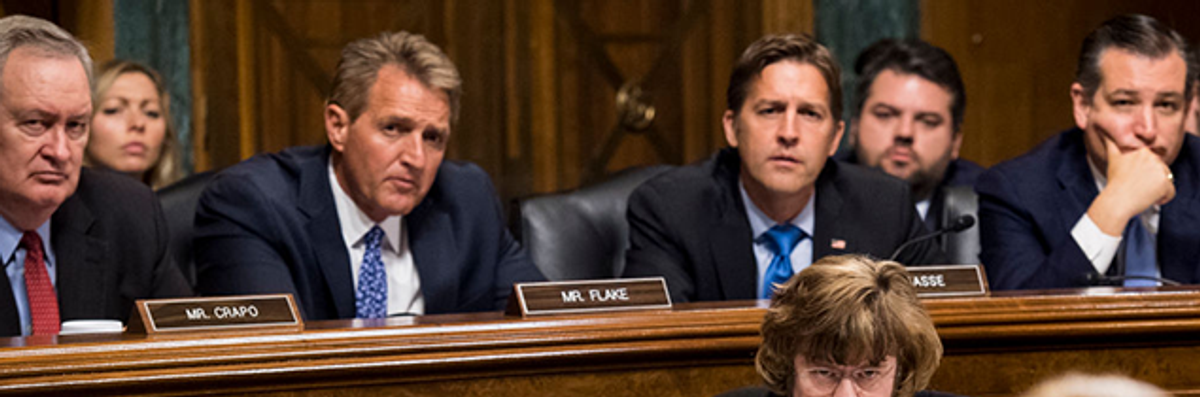
Mitchell's memo also fails to address a central question that any reasonable prosecutor would examine: motive. (Photo: Getty)
As an initial matter, many questions exist about Mitchell's claimed independence, including whether and how much she is being paid, and by whom; what Senate Republicans talked to her about before the hearing; and why she ceased asking questions shortly after Kavanaugh began testifying.
When senators question a witness at a hearing, their political biases are obvious. The same is true when prosecutors question witnesses in court -- their client is "the people." But in this unprecedented scenario, these biases were far less clear. Indeed, although Mitchell cross-examined Ford on behalf of the Republican members of the Judiciary Committee -- quite unsuccessfully in our view -- committee chairman Chuck Grassley, R-Iowa, cut off her questioning of Kavanaugh shortly after his testimony began. Notably, this happened right after Mitchell questioned Kavanaugh about the possibly incriminating July 1 entry on his calendar. The end result was that Mitchell did not question Kavanaugh in the same way that she did Ford, nor did the Republicans make any attempt to do it for her. This alone severely undermines her assessment.
A reasonable prosecutor evaluating this case would attempt to corroborate the stories of both Ford and Kavanaugh by interviewing other witnesses, tracking down alleged witness Mark Judge's employment records and by drilling down on Kavanaugh's calendar to see if it could corroborate the party in question. These are all basic investigative steps that would need to be completed before assessing the credibility of allegations such as Ford's. And yet none of these steps were taken before Mitchell wrote her memo.
Mitchell's memo also fails to address a central question that any reasonable prosecutor would examine: motive. There can be no doubt that Ford's life has been turned upside down -- no one would want to endure what she has since her allegations have been made public. Moreover, when she first told her couples therapist about the assault -- prompted by her irrational but understandable desire to feel secure in her own home -- Kavanaugh was not, contrary to Mitchell's assessment, on the short list of Supreme Court candidates. On the other hand, Kavanaugh has said numerous times that being on the Supreme Court was a life-long ambition of his, and it became clear that the only thing standing between him and that seat are the current allegations against him.
Similarly, any reasonable prosecutor would also weigh the fact that Ford has repeatedly requested an FBI investigation and has submitted to a lie-detector test, while Kavanaugh repeatedly refused to directly call for either despite being pressed at the hearing to ask for an investigation. Mitchell's failure to even address these issues is stunning.
As all prosecutors know, small lies matter, particularly where the small lies are meant to protect an unequivocal denial. In this case, Kavanaugh's denial would be rendered essentially meaningless if he admitted that he blacked out in high school from alcohol. Moreover, in our experience as prosecutors, the witnesses and defendants who thumped their chest the most were not doing so because they were falsely accused; rather, they were the most likely to be lying. They were relying on passion and emotion -- not the facts -- to convince others of their truthfulness.
Even if you overlook the underlying issues with Mitchell's memo, her assessment of the truthfulness of Ford's testimony also suffers from obvious analytical flaws. Here are just a few examples:
Finally, Mitchell's analysis ignores the fact that some corroboration already does exist. First, Kavanaugh's own calendars show that during the time period Ford reported he socialized with the several of the key people she singles out. In fact, all of the boys that Dr. Ford can identify from that party were in Kavanaugh's calendar on July 1, 1982. Second, both Kavanaugh and Ford's families were members of a country club where Ford says she had been before the attack, which is consistent with her testimony that she was in her bathing suit during the attack. Third, statements in his own yearbook and by high school and college classmates point to a man who drank excessively and was an aggressive drunk, which is also consistent with Ford's testimony and the nature of the assault. Finally, Ford's statements in 2012 and 2013 are corroboration for her Senate testimony that would be admissible in a court of law.
Rachel Mitchell may be a very fine prosecutor. But her one-sided, misleading memo draws broad conclusions without any foundation, doing a great disservice not only to the reputation of prosecutors and trained investigators everywhere but also to this confirmation process.
Dear Common Dreams reader, It’s been nearly 30 years since I co-founded Common Dreams with my late wife, Lina Newhouser. We had the radical notion that journalism should serve the public good, not corporate profits. It was clear to us from the outset what it would take to build such a project. No paid advertisements. No corporate sponsors. No millionaire publisher telling us what to think or do. Many people said we wouldn't last a year, but we proved those doubters wrong. Together with a tremendous team of journalists and dedicated staff, we built an independent media outlet free from the constraints of profits and corporate control. Our mission has always been simple: To inform. To inspire. To ignite change for the common good. Building Common Dreams was not easy. Our survival was never guaranteed. When you take on the most powerful forces—Wall Street greed, fossil fuel industry destruction, Big Tech lobbyists, and uber-rich oligarchs who have spent billions upon billions rigging the economy and democracy in their favor—the only bulwark you have is supporters who believe in your work. But here’s the urgent message from me today. It's never been this bad out there. And it's never been this hard to keep us going. At the very moment Common Dreams is most needed, the threats we face are intensifying. We need your support now more than ever. We don't accept corporate advertising and never will. We don't have a paywall because we don't think people should be blocked from critical news based on their ability to pay. Everything we do is funded by the donations of readers like you. When everyone does the little they can afford, we are strong. But if that support retreats or dries up, so do we. Will you donate now to make sure Common Dreams not only survives but thrives? —Craig Brown, Co-founder |
As an initial matter, many questions exist about Mitchell's claimed independence, including whether and how much she is being paid, and by whom; what Senate Republicans talked to her about before the hearing; and why she ceased asking questions shortly after Kavanaugh began testifying.
When senators question a witness at a hearing, their political biases are obvious. The same is true when prosecutors question witnesses in court -- their client is "the people." But in this unprecedented scenario, these biases were far less clear. Indeed, although Mitchell cross-examined Ford on behalf of the Republican members of the Judiciary Committee -- quite unsuccessfully in our view -- committee chairman Chuck Grassley, R-Iowa, cut off her questioning of Kavanaugh shortly after his testimony began. Notably, this happened right after Mitchell questioned Kavanaugh about the possibly incriminating July 1 entry on his calendar. The end result was that Mitchell did not question Kavanaugh in the same way that she did Ford, nor did the Republicans make any attempt to do it for her. This alone severely undermines her assessment.
A reasonable prosecutor evaluating this case would attempt to corroborate the stories of both Ford and Kavanaugh by interviewing other witnesses, tracking down alleged witness Mark Judge's employment records and by drilling down on Kavanaugh's calendar to see if it could corroborate the party in question. These are all basic investigative steps that would need to be completed before assessing the credibility of allegations such as Ford's. And yet none of these steps were taken before Mitchell wrote her memo.
Mitchell's memo also fails to address a central question that any reasonable prosecutor would examine: motive. There can be no doubt that Ford's life has been turned upside down -- no one would want to endure what she has since her allegations have been made public. Moreover, when she first told her couples therapist about the assault -- prompted by her irrational but understandable desire to feel secure in her own home -- Kavanaugh was not, contrary to Mitchell's assessment, on the short list of Supreme Court candidates. On the other hand, Kavanaugh has said numerous times that being on the Supreme Court was a life-long ambition of his, and it became clear that the only thing standing between him and that seat are the current allegations against him.
Similarly, any reasonable prosecutor would also weigh the fact that Ford has repeatedly requested an FBI investigation and has submitted to a lie-detector test, while Kavanaugh repeatedly refused to directly call for either despite being pressed at the hearing to ask for an investigation. Mitchell's failure to even address these issues is stunning.
As all prosecutors know, small lies matter, particularly where the small lies are meant to protect an unequivocal denial. In this case, Kavanaugh's denial would be rendered essentially meaningless if he admitted that he blacked out in high school from alcohol. Moreover, in our experience as prosecutors, the witnesses and defendants who thumped their chest the most were not doing so because they were falsely accused; rather, they were the most likely to be lying. They were relying on passion and emotion -- not the facts -- to convince others of their truthfulness.
Even if you overlook the underlying issues with Mitchell's memo, her assessment of the truthfulness of Ford's testimony also suffers from obvious analytical flaws. Here are just a few examples:
Finally, Mitchell's analysis ignores the fact that some corroboration already does exist. First, Kavanaugh's own calendars show that during the time period Ford reported he socialized with the several of the key people she singles out. In fact, all of the boys that Dr. Ford can identify from that party were in Kavanaugh's calendar on July 1, 1982. Second, both Kavanaugh and Ford's families were members of a country club where Ford says she had been before the attack, which is consistent with her testimony that she was in her bathing suit during the attack. Third, statements in his own yearbook and by high school and college classmates point to a man who drank excessively and was an aggressive drunk, which is also consistent with Ford's testimony and the nature of the assault. Finally, Ford's statements in 2012 and 2013 are corroboration for her Senate testimony that would be admissible in a court of law.
Rachel Mitchell may be a very fine prosecutor. But her one-sided, misleading memo draws broad conclusions without any foundation, doing a great disservice not only to the reputation of prosecutors and trained investigators everywhere but also to this confirmation process.
As an initial matter, many questions exist about Mitchell's claimed independence, including whether and how much she is being paid, and by whom; what Senate Republicans talked to her about before the hearing; and why she ceased asking questions shortly after Kavanaugh began testifying.
When senators question a witness at a hearing, their political biases are obvious. The same is true when prosecutors question witnesses in court -- their client is "the people." But in this unprecedented scenario, these biases were far less clear. Indeed, although Mitchell cross-examined Ford on behalf of the Republican members of the Judiciary Committee -- quite unsuccessfully in our view -- committee chairman Chuck Grassley, R-Iowa, cut off her questioning of Kavanaugh shortly after his testimony began. Notably, this happened right after Mitchell questioned Kavanaugh about the possibly incriminating July 1 entry on his calendar. The end result was that Mitchell did not question Kavanaugh in the same way that she did Ford, nor did the Republicans make any attempt to do it for her. This alone severely undermines her assessment.
A reasonable prosecutor evaluating this case would attempt to corroborate the stories of both Ford and Kavanaugh by interviewing other witnesses, tracking down alleged witness Mark Judge's employment records and by drilling down on Kavanaugh's calendar to see if it could corroborate the party in question. These are all basic investigative steps that would need to be completed before assessing the credibility of allegations such as Ford's. And yet none of these steps were taken before Mitchell wrote her memo.
Mitchell's memo also fails to address a central question that any reasonable prosecutor would examine: motive. There can be no doubt that Ford's life has been turned upside down -- no one would want to endure what she has since her allegations have been made public. Moreover, when she first told her couples therapist about the assault -- prompted by her irrational but understandable desire to feel secure in her own home -- Kavanaugh was not, contrary to Mitchell's assessment, on the short list of Supreme Court candidates. On the other hand, Kavanaugh has said numerous times that being on the Supreme Court was a life-long ambition of his, and it became clear that the only thing standing between him and that seat are the current allegations against him.
Similarly, any reasonable prosecutor would also weigh the fact that Ford has repeatedly requested an FBI investigation and has submitted to a lie-detector test, while Kavanaugh repeatedly refused to directly call for either despite being pressed at the hearing to ask for an investigation. Mitchell's failure to even address these issues is stunning.
As all prosecutors know, small lies matter, particularly where the small lies are meant to protect an unequivocal denial. In this case, Kavanaugh's denial would be rendered essentially meaningless if he admitted that he blacked out in high school from alcohol. Moreover, in our experience as prosecutors, the witnesses and defendants who thumped their chest the most were not doing so because they were falsely accused; rather, they were the most likely to be lying. They were relying on passion and emotion -- not the facts -- to convince others of their truthfulness.
Even if you overlook the underlying issues with Mitchell's memo, her assessment of the truthfulness of Ford's testimony also suffers from obvious analytical flaws. Here are just a few examples:
Finally, Mitchell's analysis ignores the fact that some corroboration already does exist. First, Kavanaugh's own calendars show that during the time period Ford reported he socialized with the several of the key people she singles out. In fact, all of the boys that Dr. Ford can identify from that party were in Kavanaugh's calendar on July 1, 1982. Second, both Kavanaugh and Ford's families were members of a country club where Ford says she had been before the attack, which is consistent with her testimony that she was in her bathing suit during the attack. Third, statements in his own yearbook and by high school and college classmates point to a man who drank excessively and was an aggressive drunk, which is also consistent with Ford's testimony and the nature of the assault. Finally, Ford's statements in 2012 and 2013 are corroboration for her Senate testimony that would be admissible in a court of law.
Rachel Mitchell may be a very fine prosecutor. But her one-sided, misleading memo draws broad conclusions without any foundation, doing a great disservice not only to the reputation of prosecutors and trained investigators everywhere but also to this confirmation process.