SUBSCRIBE TO OUR FREE NEWSLETTER
Daily news & progressive opinion—funded by the people, not the corporations—delivered straight to your inbox.
5
#000000
#FFFFFF
To donate by check, phone, or other method, see our More Ways to Give page.
Daily news & progressive opinion—funded by the people, not the corporations—delivered straight to your inbox.
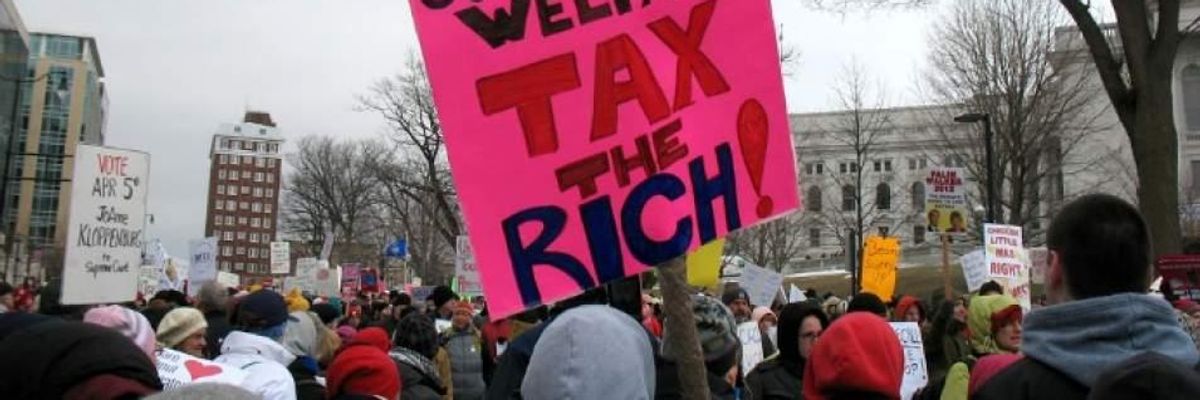
"This private sector reliance on public tax dollars gives us, as citizens, some leverage over the behavior of our largest and most powerful corporations," Pizzigati writes. (Photo: Yuri Keegstra/Flickr/cc)
Politicians often gab about the "private sector" and the "public sector," as if these two categories of economic activity operated as two completely separate worlds.
In reality, these two sectors have always been deeply intertwined.
"Without the tax dollars we provide, almost every major corporation in the United States would flounder. Some would simply cease to exist."
How deeply? Every year, the federal government spends about half a trillion dollars buying goods and services from the private sector. State and local government contracts with private-sector enterprises add hundreds of billions more.
And private-sector companies don't just receive contracts from our governmental entities. They receive all sorts of subsidies -- billions upon billions of dollars in "corporate welfare."
Where do all these dollars come from? They come from us, America's taxpayers. Without the tax dollars we provide, almost every major corporation in the United States would flounder. Some would simply cease to exist. The defense contractor Lockheed Martin, for instance, takes in almost all its revenue from government contracts.
This private sector reliance on public tax dollars gives us, as citizens, some leverage over the behavior of our largest and most powerful corporations. We could, if we so chose, deny those dollars to corporations that engage in behaviors that undermine the values we hold dear.
On other fronts, we already do this denying. For over a generation now, we've leveraged the power of the public purse against companies with employment practices that discriminate on the basis of race and gender. Companies that discriminate can't get government contracts because we've come to a consensus, as a society, that we don't want our tax dollars subsidizing racial and gender inequality.
Unfortunately, our tax dollars are still subsidizing -- in a big way -- economic inequality, as a new Institute for Policy Studies report on CEO pay details quite vividly. Billions of our tax dollars are annually going to corporations that pay their top executives more in a week, or even a day, than their typical employees can make over an entire year.
The late Peter Drucker, the founder of modern management science, believed that no corporate enterprise that pays its CEO over 25 times what its workers are earning could operate efficiently and effectively over the long haul. In 2017, every single one of the federal government's 50 largest private contractors paid its chief executive over 25 times more than its most typical workers.
In fact, most paid their top execs well over 100 times more.
And at one, DXC Technology, the CEO pulled down over $32 million in 2017 pay -- over 800 times the compensation of the firm's typical employees.
Let's add a little context here. The president of the United States earns $400,000 a year. The CEOs of the 50 private companies with the largest federal contracts last year averaged over $13.5 million. The CEOs of the 50 largest recipients of federal subsidies last year averaged over $12 million.
Our tax dollars, in other words, are helping a lucky few become fabulously rich.
We do live, as our politicians like to point out, in a "free country." Corporations can pay their top execs whatever they want. But we taxpayers have freedom, too. We can freely deny our tax dollars to enterprises that are making our society ever more unequal.
Some lawmakers are starting to step in that direction. Five states have begun considering legislation that would make it harder for companies with wide CEO-worker pay gaps to get government contracts and tax breaks. And one city -- Portland, Oregon -- has already enacted legislation that taxes corporations with wide CEO-worker pay gaps at a higher rate than corporations with more modest gaps.
We need more Portlands.
Dear Common Dreams reader, It’s been nearly 30 years since I co-founded Common Dreams with my late wife, Lina Newhouser. We had the radical notion that journalism should serve the public good, not corporate profits. It was clear to us from the outset what it would take to build such a project. No paid advertisements. No corporate sponsors. No millionaire publisher telling us what to think or do. Many people said we wouldn't last a year, but we proved those doubters wrong. Together with a tremendous team of journalists and dedicated staff, we built an independent media outlet free from the constraints of profits and corporate control. Our mission has always been simple: To inform. To inspire. To ignite change for the common good. Building Common Dreams was not easy. Our survival was never guaranteed. When you take on the most powerful forces—Wall Street greed, fossil fuel industry destruction, Big Tech lobbyists, and uber-rich oligarchs who have spent billions upon billions rigging the economy and democracy in their favor—the only bulwark you have is supporters who believe in your work. But here’s the urgent message from me today. It's never been this bad out there. And it's never been this hard to keep us going. At the very moment Common Dreams is most needed, the threats we face are intensifying. We need your support now more than ever. We don't accept corporate advertising and never will. We don't have a paywall because we don't think people should be blocked from critical news based on their ability to pay. Everything we do is funded by the donations of readers like you. When everyone does the little they can afford, we are strong. But if that support retreats or dries up, so do we. Will you donate now to make sure Common Dreams not only survives but thrives? —Craig Brown, Co-founder |
Politicians often gab about the "private sector" and the "public sector," as if these two categories of economic activity operated as two completely separate worlds.
In reality, these two sectors have always been deeply intertwined.
"Without the tax dollars we provide, almost every major corporation in the United States would flounder. Some would simply cease to exist."
How deeply? Every year, the federal government spends about half a trillion dollars buying goods and services from the private sector. State and local government contracts with private-sector enterprises add hundreds of billions more.
And private-sector companies don't just receive contracts from our governmental entities. They receive all sorts of subsidies -- billions upon billions of dollars in "corporate welfare."
Where do all these dollars come from? They come from us, America's taxpayers. Without the tax dollars we provide, almost every major corporation in the United States would flounder. Some would simply cease to exist. The defense contractor Lockheed Martin, for instance, takes in almost all its revenue from government contracts.
This private sector reliance on public tax dollars gives us, as citizens, some leverage over the behavior of our largest and most powerful corporations. We could, if we so chose, deny those dollars to corporations that engage in behaviors that undermine the values we hold dear.
On other fronts, we already do this denying. For over a generation now, we've leveraged the power of the public purse against companies with employment practices that discriminate on the basis of race and gender. Companies that discriminate can't get government contracts because we've come to a consensus, as a society, that we don't want our tax dollars subsidizing racial and gender inequality.
Unfortunately, our tax dollars are still subsidizing -- in a big way -- economic inequality, as a new Institute for Policy Studies report on CEO pay details quite vividly. Billions of our tax dollars are annually going to corporations that pay their top executives more in a week, or even a day, than their typical employees can make over an entire year.
The late Peter Drucker, the founder of modern management science, believed that no corporate enterprise that pays its CEO over 25 times what its workers are earning could operate efficiently and effectively over the long haul. In 2017, every single one of the federal government's 50 largest private contractors paid its chief executive over 25 times more than its most typical workers.
In fact, most paid their top execs well over 100 times more.
And at one, DXC Technology, the CEO pulled down over $32 million in 2017 pay -- over 800 times the compensation of the firm's typical employees.
Let's add a little context here. The president of the United States earns $400,000 a year. The CEOs of the 50 private companies with the largest federal contracts last year averaged over $13.5 million. The CEOs of the 50 largest recipients of federal subsidies last year averaged over $12 million.
Our tax dollars, in other words, are helping a lucky few become fabulously rich.
We do live, as our politicians like to point out, in a "free country." Corporations can pay their top execs whatever they want. But we taxpayers have freedom, too. We can freely deny our tax dollars to enterprises that are making our society ever more unequal.
Some lawmakers are starting to step in that direction. Five states have begun considering legislation that would make it harder for companies with wide CEO-worker pay gaps to get government contracts and tax breaks. And one city -- Portland, Oregon -- has already enacted legislation that taxes corporations with wide CEO-worker pay gaps at a higher rate than corporations with more modest gaps.
We need more Portlands.
Politicians often gab about the "private sector" and the "public sector," as if these two categories of economic activity operated as two completely separate worlds.
In reality, these two sectors have always been deeply intertwined.
"Without the tax dollars we provide, almost every major corporation in the United States would flounder. Some would simply cease to exist."
How deeply? Every year, the federal government spends about half a trillion dollars buying goods and services from the private sector. State and local government contracts with private-sector enterprises add hundreds of billions more.
And private-sector companies don't just receive contracts from our governmental entities. They receive all sorts of subsidies -- billions upon billions of dollars in "corporate welfare."
Where do all these dollars come from? They come from us, America's taxpayers. Without the tax dollars we provide, almost every major corporation in the United States would flounder. Some would simply cease to exist. The defense contractor Lockheed Martin, for instance, takes in almost all its revenue from government contracts.
This private sector reliance on public tax dollars gives us, as citizens, some leverage over the behavior of our largest and most powerful corporations. We could, if we so chose, deny those dollars to corporations that engage in behaviors that undermine the values we hold dear.
On other fronts, we already do this denying. For over a generation now, we've leveraged the power of the public purse against companies with employment practices that discriminate on the basis of race and gender. Companies that discriminate can't get government contracts because we've come to a consensus, as a society, that we don't want our tax dollars subsidizing racial and gender inequality.
Unfortunately, our tax dollars are still subsidizing -- in a big way -- economic inequality, as a new Institute for Policy Studies report on CEO pay details quite vividly. Billions of our tax dollars are annually going to corporations that pay their top executives more in a week, or even a day, than their typical employees can make over an entire year.
The late Peter Drucker, the founder of modern management science, believed that no corporate enterprise that pays its CEO over 25 times what its workers are earning could operate efficiently and effectively over the long haul. In 2017, every single one of the federal government's 50 largest private contractors paid its chief executive over 25 times more than its most typical workers.
In fact, most paid their top execs well over 100 times more.
And at one, DXC Technology, the CEO pulled down over $32 million in 2017 pay -- over 800 times the compensation of the firm's typical employees.
Let's add a little context here. The president of the United States earns $400,000 a year. The CEOs of the 50 private companies with the largest federal contracts last year averaged over $13.5 million. The CEOs of the 50 largest recipients of federal subsidies last year averaged over $12 million.
Our tax dollars, in other words, are helping a lucky few become fabulously rich.
We do live, as our politicians like to point out, in a "free country." Corporations can pay their top execs whatever they want. But we taxpayers have freedom, too. We can freely deny our tax dollars to enterprises that are making our society ever more unequal.
Some lawmakers are starting to step in that direction. Five states have begun considering legislation that would make it harder for companies with wide CEO-worker pay gaps to get government contracts and tax breaks. And one city -- Portland, Oregon -- has already enacted legislation that taxes corporations with wide CEO-worker pay gaps at a higher rate than corporations with more modest gaps.
We need more Portlands.