SUBSCRIBE TO OUR FREE NEWSLETTER
Daily news & progressive opinion—funded by the people, not the corporations—delivered straight to your inbox.
5
#000000
#FFFFFF
To donate by check, phone, or other method, see our More Ways to Give page.
Daily news & progressive opinion—funded by the people, not the corporations—delivered straight to your inbox.
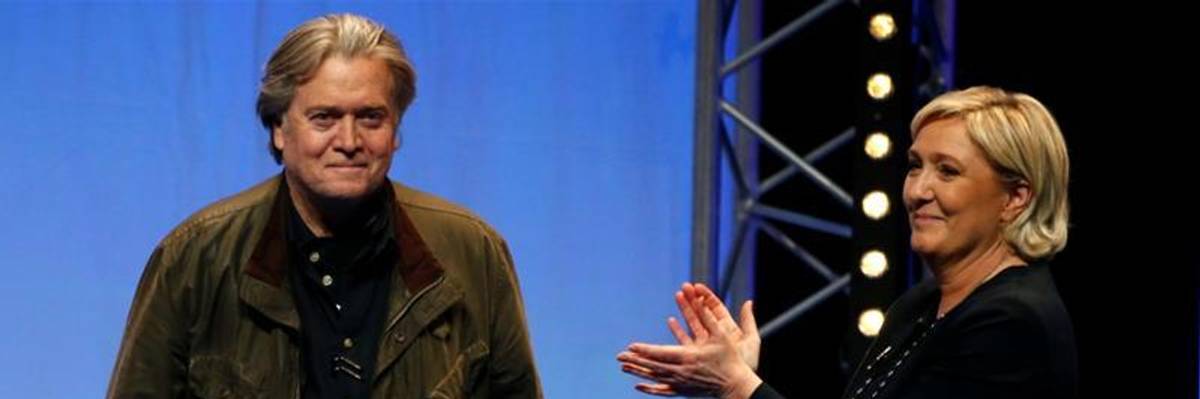
Marine Le Pen, National Front political party leader, and Former White House Chief Strategist Steve Bannon attend the party's convention in Lille, France, March 10, 2018 (Photo: Pascal Rossignol/Reuters)
When Donald Trump visited the UK, Steve Bannon wasn't far behind. The president's former chief strategist breezed effortlessly into TV and radio studios, trying to sanitise his old boss' politics and keep himself relevant. On his foray across the Atlantic, he unveiled his new plans: a foundation called "The Movement". Just how worried should we be about it?
Based in Brussels, the heart of the EU, and planning to hire 10 full-time staff, according to Bannon, The Movement will aim to influence the 2019 European elections by organising and giving advice to far-right parties. Bannon founded far-right website Breitbart, known for spreading anti-migrant stories, and if you name a far-right group, he's probably campaigned for it - lending his support to Germany's AfD, France's Front National and Spain's Vox. As Trump retweeting a fascistic group didn't stop UK Prime Minister Theresa May holding his hand, Bannon's far-right credentials did not deter wannabe PM, Boris Johnson - notorious for making racist statements - from meeting up with him.
But Bannon is just one man and within days of him making this announcement far-right figures from across Europe signalled they weren't all that interested in his plans. What's far more dangerous is the type of ideas he and others want to foster: the far-right politics that diverge on a number of different issues but can manifest in all kinds of nationalist cloaks across the world. And in some ways, that's already happening, without any help from "The Movement".
From Brexit to EU elections, what people like Bannon thrive off is the "culture war" narrative. Despite often hailing from a country's most elite institutions (see Nigel Farage), they rail against "the establishment" and all the economic problems the moribund status quo has created. But they're less interested in financial solutions and more focussed on stoking divides. They want to reshape politics by positioning it as fundamentally a clash between "traditional" and "progressive" values. Values matter: social attitudes werefar more important than social class in the UK's vote to leave the EU, for instance. Racism, misogyny, Islamophobia - these are all issues about attitudes, history and power.
Using the "culture war" narrative, Bannon and his ilk lump together liberals and the left, as if they want the same thing, and make them seem like the enemy of the "ordinary" person (of course, migrants and people of colour are rarely classed as ordinary). Take Bannon's endorsement of far-right, anti-Muslim figure Tommy Robinson when he was in the UK. In an off-air conversation, he described Robinson, who was in prison for contempt of court, "the f**king backbone of this country". This is the language of Robinson's acolytes, feverishly determined they are being silenced as the country is being taken over by Muslims and freedom of speech is being shut down.
This couldn't be more false; they're playing a role in shaping and setting political agendas. The far-right are in ascendance across significant parts of the world, and in places where they aren't in power, they're influencing the people that are in a frightening way. Because when the so-called "centre" adopts the politics of the far-right, it only strengthens its message. The warning signs are there.
In Lower Austria, one of the nine states that make up the country, a cabinet minister defended plans to limit access to kosher meat to people who had permits, which would be issued to Jews.
In Assam, the northeastern state of India, the country's ruling party, the BJP, have just released a list that effectively strips millions of people of their citizenship unless they can show they came into the state before Bangladesh became independent in 1971.
In Denmark, the government just passed a law called the "ghetto deal", which will apply to 25 neighbourhoods classified as "ghettos" on the basis of peoples' income, education levels and "non-Western" background. The "deal" will include a whole range of policies, including harsher punishments for crimes committed in these areas. If you're born to parents who live in one of these areas, you'll be classed as a "ghetto child" and from the age of one, you'll be forced to spend a minimum of 25 hours a week apart from your family, excluding naps, to learn about "Danish values". Otherwise, your family could lose their benefits.
In different parts of the world and implemented by parties of different political persuasions, these cases aren't all the same. The different contexts - geographical, socioeconomic, politics and historical - all matter to make sense of them individually. But they're a sign of what the far-right, who use this culture wars narrative, want to help pave the way for: aggressive state control, marginalising minorities and going after migrants.
The far-right doesn't just announce itself as extreme, it creeps in under xenophobic language that's not totally alien to the mainstream - declaring the importance of controlling borders and clamping down on immigration. And like Bannon, far-right politicians walk right onto our television screens raving about how they're being sidelined as they slowly try to normalise themselves and their messages. The Movement could prove a dangerous vehicle for these very ideas, but without it or not, the far-right is already helping set the political agenda in a significant way.
Dear Common Dreams reader, It’s been nearly 30 years since I co-founded Common Dreams with my late wife, Lina Newhouser. We had the radical notion that journalism should serve the public good, not corporate profits. It was clear to us from the outset what it would take to build such a project. No paid advertisements. No corporate sponsors. No millionaire publisher telling us what to think or do. Many people said we wouldn't last a year, but we proved those doubters wrong. Together with a tremendous team of journalists and dedicated staff, we built an independent media outlet free from the constraints of profits and corporate control. Our mission has always been simple: To inform. To inspire. To ignite change for the common good. Building Common Dreams was not easy. Our survival was never guaranteed. When you take on the most powerful forces—Wall Street greed, fossil fuel industry destruction, Big Tech lobbyists, and uber-rich oligarchs who have spent billions upon billions rigging the economy and democracy in their favor—the only bulwark you have is supporters who believe in your work. But here’s the urgent message from me today. It's never been this bad out there. And it's never been this hard to keep us going. At the very moment Common Dreams is most needed, the threats we face are intensifying. We need your support now more than ever. We don't accept corporate advertising and never will. We don't have a paywall because we don't think people should be blocked from critical news based on their ability to pay. Everything we do is funded by the donations of readers like you. When everyone does the little they can afford, we are strong. But if that support retreats or dries up, so do we. Will you donate now to make sure Common Dreams not only survives but thrives? —Craig Brown, Co-founder |
When Donald Trump visited the UK, Steve Bannon wasn't far behind. The president's former chief strategist breezed effortlessly into TV and radio studios, trying to sanitise his old boss' politics and keep himself relevant. On his foray across the Atlantic, he unveiled his new plans: a foundation called "The Movement". Just how worried should we be about it?
Based in Brussels, the heart of the EU, and planning to hire 10 full-time staff, according to Bannon, The Movement will aim to influence the 2019 European elections by organising and giving advice to far-right parties. Bannon founded far-right website Breitbart, known for spreading anti-migrant stories, and if you name a far-right group, he's probably campaigned for it - lending his support to Germany's AfD, France's Front National and Spain's Vox. As Trump retweeting a fascistic group didn't stop UK Prime Minister Theresa May holding his hand, Bannon's far-right credentials did not deter wannabe PM, Boris Johnson - notorious for making racist statements - from meeting up with him.
But Bannon is just one man and within days of him making this announcement far-right figures from across Europe signalled they weren't all that interested in his plans. What's far more dangerous is the type of ideas he and others want to foster: the far-right politics that diverge on a number of different issues but can manifest in all kinds of nationalist cloaks across the world. And in some ways, that's already happening, without any help from "The Movement".
From Brexit to EU elections, what people like Bannon thrive off is the "culture war" narrative. Despite often hailing from a country's most elite institutions (see Nigel Farage), they rail against "the establishment" and all the economic problems the moribund status quo has created. But they're less interested in financial solutions and more focussed on stoking divides. They want to reshape politics by positioning it as fundamentally a clash between "traditional" and "progressive" values. Values matter: social attitudes werefar more important than social class in the UK's vote to leave the EU, for instance. Racism, misogyny, Islamophobia - these are all issues about attitudes, history and power.
Using the "culture war" narrative, Bannon and his ilk lump together liberals and the left, as if they want the same thing, and make them seem like the enemy of the "ordinary" person (of course, migrants and people of colour are rarely classed as ordinary). Take Bannon's endorsement of far-right, anti-Muslim figure Tommy Robinson when he was in the UK. In an off-air conversation, he described Robinson, who was in prison for contempt of court, "the f**king backbone of this country". This is the language of Robinson's acolytes, feverishly determined they are being silenced as the country is being taken over by Muslims and freedom of speech is being shut down.
This couldn't be more false; they're playing a role in shaping and setting political agendas. The far-right are in ascendance across significant parts of the world, and in places where they aren't in power, they're influencing the people that are in a frightening way. Because when the so-called "centre" adopts the politics of the far-right, it only strengthens its message. The warning signs are there.
In Lower Austria, one of the nine states that make up the country, a cabinet minister defended plans to limit access to kosher meat to people who had permits, which would be issued to Jews.
In Assam, the northeastern state of India, the country's ruling party, the BJP, have just released a list that effectively strips millions of people of their citizenship unless they can show they came into the state before Bangladesh became independent in 1971.
In Denmark, the government just passed a law called the "ghetto deal", which will apply to 25 neighbourhoods classified as "ghettos" on the basis of peoples' income, education levels and "non-Western" background. The "deal" will include a whole range of policies, including harsher punishments for crimes committed in these areas. If you're born to parents who live in one of these areas, you'll be classed as a "ghetto child" and from the age of one, you'll be forced to spend a minimum of 25 hours a week apart from your family, excluding naps, to learn about "Danish values". Otherwise, your family could lose their benefits.
In different parts of the world and implemented by parties of different political persuasions, these cases aren't all the same. The different contexts - geographical, socioeconomic, politics and historical - all matter to make sense of them individually. But they're a sign of what the far-right, who use this culture wars narrative, want to help pave the way for: aggressive state control, marginalising minorities and going after migrants.
The far-right doesn't just announce itself as extreme, it creeps in under xenophobic language that's not totally alien to the mainstream - declaring the importance of controlling borders and clamping down on immigration. And like Bannon, far-right politicians walk right onto our television screens raving about how they're being sidelined as they slowly try to normalise themselves and their messages. The Movement could prove a dangerous vehicle for these very ideas, but without it or not, the far-right is already helping set the political agenda in a significant way.
When Donald Trump visited the UK, Steve Bannon wasn't far behind. The president's former chief strategist breezed effortlessly into TV and radio studios, trying to sanitise his old boss' politics and keep himself relevant. On his foray across the Atlantic, he unveiled his new plans: a foundation called "The Movement". Just how worried should we be about it?
Based in Brussels, the heart of the EU, and planning to hire 10 full-time staff, according to Bannon, The Movement will aim to influence the 2019 European elections by organising and giving advice to far-right parties. Bannon founded far-right website Breitbart, known for spreading anti-migrant stories, and if you name a far-right group, he's probably campaigned for it - lending his support to Germany's AfD, France's Front National and Spain's Vox. As Trump retweeting a fascistic group didn't stop UK Prime Minister Theresa May holding his hand, Bannon's far-right credentials did not deter wannabe PM, Boris Johnson - notorious for making racist statements - from meeting up with him.
But Bannon is just one man and within days of him making this announcement far-right figures from across Europe signalled they weren't all that interested in his plans. What's far more dangerous is the type of ideas he and others want to foster: the far-right politics that diverge on a number of different issues but can manifest in all kinds of nationalist cloaks across the world. And in some ways, that's already happening, without any help from "The Movement".
From Brexit to EU elections, what people like Bannon thrive off is the "culture war" narrative. Despite often hailing from a country's most elite institutions (see Nigel Farage), they rail against "the establishment" and all the economic problems the moribund status quo has created. But they're less interested in financial solutions and more focussed on stoking divides. They want to reshape politics by positioning it as fundamentally a clash between "traditional" and "progressive" values. Values matter: social attitudes werefar more important than social class in the UK's vote to leave the EU, for instance. Racism, misogyny, Islamophobia - these are all issues about attitudes, history and power.
Using the "culture war" narrative, Bannon and his ilk lump together liberals and the left, as if they want the same thing, and make them seem like the enemy of the "ordinary" person (of course, migrants and people of colour are rarely classed as ordinary). Take Bannon's endorsement of far-right, anti-Muslim figure Tommy Robinson when he was in the UK. In an off-air conversation, he described Robinson, who was in prison for contempt of court, "the f**king backbone of this country". This is the language of Robinson's acolytes, feverishly determined they are being silenced as the country is being taken over by Muslims and freedom of speech is being shut down.
This couldn't be more false; they're playing a role in shaping and setting political agendas. The far-right are in ascendance across significant parts of the world, and in places where they aren't in power, they're influencing the people that are in a frightening way. Because when the so-called "centre" adopts the politics of the far-right, it only strengthens its message. The warning signs are there.
In Lower Austria, one of the nine states that make up the country, a cabinet minister defended plans to limit access to kosher meat to people who had permits, which would be issued to Jews.
In Assam, the northeastern state of India, the country's ruling party, the BJP, have just released a list that effectively strips millions of people of their citizenship unless they can show they came into the state before Bangladesh became independent in 1971.
In Denmark, the government just passed a law called the "ghetto deal", which will apply to 25 neighbourhoods classified as "ghettos" on the basis of peoples' income, education levels and "non-Western" background. The "deal" will include a whole range of policies, including harsher punishments for crimes committed in these areas. If you're born to parents who live in one of these areas, you'll be classed as a "ghetto child" and from the age of one, you'll be forced to spend a minimum of 25 hours a week apart from your family, excluding naps, to learn about "Danish values". Otherwise, your family could lose their benefits.
In different parts of the world and implemented by parties of different political persuasions, these cases aren't all the same. The different contexts - geographical, socioeconomic, politics and historical - all matter to make sense of them individually. But they're a sign of what the far-right, who use this culture wars narrative, want to help pave the way for: aggressive state control, marginalising minorities and going after migrants.
The far-right doesn't just announce itself as extreme, it creeps in under xenophobic language that's not totally alien to the mainstream - declaring the importance of controlling borders and clamping down on immigration. And like Bannon, far-right politicians walk right onto our television screens raving about how they're being sidelined as they slowly try to normalise themselves and their messages. The Movement could prove a dangerous vehicle for these very ideas, but without it or not, the far-right is already helping set the political agenda in a significant way.