SUBSCRIBE TO OUR FREE NEWSLETTER
Daily news & progressive opinion—funded by the people, not the corporations—delivered straight to your inbox.
5
#000000
#FFFFFF
To donate by check, phone, or other method, see our More Ways to Give page.
Daily news & progressive opinion—funded by the people, not the corporations—delivered straight to your inbox.
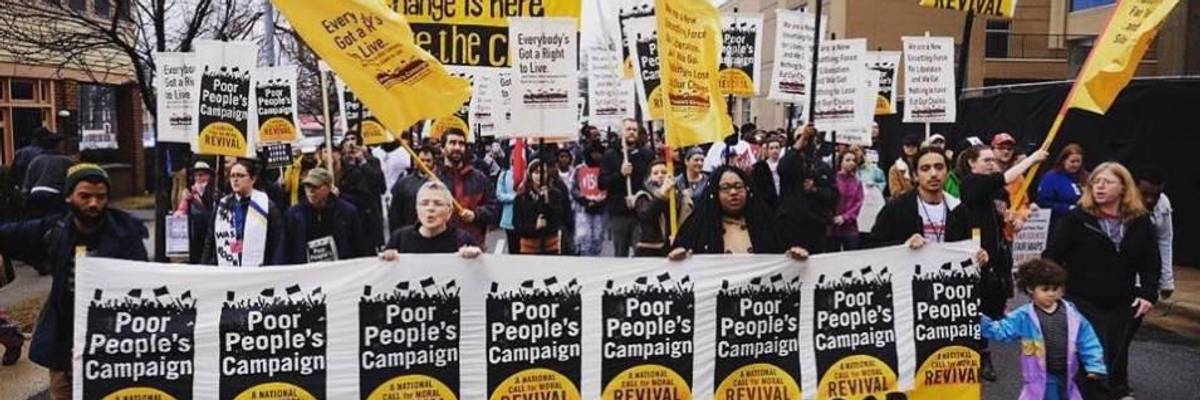
"This battle is a tough one, as public sector workers are constantly under attack, all over the world." (Photo: Poor People's Campaign/Twitter)
They gather every Monday. Hundreds of low-wage workers, faith leaders, civil rights organizers, trade union members and liberal activists from all over the US have been taking to the streets every Monday since May 13th, to protest inequality, racism, ecological devastation, militarism and all kinds of discrimination.
They call themselves the "Poor People's Campaign," a direct reference to the movement launched by Martin Luther King Jr. a few months before his assassination on 4 April 1968.
The heart of the campaign was a mule-drawn procession from Marks, Mississippi, at that time the poorest town in the poorest State of the United States, eventually arriving in Washington. Today's "Poor People's Campaign" will also culminate in a national action at the US Capitol. It will be on 23 June, UN Public Service Day.
This is not a coincidence. Only real access for all to quality public services--education, health care, childcare services, decent retirement, public transport, efficient justice systems and quality infrastructures--will allow the fight for social justice and the reduction of inequalities to progress.
Martin Luther King knew it. The day of his assassination in Memphis, he was supporting 1,300 sanitation workers who were on strike, convinced that a coalition of activists from trade unions, faith and social justice organizations was the best way to lift millions of Americans out of poverty.
Public capital - as opposed to private - has shrunk to nearly zero everywhere since 1970 - and less than zero in the US and Britain - due to austerity programs and regressive tax systems, along with political framing that considers public companies as obsolete, and public servants as a class of privileged workers, expensive and inefficient.
Fifty years later, this agenda is more relevant than ever in the United States, as it is in the rest of the world. Public capital - as opposed to private - has shrunk to nearly zero everywhere since 1970 - and less than zero in the US and Britain - due to austerity programs and regressive tax systems, along with political framing that considers public companies as obsolete, and public servants as a class of privileged workers, expensive and inefficient. Not to mention trade unionists, seen as dangerous dinosaurs that should be mocked at best, and even imprisoned.
The consequences are devastating. Income inequality has increased in all world regions in recent decades as the global top 1% earners have captured twice as much of that growth as the 50% poorest individuals, as shown by the World Inequality report 2018.
The phenomenon is impressive in the United States, where the top 1% wealth share rose from 22% in 1980 to 39% in 2014. Most of that increase in inequality was due to the rise of the top 0.1% wealth owners.
This battle is a tough one, as public sector workers are constantly under attack, all over the world. The number of countries with arbitrary arrests and detention of workers increased from 44 to 59 in 2017, according to the International Trade Union Confederation's Global Rights Index. About 2.5 billion people - in the informal economy, migrants and those in precarious jobs - are excluded from any protection under labor laws.
But this is not a fatality. At Public Services International (PSI), a Global Union Federation dedicated to promoting quality public services, we are convinced that now, more than ever, working people need strong unions to fight back and get good jobs and fair salaries.
Just like Martin Luther King 50 years ago, we have a dream: that one day workers of all races and backgrounds will have a decent life - "One Day" is the title of a PSI series of films on the world of labor which presents the extraordinary lives of ordinary public sector workers around the globe.
On this Public Service Day, we want to celebrate these workers again. But it is not about one day or one moment. It is about building a movement that will last. It is a long journey, but when social movements and trade unions get together, we tend to win.
It is time to shift the narrative. The struggle for universal rights, such as a living wage, good working conditions and access to quality public services will never be outdated.
Dear Common Dreams reader, It’s been nearly 30 years since I co-founded Common Dreams with my late wife, Lina Newhouser. We had the radical notion that journalism should serve the public good, not corporate profits. It was clear to us from the outset what it would take to build such a project. No paid advertisements. No corporate sponsors. No millionaire publisher telling us what to think or do. Many people said we wouldn't last a year, but we proved those doubters wrong. Together with a tremendous team of journalists and dedicated staff, we built an independent media outlet free from the constraints of profits and corporate control. Our mission has always been simple: To inform. To inspire. To ignite change for the common good. Building Common Dreams was not easy. Our survival was never guaranteed. When you take on the most powerful forces—Wall Street greed, fossil fuel industry destruction, Big Tech lobbyists, and uber-rich oligarchs who have spent billions upon billions rigging the economy and democracy in their favor—the only bulwark you have is supporters who believe in your work. But here’s the urgent message from me today. It's never been this bad out there. And it's never been this hard to keep us going. At the very moment Common Dreams is most needed, the threats we face are intensifying. We need your support now more than ever. We don't accept corporate advertising and never will. We don't have a paywall because we don't think people should be blocked from critical news based on their ability to pay. Everything we do is funded by the donations of readers like you. When everyone does the little they can afford, we are strong. But if that support retreats or dries up, so do we. Will you donate now to make sure Common Dreams not only survives but thrives? —Craig Brown, Co-founder |
They gather every Monday. Hundreds of low-wage workers, faith leaders, civil rights organizers, trade union members and liberal activists from all over the US have been taking to the streets every Monday since May 13th, to protest inequality, racism, ecological devastation, militarism and all kinds of discrimination.
They call themselves the "Poor People's Campaign," a direct reference to the movement launched by Martin Luther King Jr. a few months before his assassination on 4 April 1968.
The heart of the campaign was a mule-drawn procession from Marks, Mississippi, at that time the poorest town in the poorest State of the United States, eventually arriving in Washington. Today's "Poor People's Campaign" will also culminate in a national action at the US Capitol. It will be on 23 June, UN Public Service Day.
This is not a coincidence. Only real access for all to quality public services--education, health care, childcare services, decent retirement, public transport, efficient justice systems and quality infrastructures--will allow the fight for social justice and the reduction of inequalities to progress.
Martin Luther King knew it. The day of his assassination in Memphis, he was supporting 1,300 sanitation workers who were on strike, convinced that a coalition of activists from trade unions, faith and social justice organizations was the best way to lift millions of Americans out of poverty.
Public capital - as opposed to private - has shrunk to nearly zero everywhere since 1970 - and less than zero in the US and Britain - due to austerity programs and regressive tax systems, along with political framing that considers public companies as obsolete, and public servants as a class of privileged workers, expensive and inefficient.
Fifty years later, this agenda is more relevant than ever in the United States, as it is in the rest of the world. Public capital - as opposed to private - has shrunk to nearly zero everywhere since 1970 - and less than zero in the US and Britain - due to austerity programs and regressive tax systems, along with political framing that considers public companies as obsolete, and public servants as a class of privileged workers, expensive and inefficient. Not to mention trade unionists, seen as dangerous dinosaurs that should be mocked at best, and even imprisoned.
The consequences are devastating. Income inequality has increased in all world regions in recent decades as the global top 1% earners have captured twice as much of that growth as the 50% poorest individuals, as shown by the World Inequality report 2018.
The phenomenon is impressive in the United States, where the top 1% wealth share rose from 22% in 1980 to 39% in 2014. Most of that increase in inequality was due to the rise of the top 0.1% wealth owners.
This battle is a tough one, as public sector workers are constantly under attack, all over the world. The number of countries with arbitrary arrests and detention of workers increased from 44 to 59 in 2017, according to the International Trade Union Confederation's Global Rights Index. About 2.5 billion people - in the informal economy, migrants and those in precarious jobs - are excluded from any protection under labor laws.
But this is not a fatality. At Public Services International (PSI), a Global Union Federation dedicated to promoting quality public services, we are convinced that now, more than ever, working people need strong unions to fight back and get good jobs and fair salaries.
Just like Martin Luther King 50 years ago, we have a dream: that one day workers of all races and backgrounds will have a decent life - "One Day" is the title of a PSI series of films on the world of labor which presents the extraordinary lives of ordinary public sector workers around the globe.
On this Public Service Day, we want to celebrate these workers again. But it is not about one day or one moment. It is about building a movement that will last. It is a long journey, but when social movements and trade unions get together, we tend to win.
It is time to shift the narrative. The struggle for universal rights, such as a living wage, good working conditions and access to quality public services will never be outdated.
They gather every Monday. Hundreds of low-wage workers, faith leaders, civil rights organizers, trade union members and liberal activists from all over the US have been taking to the streets every Monday since May 13th, to protest inequality, racism, ecological devastation, militarism and all kinds of discrimination.
They call themselves the "Poor People's Campaign," a direct reference to the movement launched by Martin Luther King Jr. a few months before his assassination on 4 April 1968.
The heart of the campaign was a mule-drawn procession from Marks, Mississippi, at that time the poorest town in the poorest State of the United States, eventually arriving in Washington. Today's "Poor People's Campaign" will also culminate in a national action at the US Capitol. It will be on 23 June, UN Public Service Day.
This is not a coincidence. Only real access for all to quality public services--education, health care, childcare services, decent retirement, public transport, efficient justice systems and quality infrastructures--will allow the fight for social justice and the reduction of inequalities to progress.
Martin Luther King knew it. The day of his assassination in Memphis, he was supporting 1,300 sanitation workers who were on strike, convinced that a coalition of activists from trade unions, faith and social justice organizations was the best way to lift millions of Americans out of poverty.
Public capital - as opposed to private - has shrunk to nearly zero everywhere since 1970 - and less than zero in the US and Britain - due to austerity programs and regressive tax systems, along with political framing that considers public companies as obsolete, and public servants as a class of privileged workers, expensive and inefficient.
Fifty years later, this agenda is more relevant than ever in the United States, as it is in the rest of the world. Public capital - as opposed to private - has shrunk to nearly zero everywhere since 1970 - and less than zero in the US and Britain - due to austerity programs and regressive tax systems, along with political framing that considers public companies as obsolete, and public servants as a class of privileged workers, expensive and inefficient. Not to mention trade unionists, seen as dangerous dinosaurs that should be mocked at best, and even imprisoned.
The consequences are devastating. Income inequality has increased in all world regions in recent decades as the global top 1% earners have captured twice as much of that growth as the 50% poorest individuals, as shown by the World Inequality report 2018.
The phenomenon is impressive in the United States, where the top 1% wealth share rose from 22% in 1980 to 39% in 2014. Most of that increase in inequality was due to the rise of the top 0.1% wealth owners.
This battle is a tough one, as public sector workers are constantly under attack, all over the world. The number of countries with arbitrary arrests and detention of workers increased from 44 to 59 in 2017, according to the International Trade Union Confederation's Global Rights Index. About 2.5 billion people - in the informal economy, migrants and those in precarious jobs - are excluded from any protection under labor laws.
But this is not a fatality. At Public Services International (PSI), a Global Union Federation dedicated to promoting quality public services, we are convinced that now, more than ever, working people need strong unions to fight back and get good jobs and fair salaries.
Just like Martin Luther King 50 years ago, we have a dream: that one day workers of all races and backgrounds will have a decent life - "One Day" is the title of a PSI series of films on the world of labor which presents the extraordinary lives of ordinary public sector workers around the globe.
On this Public Service Day, we want to celebrate these workers again. But it is not about one day or one moment. It is about building a movement that will last. It is a long journey, but when social movements and trade unions get together, we tend to win.
It is time to shift the narrative. The struggle for universal rights, such as a living wage, good working conditions and access to quality public services will never be outdated.