SUBSCRIBE TO OUR FREE NEWSLETTER
Daily news & progressive opinion—funded by the people, not the corporations—delivered straight to your inbox.
5
#000000
#FFFFFF
To donate by check, phone, or other method, see our More Ways to Give page.
Daily news & progressive opinion—funded by the people, not the corporations—delivered straight to your inbox.
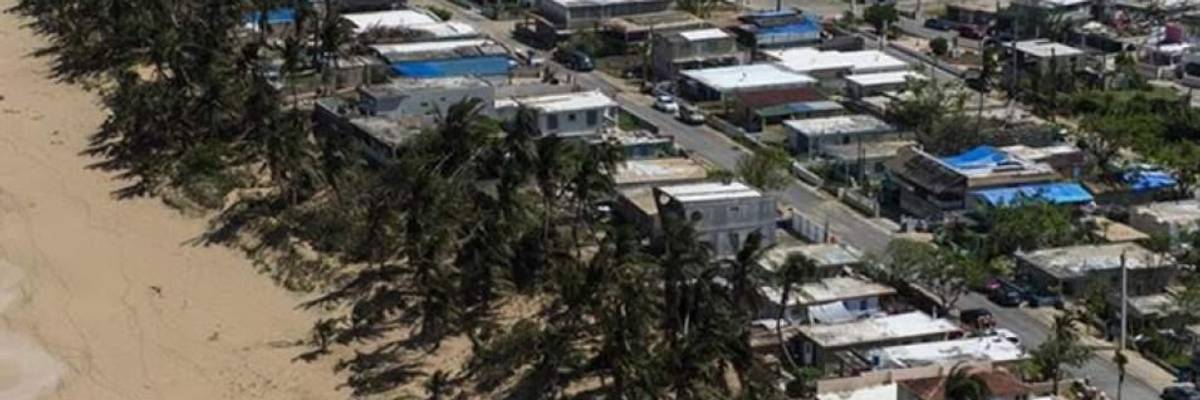
"While referring uniformly to this latest centrally-generated fiasco as a "total" blackout, the corporate media have almost totally ignored this steady, fast-growing stream of power being generated on Puerto Rico, virtually all of it solar." (Photo: USAF Nicholas Dutton)
Puerto Rico has made history by becoming -- briefly -- the largest US territory or state to be powered almost entirely by renewable energy.
The corporate media has done all it can to black the story out.
The rising grassroots movement to totally rebuild Puerto Rico's electric supply system with renewable energy and locally owned micro-grids poses a serious threat to the centralized, fossil-based corporate elite.
But two hurricanes and two human-error blackouts have opened the door to systemic change.
Here's how:
Last September, Hurricane Irma blew through the Caribbean, passing over enough of Puerto Rico to plunge tens of thousands of people into darkness. Many of them are still without power.
Then Hurricane Maria shredded the island's electric grid and blacked out its 3.4 million residents virtually in toto.
The island had two large wind farms, one of which was severely damaged. The other survived, but had no grid through which to distribute its electricity.
Some solar arrays on the island were also severely damaged.
But at a farm in Barranquitas owned by Hector Santiago, 244 solar panels kept some 2,500 light bulbs alight to maximize greenhouse plant growth. Much to the derision of his neighbors, Santiago had invested some $300,000 in the solar array. Small gas and kerosene-fired generators kicked back up around the island. But Santiago's solar array may well have been its biggest operating power station.
Over the following months, the Puerto Rico Electric Power Authority tried to restore its rickety poles and wires, plus its network of obsolete gas and oil plants ... and the ancient coal plant that burns ore from Colombia.
Along the way, PREPA's director was fired, and Governor Ricardo Antonio "Ricky" Rossello Nevares has campaigned to privatize the utility, a move strongly opposed by democracy activists.
On April 8, as PREPA was bringing the island back up to near-total power, restoration workers felled a tree onto live transmission wires, knocking out power to some 850,000 customers.
Ten days later, PREPA proudly announced that it had restored power to 95.8 percent of the island's population. Some 62,000 customers were still in the dark. But PREPA was proud that each the territory's 78 municipalities had at least some power.
Literally within hours, Puerto Rico was again plunged into darkness. The same contractor that on April 8 had dropped a tree into the grid now ran an excavator that shorted out the entire system. Once again, Puerto Rico was without central-generated electric power.
But now there was much more solar. In the wake of Irma and Maria, Solartopian activists have poured thousands of photovoltaic panels into the island. Strongly advocating that they become the centerpiece of a rebuilt energy supply system, many collectors now power locally owned micro-grids.
According to Elon Musk, Tesla has helped make 662 locations energy self-sufficient. Key has been San Juan's Hospital del Nino, which in just two weeks was made energy self-sufficient with panels and batteries.
Nearly all the island's hospitals were knocked out by Maria. Dialysis machines, operating rooms, air conditioning and other key services went dead. Many still are.
Ironically, according to activist Joel Segal, much of the nation's supply of pain-killing morphine and Dilaudid also went away, as they are mostly (for tax purposes) manufactured in Puerto Rico.
While referring uniformly to this latest centrally-generated fiasco as a "total" blackout, the corporate media have almost totally ignored this steady, fast-growing stream of power being generated on Puerto Rico, virtually all of it solar.
CNN did cover a local named "Frank," who after Maria took his home solar with $7500 in system components. Wired has reported on a Brooklyn architect, Andrew Marvel (a grand-nephew of the famed futurist Buckminster Fuller), who plans to use grants of $625,000 for his Resilient Power Puerto Rico to build 25 small arrays with Tesla battery backups. Another 75 or more may follow.
During my California Solartopia show on KPFK-Pacifica in Los Angeles, a listener pledged $20,000 for a neighborhood micro-grid linked with solar panels and batteries.
Rep. Ted Lieu (D-Calif.) and Rep. Stacey Plackett (D-Virgin Islands) have asked FEMA to take the island solar. So has San Juan's progressive mayor, Carmen Yulin Cruz.
But it's all too hot for the corporate media.
In December PREPA and the New York governor's office estimated that $17.6 billion was needed to revamp Puerto Rico's old grid, funds that could instead help take the island totally solar.
To put that in perspective: Governor Andrew Cuomo wants New York ratepayers to fork over $8 billion to keep four decrepit upstate reactors on line, despite their owners' attempts to close them. Ohio's FirstEnergy just asked Trump to force ratepayers to fork over $8 billion PER YEAR in "emergency funding" to prop up four more dying nukes and scores of obsolete coal burners.
Ironically, the blacked-out story of Puerto Rico having already inadvertently gone almost entirely solar has opened the brightest window onto a sustainable future.
A Solartopian Puerto Rico would enjoy permanent, reliable service, free of fuel costs and protected from the ravages of the inevitable next storm while avoiding the emissions that would help cause and intensify it.
But a Solartopian Puerto Rico would threaten the Trumpian corporatists who want to "restore" the island's central, fossil-fired, utterly corrupted grid, which is sure to go down in the next global-warmed hurricane. Or by the next felled tree and errant excavator.
Puerto Rico's Solartopian moments are big news. So are the solar panels and micro-grids that could help the island survive the next hurricanes (season starts June 1) and corporate wrecking crews.
Let's keep those panels coming!
To learn more contact me at solartopia.org.
Hear this at prn.fm with Joel Segal & David Braun: https://prn.fm/solartopia-green-power-wellness-hour-04-19-18/
Dear Common Dreams reader, It’s been nearly 30 years since I co-founded Common Dreams with my late wife, Lina Newhouser. We had the radical notion that journalism should serve the public good, not corporate profits. It was clear to us from the outset what it would take to build such a project. No paid advertisements. No corporate sponsors. No millionaire publisher telling us what to think or do. Many people said we wouldn't last a year, but we proved those doubters wrong. Together with a tremendous team of journalists and dedicated staff, we built an independent media outlet free from the constraints of profits and corporate control. Our mission has always been simple: To inform. To inspire. To ignite change for the common good. Building Common Dreams was not easy. Our survival was never guaranteed. When you take on the most powerful forces—Wall Street greed, fossil fuel industry destruction, Big Tech lobbyists, and uber-rich oligarchs who have spent billions upon billions rigging the economy and democracy in their favor—the only bulwark you have is supporters who believe in your work. But here’s the urgent message from me today. It's never been this bad out there. And it's never been this hard to keep us going. At the very moment Common Dreams is most needed, the threats we face are intensifying. We need your support now more than ever. We don't accept corporate advertising and never will. We don't have a paywall because we don't think people should be blocked from critical news based on their ability to pay. Everything we do is funded by the donations of readers like you. When everyone does the little they can afford, we are strong. But if that support retreats or dries up, so do we. Will you donate now to make sure Common Dreams not only survives but thrives? —Craig Brown, Co-founder |
Puerto Rico has made history by becoming -- briefly -- the largest US territory or state to be powered almost entirely by renewable energy.
The corporate media has done all it can to black the story out.
The rising grassroots movement to totally rebuild Puerto Rico's electric supply system with renewable energy and locally owned micro-grids poses a serious threat to the centralized, fossil-based corporate elite.
But two hurricanes and two human-error blackouts have opened the door to systemic change.
Here's how:
Last September, Hurricane Irma blew through the Caribbean, passing over enough of Puerto Rico to plunge tens of thousands of people into darkness. Many of them are still without power.
Then Hurricane Maria shredded the island's electric grid and blacked out its 3.4 million residents virtually in toto.
The island had two large wind farms, one of which was severely damaged. The other survived, but had no grid through which to distribute its electricity.
Some solar arrays on the island were also severely damaged.
But at a farm in Barranquitas owned by Hector Santiago, 244 solar panels kept some 2,500 light bulbs alight to maximize greenhouse plant growth. Much to the derision of his neighbors, Santiago had invested some $300,000 in the solar array. Small gas and kerosene-fired generators kicked back up around the island. But Santiago's solar array may well have been its biggest operating power station.
Over the following months, the Puerto Rico Electric Power Authority tried to restore its rickety poles and wires, plus its network of obsolete gas and oil plants ... and the ancient coal plant that burns ore from Colombia.
Along the way, PREPA's director was fired, and Governor Ricardo Antonio "Ricky" Rossello Nevares has campaigned to privatize the utility, a move strongly opposed by democracy activists.
On April 8, as PREPA was bringing the island back up to near-total power, restoration workers felled a tree onto live transmission wires, knocking out power to some 850,000 customers.
Ten days later, PREPA proudly announced that it had restored power to 95.8 percent of the island's population. Some 62,000 customers were still in the dark. But PREPA was proud that each the territory's 78 municipalities had at least some power.
Literally within hours, Puerto Rico was again plunged into darkness. The same contractor that on April 8 had dropped a tree into the grid now ran an excavator that shorted out the entire system. Once again, Puerto Rico was without central-generated electric power.
But now there was much more solar. In the wake of Irma and Maria, Solartopian activists have poured thousands of photovoltaic panels into the island. Strongly advocating that they become the centerpiece of a rebuilt energy supply system, many collectors now power locally owned micro-grids.
According to Elon Musk, Tesla has helped make 662 locations energy self-sufficient. Key has been San Juan's Hospital del Nino, which in just two weeks was made energy self-sufficient with panels and batteries.
Nearly all the island's hospitals were knocked out by Maria. Dialysis machines, operating rooms, air conditioning and other key services went dead. Many still are.
Ironically, according to activist Joel Segal, much of the nation's supply of pain-killing morphine and Dilaudid also went away, as they are mostly (for tax purposes) manufactured in Puerto Rico.
While referring uniformly to this latest centrally-generated fiasco as a "total" blackout, the corporate media have almost totally ignored this steady, fast-growing stream of power being generated on Puerto Rico, virtually all of it solar.
CNN did cover a local named "Frank," who after Maria took his home solar with $7500 in system components. Wired has reported on a Brooklyn architect, Andrew Marvel (a grand-nephew of the famed futurist Buckminster Fuller), who plans to use grants of $625,000 for his Resilient Power Puerto Rico to build 25 small arrays with Tesla battery backups. Another 75 or more may follow.
During my California Solartopia show on KPFK-Pacifica in Los Angeles, a listener pledged $20,000 for a neighborhood micro-grid linked with solar panels and batteries.
Rep. Ted Lieu (D-Calif.) and Rep. Stacey Plackett (D-Virgin Islands) have asked FEMA to take the island solar. So has San Juan's progressive mayor, Carmen Yulin Cruz.
But it's all too hot for the corporate media.
In December PREPA and the New York governor's office estimated that $17.6 billion was needed to revamp Puerto Rico's old grid, funds that could instead help take the island totally solar.
To put that in perspective: Governor Andrew Cuomo wants New York ratepayers to fork over $8 billion to keep four decrepit upstate reactors on line, despite their owners' attempts to close them. Ohio's FirstEnergy just asked Trump to force ratepayers to fork over $8 billion PER YEAR in "emergency funding" to prop up four more dying nukes and scores of obsolete coal burners.
Ironically, the blacked-out story of Puerto Rico having already inadvertently gone almost entirely solar has opened the brightest window onto a sustainable future.
A Solartopian Puerto Rico would enjoy permanent, reliable service, free of fuel costs and protected from the ravages of the inevitable next storm while avoiding the emissions that would help cause and intensify it.
But a Solartopian Puerto Rico would threaten the Trumpian corporatists who want to "restore" the island's central, fossil-fired, utterly corrupted grid, which is sure to go down in the next global-warmed hurricane. Or by the next felled tree and errant excavator.
Puerto Rico's Solartopian moments are big news. So are the solar panels and micro-grids that could help the island survive the next hurricanes (season starts June 1) and corporate wrecking crews.
Let's keep those panels coming!
To learn more contact me at solartopia.org.
Hear this at prn.fm with Joel Segal & David Braun: https://prn.fm/solartopia-green-power-wellness-hour-04-19-18/
Puerto Rico has made history by becoming -- briefly -- the largest US territory or state to be powered almost entirely by renewable energy.
The corporate media has done all it can to black the story out.
The rising grassroots movement to totally rebuild Puerto Rico's electric supply system with renewable energy and locally owned micro-grids poses a serious threat to the centralized, fossil-based corporate elite.
But two hurricanes and two human-error blackouts have opened the door to systemic change.
Here's how:
Last September, Hurricane Irma blew through the Caribbean, passing over enough of Puerto Rico to plunge tens of thousands of people into darkness. Many of them are still without power.
Then Hurricane Maria shredded the island's electric grid and blacked out its 3.4 million residents virtually in toto.
The island had two large wind farms, one of which was severely damaged. The other survived, but had no grid through which to distribute its electricity.
Some solar arrays on the island were also severely damaged.
But at a farm in Barranquitas owned by Hector Santiago, 244 solar panels kept some 2,500 light bulbs alight to maximize greenhouse plant growth. Much to the derision of his neighbors, Santiago had invested some $300,000 in the solar array. Small gas and kerosene-fired generators kicked back up around the island. But Santiago's solar array may well have been its biggest operating power station.
Over the following months, the Puerto Rico Electric Power Authority tried to restore its rickety poles and wires, plus its network of obsolete gas and oil plants ... and the ancient coal plant that burns ore from Colombia.
Along the way, PREPA's director was fired, and Governor Ricardo Antonio "Ricky" Rossello Nevares has campaigned to privatize the utility, a move strongly opposed by democracy activists.
On April 8, as PREPA was bringing the island back up to near-total power, restoration workers felled a tree onto live transmission wires, knocking out power to some 850,000 customers.
Ten days later, PREPA proudly announced that it had restored power to 95.8 percent of the island's population. Some 62,000 customers were still in the dark. But PREPA was proud that each the territory's 78 municipalities had at least some power.
Literally within hours, Puerto Rico was again plunged into darkness. The same contractor that on April 8 had dropped a tree into the grid now ran an excavator that shorted out the entire system. Once again, Puerto Rico was without central-generated electric power.
But now there was much more solar. In the wake of Irma and Maria, Solartopian activists have poured thousands of photovoltaic panels into the island. Strongly advocating that they become the centerpiece of a rebuilt energy supply system, many collectors now power locally owned micro-grids.
According to Elon Musk, Tesla has helped make 662 locations energy self-sufficient. Key has been San Juan's Hospital del Nino, which in just two weeks was made energy self-sufficient with panels and batteries.
Nearly all the island's hospitals were knocked out by Maria. Dialysis machines, operating rooms, air conditioning and other key services went dead. Many still are.
Ironically, according to activist Joel Segal, much of the nation's supply of pain-killing morphine and Dilaudid also went away, as they are mostly (for tax purposes) manufactured in Puerto Rico.
While referring uniformly to this latest centrally-generated fiasco as a "total" blackout, the corporate media have almost totally ignored this steady, fast-growing stream of power being generated on Puerto Rico, virtually all of it solar.
CNN did cover a local named "Frank," who after Maria took his home solar with $7500 in system components. Wired has reported on a Brooklyn architect, Andrew Marvel (a grand-nephew of the famed futurist Buckminster Fuller), who plans to use grants of $625,000 for his Resilient Power Puerto Rico to build 25 small arrays with Tesla battery backups. Another 75 or more may follow.
During my California Solartopia show on KPFK-Pacifica in Los Angeles, a listener pledged $20,000 for a neighborhood micro-grid linked with solar panels and batteries.
Rep. Ted Lieu (D-Calif.) and Rep. Stacey Plackett (D-Virgin Islands) have asked FEMA to take the island solar. So has San Juan's progressive mayor, Carmen Yulin Cruz.
But it's all too hot for the corporate media.
In December PREPA and the New York governor's office estimated that $17.6 billion was needed to revamp Puerto Rico's old grid, funds that could instead help take the island totally solar.
To put that in perspective: Governor Andrew Cuomo wants New York ratepayers to fork over $8 billion to keep four decrepit upstate reactors on line, despite their owners' attempts to close them. Ohio's FirstEnergy just asked Trump to force ratepayers to fork over $8 billion PER YEAR in "emergency funding" to prop up four more dying nukes and scores of obsolete coal burners.
Ironically, the blacked-out story of Puerto Rico having already inadvertently gone almost entirely solar has opened the brightest window onto a sustainable future.
A Solartopian Puerto Rico would enjoy permanent, reliable service, free of fuel costs and protected from the ravages of the inevitable next storm while avoiding the emissions that would help cause and intensify it.
But a Solartopian Puerto Rico would threaten the Trumpian corporatists who want to "restore" the island's central, fossil-fired, utterly corrupted grid, which is sure to go down in the next global-warmed hurricane. Or by the next felled tree and errant excavator.
Puerto Rico's Solartopian moments are big news. So are the solar panels and micro-grids that could help the island survive the next hurricanes (season starts June 1) and corporate wrecking crews.
Let's keep those panels coming!
To learn more contact me at solartopia.org.
Hear this at prn.fm with Joel Segal & David Braun: https://prn.fm/solartopia-green-power-wellness-hour-04-19-18/