SUBSCRIBE TO OUR FREE NEWSLETTER
Daily news & progressive opinion—funded by the people, not the corporations—delivered straight to your inbox.
5
#000000
#FFFFFF
To donate by check, phone, or other method, see our More Ways to Give page.
Daily news & progressive opinion—funded by the people, not the corporations—delivered straight to your inbox.
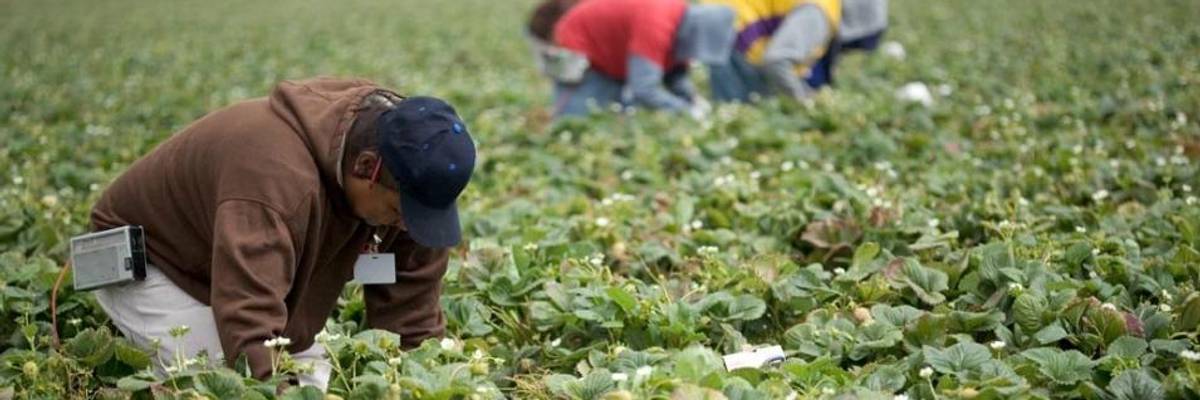
Agricultural workers in Salinas, California. (Photo: Michael Davidson/flickr/cc)
Inequality doesn't just come out of the blue; it's intentionally created by decisions that elites make -- usually behind closed doors, so those knocked down don't know what (or who) hit them.
Take America's 4 million fast-food workers, whose average pay hovers around a miserly $300 a week before taxes.
With the labor market tightening, why don't they just hop down the street to another franchise offering a better deal? Many try that, only to be rejected again and again, unaware that most fast-food chains have hidden within their franchising contracts "no-hire agreements," prohibiting one franchisee from hiring another's employees.
In a landmark study this year, two prominent labor economists at Princeton found that these secret bans on wage competition are used by more than 70,000 chain restaurants, including Burger King, Carl's Jr., Domino's and Pizza Hut. By colluding to prevent millions of Americans from switching jobs to increase their incomes and opportunities, these giants have artificially kept the pay of fast-food workers and many other franchise employees stuck at poverty levels. That's one place inequality comes from -- and it's downright un-American.
And what about the people who actually grow the food we eat? How are they treated by the Powers that Be? Every decade or so, America's mass media are surprised to discover that migrant farmworkers are still being miserably paid and despicably treated by the industry that profits from their labor. Stories run, the public is outraged (again), assorted officials pledge action, then ... nothing, no change takes place.
Here we go again. Several news reports in recent months have documented the ongoing, shameful abuse of these hard-working, hard-traveling families. A Los Angeles Times report revealed that, even if they receive the legal minimum wage, many farm laborers earn less than $17,500 a year because of their poverty-level paychecks and the seasonal nature of their work. Moreover, they are often "housed" in shacks, old chicken coops, shipping containers, and squalid motels. Yet in my state, owing to the Texas Legislature's cutbacks, the agency responsible for safe and sanitary migrant housing spent a grand total of $2,476 on inspections in 2015. The agency has imposed zero fines for housing violations since 2005. "As a result," the Austin American-Statesman reported, "an estimated 9 in 10 Texas migrant farmworkers lack access to licensed housing that meets minimum health and safety standards required by state and federal law."
This year, though, agribusiness interests from Florida to California are uniting in a push for new assistance -- not for laborers though, for themselves! While agribusiness interests were bit Trump backers (their PACs gave more money to Trump than to any other candidate), many in the industry are now expressing shock that he may actually intend to fulfill his campaign promise to cut off the flow of undocumented immigrants (who, they now admit, make up as much as 70 percent of the industry's workforce). So they've rushed to Washington, frantically demanding a special exemption from their president's planned lockout of Mexican laborers. In the process, they've suddenly recharacterized the very migrants they've been so callously mistreating as noble employees essential to the USA's food security.
BigAg deserves no special break at all, of course, but if Trump and Congress give any help to them, at the very least they should be required to pay a living wage, provide decent family housing and health care, and treat all farmworkers with the respect due people who really are essential to our food security. To help push for basic human justice, connect with the United Farm Workers at ufw.org.
This country and this world are at a monumental crossroads. US voters have an opportunity to beat back the forces of fascism and confront the billionaires who are rigging the economy, our media system, and our democracy, making it increasingly impossible for ordinary people to get by. We’re not just talking about the election. We’re talking about what must be done once these fascist elements are vanquished from power. We need a bolder set of solutions than what either major party has so far been willing to offer and a working-class movement ready to fight like hell for it. Trump didn't emerge from nowhere. The conditions that fueled MAGA authoritarianism were created by decades of radical neoliberal economic policies and a corrupt political system dominated by corporate interests. They slashed taxes on the super-rich, promising that the benefits would trickle down. They said giveaways to the corporate titans would make life more affordable for the rest of us. It was all bullshit. And when a bitter, betrayed populace searches for someone to blame, right-wing demagogues have little trouble finding scapegoats. People know when they're being lied to, but you won't hear any of this from the corporate media. Only independent journalism—powered and funded by people who believe in building a better world—can deliver truly trustworthy daily news. If you share our vision, please contribute whatever you can to sustain our work. |
Inequality doesn't just come out of the blue; it's intentionally created by decisions that elites make -- usually behind closed doors, so those knocked down don't know what (or who) hit them.
Take America's 4 million fast-food workers, whose average pay hovers around a miserly $300 a week before taxes.
With the labor market tightening, why don't they just hop down the street to another franchise offering a better deal? Many try that, only to be rejected again and again, unaware that most fast-food chains have hidden within their franchising contracts "no-hire agreements," prohibiting one franchisee from hiring another's employees.
In a landmark study this year, two prominent labor economists at Princeton found that these secret bans on wage competition are used by more than 70,000 chain restaurants, including Burger King, Carl's Jr., Domino's and Pizza Hut. By colluding to prevent millions of Americans from switching jobs to increase their incomes and opportunities, these giants have artificially kept the pay of fast-food workers and many other franchise employees stuck at poverty levels. That's one place inequality comes from -- and it's downright un-American.
And what about the people who actually grow the food we eat? How are they treated by the Powers that Be? Every decade or so, America's mass media are surprised to discover that migrant farmworkers are still being miserably paid and despicably treated by the industry that profits from their labor. Stories run, the public is outraged (again), assorted officials pledge action, then ... nothing, no change takes place.
Here we go again. Several news reports in recent months have documented the ongoing, shameful abuse of these hard-working, hard-traveling families. A Los Angeles Times report revealed that, even if they receive the legal minimum wage, many farm laborers earn less than $17,500 a year because of their poverty-level paychecks and the seasonal nature of their work. Moreover, they are often "housed" in shacks, old chicken coops, shipping containers, and squalid motels. Yet in my state, owing to the Texas Legislature's cutbacks, the agency responsible for safe and sanitary migrant housing spent a grand total of $2,476 on inspections in 2015. The agency has imposed zero fines for housing violations since 2005. "As a result," the Austin American-Statesman reported, "an estimated 9 in 10 Texas migrant farmworkers lack access to licensed housing that meets minimum health and safety standards required by state and federal law."
This year, though, agribusiness interests from Florida to California are uniting in a push for new assistance -- not for laborers though, for themselves! While agribusiness interests were bit Trump backers (their PACs gave more money to Trump than to any other candidate), many in the industry are now expressing shock that he may actually intend to fulfill his campaign promise to cut off the flow of undocumented immigrants (who, they now admit, make up as much as 70 percent of the industry's workforce). So they've rushed to Washington, frantically demanding a special exemption from their president's planned lockout of Mexican laborers. In the process, they've suddenly recharacterized the very migrants they've been so callously mistreating as noble employees essential to the USA's food security.
BigAg deserves no special break at all, of course, but if Trump and Congress give any help to them, at the very least they should be required to pay a living wage, provide decent family housing and health care, and treat all farmworkers with the respect due people who really are essential to our food security. To help push for basic human justice, connect with the United Farm Workers at ufw.org.