SUBSCRIBE TO OUR FREE NEWSLETTER
Daily news & progressive opinion—funded by the people, not the corporations—delivered straight to your inbox.
5
#000000
#FFFFFF
To donate by check, phone, or other method, see our More Ways to Give page.
Daily news & progressive opinion—funded by the people, not the corporations—delivered straight to your inbox.
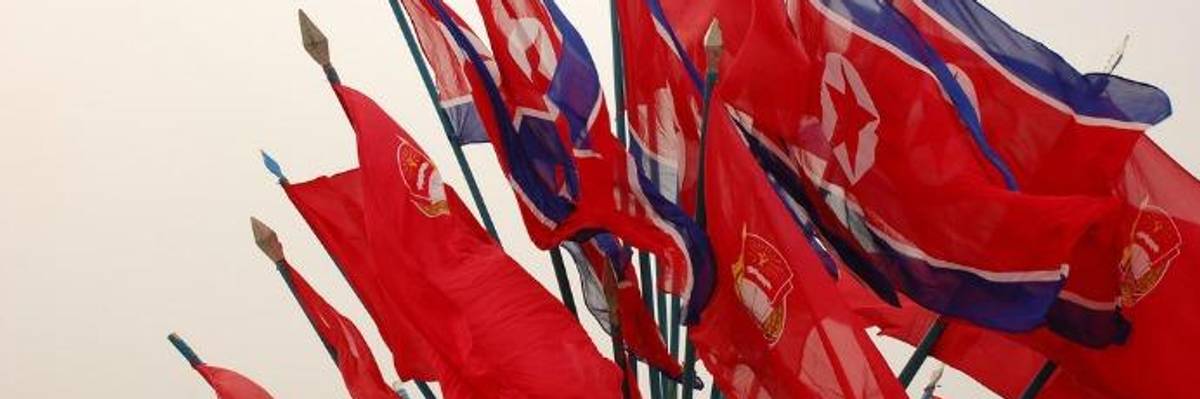
"North Korea may be 'begging for war,' as U.N. Ambassador Nikki Haley exclaimed, but it's not alone in doing so," writes Robert C. Koehler. (Photo: (stephan)/Flickr/cc)
"There are no good options," Brian Williams said the other night on MSNBC, launching a discussion about North Korea with the implication that war--maybe nuclear war--is the only solution to the problem it represents.
We've been cradling our own suicide for seven decades. The baby's eyes open...
"There are no good options," Brian Williams said the other night on MSNBC, launching a discussion about North Korea with the implication that war--maybe nuclear war--is the only solution to the problem it represents.
We've been cradling our own suicide for seven decades. The baby's eyes open...
And Williams was right, though not in a way that he understood. When war--forceful domination, victory through threat, carnage and, if necessary, annihilation--is the ultimate limit of one's consciousness, there are no good options. Even the peace negotiated in the context of war is bound to be temporary and grudging and therefore a bad option--sort of like the "peace" achieved at the end of the Korean War, after which both sides still, as Reuters reports, "have thousands of rockets and artillery pieces aimed at each other across the world's most heavily armed border."
Only beyond the context of war are there any options at all. Only beyond the context of war does humanity have any hope of avoiding suicide. And contrary to the consensus viewpoint of mainstream politicians and reporters, this is not completely unexplored territory.
Because Donald Trump is president, reaching for this trans-war consciousness is as crucial as it has ever been.
Maybe the best place to begin is by noting that there are some 22,000 nuclear weapons on the planet. This fact is almost never part of the news about North Korea, which has, as of this week, when it detonated an alleged hydrogen bomb, conducted six nuclear tests. The fact that Kim Jong-un's tiny, unpredictable country is a member of the nuclear club is disconcerting, but the fact that there's a "nuclear club" at all--and that its members are spending as much as a trillion dollars a decade to modernize their nuclear weapons--is even more disconcerting. And the fact that the modernization process is happening so quietly, without controversy or public debate (or even awareness) exacerbates the horror exponentially.
North Korea may be "begging for war," as U.N. Ambassador Nikki Haley exclaimed, but it's not alone in doing so. None of the planet's nuclear-armed nations have abided by the 1970 Treaty on the Non-Proliferation of Nuclear Weapons, which explicitly calls for complete nuclear disarmament. How easy this has been to ignore.
As Simon Tisdall wrote recently in the Guardian: "...the past and present leaders of the U.S., Russia, China, France and the U.K., whose governments signed but have not fulfilled the terms of the 1970 nuclear non-proliferation treaty, have to some degree brought the North Korea crisis on themselves. Kim Jong-un's recklessness and bad faith is a product of their own."
Preparing for war produces, at best, obedience, which usually comes with hidden resentments. Because North Korea has displayed defiance rather than obedience, the mainstream media have portrayed the country and its leader as, essentially, evil cartoon characters: a crazy country that doesn't know its place and is therefore begging for war.
To reach beyond war, to reach toward the future and create the possibility that it will arrive--to create sensible options--first of all requires dealing with one's enemy with respect and understanding. In the case of North Korea, this means revisiting the Korean War, in which some 3 million North Koreans died and, as Anna Fifield pointed out recently in the Washington Post, "the U.S. Air Force leveled the North, to the extent that American generals complained there was nothing left to bomb.
"Ever since," she writes, "North Korea has existed in a state of insecurity, with the totalitarian regime telling the population that the United States is out to destroy them--again.
"It is in this context that, following the collapse of its nuclear-armed benefactor, the Soviet Union, the Kim regime has sought weapons of its own."
She points out that this is not irrational behavior--certainly not for a small, isolated country in the crosshairs of the United States. On a planet with no good options, North Korea's capacity to produce a little mutually assured destruction may be its best bet to curtail invasion. Indeed, no nuclear-armed nation has ever been invaded.
With that understanding in place, John Delury, a professor at the Yonsei University Graduate School of International Studies in Seoul, has some further advice to offer: "Now is the time," he wrote in the Washington Post in April, "to jump-start a diplomatic initiative that reopens channels, lowers tensions and caps North Korea's capabilities where they are. Then, working closely with the new government in Seoul and others, the United States should support a long-term strategy that integrates North Korea into regional stability and prosperity....
"By simply inflicting economic pain, threatening military strikes and keeping tensions high, the United States is playing into the worst tendencies of the North Korean system. Kim's nuclear intentions will harden and North Korea's capabilities will only grow. It's time to reverse course."
The time is now: to stop pretending that war will keep us safe, to stop cradling humanity's capacity to commit suicide.
And the United States is not Donald Trump. Our collective consciousness is bigger than that of a bully. That means we have the capacity to understand that the threat posed by North Korea is a reminder that nuclear disarmament for the whole planet is long overdue. There are no good nuclear weapons.
This country and this world are at a monumental crossroads. US voters have an opportunity to beat back the forces of fascism and confront the billionaires who are rigging the economy, our media system, and our democracy, making it increasingly impossible for ordinary people to get by. We’re not just talking about the election. We’re talking about what must be done once these fascist elements are vanquished from power. We need a bolder set of solutions than what either major party has so far been willing to offer and a working-class movement ready to fight like hell for it. Trump didn't emerge from nowhere. The conditions that fueled MAGA authoritarianism were created by decades of radical neoliberal economic policies and a corrupt political system dominated by corporate interests. They slashed taxes on the super-rich, promising that the benefits would trickle down. They said giveaways to the corporate titans would make life more affordable for the rest of us. It was all bullshit. And when a bitter, betrayed populace searches for someone to blame, right-wing demagogues have little trouble finding scapegoats. People know when they're being lied to, but you won't hear any of this from the corporate media. Only independent journalism—powered and funded by people who believe in building a better world—can deliver truly trustworthy daily news. If you share our vision, please contribute whatever you can to sustain our work. |
"There are no good options," Brian Williams said the other night on MSNBC, launching a discussion about North Korea with the implication that war--maybe nuclear war--is the only solution to the problem it represents.
We've been cradling our own suicide for seven decades. The baby's eyes open...
And Williams was right, though not in a way that he understood. When war--forceful domination, victory through threat, carnage and, if necessary, annihilation--is the ultimate limit of one's consciousness, there are no good options. Even the peace negotiated in the context of war is bound to be temporary and grudging and therefore a bad option--sort of like the "peace" achieved at the end of the Korean War, after which both sides still, as Reuters reports, "have thousands of rockets and artillery pieces aimed at each other across the world's most heavily armed border."
Only beyond the context of war are there any options at all. Only beyond the context of war does humanity have any hope of avoiding suicide. And contrary to the consensus viewpoint of mainstream politicians and reporters, this is not completely unexplored territory.
Because Donald Trump is president, reaching for this trans-war consciousness is as crucial as it has ever been.
Maybe the best place to begin is by noting that there are some 22,000 nuclear weapons on the planet. This fact is almost never part of the news about North Korea, which has, as of this week, when it detonated an alleged hydrogen bomb, conducted six nuclear tests. The fact that Kim Jong-un's tiny, unpredictable country is a member of the nuclear club is disconcerting, but the fact that there's a "nuclear club" at all--and that its members are spending as much as a trillion dollars a decade to modernize their nuclear weapons--is even more disconcerting. And the fact that the modernization process is happening so quietly, without controversy or public debate (or even awareness) exacerbates the horror exponentially.
North Korea may be "begging for war," as U.N. Ambassador Nikki Haley exclaimed, but it's not alone in doing so. None of the planet's nuclear-armed nations have abided by the 1970 Treaty on the Non-Proliferation of Nuclear Weapons, which explicitly calls for complete nuclear disarmament. How easy this has been to ignore.
As Simon Tisdall wrote recently in the Guardian: "...the past and present leaders of the U.S., Russia, China, France and the U.K., whose governments signed but have not fulfilled the terms of the 1970 nuclear non-proliferation treaty, have to some degree brought the North Korea crisis on themselves. Kim Jong-un's recklessness and bad faith is a product of their own."
Preparing for war produces, at best, obedience, which usually comes with hidden resentments. Because North Korea has displayed defiance rather than obedience, the mainstream media have portrayed the country and its leader as, essentially, evil cartoon characters: a crazy country that doesn't know its place and is therefore begging for war.
To reach beyond war, to reach toward the future and create the possibility that it will arrive--to create sensible options--first of all requires dealing with one's enemy with respect and understanding. In the case of North Korea, this means revisiting the Korean War, in which some 3 million North Koreans died and, as Anna Fifield pointed out recently in the Washington Post, "the U.S. Air Force leveled the North, to the extent that American generals complained there was nothing left to bomb.
"Ever since," she writes, "North Korea has existed in a state of insecurity, with the totalitarian regime telling the population that the United States is out to destroy them--again.
"It is in this context that, following the collapse of its nuclear-armed benefactor, the Soviet Union, the Kim regime has sought weapons of its own."
She points out that this is not irrational behavior--certainly not for a small, isolated country in the crosshairs of the United States. On a planet with no good options, North Korea's capacity to produce a little mutually assured destruction may be its best bet to curtail invasion. Indeed, no nuclear-armed nation has ever been invaded.
With that understanding in place, John Delury, a professor at the Yonsei University Graduate School of International Studies in Seoul, has some further advice to offer: "Now is the time," he wrote in the Washington Post in April, "to jump-start a diplomatic initiative that reopens channels, lowers tensions and caps North Korea's capabilities where they are. Then, working closely with the new government in Seoul and others, the United States should support a long-term strategy that integrates North Korea into regional stability and prosperity....
"By simply inflicting economic pain, threatening military strikes and keeping tensions high, the United States is playing into the worst tendencies of the North Korean system. Kim's nuclear intentions will harden and North Korea's capabilities will only grow. It's time to reverse course."
The time is now: to stop pretending that war will keep us safe, to stop cradling humanity's capacity to commit suicide.
And the United States is not Donald Trump. Our collective consciousness is bigger than that of a bully. That means we have the capacity to understand that the threat posed by North Korea is a reminder that nuclear disarmament for the whole planet is long overdue. There are no good nuclear weapons.