SUBSCRIBE TO OUR FREE NEWSLETTER
Daily news & progressive opinion—funded by the people, not the corporations—delivered straight to your inbox.
5
#000000
#FFFFFF
To donate by check, phone, or other method, see our More Ways to Give page.
The best argument for a single-payer health plan is the recent decision by giant health insurer Aetna to bail out next year from 11 of the 15 states where it sells Obamacare plans.
Aetna's decision follows similar moves by UnitedHealth Group, the nation's largest insurer, and Humana, one of the other giants.
All claim they're not making enough money because too many people with serious health problems are using the Obamacare exchanges, and not enough healthy people are signing up.
The problem isn't Obamacare per se. It's in the structure of private markets for health insurance - which creates powerful incentives to avoid sick people and attract healthy ones. Obamacare is just making the structural problem more obvious.
"The problem isn't Obamacare per se. It's in the structure of private markets for health insurance - which creates powerful incentives to avoid sick people and attract healthy ones. Obamacare is just making the structural problem more obvious." In a nutshell, the more sick people and the fewer healthy people a private for-profit insurer attracts, the less competitive that insurer becomes relative to other insurers that don't attract as high a percentage of the sick but a higher percentage of the healthy. Eventually, insurers that take in too many sick and too few healthy people are driven out of business.
If insurers had no idea who'd be sick and who'd be healthy when they sign up for insurance (and keep them insured at the same price even after they become sick), this wouldn't be a problem. But they do know - and they're developing more and more sophisticated ways of finding out.
It's not just people with pre-existing conditions who have caused insurers to run for the happy hills of healthy customers. It's also people with genetic predispositions toward certain illnesses that are expensive to treat, like heart disease and cancer. And people who don't exercise enough, or have unhealthy habits, or live in unhealthy places.
So health insurers spend lots of time, effort, and money trying to attract people who have high odds of staying healthy (the young and the fit) while doing whatever they can to fend off those who have high odds of getting sick (the older, infirm, and the unfit).
As a result we end up with the most bizarre health-insurance system imaginable: One ever more carefully designed to avoid sick people.
If this weren't enough to convince rational people to do what most other advanced nations have done and create a single-payer system, consider that America's giant health insurers are now busily consolidating into ever-larger behemoths. UnitedHealth is already humongous. Aetna, meanwhile, is trying to buy Humana.
Insurers say they're doing this in order to reap economies of scale, but there's little evidence that large size generates cost savings.
In reality, they're becoming very big to get more bargaining leverage over everyone they do business with - hospitals, doctors, employers, the government, and consumers. That way they make even bigger profits.
But these bigger profits come at the expense of hospitals, doctors, employers, the government, and, ultimately, taxpayers and consumers.
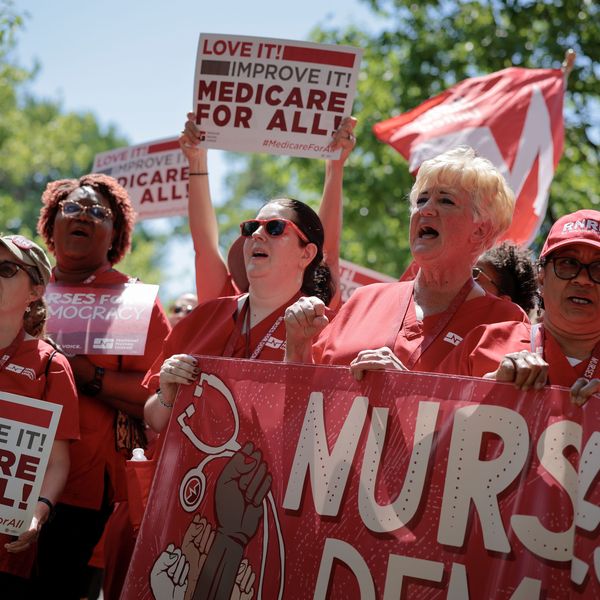
So the real choice in the future is becoming clear. Obamacare is only smoking it out. One alternative is a public single-payer system. The other is a hugely-expensive for-profit oligopoly with the market power to charge high prices even to healthy people - and to charge sick people (or those likely to be sick) an arm and a leg.
The best argument for a single-payer health plan is the recent decision by giant health insurer Aetna to bail out next year from 11 of the 15 states where it sells Obamacare plans.
Aetna's decision follows similar moves by UnitedHealth Group, the nation's largest insurer, and Humana, one of the other giants.
All claim they're not making enough money because too many people with serious health problems are using the Obamacare exchanges, and not enough healthy people are signing up.
The problem isn't Obamacare per se. It's in the structure of private markets for health insurance - which creates powerful incentives to avoid sick people and attract healthy ones. Obamacare is just making the structural problem more obvious.
"The problem isn't Obamacare per se. It's in the structure of private markets for health insurance - which creates powerful incentives to avoid sick people and attract healthy ones. Obamacare is just making the structural problem more obvious." In a nutshell, the more sick people and the fewer healthy people a private for-profit insurer attracts, the less competitive that insurer becomes relative to other insurers that don't attract as high a percentage of the sick but a higher percentage of the healthy. Eventually, insurers that take in too many sick and too few healthy people are driven out of business.
If insurers had no idea who'd be sick and who'd be healthy when they sign up for insurance (and keep them insured at the same price even after they become sick), this wouldn't be a problem. But they do know - and they're developing more and more sophisticated ways of finding out.
It's not just people with pre-existing conditions who have caused insurers to run for the happy hills of healthy customers. It's also people with genetic predispositions toward certain illnesses that are expensive to treat, like heart disease and cancer. And people who don't exercise enough, or have unhealthy habits, or live in unhealthy places.
So health insurers spend lots of time, effort, and money trying to attract people who have high odds of staying healthy (the young and the fit) while doing whatever they can to fend off those who have high odds of getting sick (the older, infirm, and the unfit).
As a result we end up with the most bizarre health-insurance system imaginable: One ever more carefully designed to avoid sick people.
If this weren't enough to convince rational people to do what most other advanced nations have done and create a single-payer system, consider that America's giant health insurers are now busily consolidating into ever-larger behemoths. UnitedHealth is already humongous. Aetna, meanwhile, is trying to buy Humana.
Insurers say they're doing this in order to reap economies of scale, but there's little evidence that large size generates cost savings.
In reality, they're becoming very big to get more bargaining leverage over everyone they do business with - hospitals, doctors, employers, the government, and consumers. That way they make even bigger profits.
But these bigger profits come at the expense of hospitals, doctors, employers, the government, and, ultimately, taxpayers and consumers.
So the real choice in the future is becoming clear. Obamacare is only smoking it out. One alternative is a public single-payer system. The other is a hugely-expensive for-profit oligopoly with the market power to charge high prices even to healthy people - and to charge sick people (or those likely to be sick) an arm and a leg.
The best argument for a single-payer health plan is the recent decision by giant health insurer Aetna to bail out next year from 11 of the 15 states where it sells Obamacare plans.
Aetna's decision follows similar moves by UnitedHealth Group, the nation's largest insurer, and Humana, one of the other giants.
All claim they're not making enough money because too many people with serious health problems are using the Obamacare exchanges, and not enough healthy people are signing up.
The problem isn't Obamacare per se. It's in the structure of private markets for health insurance - which creates powerful incentives to avoid sick people and attract healthy ones. Obamacare is just making the structural problem more obvious.
"The problem isn't Obamacare per se. It's in the structure of private markets for health insurance - which creates powerful incentives to avoid sick people and attract healthy ones. Obamacare is just making the structural problem more obvious." In a nutshell, the more sick people and the fewer healthy people a private for-profit insurer attracts, the less competitive that insurer becomes relative to other insurers that don't attract as high a percentage of the sick but a higher percentage of the healthy. Eventually, insurers that take in too many sick and too few healthy people are driven out of business.
If insurers had no idea who'd be sick and who'd be healthy when they sign up for insurance (and keep them insured at the same price even after they become sick), this wouldn't be a problem. But they do know - and they're developing more and more sophisticated ways of finding out.
It's not just people with pre-existing conditions who have caused insurers to run for the happy hills of healthy customers. It's also people with genetic predispositions toward certain illnesses that are expensive to treat, like heart disease and cancer. And people who don't exercise enough, or have unhealthy habits, or live in unhealthy places.
So health insurers spend lots of time, effort, and money trying to attract people who have high odds of staying healthy (the young and the fit) while doing whatever they can to fend off those who have high odds of getting sick (the older, infirm, and the unfit).
As a result we end up with the most bizarre health-insurance system imaginable: One ever more carefully designed to avoid sick people.
If this weren't enough to convince rational people to do what most other advanced nations have done and create a single-payer system, consider that America's giant health insurers are now busily consolidating into ever-larger behemoths. UnitedHealth is already humongous. Aetna, meanwhile, is trying to buy Humana.
Insurers say they're doing this in order to reap economies of scale, but there's little evidence that large size generates cost savings.
In reality, they're becoming very big to get more bargaining leverage over everyone they do business with - hospitals, doctors, employers, the government, and consumers. That way they make even bigger profits.
But these bigger profits come at the expense of hospitals, doctors, employers, the government, and, ultimately, taxpayers and consumers.
So the real choice in the future is becoming clear. Obamacare is only smoking it out. One alternative is a public single-payer system. The other is a hugely-expensive for-profit oligopoly with the market power to charge high prices even to healthy people - and to charge sick people (or those likely to be sick) an arm and a leg.