SUBSCRIBE TO OUR FREE NEWSLETTER
Daily news & progressive opinion—funded by the people, not the corporations—delivered straight to your inbox.
5
#000000
#FFFFFF
To donate by check, phone, or other method, see our More Ways to Give page.
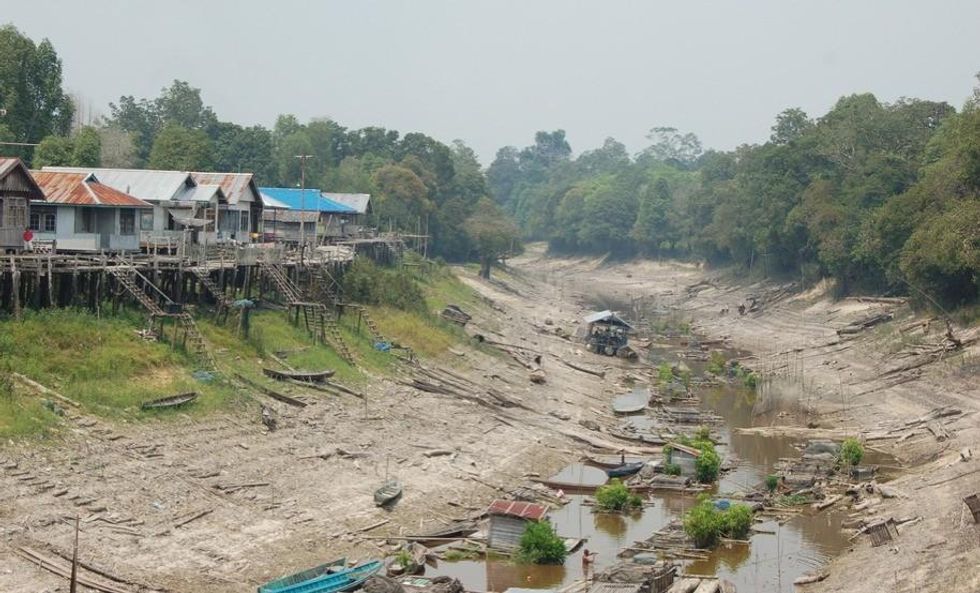
Humanity is polluting, mismanaging, and displacing our finite freshwater sources at an alarming rate. Since 1990, half the rivers in China have disappeared. The Ogallala Aquifer that supplies the U.S. breadbasket will be gone "in our lifetime," the U.S. Department of Agriculture says.
By 2030, global demand for water will outstrip supply by 40 percent, a surefire recipe for great suffering. Five hundred scientists recently told UN Secretary General Ban Ki-moon that our collective abuse of water has caused the planet to enter "a new geologic age" and that the majority of the planet's population lives within 31 miles of an endangered water source.
"Just as water can be a source of disputes, conflict, and violence, water can bring people, communities, and nations together in the shared search for solutions."
Yet in election after election the world over, no one's paying attention to this urgent issue.
That's why I'm calling for a new water ethic that places water and its protection at the heart of all policy and practice. This may strike you as far-fetched, but we must do it now. The future of the planet and the human race both depend on it.
And taking our water crisis seriously will change everything.
What would farm policy look like if we understood that the global food system is depleting local watersheds through the export of a torrent of "virtual water"? Vast quantities of water are embedded in apples, corn, and other crops.
How would trade policy change if we understood that global trade deals give global firms the right to claim "ownership" of the water they use in other countries?
Would our energy policies change if we realized that water-guzzling biofuels may be more environmentally dangerous than the fossil fuels they're supposed to replace?
This new water ethic should honor four principles.
First, water is a human right and must be more equitably shared. The United Nations has recognized that drinking water and sanitation are fundamental rights and that governments have obligations not only to supply these services to their people but also to prevent harm to source water. This provides an important tool to local communities as they confront dangerous mines, dams, and fossil-fuel extraction operations around the world.
Second, water is a common heritage of humanity and of future generations and must be protected as a public trust in law and practice. Water must never be bought, hoarded, sold, or traded as a commodity on the open market and governments must maintain the water commons for the public good, not private gain. While private businesses have a role in helping find solutions to our water crisis, they shouldn't be allowed to determine access to this basic public service. The public good trumps the corporate drive to make profits when it comes to water.
Third, water has rights too, outside its usefulness to humans. Water belongs to the Earth and other species. Our belief in "unlimited growth" and our treatment of water as a tool for industrial development have put the earth's watersheds in jeopardy. Water isn't merely a resource for our convenience, pleasure, and profit. It's the essential element in a living ecosystem. We need to adapt our laws and practices to ensure the protection of water and the restoration of watersheds -- a crucial antidote to global warming.
Finally, I deeply believe that water can teach us how to live together if only we will let it. There is enormous potential for water conflict in a world of rising demand and diminishing supply. But just as water can be a source of disputes, conflict, and violence, water can bring people, communities, and nations together in the shared search for solutions.
Preserving water supplies will require more collaborative and sustainable ways of growing food, producing energy, and trading across borders. It will demand robust democratic governance.
It is my deepest hope that water can become nature's gift to humanity and teach us how to tread more lightly on the earth -- in peace and respect with one another.
Humanity is polluting, mismanaging, and displacing our finite freshwater sources at an alarming rate. Since 1990, half the rivers in China have disappeared. The Ogallala Aquifer that supplies the U.S. breadbasket will be gone "in our lifetime," the U.S. Department of Agriculture says.
By 2030, global demand for water will outstrip supply by 40 percent, a surefire recipe for great suffering. Five hundred scientists recently told UN Secretary General Ban Ki-moon that our collective abuse of water has caused the planet to enter "a new geologic age" and that the majority of the planet's population lives within 31 miles of an endangered water source.
"Just as water can be a source of disputes, conflict, and violence, water can bring people, communities, and nations together in the shared search for solutions."
Yet in election after election the world over, no one's paying attention to this urgent issue.
That's why I'm calling for a new water ethic that places water and its protection at the heart of all policy and practice. This may strike you as far-fetched, but we must do it now. The future of the planet and the human race both depend on it.
And taking our water crisis seriously will change everything.
What would farm policy look like if we understood that the global food system is depleting local watersheds through the export of a torrent of "virtual water"? Vast quantities of water are embedded in apples, corn, and other crops.
How would trade policy change if we understood that global trade deals give global firms the right to claim "ownership" of the water they use in other countries?
Would our energy policies change if we realized that water-guzzling biofuels may be more environmentally dangerous than the fossil fuels they're supposed to replace?
This new water ethic should honor four principles.
First, water is a human right and must be more equitably shared. The United Nations has recognized that drinking water and sanitation are fundamental rights and that governments have obligations not only to supply these services to their people but also to prevent harm to source water. This provides an important tool to local communities as they confront dangerous mines, dams, and fossil-fuel extraction operations around the world.
Second, water is a common heritage of humanity and of future generations and must be protected as a public trust in law and practice. Water must never be bought, hoarded, sold, or traded as a commodity on the open market and governments must maintain the water commons for the public good, not private gain. While private businesses have a role in helping find solutions to our water crisis, they shouldn't be allowed to determine access to this basic public service. The public good trumps the corporate drive to make profits when it comes to water.
Third, water has rights too, outside its usefulness to humans. Water belongs to the Earth and other species. Our belief in "unlimited growth" and our treatment of water as a tool for industrial development have put the earth's watersheds in jeopardy. Water isn't merely a resource for our convenience, pleasure, and profit. It's the essential element in a living ecosystem. We need to adapt our laws and practices to ensure the protection of water and the restoration of watersheds -- a crucial antidote to global warming.
Finally, I deeply believe that water can teach us how to live together if only we will let it. There is enormous potential for water conflict in a world of rising demand and diminishing supply. But just as water can be a source of disputes, conflict, and violence, water can bring people, communities, and nations together in the shared search for solutions.
Preserving water supplies will require more collaborative and sustainable ways of growing food, producing energy, and trading across borders. It will demand robust democratic governance.
It is my deepest hope that water can become nature's gift to humanity and teach us how to tread more lightly on the earth -- in peace and respect with one another.
Humanity is polluting, mismanaging, and displacing our finite freshwater sources at an alarming rate. Since 1990, half the rivers in China have disappeared. The Ogallala Aquifer that supplies the U.S. breadbasket will be gone "in our lifetime," the U.S. Department of Agriculture says.
By 2030, global demand for water will outstrip supply by 40 percent, a surefire recipe for great suffering. Five hundred scientists recently told UN Secretary General Ban Ki-moon that our collective abuse of water has caused the planet to enter "a new geologic age" and that the majority of the planet's population lives within 31 miles of an endangered water source.
"Just as water can be a source of disputes, conflict, and violence, water can bring people, communities, and nations together in the shared search for solutions."
Yet in election after election the world over, no one's paying attention to this urgent issue.
That's why I'm calling for a new water ethic that places water and its protection at the heart of all policy and practice. This may strike you as far-fetched, but we must do it now. The future of the planet and the human race both depend on it.
And taking our water crisis seriously will change everything.
What would farm policy look like if we understood that the global food system is depleting local watersheds through the export of a torrent of "virtual water"? Vast quantities of water are embedded in apples, corn, and other crops.
How would trade policy change if we understood that global trade deals give global firms the right to claim "ownership" of the water they use in other countries?
Would our energy policies change if we realized that water-guzzling biofuels may be more environmentally dangerous than the fossil fuels they're supposed to replace?
This new water ethic should honor four principles.
First, water is a human right and must be more equitably shared. The United Nations has recognized that drinking water and sanitation are fundamental rights and that governments have obligations not only to supply these services to their people but also to prevent harm to source water. This provides an important tool to local communities as they confront dangerous mines, dams, and fossil-fuel extraction operations around the world.
Second, water is a common heritage of humanity and of future generations and must be protected as a public trust in law and practice. Water must never be bought, hoarded, sold, or traded as a commodity on the open market and governments must maintain the water commons for the public good, not private gain. While private businesses have a role in helping find solutions to our water crisis, they shouldn't be allowed to determine access to this basic public service. The public good trumps the corporate drive to make profits when it comes to water.
Third, water has rights too, outside its usefulness to humans. Water belongs to the Earth and other species. Our belief in "unlimited growth" and our treatment of water as a tool for industrial development have put the earth's watersheds in jeopardy. Water isn't merely a resource for our convenience, pleasure, and profit. It's the essential element in a living ecosystem. We need to adapt our laws and practices to ensure the protection of water and the restoration of watersheds -- a crucial antidote to global warming.
Finally, I deeply believe that water can teach us how to live together if only we will let it. There is enormous potential for water conflict in a world of rising demand and diminishing supply. But just as water can be a source of disputes, conflict, and violence, water can bring people, communities, and nations together in the shared search for solutions.
Preserving water supplies will require more collaborative and sustainable ways of growing food, producing energy, and trading across borders. It will demand robust democratic governance.
It is my deepest hope that water can become nature's gift to humanity and teach us how to tread more lightly on the earth -- in peace and respect with one another.