SUBSCRIBE TO OUR FREE NEWSLETTER
Daily news & progressive opinion—funded by the people, not the corporations—delivered straight to your inbox.
5
#000000
#FFFFFF
To donate by check, phone, or other method, see our More Ways to Give page.
The NSA has officially stopped sugar coating the fact that it wants to spy on every American.
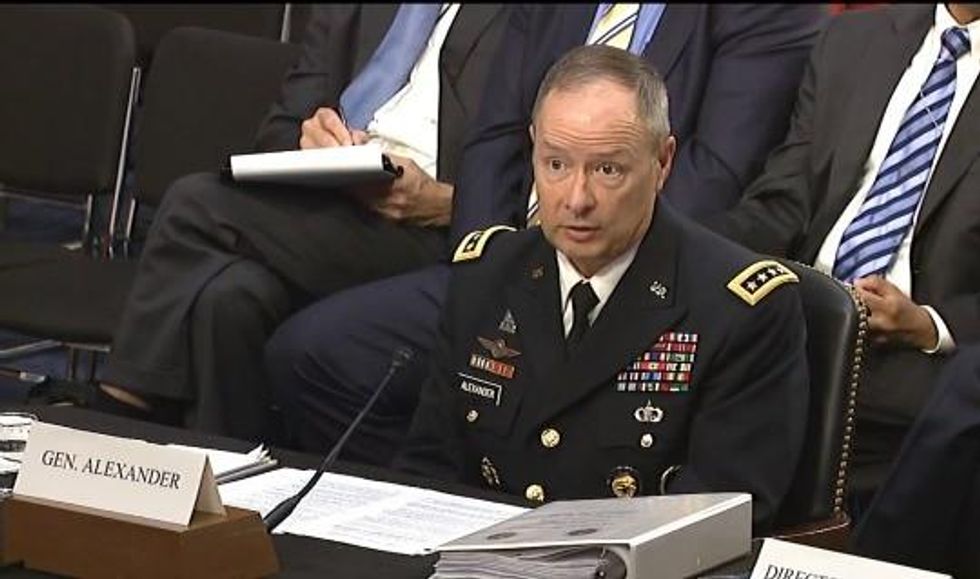
At last Thursday's Senate Intelligence Committee hearing on FISA legislation, Sen. Mark Udall (D-Colo.) asked NSA director, Gen. Keith Alexander, whether his spy agency should be collecting all Americans' phone records. Gen. Alexander, in a shockingly forthcoming response, admitted that he "believe[s] it is in the nation's best interest to put all the phone records into a lockbox that we can search when the nation needs it." He also explained that "there is no upper limit" to the number of Americans' phone records that the NSA can collect.
This admission is particularly unnerving in light of the last few months' revelations of the NSA's dragnet surveillance of Americans' communications under programs authorized by Section 215 of the Patriot Act and Section 702 of the FISA Amendments Act. And Sens. Wyden (D-Ore.) and Udall made it crystal clear that in spite of all that we have learned about these programs since the NSA leaks began, there may still be a lot that we don't know - and as they've been warning since 2011, they think we deserve to find out.
In a line of questioning that was eerily similar to last March when he asked Director of National Intelligence James Clapper if the NSA was collecting information on millions of Americans and was disingenuously told "No," Sen. Wyden asked Gen. Alexander if the "NSA has ever collected or made any plans to collect Americans' cell-site information in bulk." Gen. Alexander replied only that the NSA doesn't collect it under Section 215 of the Patriot Act, but when Wyden pressed him to state whether the NSA was collecting it under another authority, he refused to answer.
Not long after that exchange, Deputy Attorney General Cole told Sen. Udall that Section 215 does authorize the NSA to collect other types of bulk records in addition to telephony metadata. In July, he testified before the House Judiciary Committee that Section 215 may authorize the bulk collection of Americans' credit card records, tax returns, and even Google searches.
Have no doubt: both Sen. Wyden and Sen. Udall are strongly insinuating that many more personal records are, or have been, collected by the NSA. During the introduction of their comprehensive intelligence reform bill--also sponsored by Sens. Richard Blumenthal (D-Conn.) and Rand Paul (R-Ky.)--this week, Udall once again make it clear that more disclosures are coming.
"The National Security Agency has been unable to properly manage existing surveillance programs," he said. "This has led to the abuse of Americans' privacy and misleading statements made to the Foreign Intelligence Surveillance Court -- and we've only seen the tip of the iceberg."
Statements like that combined with all the revelations over the last few months confirm that the scope and indiscriminate nature of the NSA's domestic surveillance programs must be reined in by reforming FISA and the Patriot Act. Yet, civil libertarians and privacy advocates have to remain vigilant that "reform" isn't doublespeak for empowering the NSA even further.
Also last week, Intelligence Committee Chairwoman Sen. Feinstein (D-Cal.), announced that she will introduce reform legislation and consider it in her committee in the coming week. Bill text isn't publicly available yet, but she outlined what we can expect to see. One of the purported reforms may significantly expand the NSA's domestic surveillance authorities by legalizing the warrantless wiretapping of people known to be located in the U.S. for 7 days where that surveillance began abroad. It is critical that reform bills rein in, and in no way expand, these programs.
We urge Feinstein to allow her bill to be considered in open session, so that Americans can see how Congress makes decisions about our privacy and civil liberties.
The NSA has officially stopped sugar coating the fact that it wants to spy on every American.
At last Thursday's Senate Intelligence Committee hearing on FISA legislation, Sen. Mark Udall (D-Colo.) asked NSA director, Gen. Keith Alexander, whether his spy agency should be collecting all Americans' phone records. Gen. Alexander, in a shockingly forthcoming response, admitted that he "believe[s] it is in the nation's best interest to put all the phone records into a lockbox that we can search when the nation needs it." He also explained that "there is no upper limit" to the number of Americans' phone records that the NSA can collect.
This admission is particularly unnerving in light of the last few months' revelations of the NSA's dragnet surveillance of Americans' communications under programs authorized by Section 215 of the Patriot Act and Section 702 of the FISA Amendments Act. And Sens. Wyden (D-Ore.) and Udall made it crystal clear that in spite of all that we have learned about these programs since the NSA leaks began, there may still be a lot that we don't know - and as they've been warning since 2011, they think we deserve to find out.
In a line of questioning that was eerily similar to last March when he asked Director of National Intelligence James Clapper if the NSA was collecting information on millions of Americans and was disingenuously told "No," Sen. Wyden asked Gen. Alexander if the "NSA has ever collected or made any plans to collect Americans' cell-site information in bulk." Gen. Alexander replied only that the NSA doesn't collect it under Section 215 of the Patriot Act, but when Wyden pressed him to state whether the NSA was collecting it under another authority, he refused to answer.
Not long after that exchange, Deputy Attorney General Cole told Sen. Udall that Section 215 does authorize the NSA to collect other types of bulk records in addition to telephony metadata. In July, he testified before the House Judiciary Committee that Section 215 may authorize the bulk collection of Americans' credit card records, tax returns, and even Google searches.
Have no doubt: both Sen. Wyden and Sen. Udall are strongly insinuating that many more personal records are, or have been, collected by the NSA. During the introduction of their comprehensive intelligence reform bill--also sponsored by Sens. Richard Blumenthal (D-Conn.) and Rand Paul (R-Ky.)--this week, Udall once again make it clear that more disclosures are coming.
"The National Security Agency has been unable to properly manage existing surveillance programs," he said. "This has led to the abuse of Americans' privacy and misleading statements made to the Foreign Intelligence Surveillance Court -- and we've only seen the tip of the iceberg."
Statements like that combined with all the revelations over the last few months confirm that the scope and indiscriminate nature of the NSA's domestic surveillance programs must be reined in by reforming FISA and the Patriot Act. Yet, civil libertarians and privacy advocates have to remain vigilant that "reform" isn't doublespeak for empowering the NSA even further.
Also last week, Intelligence Committee Chairwoman Sen. Feinstein (D-Cal.), announced that she will introduce reform legislation and consider it in her committee in the coming week. Bill text isn't publicly available yet, but she outlined what we can expect to see. One of the purported reforms may significantly expand the NSA's domestic surveillance authorities by legalizing the warrantless wiretapping of people known to be located in the U.S. for 7 days where that surveillance began abroad. It is critical that reform bills rein in, and in no way expand, these programs.
We urge Feinstein to allow her bill to be considered in open session, so that Americans can see how Congress makes decisions about our privacy and civil liberties.
The NSA has officially stopped sugar coating the fact that it wants to spy on every American.
At last Thursday's Senate Intelligence Committee hearing on FISA legislation, Sen. Mark Udall (D-Colo.) asked NSA director, Gen. Keith Alexander, whether his spy agency should be collecting all Americans' phone records. Gen. Alexander, in a shockingly forthcoming response, admitted that he "believe[s] it is in the nation's best interest to put all the phone records into a lockbox that we can search when the nation needs it." He also explained that "there is no upper limit" to the number of Americans' phone records that the NSA can collect.
This admission is particularly unnerving in light of the last few months' revelations of the NSA's dragnet surveillance of Americans' communications under programs authorized by Section 215 of the Patriot Act and Section 702 of the FISA Amendments Act. And Sens. Wyden (D-Ore.) and Udall made it crystal clear that in spite of all that we have learned about these programs since the NSA leaks began, there may still be a lot that we don't know - and as they've been warning since 2011, they think we deserve to find out.
In a line of questioning that was eerily similar to last March when he asked Director of National Intelligence James Clapper if the NSA was collecting information on millions of Americans and was disingenuously told "No," Sen. Wyden asked Gen. Alexander if the "NSA has ever collected or made any plans to collect Americans' cell-site information in bulk." Gen. Alexander replied only that the NSA doesn't collect it under Section 215 of the Patriot Act, but when Wyden pressed him to state whether the NSA was collecting it under another authority, he refused to answer.
Not long after that exchange, Deputy Attorney General Cole told Sen. Udall that Section 215 does authorize the NSA to collect other types of bulk records in addition to telephony metadata. In July, he testified before the House Judiciary Committee that Section 215 may authorize the bulk collection of Americans' credit card records, tax returns, and even Google searches.
Have no doubt: both Sen. Wyden and Sen. Udall are strongly insinuating that many more personal records are, or have been, collected by the NSA. During the introduction of their comprehensive intelligence reform bill--also sponsored by Sens. Richard Blumenthal (D-Conn.) and Rand Paul (R-Ky.)--this week, Udall once again make it clear that more disclosures are coming.
"The National Security Agency has been unable to properly manage existing surveillance programs," he said. "This has led to the abuse of Americans' privacy and misleading statements made to the Foreign Intelligence Surveillance Court -- and we've only seen the tip of the iceberg."
Statements like that combined with all the revelations over the last few months confirm that the scope and indiscriminate nature of the NSA's domestic surveillance programs must be reined in by reforming FISA and the Patriot Act. Yet, civil libertarians and privacy advocates have to remain vigilant that "reform" isn't doublespeak for empowering the NSA even further.
Also last week, Intelligence Committee Chairwoman Sen. Feinstein (D-Cal.), announced that she will introduce reform legislation and consider it in her committee in the coming week. Bill text isn't publicly available yet, but she outlined what we can expect to see. One of the purported reforms may significantly expand the NSA's domestic surveillance authorities by legalizing the warrantless wiretapping of people known to be located in the U.S. for 7 days where that surveillance began abroad. It is critical that reform bills rein in, and in no way expand, these programs.
We urge Feinstein to allow her bill to be considered in open session, so that Americans can see how Congress makes decisions about our privacy and civil liberties.