SUBSCRIBE TO OUR FREE NEWSLETTER
Daily news & progressive opinion—funded by the people, not the corporations—delivered straight to your inbox.
5
#000000
#FFFFFF
To donate by check, phone, or other method, see our More Ways to Give page.
Edward Snowden's renegade decision to reveal the jaw-dropping scope of the National Security Agency's electronic surveillance is being vindicated -- even as Snowden himself is being vilified.
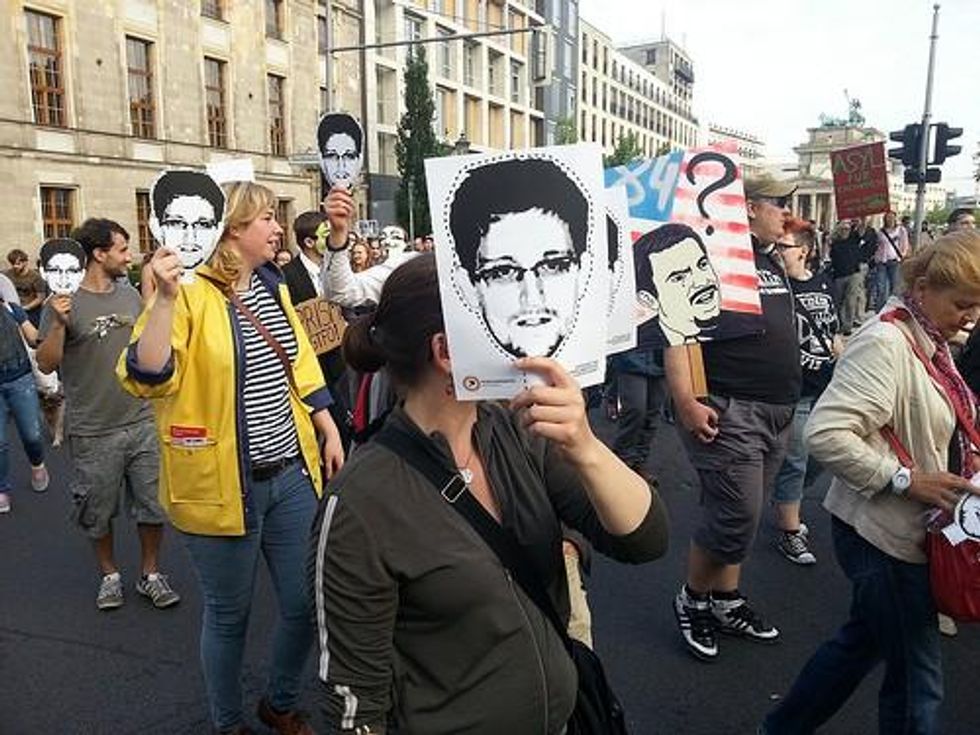
Intelligence officials in the Obama administration and their allies on Capitol Hill paint the fugitive analyst as nothing but a traitor who wants to harm the United States. Many of those same officials grudgingly acknowledge, however, that public debate about the NSA's domestic snooping is now unavoidable.
This would be impossible if Snowden -- or someone like him -- hadn't spilled the beans. We wouldn't know that the NSA is keeping a database of all our phone calls. We wouldn't know that the government gets the authority to keep track of our private communications -- even if we are not suspected of terrorist activity or associations -- from secret judicial orders issued by a secret court based on secret interpretations of the law.
Snowden, of course, is hardly receiving the thanks of a grateful nation. He has spent the last five weeks trapped in the transit zone of Sheremetyevo Airport outside Moscow. Russian officials, who won't send him home for prosecution, wish he would move along. But Snowden fears that if he takes off for one of the South American countries that have offered asylum, he risks being intercepted en route and extradited. It's a tough situation, and time is not on his side.
You can cheer Snowden's predicament or you can bemoan it. But even some of the NSA's fiercest defenders have admitted, if not in so many words, that Snowden performed a valuable public service.
This month, the office of Director of National Intelligence James Clapper issued a public statement announcing that the secret Federal Intelligence Surveillance Court has renewed the government's authority to collect "metadata" about our phone calls. This was being disclosed "in light of the significant and continuing public interest in the . . . collection program."
Isn't that rich? If the spooks had their way, there would be no "continuing public interest" in the program. We wouldn't know it exists.
The new position espoused by President Obama and those who kept the NSA's domestic surveillance a deep, dark secret is that of course we should have a wide-ranging national debate about balancing the imperatives of privacy and security. But they don't mean it.
I know this because when an actual debate erupted in Congress last week, the intelligence cognoscenti freaked out.
An attempt to cut off funding for the NSA's collection of phone data, sponsored by an unlikely pair of allies in the House -- Justin Amash, a conservative Republican, and John Conyers, a liberal Democrat, both from Michigan -- suffered a surprisingly narrow defeat, 217 to 205. The measure was denounced by the White House and the congressional leadership of both parties, yet it received bipartisan support, from 94 Republicans and 111 Democrats.
The Amash-Conyers amendment was in no danger of becoming law -- the Senate would have killed it and, if all else failed, President Obama would have vetoed it. But it put the intelligence establishment on notice: The spooks don't decide how far is too far. We do.
A recent Washington Post-ABC News poll showed that three out of four Americans believe the vacuum-cleaner collection of phone call data by the NSA intrudes on our privacy rights. At the same time, nearly three-fifths of those surveyed said it was "more important right now" to investigate possible terrorist threats than to respect privacy. A contradiction, perhaps? Not necessarily.
It is possible to endorse sweeping and intrusive measures in the course of a specific investigation but to reject those same measures as part of a fishing expedition. At the heart of the Fourth Amendment is the concept that a search must be justified by suspicion. Yet how many of those whose phone call information is being logged are suspected of being terrorists? One in a million?
Equally antithetical to the idea of a free society, in my view, is the government's position that we are not permitted to know even how the secret intelligence court interprets our laws and the Constitution. The order that Snowden leaked -- compelling a Verizon unit to cough up data on the phone calls it handled -- was one of only a few to come to light in the court's three decades of existence. Now there are voices calling for all the court's rulings to be released.
We're talking about these issues. You can wish Edward Snowden well or wish him a lifetime in prison. Either way, you should thank him.
Edward Snowden's renegade decision to reveal the jaw-dropping scope of the National Security Agency's electronic surveillance is being vindicated -- even as Snowden himself is being vilified.
Intelligence officials in the Obama administration and their allies on Capitol Hill paint the fugitive analyst as nothing but a traitor who wants to harm the United States. Many of those same officials grudgingly acknowledge, however, that public debate about the NSA's domestic snooping is now unavoidable.
This would be impossible if Snowden -- or someone like him -- hadn't spilled the beans. We wouldn't know that the NSA is keeping a database of all our phone calls. We wouldn't know that the government gets the authority to keep track of our private communications -- even if we are not suspected of terrorist activity or associations -- from secret judicial orders issued by a secret court based on secret interpretations of the law.
Snowden, of course, is hardly receiving the thanks of a grateful nation. He has spent the last five weeks trapped in the transit zone of Sheremetyevo Airport outside Moscow. Russian officials, who won't send him home for prosecution, wish he would move along. But Snowden fears that if he takes off for one of the South American countries that have offered asylum, he risks being intercepted en route and extradited. It's a tough situation, and time is not on his side.
You can cheer Snowden's predicament or you can bemoan it. But even some of the NSA's fiercest defenders have admitted, if not in so many words, that Snowden performed a valuable public service.
This month, the office of Director of National Intelligence James Clapper issued a public statement announcing that the secret Federal Intelligence Surveillance Court has renewed the government's authority to collect "metadata" about our phone calls. This was being disclosed "in light of the significant and continuing public interest in the . . . collection program."
Isn't that rich? If the spooks had their way, there would be no "continuing public interest" in the program. We wouldn't know it exists.
The new position espoused by President Obama and those who kept the NSA's domestic surveillance a deep, dark secret is that of course we should have a wide-ranging national debate about balancing the imperatives of privacy and security. But they don't mean it.
I know this because when an actual debate erupted in Congress last week, the intelligence cognoscenti freaked out.
An attempt to cut off funding for the NSA's collection of phone data, sponsored by an unlikely pair of allies in the House -- Justin Amash, a conservative Republican, and John Conyers, a liberal Democrat, both from Michigan -- suffered a surprisingly narrow defeat, 217 to 205. The measure was denounced by the White House and the congressional leadership of both parties, yet it received bipartisan support, from 94 Republicans and 111 Democrats.
The Amash-Conyers amendment was in no danger of becoming law -- the Senate would have killed it and, if all else failed, President Obama would have vetoed it. But it put the intelligence establishment on notice: The spooks don't decide how far is too far. We do.
A recent Washington Post-ABC News poll showed that three out of four Americans believe the vacuum-cleaner collection of phone call data by the NSA intrudes on our privacy rights. At the same time, nearly three-fifths of those surveyed said it was "more important right now" to investigate possible terrorist threats than to respect privacy. A contradiction, perhaps? Not necessarily.
It is possible to endorse sweeping and intrusive measures in the course of a specific investigation but to reject those same measures as part of a fishing expedition. At the heart of the Fourth Amendment is the concept that a search must be justified by suspicion. Yet how many of those whose phone call information is being logged are suspected of being terrorists? One in a million?
Equally antithetical to the idea of a free society, in my view, is the government's position that we are not permitted to know even how the secret intelligence court interprets our laws and the Constitution. The order that Snowden leaked -- compelling a Verizon unit to cough up data on the phone calls it handled -- was one of only a few to come to light in the court's three decades of existence. Now there are voices calling for all the court's rulings to be released.
We're talking about these issues. You can wish Edward Snowden well or wish him a lifetime in prison. Either way, you should thank him.
Edward Snowden's renegade decision to reveal the jaw-dropping scope of the National Security Agency's electronic surveillance is being vindicated -- even as Snowden himself is being vilified.
Intelligence officials in the Obama administration and their allies on Capitol Hill paint the fugitive analyst as nothing but a traitor who wants to harm the United States. Many of those same officials grudgingly acknowledge, however, that public debate about the NSA's domestic snooping is now unavoidable.
This would be impossible if Snowden -- or someone like him -- hadn't spilled the beans. We wouldn't know that the NSA is keeping a database of all our phone calls. We wouldn't know that the government gets the authority to keep track of our private communications -- even if we are not suspected of terrorist activity or associations -- from secret judicial orders issued by a secret court based on secret interpretations of the law.
Snowden, of course, is hardly receiving the thanks of a grateful nation. He has spent the last five weeks trapped in the transit zone of Sheremetyevo Airport outside Moscow. Russian officials, who won't send him home for prosecution, wish he would move along. But Snowden fears that if he takes off for one of the South American countries that have offered asylum, he risks being intercepted en route and extradited. It's a tough situation, and time is not on his side.
You can cheer Snowden's predicament or you can bemoan it. But even some of the NSA's fiercest defenders have admitted, if not in so many words, that Snowden performed a valuable public service.
This month, the office of Director of National Intelligence James Clapper issued a public statement announcing that the secret Federal Intelligence Surveillance Court has renewed the government's authority to collect "metadata" about our phone calls. This was being disclosed "in light of the significant and continuing public interest in the . . . collection program."
Isn't that rich? If the spooks had their way, there would be no "continuing public interest" in the program. We wouldn't know it exists.
The new position espoused by President Obama and those who kept the NSA's domestic surveillance a deep, dark secret is that of course we should have a wide-ranging national debate about balancing the imperatives of privacy and security. But they don't mean it.
I know this because when an actual debate erupted in Congress last week, the intelligence cognoscenti freaked out.
An attempt to cut off funding for the NSA's collection of phone data, sponsored by an unlikely pair of allies in the House -- Justin Amash, a conservative Republican, and John Conyers, a liberal Democrat, both from Michigan -- suffered a surprisingly narrow defeat, 217 to 205. The measure was denounced by the White House and the congressional leadership of both parties, yet it received bipartisan support, from 94 Republicans and 111 Democrats.
The Amash-Conyers amendment was in no danger of becoming law -- the Senate would have killed it and, if all else failed, President Obama would have vetoed it. But it put the intelligence establishment on notice: The spooks don't decide how far is too far. We do.
A recent Washington Post-ABC News poll showed that three out of four Americans believe the vacuum-cleaner collection of phone call data by the NSA intrudes on our privacy rights. At the same time, nearly three-fifths of those surveyed said it was "more important right now" to investigate possible terrorist threats than to respect privacy. A contradiction, perhaps? Not necessarily.
It is possible to endorse sweeping and intrusive measures in the course of a specific investigation but to reject those same measures as part of a fishing expedition. At the heart of the Fourth Amendment is the concept that a search must be justified by suspicion. Yet how many of those whose phone call information is being logged are suspected of being terrorists? One in a million?
Equally antithetical to the idea of a free society, in my view, is the government's position that we are not permitted to know even how the secret intelligence court interprets our laws and the Constitution. The order that Snowden leaked -- compelling a Verizon unit to cough up data on the phone calls it handled -- was one of only a few to come to light in the court's three decades of existence. Now there are voices calling for all the court's rulings to be released.
We're talking about these issues. You can wish Edward Snowden well or wish him a lifetime in prison. Either way, you should thank him.