
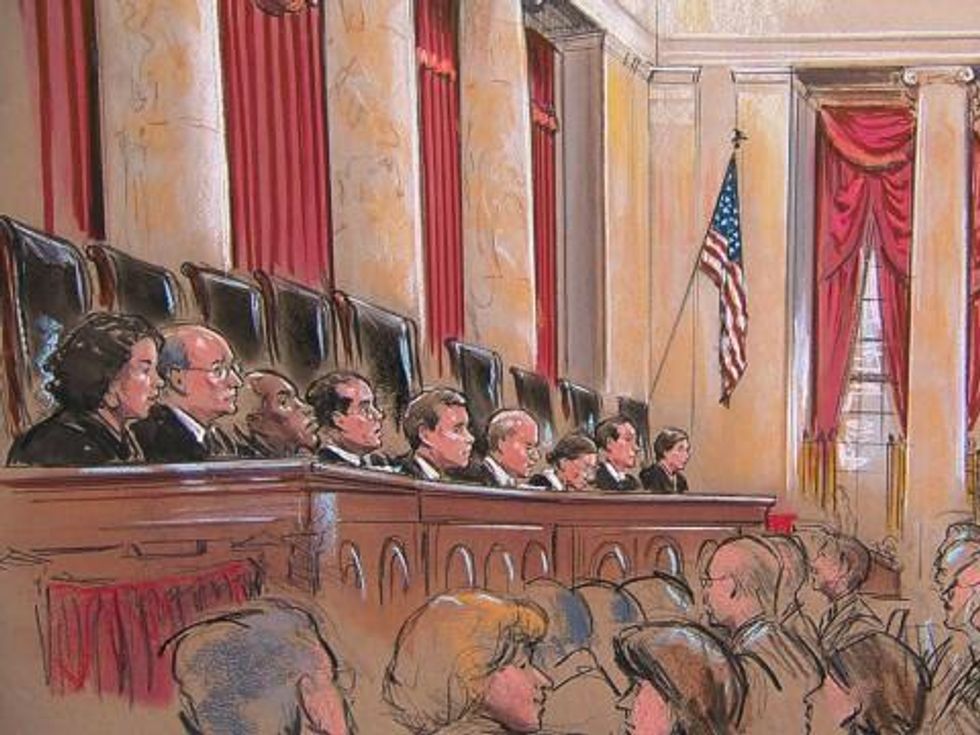
The U.S. Supreme Court announced three historic 5-4 decisions this week. In the first, a core component of the Voting Rights Act was gutted, enabling Southern states to enact regressive voting laws that will likely disenfranchise the ever-growing number of voters of color. The second pair of cases threw out the federal Defense of Marriage Act (DOMA), the legal travesty that defined marriage in federal law as only between a man and a woman, and effectively overturned California's Prop 8, which bans same-sex marriage. For those who struggle for equality and civil rights, these three decisions mark one brutal defeat and two stunning victories.
"What the court did ... is stab the Voting Rights Act of 1965 in its very heart," Georgia Congressman John Lewis said of Tuesday's decision. "It is a major setback. We may not have people being beaten today. Maybe they're not being denied the right to participate or to register to vote. They're not being chased by police dogs or trampled by horses. But in the 11 states of the old Confederacy, and even in some of the states outside of the South, there's been a systematic, deliberate attempt to take us back to another period."
Lewis is the 73-year-old dean of the Georgia congressional delegation. As a young man, he led the Student Nonviolent Coordinating Committee (SNCC), and was the youngest speaker to address the March on Washington 50 years ago. He recently recalled a signal moment in that struggle, appearing on the "Democracy Now!" news hour:
"On March 7, 1965, a group of us attempted to march from Selma to Montgomery, Alabama, to dramatize to the nation that people wanted to register to vote. ... In Selma, Alabama, in 1965, only 2.1 percent of blacks of voting age were registered to vote. The only place you could attempt to register was to go down to the courthouse. You had to pass a so-called literacy test. And they would tell people over and over again that they didn't or couldn't pass the literacy test."
What happened to those marchers as they tried to cross the Edmund Pettus Bridge into Selma has entered the canon of American protest history. Lewis continued: "We got to the top of the bridge. We saw a sea of blue--Alabama state troopers--and we continued to walk. We came within hearing distance of the state troopers ... you saw these guys putting on their gas masks. They came toward us, beating us with nightsticks and bullwhips, trampling us with horses. I was hit in the head by a state trooper with a nightstick. I had a concussion at the bridge. My legs went out from under me. I felt like I was going to die. I thought I saw Death."
Lewis had his head bashed in, and was one of 17 seriously injured that day. He recovered and continued the struggle. Months later, President Lyndon Johnson signed the Voting Rights Act into law.
Throughout his career, John Lewis has forged a solid record of fighting for civil rights--not just for African-Americans, but for all who suffer discrimination.
Which brings us to the second key decision this week from the Supreme Court. The court ruled unconstitutional the Defense of Marriage Act, which federally defined marriage as between a man and a woman. Backing that up was another 5-4 decision that essentially overturns California's notorious Prop 8, which banned same-sex marriage. Soon, it will be legal for gay and lesbian couples to marry in the most populous state in the country.
Back when DOMA was being debated in 1996, with President Bill Clinton championing it and with bipartisan support in Congress, John Lewis spoke out against it with the same passion he showed in the struggle for voting rights. Lewis said then, on the floor of the House: "This bill is a slap in the face of the Declaration of Independence. It denies gay men and women the right of liberty and the pursuit of happiness. Marriage is a basic human right. You cannot tell people they cannot fall in love. I will not turn my back on another American. I will not oppress my fellow human being. I fought too hard and too long against discrimination based on race and color not to stand up against discrimination based on sexual orientation." After this week's DOMA decision, he reiterated, "It's better to love than to hate."
For John Lewis, human rights cannot be compromised, they are indivisible. Following his lead, people should channel the joy they feel for the marriage equality victories today to a renewed struggle for voting rights, for equality for all.
Denis Moynihan contributed research to this column.
The U.S. Supreme Court announced three historic 5-4 decisions this week. In the first, a core component of the Voting Rights Act was gutted, enabling Southern states to enact regressive voting laws that will likely disenfranchise the ever-growing number of voters of color. The second pair of cases threw out the federal Defense of Marriage Act (DOMA), the legal travesty that defined marriage in federal law as only between a man and a woman, and effectively overturned California's Prop 8, which bans same-sex marriage. For those who struggle for equality and civil rights, these three decisions mark one brutal defeat and two stunning victories.
"What the court did ... is stab the Voting Rights Act of 1965 in its very heart," Georgia Congressman John Lewis said of Tuesday's decision. "It is a major setback. We may not have people being beaten today. Maybe they're not being denied the right to participate or to register to vote. They're not being chased by police dogs or trampled by horses. But in the 11 states of the old Confederacy, and even in some of the states outside of the South, there's been a systematic, deliberate attempt to take us back to another period."
Lewis is the 73-year-old dean of the Georgia congressional delegation. As a young man, he led the Student Nonviolent Coordinating Committee (SNCC), and was the youngest speaker to address the March on Washington 50 years ago. He recently recalled a signal moment in that struggle, appearing on the "Democracy Now!" news hour:
"On March 7, 1965, a group of us attempted to march from Selma to Montgomery, Alabama, to dramatize to the nation that people wanted to register to vote. ... In Selma, Alabama, in 1965, only 2.1 percent of blacks of voting age were registered to vote. The only place you could attempt to register was to go down to the courthouse. You had to pass a so-called literacy test. And they would tell people over and over again that they didn't or couldn't pass the literacy test."
What happened to those marchers as they tried to cross the Edmund Pettus Bridge into Selma has entered the canon of American protest history. Lewis continued: "We got to the top of the bridge. We saw a sea of blue--Alabama state troopers--and we continued to walk. We came within hearing distance of the state troopers ... you saw these guys putting on their gas masks. They came toward us, beating us with nightsticks and bullwhips, trampling us with horses. I was hit in the head by a state trooper with a nightstick. I had a concussion at the bridge. My legs went out from under me. I felt like I was going to die. I thought I saw Death."
Lewis had his head bashed in, and was one of 17 seriously injured that day. He recovered and continued the struggle. Months later, President Lyndon Johnson signed the Voting Rights Act into law.
Throughout his career, John Lewis has forged a solid record of fighting for civil rights--not just for African-Americans, but for all who suffer discrimination.
Which brings us to the second key decision this week from the Supreme Court. The court ruled unconstitutional the Defense of Marriage Act, which federally defined marriage as between a man and a woman. Backing that up was another 5-4 decision that essentially overturns California's notorious Prop 8, which banned same-sex marriage. Soon, it will be legal for gay and lesbian couples to marry in the most populous state in the country.
Back when DOMA was being debated in 1996, with President Bill Clinton championing it and with bipartisan support in Congress, John Lewis spoke out against it with the same passion he showed in the struggle for voting rights. Lewis said then, on the floor of the House: "This bill is a slap in the face of the Declaration of Independence. It denies gay men and women the right of liberty and the pursuit of happiness. Marriage is a basic human right. You cannot tell people they cannot fall in love. I will not turn my back on another American. I will not oppress my fellow human being. I fought too hard and too long against discrimination based on race and color not to stand up against discrimination based on sexual orientation." After this week's DOMA decision, he reiterated, "It's better to love than to hate."
For John Lewis, human rights cannot be compromised, they are indivisible. Following his lead, people should channel the joy they feel for the marriage equality victories today to a renewed struggle for voting rights, for equality for all.
Denis Moynihan contributed research to this column.
The U.S. Supreme Court announced three historic 5-4 decisions this week. In the first, a core component of the Voting Rights Act was gutted, enabling Southern states to enact regressive voting laws that will likely disenfranchise the ever-growing number of voters of color. The second pair of cases threw out the federal Defense of Marriage Act (DOMA), the legal travesty that defined marriage in federal law as only between a man and a woman, and effectively overturned California's Prop 8, which bans same-sex marriage. For those who struggle for equality and civil rights, these three decisions mark one brutal defeat and two stunning victories.
"What the court did ... is stab the Voting Rights Act of 1965 in its very heart," Georgia Congressman John Lewis said of Tuesday's decision. "It is a major setback. We may not have people being beaten today. Maybe they're not being denied the right to participate or to register to vote. They're not being chased by police dogs or trampled by horses. But in the 11 states of the old Confederacy, and even in some of the states outside of the South, there's been a systematic, deliberate attempt to take us back to another period."
Lewis is the 73-year-old dean of the Georgia congressional delegation. As a young man, he led the Student Nonviolent Coordinating Committee (SNCC), and was the youngest speaker to address the March on Washington 50 years ago. He recently recalled a signal moment in that struggle, appearing on the "Democracy Now!" news hour:
"On March 7, 1965, a group of us attempted to march from Selma to Montgomery, Alabama, to dramatize to the nation that people wanted to register to vote. ... In Selma, Alabama, in 1965, only 2.1 percent of blacks of voting age were registered to vote. The only place you could attempt to register was to go down to the courthouse. You had to pass a so-called literacy test. And they would tell people over and over again that they didn't or couldn't pass the literacy test."
What happened to those marchers as they tried to cross the Edmund Pettus Bridge into Selma has entered the canon of American protest history. Lewis continued: "We got to the top of the bridge. We saw a sea of blue--Alabama state troopers--and we continued to walk. We came within hearing distance of the state troopers ... you saw these guys putting on their gas masks. They came toward us, beating us with nightsticks and bullwhips, trampling us with horses. I was hit in the head by a state trooper with a nightstick. I had a concussion at the bridge. My legs went out from under me. I felt like I was going to die. I thought I saw Death."
Lewis had his head bashed in, and was one of 17 seriously injured that day. He recovered and continued the struggle. Months later, President Lyndon Johnson signed the Voting Rights Act into law.
Throughout his career, John Lewis has forged a solid record of fighting for civil rights--not just for African-Americans, but for all who suffer discrimination.
Which brings us to the second key decision this week from the Supreme Court. The court ruled unconstitutional the Defense of Marriage Act, which federally defined marriage as between a man and a woman. Backing that up was another 5-4 decision that essentially overturns California's notorious Prop 8, which banned same-sex marriage. Soon, it will be legal for gay and lesbian couples to marry in the most populous state in the country.
Back when DOMA was being debated in 1996, with President Bill Clinton championing it and with bipartisan support in Congress, John Lewis spoke out against it with the same passion he showed in the struggle for voting rights. Lewis said then, on the floor of the House: "This bill is a slap in the face of the Declaration of Independence. It denies gay men and women the right of liberty and the pursuit of happiness. Marriage is a basic human right. You cannot tell people they cannot fall in love. I will not turn my back on another American. I will not oppress my fellow human being. I fought too hard and too long against discrimination based on race and color not to stand up against discrimination based on sexual orientation." After this week's DOMA decision, he reiterated, "It's better to love than to hate."
For John Lewis, human rights cannot be compromised, they are indivisible. Following his lead, people should channel the joy they feel for the marriage equality victories today to a renewed struggle for voting rights, for equality for all.
Denis Moynihan contributed research to this column.