SUBSCRIBE TO OUR FREE NEWSLETTER
Daily news & progressive opinion—funded by the people, not the corporations—delivered straight to your inbox.
5
#000000
#FFFFFF
To donate by check, phone, or other method, see our More Ways to Give page.
The world's attention is focused at the moment on Taksim Square in Istanbul and the popular uprising against the government of Recip Tayyip Erdogan. Everyone is saying that the anti-authoritarian rebellions that have been sweeping the world, and lately particularly the Middle East, have now reached Turkey, long acclaimed as a "model" government that would be impervious to such uprisings.
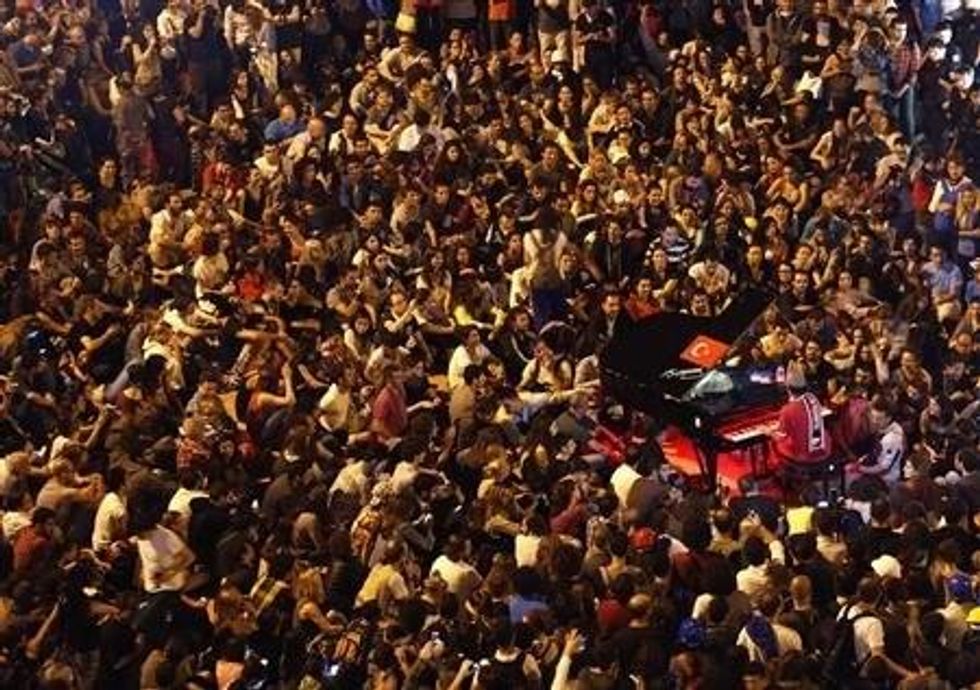
As with similar uprisings, the focus is on the authoritarian behavior of the government, and for some, its commitment to neo-liberal economic policies. Thus far, what started as a tiny protest of environmentalists against the government's intention to eliminate the last major green area inside Istanbul in favor of a development project caught on and attracted daily more and more people to Taksim Square in Istanbul and similar sites all over Turkey. The response of the government has been unyielding in its previous decisions, instead engaging in repression of the demonstrators by the police. This response has seemed to be counter-productive, attracting ever more people to the protests.
As is usual in such protests, the protestors now cover a very wide gamut of persons. There is what might be called the secular left, and especially the women, who are upset with the creeping imposition of Islamic rules and constraints by the "moderate" AKP party in power. There are those who are upset with the ever-larger involvement of the government in the attempt to oust Bashar al-Assad in Syria. There are those on the political right who consider themselves the protagonists of a "Kemalist" position, which is nationalist and hostile to Islamist parties. There is even a faction within the AKP, led by President Abdullah Gul, which considers the government too little Islamist, too tied to the United States in terms of its foreign policy, and too repressive of the groups that are protesting.
In short, it is a typical situation in which it is unsure whether the government can continue to hold. And it is equally unsure what kind of government would succeed it, if it fell, whether via resignation or new elections. It is this uncertainty of the outcome that is most disturbing to the Kurds, who are themselves divided about how they should behave in this situation.
The Kurds in Turkey have been struggling, ever since there was a Turkish republic, to obtain the right to autonomous structures and the use of the Kurdish language. For some, this necessarily implied an independent state, while others were ready to accept a constitutionally-guaranteed autonomy within Turkey. This objective conflicted deeply with the integrative Turkish nationalism propounded by Mustafa Kemal Ataturk. Ataturk and his followers insisted that there were nothing but Turks in Turkey. His "gesture" to the Kurds was to proclaim them "mountain Turks," with no concessions whatsoever on language.
The Kurds of course are located within a number of neighboring states, principally Turkey, Syria, Iraq, and Iran. Their biggest concentration, however, lies within Turkey. And in the last forty years, they have been organized politically within a movement called the PKK (Kurdish Workers Party), whose leader has been Abdullah Ocalan. This movement engaged in military action to pursue its objectives. The successive Turkish governments, and particularly the Turkish army, fought back ruthlessly, proclaiming the PKK a "terrorist" organization.
In 1999, with the assistance of the United States, the government was able to abduct Ocalan in Kenya. They convicted him of treason, sentencing him to death. This sentence was de facto commuted to life imprisonment on the remote island of Imrani, with no possibility of contact with anyone. In recent years, the position of the AKP in power and of the PKK (still considering Ocalan their leader) has evolved. In particular, the PKK is no longer a Marxist-Leninist party, and wishes the guns to be silent and allow diplomacy to work. As a result there have been some ongoing discussions between the two parties as to a possible compromise that would end the conflict. The PKK has said that it is ready to abandon military action and participate in "normal" political life in Turkey, provided that Ocalan is released, and there is some recognition of autonomy and linguistic rights. The AKP government seems to have been receptive to the arrangement, apparently realizing that a purely military victory is impossible.
The major obstacle has been deep mutual suspicion. Neither side wants to lay down its arms before the other. How to work out a transition to the new arrangements is precisely the matter under discussion. The big problem for each of the two parties is to ensure that their followers accept it. Erdogan was having trouble with one wing of the AKP, and Ocalan was having trouble (perhaps less than Erdogan) with some elements in the PKK.
In the middle of these delicate discussions came the uprising in Taksim Square. And here is the Kurdish dilemma. There seem to be only two groups that are sympathetic to this proposed "solution" to the Kurdish demands. One is Erdogan and his supporters, and the other is some segments of the secular left who are a mainstay of the anti-Erdogan uprising. The other groups in Taksim Square are precisely opposed to the possible new arrangements with the Kurds.
What then should the Kurdish movement do politically? There are some Kurdish militants, particularly in Istanbul and other large cities, who have joined the rebellion, as individuals. But the PKK has carefully avoided any statement on the uprising. And in Diyabarkir, the largest Kurdish city, the number of protesters has been very few. It could well be that a major victim of the anti-authoritarian uprising in Turkey will be the Kurds.
The world's attention is focused at the moment on Taksim Square in Istanbul and the popular uprising against the government of Recip Tayyip Erdogan. Everyone is saying that the anti-authoritarian rebellions that have been sweeping the world, and lately particularly the Middle East, have now reached Turkey, long acclaimed as a "model" government that would be impervious to such uprisings.
As with similar uprisings, the focus is on the authoritarian behavior of the government, and for some, its commitment to neo-liberal economic policies. Thus far, what started as a tiny protest of environmentalists against the government's intention to eliminate the last major green area inside Istanbul in favor of a development project caught on and attracted daily more and more people to Taksim Square in Istanbul and similar sites all over Turkey. The response of the government has been unyielding in its previous decisions, instead engaging in repression of the demonstrators by the police. This response has seemed to be counter-productive, attracting ever more people to the protests.
As is usual in such protests, the protestors now cover a very wide gamut of persons. There is what might be called the secular left, and especially the women, who are upset with the creeping imposition of Islamic rules and constraints by the "moderate" AKP party in power. There are those who are upset with the ever-larger involvement of the government in the attempt to oust Bashar al-Assad in Syria. There are those on the political right who consider themselves the protagonists of a "Kemalist" position, which is nationalist and hostile to Islamist parties. There is even a faction within the AKP, led by President Abdullah Gul, which considers the government too little Islamist, too tied to the United States in terms of its foreign policy, and too repressive of the groups that are protesting.
In short, it is a typical situation in which it is unsure whether the government can continue to hold. And it is equally unsure what kind of government would succeed it, if it fell, whether via resignation or new elections. It is this uncertainty of the outcome that is most disturbing to the Kurds, who are themselves divided about how they should behave in this situation.
The Kurds in Turkey have been struggling, ever since there was a Turkish republic, to obtain the right to autonomous structures and the use of the Kurdish language. For some, this necessarily implied an independent state, while others were ready to accept a constitutionally-guaranteed autonomy within Turkey. This objective conflicted deeply with the integrative Turkish nationalism propounded by Mustafa Kemal Ataturk. Ataturk and his followers insisted that there were nothing but Turks in Turkey. His "gesture" to the Kurds was to proclaim them "mountain Turks," with no concessions whatsoever on language.
The Kurds of course are located within a number of neighboring states, principally Turkey, Syria, Iraq, and Iran. Their biggest concentration, however, lies within Turkey. And in the last forty years, they have been organized politically within a movement called the PKK (Kurdish Workers Party), whose leader has been Abdullah Ocalan. This movement engaged in military action to pursue its objectives. The successive Turkish governments, and particularly the Turkish army, fought back ruthlessly, proclaiming the PKK a "terrorist" organization.
In 1999, with the assistance of the United States, the government was able to abduct Ocalan in Kenya. They convicted him of treason, sentencing him to death. This sentence was de facto commuted to life imprisonment on the remote island of Imrani, with no possibility of contact with anyone. In recent years, the position of the AKP in power and of the PKK (still considering Ocalan their leader) has evolved. In particular, the PKK is no longer a Marxist-Leninist party, and wishes the guns to be silent and allow diplomacy to work. As a result there have been some ongoing discussions between the two parties as to a possible compromise that would end the conflict. The PKK has said that it is ready to abandon military action and participate in "normal" political life in Turkey, provided that Ocalan is released, and there is some recognition of autonomy and linguistic rights. The AKP government seems to have been receptive to the arrangement, apparently realizing that a purely military victory is impossible.
The major obstacle has been deep mutual suspicion. Neither side wants to lay down its arms before the other. How to work out a transition to the new arrangements is precisely the matter under discussion. The big problem for each of the two parties is to ensure that their followers accept it. Erdogan was having trouble with one wing of the AKP, and Ocalan was having trouble (perhaps less than Erdogan) with some elements in the PKK.
In the middle of these delicate discussions came the uprising in Taksim Square. And here is the Kurdish dilemma. There seem to be only two groups that are sympathetic to this proposed "solution" to the Kurdish demands. One is Erdogan and his supporters, and the other is some segments of the secular left who are a mainstay of the anti-Erdogan uprising. The other groups in Taksim Square are precisely opposed to the possible new arrangements with the Kurds.
What then should the Kurdish movement do politically? There are some Kurdish militants, particularly in Istanbul and other large cities, who have joined the rebellion, as individuals. But the PKK has carefully avoided any statement on the uprising. And in Diyabarkir, the largest Kurdish city, the number of protesters has been very few. It could well be that a major victim of the anti-authoritarian uprising in Turkey will be the Kurds.
The world's attention is focused at the moment on Taksim Square in Istanbul and the popular uprising against the government of Recip Tayyip Erdogan. Everyone is saying that the anti-authoritarian rebellions that have been sweeping the world, and lately particularly the Middle East, have now reached Turkey, long acclaimed as a "model" government that would be impervious to such uprisings.
As with similar uprisings, the focus is on the authoritarian behavior of the government, and for some, its commitment to neo-liberal economic policies. Thus far, what started as a tiny protest of environmentalists against the government's intention to eliminate the last major green area inside Istanbul in favor of a development project caught on and attracted daily more and more people to Taksim Square in Istanbul and similar sites all over Turkey. The response of the government has been unyielding in its previous decisions, instead engaging in repression of the demonstrators by the police. This response has seemed to be counter-productive, attracting ever more people to the protests.
As is usual in such protests, the protestors now cover a very wide gamut of persons. There is what might be called the secular left, and especially the women, who are upset with the creeping imposition of Islamic rules and constraints by the "moderate" AKP party in power. There are those who are upset with the ever-larger involvement of the government in the attempt to oust Bashar al-Assad in Syria. There are those on the political right who consider themselves the protagonists of a "Kemalist" position, which is nationalist and hostile to Islamist parties. There is even a faction within the AKP, led by President Abdullah Gul, which considers the government too little Islamist, too tied to the United States in terms of its foreign policy, and too repressive of the groups that are protesting.
In short, it is a typical situation in which it is unsure whether the government can continue to hold. And it is equally unsure what kind of government would succeed it, if it fell, whether via resignation or new elections. It is this uncertainty of the outcome that is most disturbing to the Kurds, who are themselves divided about how they should behave in this situation.
The Kurds in Turkey have been struggling, ever since there was a Turkish republic, to obtain the right to autonomous structures and the use of the Kurdish language. For some, this necessarily implied an independent state, while others were ready to accept a constitutionally-guaranteed autonomy within Turkey. This objective conflicted deeply with the integrative Turkish nationalism propounded by Mustafa Kemal Ataturk. Ataturk and his followers insisted that there were nothing but Turks in Turkey. His "gesture" to the Kurds was to proclaim them "mountain Turks," with no concessions whatsoever on language.
The Kurds of course are located within a number of neighboring states, principally Turkey, Syria, Iraq, and Iran. Their biggest concentration, however, lies within Turkey. And in the last forty years, they have been organized politically within a movement called the PKK (Kurdish Workers Party), whose leader has been Abdullah Ocalan. This movement engaged in military action to pursue its objectives. The successive Turkish governments, and particularly the Turkish army, fought back ruthlessly, proclaiming the PKK a "terrorist" organization.
In 1999, with the assistance of the United States, the government was able to abduct Ocalan in Kenya. They convicted him of treason, sentencing him to death. This sentence was de facto commuted to life imprisonment on the remote island of Imrani, with no possibility of contact with anyone. In recent years, the position of the AKP in power and of the PKK (still considering Ocalan their leader) has evolved. In particular, the PKK is no longer a Marxist-Leninist party, and wishes the guns to be silent and allow diplomacy to work. As a result there have been some ongoing discussions between the two parties as to a possible compromise that would end the conflict. The PKK has said that it is ready to abandon military action and participate in "normal" political life in Turkey, provided that Ocalan is released, and there is some recognition of autonomy and linguistic rights. The AKP government seems to have been receptive to the arrangement, apparently realizing that a purely military victory is impossible.
The major obstacle has been deep mutual suspicion. Neither side wants to lay down its arms before the other. How to work out a transition to the new arrangements is precisely the matter under discussion. The big problem for each of the two parties is to ensure that their followers accept it. Erdogan was having trouble with one wing of the AKP, and Ocalan was having trouble (perhaps less than Erdogan) with some elements in the PKK.
In the middle of these delicate discussions came the uprising in Taksim Square. And here is the Kurdish dilemma. There seem to be only two groups that are sympathetic to this proposed "solution" to the Kurdish demands. One is Erdogan and his supporters, and the other is some segments of the secular left who are a mainstay of the anti-Erdogan uprising. The other groups in Taksim Square are precisely opposed to the possible new arrangements with the Kurds.
What then should the Kurdish movement do politically? There are some Kurdish militants, particularly in Istanbul and other large cities, who have joined the rebellion, as individuals. But the PKK has carefully avoided any statement on the uprising. And in Diyabarkir, the largest Kurdish city, the number of protesters has been very few. It could well be that a major victim of the anti-authoritarian uprising in Turkey will be the Kurds.