SUBSCRIBE TO OUR FREE NEWSLETTER
Daily news & progressive opinion—funded by the people, not the corporations—delivered straight to your inbox.
5
#000000
#FFFFFF
To donate by check, phone, or other method, see our More Ways to Give page.
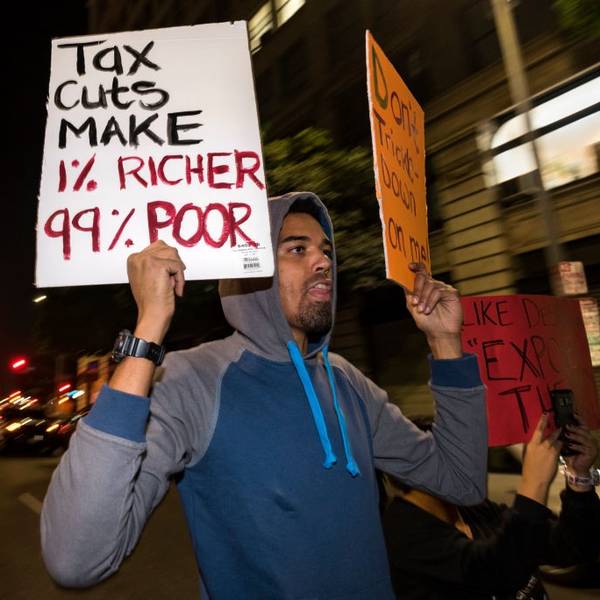
Paying taxes, as tens of millions of us in the United States do every April, evokes many emotions--from gratitude for government programs that feed the hungry to disgust over paying for fossil fuel subsidies and unjust wars. But among a growing number of people, it is also evoking anger over an unequal tax system that favors the 1 percent over the 99 percent. More and more of us are saying that corporations, Wall Street, and the wealthy should pay their fair share.
The good news is that rising numbers of organizations and people are involved in struggles for a more just tax system. Below we share the contours of three such campaigns, all of them winnable before the next U.S. president is elected.
Corporations: Daily newspaper headlines remind us that corporations are making record profits while their workers' paychecks have been frozen for decades. These same corporations complain that the corporate tax rate, pegged at a mere 35 percent, is one of the highest in the world. And, corporations are lobbying furiously to cut that rate.
Among the things that these corporations don't tell you is that, thanks to the thousands of loopholes their lobbyists have peppered throughout the tax code, large numbers of them actually pay little or no taxes at all. Last fall, the Institute for Policy Studies (IPS) pointed out that 25 of the largest U.S. corporations paid their CEOs more than they paid Uncle Sam. As a result, the corporate share of overall U.S. tax revenue has fallen to near its lowest share in over half a century.
Perhaps the biggest tax advantage that giant globe-girdling corporations enjoy is that the Cayman Islands, Bermuda, and several other offshore "tax havens" charge little or no corporate taxes. Thanks to clever accountants, such corporations can declare large portions of their profits in these countries with low tax rates and thereby minimize corporate tax payments to Uncle Sam. In fact, U.S. corporations avoid paying an astounding $90 billion in U.S. taxes a year by taking advantage of these tax havens. Needless to say, this also puts at a relative disadvantage locally rooted small businesses that have no such tax loophole.
The good news: A coalition of groups called the Financial Accountability and Corporate Transparency (FACT) Network is rallying support behind the Cut Unjustified Tax Loopholes Act. The bill, introduced by Senators Carl Levin (D-MI) and Sheldon Whitehouse (D-RI), would significantly close these loopholes.
Wall Street: Occupy Wall Street was right on the money as it lambasted the casino-like financial activities of Wall Street firms, activities that helped crash the economy in 2008. Indeed, a huge share of trades of stocks and derivatives in the United States are handled by so-called "high speed" trading firms whose sole purpose is to make money for corporate and individual clients via purely speculative activity that has nothing to do with a productive Main Street economy.
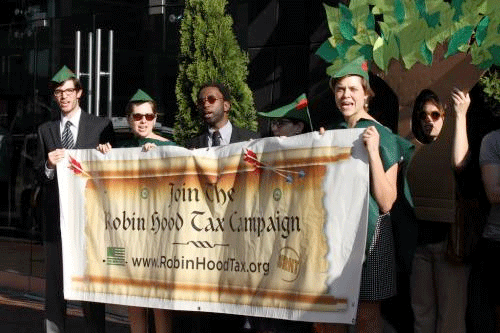
The good news: A set of groups in the United States has joined allies in Europe and around the world to call for financial speculation taxes to curb speculation while raising hundreds of billions of dollars to fund jobs, climate-saving innovations, public health, and the like. In the United States, groups as far-ranging as National Nurses United, HIV/AIDS activists, and climate justice groups have come together behind such a tax, often called a Robin Hood tax. In early April, activists dressed as polar bears joined others clad in the Robin Hood green to protest a meeting of financial officials in Washington. This is hardly a pipe dream. Citizen pressure has compelled eleven European Union nations to agree to initiate such a tax as early as 2014.
Individuals: The top tax rate on individuals was lowered from 91 percent under President Eisenhower to a mere 35 percent under George W. Bush. With pressure from unions and other groups, the U.S. Congress pushed it back up to 39.6 percent for the top 1 percent in early January 2013. Yet, among the richest U.S. citizens who still make out like bandits are the CEOs of the largest firms. Thanks to yet another outrageous and gaping tax loophole, corporations can deduct CEO pay over $1 million as long as they can claim it is performance-based--something that it turns out is quite easy to do. Hence, there is no real check on today's staggering pay packages that offer CEOs, on average, more than 380 times their average worker's pay.
The good news: A number of unions and social justice groups are rallying together to close this tax loophole on CEO pay. Even Senator John McCain favors reducing this perverse ratio. And, there is an important recent precedent for such action: In Obama's first term, both the bank bailout and the health care reform legislation included a $500,000 cap on pay deductibility with no performance pay exemptions.
Bottom line: Each of these three fights is winnable as public outrage grows, and as other revenue-hungry governments point the way to sensible tax reform. To create decent jobs and thriving Main Streets, our local, state and federal governments need revenue. A fair tax system can deliver that with no cuts in vital government programs. The United States is not broke; its rules and tax system are simply unfair.
This article was written for YES! Magazine, a national, nonprofit media organization that fuses powerful ideas with practical actions.
Paying taxes, as tens of millions of us in the United States do every April, evokes many emotions--from gratitude for government programs that feed the hungry to disgust over paying for fossil fuel subsidies and unjust wars. But among a growing number of people, it is also evoking anger over an unequal tax system that favors the 1 percent over the 99 percent. More and more of us are saying that corporations, Wall Street, and the wealthy should pay their fair share.
The good news is that rising numbers of organizations and people are involved in struggles for a more just tax system. Below we share the contours of three such campaigns, all of them winnable before the next U.S. president is elected.
Corporations: Daily newspaper headlines remind us that corporations are making record profits while their workers' paychecks have been frozen for decades. These same corporations complain that the corporate tax rate, pegged at a mere 35 percent, is one of the highest in the world. And, corporations are lobbying furiously to cut that rate.
Among the things that these corporations don't tell you is that, thanks to the thousands of loopholes their lobbyists have peppered throughout the tax code, large numbers of them actually pay little or no taxes at all. Last fall, the Institute for Policy Studies (IPS) pointed out that 25 of the largest U.S. corporations paid their CEOs more than they paid Uncle Sam. As a result, the corporate share of overall U.S. tax revenue has fallen to near its lowest share in over half a century.
Perhaps the biggest tax advantage that giant globe-girdling corporations enjoy is that the Cayman Islands, Bermuda, and several other offshore "tax havens" charge little or no corporate taxes. Thanks to clever accountants, such corporations can declare large portions of their profits in these countries with low tax rates and thereby minimize corporate tax payments to Uncle Sam. In fact, U.S. corporations avoid paying an astounding $90 billion in U.S. taxes a year by taking advantage of these tax havens. Needless to say, this also puts at a relative disadvantage locally rooted small businesses that have no such tax loophole.
The good news: A coalition of groups called the Financial Accountability and Corporate Transparency (FACT) Network is rallying support behind the Cut Unjustified Tax Loopholes Act. The bill, introduced by Senators Carl Levin (D-MI) and Sheldon Whitehouse (D-RI), would significantly close these loopholes.
Wall Street: Occupy Wall Street was right on the money as it lambasted the casino-like financial activities of Wall Street firms, activities that helped crash the economy in 2008. Indeed, a huge share of trades of stocks and derivatives in the United States are handled by so-called "high speed" trading firms whose sole purpose is to make money for corporate and individual clients via purely speculative activity that has nothing to do with a productive Main Street economy.
The good news: A set of groups in the United States has joined allies in Europe and around the world to call for financial speculation taxes to curb speculation while raising hundreds of billions of dollars to fund jobs, climate-saving innovations, public health, and the like. In the United States, groups as far-ranging as National Nurses United, HIV/AIDS activists, and climate justice groups have come together behind such a tax, often called a Robin Hood tax. In early April, activists dressed as polar bears joined others clad in the Robin Hood green to protest a meeting of financial officials in Washington. This is hardly a pipe dream. Citizen pressure has compelled eleven European Union nations to agree to initiate such a tax as early as 2014.
Individuals: The top tax rate on individuals was lowered from 91 percent under President Eisenhower to a mere 35 percent under George W. Bush. With pressure from unions and other groups, the U.S. Congress pushed it back up to 39.6 percent for the top 1 percent in early January 2013. Yet, among the richest U.S. citizens who still make out like bandits are the CEOs of the largest firms. Thanks to yet another outrageous and gaping tax loophole, corporations can deduct CEO pay over $1 million as long as they can claim it is performance-based--something that it turns out is quite easy to do. Hence, there is no real check on today's staggering pay packages that offer CEOs, on average, more than 380 times their average worker's pay.
The good news: A number of unions and social justice groups are rallying together to close this tax loophole on CEO pay. Even Senator John McCain favors reducing this perverse ratio. And, there is an important recent precedent for such action: In Obama's first term, both the bank bailout and the health care reform legislation included a $500,000 cap on pay deductibility with no performance pay exemptions.
Bottom line: Each of these three fights is winnable as public outrage grows, and as other revenue-hungry governments point the way to sensible tax reform. To create decent jobs and thriving Main Streets, our local, state and federal governments need revenue. A fair tax system can deliver that with no cuts in vital government programs. The United States is not broke; its rules and tax system are simply unfair.
This article was written for YES! Magazine, a national, nonprofit media organization that fuses powerful ideas with practical actions.
Paying taxes, as tens of millions of us in the United States do every April, evokes many emotions--from gratitude for government programs that feed the hungry to disgust over paying for fossil fuel subsidies and unjust wars. But among a growing number of people, it is also evoking anger over an unequal tax system that favors the 1 percent over the 99 percent. More and more of us are saying that corporations, Wall Street, and the wealthy should pay their fair share.
The good news is that rising numbers of organizations and people are involved in struggles for a more just tax system. Below we share the contours of three such campaigns, all of them winnable before the next U.S. president is elected.
Corporations: Daily newspaper headlines remind us that corporations are making record profits while their workers' paychecks have been frozen for decades. These same corporations complain that the corporate tax rate, pegged at a mere 35 percent, is one of the highest in the world. And, corporations are lobbying furiously to cut that rate.
Among the things that these corporations don't tell you is that, thanks to the thousands of loopholes their lobbyists have peppered throughout the tax code, large numbers of them actually pay little or no taxes at all. Last fall, the Institute for Policy Studies (IPS) pointed out that 25 of the largest U.S. corporations paid their CEOs more than they paid Uncle Sam. As a result, the corporate share of overall U.S. tax revenue has fallen to near its lowest share in over half a century.
Perhaps the biggest tax advantage that giant globe-girdling corporations enjoy is that the Cayman Islands, Bermuda, and several other offshore "tax havens" charge little or no corporate taxes. Thanks to clever accountants, such corporations can declare large portions of their profits in these countries with low tax rates and thereby minimize corporate tax payments to Uncle Sam. In fact, U.S. corporations avoid paying an astounding $90 billion in U.S. taxes a year by taking advantage of these tax havens. Needless to say, this also puts at a relative disadvantage locally rooted small businesses that have no such tax loophole.
The good news: A coalition of groups called the Financial Accountability and Corporate Transparency (FACT) Network is rallying support behind the Cut Unjustified Tax Loopholes Act. The bill, introduced by Senators Carl Levin (D-MI) and Sheldon Whitehouse (D-RI), would significantly close these loopholes.
Wall Street: Occupy Wall Street was right on the money as it lambasted the casino-like financial activities of Wall Street firms, activities that helped crash the economy in 2008. Indeed, a huge share of trades of stocks and derivatives in the United States are handled by so-called "high speed" trading firms whose sole purpose is to make money for corporate and individual clients via purely speculative activity that has nothing to do with a productive Main Street economy.
The good news: A set of groups in the United States has joined allies in Europe and around the world to call for financial speculation taxes to curb speculation while raising hundreds of billions of dollars to fund jobs, climate-saving innovations, public health, and the like. In the United States, groups as far-ranging as National Nurses United, HIV/AIDS activists, and climate justice groups have come together behind such a tax, often called a Robin Hood tax. In early April, activists dressed as polar bears joined others clad in the Robin Hood green to protest a meeting of financial officials in Washington. This is hardly a pipe dream. Citizen pressure has compelled eleven European Union nations to agree to initiate such a tax as early as 2014.
Individuals: The top tax rate on individuals was lowered from 91 percent under President Eisenhower to a mere 35 percent under George W. Bush. With pressure from unions and other groups, the U.S. Congress pushed it back up to 39.6 percent for the top 1 percent in early January 2013. Yet, among the richest U.S. citizens who still make out like bandits are the CEOs of the largest firms. Thanks to yet another outrageous and gaping tax loophole, corporations can deduct CEO pay over $1 million as long as they can claim it is performance-based--something that it turns out is quite easy to do. Hence, there is no real check on today's staggering pay packages that offer CEOs, on average, more than 380 times their average worker's pay.
The good news: A number of unions and social justice groups are rallying together to close this tax loophole on CEO pay. Even Senator John McCain favors reducing this perverse ratio. And, there is an important recent precedent for such action: In Obama's first term, both the bank bailout and the health care reform legislation included a $500,000 cap on pay deductibility with no performance pay exemptions.
Bottom line: Each of these three fights is winnable as public outrage grows, and as other revenue-hungry governments point the way to sensible tax reform. To create decent jobs and thriving Main Streets, our local, state and federal governments need revenue. A fair tax system can deliver that with no cuts in vital government programs. The United States is not broke; its rules and tax system are simply unfair.
This article was written for YES! Magazine, a national, nonprofit media organization that fuses powerful ideas with practical actions.