SUBSCRIBE TO OUR FREE NEWSLETTER
Daily news & progressive opinion—funded by the people, not the corporations—delivered straight to your inbox.
5
#000000
#FFFFFF
To donate by check, phone, or other method, see our More Ways to Give page.
Here are some of the news stories out of Europe:
New York Times: Unemployment in Euro Zone Reaches a Record High
WSJ: Sixth Quarter of Contraction Looms for Euro Zone
Der Spiegel: Shredded Social Safety Net: European Austerity Costing Lives
WSJ: Spain Says Budget Gap Is Wider Than Reported
New York Times: European Car Sales Point to Continuing Slump
WSJ: Italy Unable to Form Government
New York Times: Debt Rising in Europe
Paul Krugman's right: This isn't a recession. It's Europe's Second Depression, and it's on track to last even longer than the first one. Austerity economics has been imposed across most of the Eurozone, to a greater or lesser degree, with devastating economic results: This is Europe's sixth consecutive quarter of economic contraction.
Europe's Austerity Recession (or Depression) has now lasted longer than the one brought on by the financial crisis of 2008.
The first downturn was brought on by private greed and public negligence. This one's been brought on by public insanity fueled by private interests.
Europe's first downturn was brought on by private greed and public negligence. This one's been brought on by public insanity fueled by private interests.
And the austerity poison is literally deadly: The Lancet, a respected medical journal, reports a sharp increase in suicides and epidemics as the rest of European austerity measures.
There's at least one heartwarming story to come out of all this misery. Greek and Cypriot entertainers held a concert on Cyprus- a "mini-Live Aid," if you will - and instead of charging admission, organizers asked people to bring food for Cypriot families who can't afford food.
"We came to help those who have problems," said a dentist who attended the concert. "Now we can help - but we don't know if we will be able to help tomorrow."
It's nice to know that somebody's thinking about the victims of austerity on Cyprus - especially since even more severe austerity measures will soon be imposed there.
Meanwhile, manufacturing output is plunging across the Eurozone. Spain saw the worst decline in employment since 2009. Unemployment hasn't been this high in the Eurozone since record-keeping began in 1995. And Europe's infrastructure has a dimming future.
"Europe's carefully maintained autobahns, high-speed TGV trains and vast network of modern airports have long been the envy of the world," writes Reuters. "But thanks to austerity budgets that are slashing infrastructure spending ..., that may not be true for much longer."
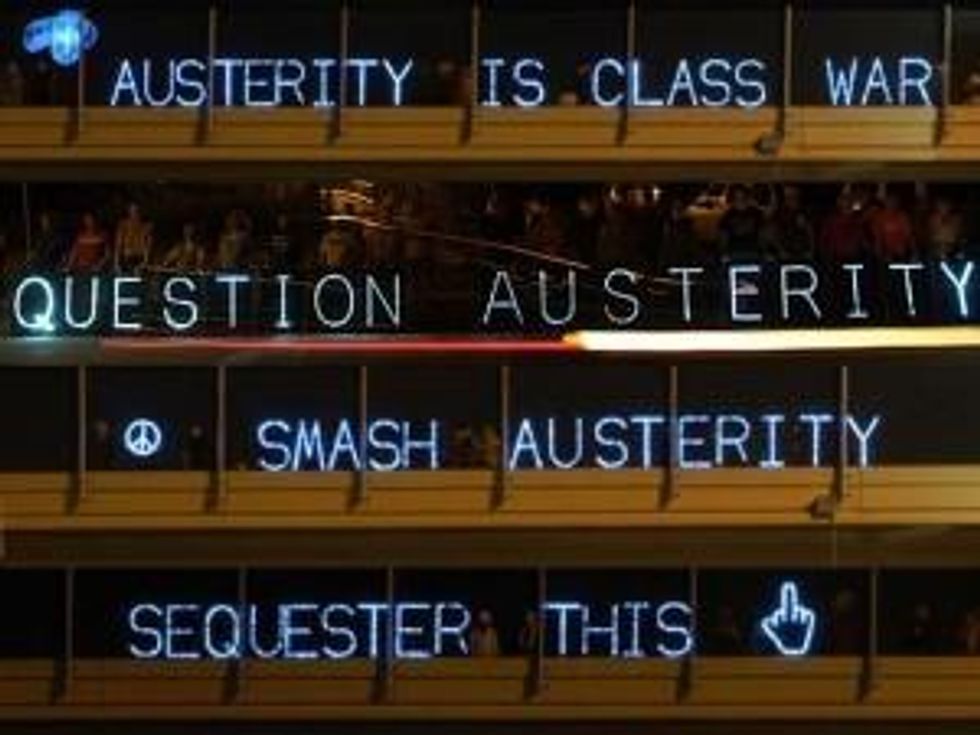
No wonder last month's European Union summit was marked by protests and Italy's leaders still can't form a government.
What can we learn from Europe's misery? For our political leaders the answer seems to be: Nothing. In fact, Washington seems determined to follow in Washington's footsteps. We've already had a couple of rounds of austerity ourselves - in the last deficit deal, and now in the "sequester" cuts. The President and the Republicans both employ pro-austerity rhetoric which argues that deficits are our biggest problem. They just disagree about where and how it should be imposed.
The President occasionally offers half-hearted stimulus programs, but he never actually fights for them. The Republican platform has become increasing extremist, emphasizing the radical dismantling of our social contract and a deregulated environment in which citizens would become the hapless prey of corporate predators.
President Obama may challenge the GOP verbally on a couple of points, but he continues to propose pre-"conservatized" ideas, which the GOP promptly and predictably pushes further to the right. (His new budget is likely to be the next example of this.) And by endlessly repeating the false idea that deficits are our most urgent economic problem, he has performed an invaluable service to the cause of harmful austerity economics.
In other words, The Republicans want to place the country on an express train to hell, and the President usually suggests we take the local instead.
Our economic problems aren't as severe as the Europeans' - yet. Maybe that's why we haven't seen very many Americans in the streets protesting lately. But if that doesn't happen soon, Europe's miserable present is very probably a glimpse into our future.
Not that things would have to be all bad. Someday they might hold "mini-Live Aids" for us, too, with lots of free music and cans of dried food for families like yours and mine. As we watch the "deficit debate" unfold, we're learning that the Live Aid folks were right about one thing:
We really are the world.