
Two years ago this week, the Bahraini monarchy started cracking down on its people. It's still at it, with the complicity of the Obama Administration.
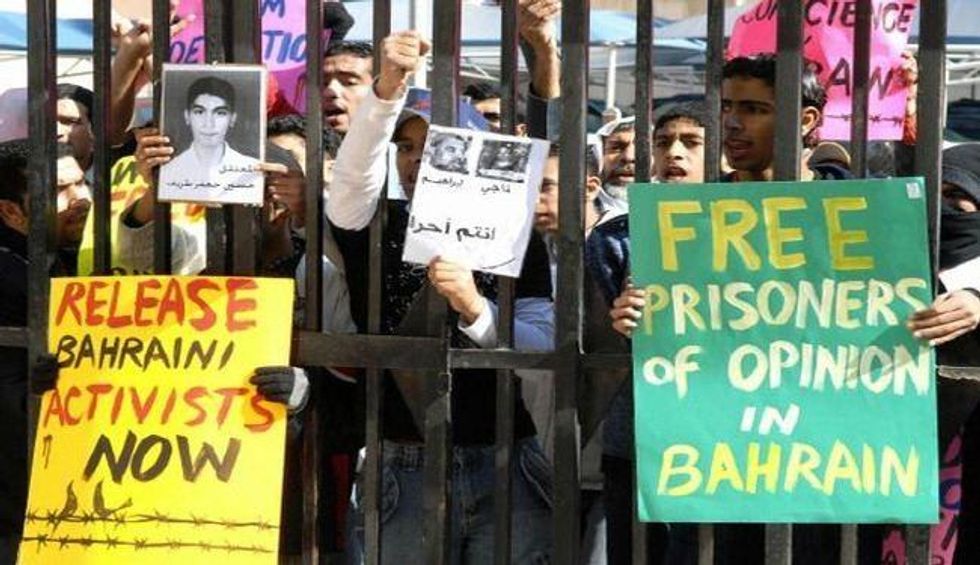
On February 14, 2011, Bahrainis embarked on their version of the Arab Spring, running up against official repression immediately. The protests so unnerved the regime that it called upon the Saudis to invade the country. The Saudis did so a month later with the acquiescence, at least, of the Obama Administration, and a long night descended upon the island nation.
Dozens of protesters have been killed at the hands of the security forces over the past two years. Hundreds are in jail. Just last month, the Bahraini appeals court confirmed life sentences for seven prominent activists, including Abdulhadi al-Khawaja, who had staged a long hunger strike in protest against his mistreatment.
Over the past year, "the government shifted from talking about reforms to silencing critical voices, banning demonstrations, and restricting access to independent journalists and rights organizations," Human Rights Watch Deputy Middle East Director Joe Stork recently stated. "These actions thoroughly discredit claims by Bahraini authorities of respecting human rights."
The demonstrators persevere.
"Protests have taken place every day for the past few weeks," reports Reese Erlich (a contributor to The Progressive) for NPR. "A group of six traditional opposition parties, headed by the Al Wefaq National Islamic Society, continue to mobilize the largest numbers. But the February 14 Youth Coalition has challenged those parties with more radical demands and militant tactics."
And the toll continues to rise.
"In Bahrain, a teenage boy has been killed by security forces during protests marking the second anniversary of the country's pro-democracy uprising," Democracy Now reports. "Opposition activists said Hussain al-Jaziri died from shotgun wounds. At least eighty-seven people have died at the hands of security forces in the Gulf nation since 2011."
The United States has played a hypocritical and pernicious role here. A mix of security considerations, Iranophobia, and oil has put the Obama team on the wrong side of democracy. The U.S. Fifth Fleet is stationed in Bahrain. The uprising has acquired a sectarian hue for some due to the Shiite majority confronting the Sunni monarchy. Shiite Iran has been accused (with scant evidence) of fishing in troubled waters. And the United States believes it can't afford to alienate such a crucial supplier of oil as Saudi Arabia. Hence, its response to the Bahraini crackdown has been coldhearted.
"Even the most basic steps that were taken against other governments during these mass uprisings that the Middle East and North Africa region has witnessed, we haven't seen those steps taken towards Bahrain," activist Maryam al-Khawaja (daughter of Abdulhadi al-Khawaja) tells Democracy Now. "We've been seeing the selling of arms to Bahrain by the United States and the United Kingdom and others, ongoing business as usual when it comes to economic deals and so on--all in the name of security."
The cozying up to the Bahraini monarchy seems to be a bipartisan venture. "Met w/ #Bahrain's King Hamad bin Isa al-Khalifa this weekend," Senator John McCain tweeted in December.
In all the tumult, Bahraini women have been in the forefront of the uprising.
"I watched one woman singlehandedly organize activities for traumatized children of martyrs and prisoners," Jen Marlowe wrote in the November issue of The Progressive. "I accompanied two female doctors from Physicians for Human Rights as they went from house to house, documenting the long-term affects of continuous exposure to tear gas. I stood next to a fearless young woman who photographed riot police attacking protestors with tear gas. I interviewed a defiant female university student just hours after her release from prison, where she had been sexually abused."
Last month, thirty human rights organizations from around the world sent a letter to President Obama urging him to apply pressure to get pro-democracy campaigners released.
"Dear Mr. President," the letter reads, "The Gulf Center for Human Rights (GCHR) and the Bahrain Center for Human Rights (BCHR), as well as the undersigned human rights organizations, call on you to take substantive action towards securing the immediate release of thirteen activists and human rights defenders who are arbitrarily detained in Bahrain."
Obama needs to heed their plea, instead of coddling a repressive monarchy.
Two years ago this week, the Bahraini monarchy started cracking down on its people. It's still at it, with the complicity of the Obama Administration.
On February 14, 2011, Bahrainis embarked on their version of the Arab Spring, running up against official repression immediately. The protests so unnerved the regime that it called upon the Saudis to invade the country. The Saudis did so a month later with the acquiescence, at least, of the Obama Administration, and a long night descended upon the island nation.
Dozens of protesters have been killed at the hands of the security forces over the past two years. Hundreds are in jail. Just last month, the Bahraini appeals court confirmed life sentences for seven prominent activists, including Abdulhadi al-Khawaja, who had staged a long hunger strike in protest against his mistreatment.
Over the past year, "the government shifted from talking about reforms to silencing critical voices, banning demonstrations, and restricting access to independent journalists and rights organizations," Human Rights Watch Deputy Middle East Director Joe Stork recently stated. "These actions thoroughly discredit claims by Bahraini authorities of respecting human rights."
The demonstrators persevere.
"Protests have taken place every day for the past few weeks," reports Reese Erlich (a contributor to The Progressive) for NPR. "A group of six traditional opposition parties, headed by the Al Wefaq National Islamic Society, continue to mobilize the largest numbers. But the February 14 Youth Coalition has challenged those parties with more radical demands and militant tactics."
And the toll continues to rise.
"In Bahrain, a teenage boy has been killed by security forces during protests marking the second anniversary of the country's pro-democracy uprising," Democracy Now reports. "Opposition activists said Hussain al-Jaziri died from shotgun wounds. At least eighty-seven people have died at the hands of security forces in the Gulf nation since 2011."
The United States has played a hypocritical and pernicious role here. A mix of security considerations, Iranophobia, and oil has put the Obama team on the wrong side of democracy. The U.S. Fifth Fleet is stationed in Bahrain. The uprising has acquired a sectarian hue for some due to the Shiite majority confronting the Sunni monarchy. Shiite Iran has been accused (with scant evidence) of fishing in troubled waters. And the United States believes it can't afford to alienate such a crucial supplier of oil as Saudi Arabia. Hence, its response to the Bahraini crackdown has been coldhearted.
"Even the most basic steps that were taken against other governments during these mass uprisings that the Middle East and North Africa region has witnessed, we haven't seen those steps taken towards Bahrain," activist Maryam al-Khawaja (daughter of Abdulhadi al-Khawaja) tells Democracy Now. "We've been seeing the selling of arms to Bahrain by the United States and the United Kingdom and others, ongoing business as usual when it comes to economic deals and so on--all in the name of security."
The cozying up to the Bahraini monarchy seems to be a bipartisan venture. "Met w/ #Bahrain's King Hamad bin Isa al-Khalifa this weekend," Senator John McCain tweeted in December.
In all the tumult, Bahraini women have been in the forefront of the uprising.
"I watched one woman singlehandedly organize activities for traumatized children of martyrs and prisoners," Jen Marlowe wrote in the November issue of The Progressive. "I accompanied two female doctors from Physicians for Human Rights as they went from house to house, documenting the long-term affects of continuous exposure to tear gas. I stood next to a fearless young woman who photographed riot police attacking protestors with tear gas. I interviewed a defiant female university student just hours after her release from prison, where she had been sexually abused."
Last month, thirty human rights organizations from around the world sent a letter to President Obama urging him to apply pressure to get pro-democracy campaigners released.
"Dear Mr. President," the letter reads, "The Gulf Center for Human Rights (GCHR) and the Bahrain Center for Human Rights (BCHR), as well as the undersigned human rights organizations, call on you to take substantive action towards securing the immediate release of thirteen activists and human rights defenders who are arbitrarily detained in Bahrain."
Obama needs to heed their plea, instead of coddling a repressive monarchy.
Two years ago this week, the Bahraini monarchy started cracking down on its people. It's still at it, with the complicity of the Obama Administration.
On February 14, 2011, Bahrainis embarked on their version of the Arab Spring, running up against official repression immediately. The protests so unnerved the regime that it called upon the Saudis to invade the country. The Saudis did so a month later with the acquiescence, at least, of the Obama Administration, and a long night descended upon the island nation.
Dozens of protesters have been killed at the hands of the security forces over the past two years. Hundreds are in jail. Just last month, the Bahraini appeals court confirmed life sentences for seven prominent activists, including Abdulhadi al-Khawaja, who had staged a long hunger strike in protest against his mistreatment.
Over the past year, "the government shifted from talking about reforms to silencing critical voices, banning demonstrations, and restricting access to independent journalists and rights organizations," Human Rights Watch Deputy Middle East Director Joe Stork recently stated. "These actions thoroughly discredit claims by Bahraini authorities of respecting human rights."
The demonstrators persevere.
"Protests have taken place every day for the past few weeks," reports Reese Erlich (a contributor to The Progressive) for NPR. "A group of six traditional opposition parties, headed by the Al Wefaq National Islamic Society, continue to mobilize the largest numbers. But the February 14 Youth Coalition has challenged those parties with more radical demands and militant tactics."
And the toll continues to rise.
"In Bahrain, a teenage boy has been killed by security forces during protests marking the second anniversary of the country's pro-democracy uprising," Democracy Now reports. "Opposition activists said Hussain al-Jaziri died from shotgun wounds. At least eighty-seven people have died at the hands of security forces in the Gulf nation since 2011."
The United States has played a hypocritical and pernicious role here. A mix of security considerations, Iranophobia, and oil has put the Obama team on the wrong side of democracy. The U.S. Fifth Fleet is stationed in Bahrain. The uprising has acquired a sectarian hue for some due to the Shiite majority confronting the Sunni monarchy. Shiite Iran has been accused (with scant evidence) of fishing in troubled waters. And the United States believes it can't afford to alienate such a crucial supplier of oil as Saudi Arabia. Hence, its response to the Bahraini crackdown has been coldhearted.
"Even the most basic steps that were taken against other governments during these mass uprisings that the Middle East and North Africa region has witnessed, we haven't seen those steps taken towards Bahrain," activist Maryam al-Khawaja (daughter of Abdulhadi al-Khawaja) tells Democracy Now. "We've been seeing the selling of arms to Bahrain by the United States and the United Kingdom and others, ongoing business as usual when it comes to economic deals and so on--all in the name of security."
The cozying up to the Bahraini monarchy seems to be a bipartisan venture. "Met w/ #Bahrain's King Hamad bin Isa al-Khalifa this weekend," Senator John McCain tweeted in December.
In all the tumult, Bahraini women have been in the forefront of the uprising.
"I watched one woman singlehandedly organize activities for traumatized children of martyrs and prisoners," Jen Marlowe wrote in the November issue of The Progressive. "I accompanied two female doctors from Physicians for Human Rights as they went from house to house, documenting the long-term affects of continuous exposure to tear gas. I stood next to a fearless young woman who photographed riot police attacking protestors with tear gas. I interviewed a defiant female university student just hours after her release from prison, where she had been sexually abused."
Last month, thirty human rights organizations from around the world sent a letter to President Obama urging him to apply pressure to get pro-democracy campaigners released.
"Dear Mr. President," the letter reads, "The Gulf Center for Human Rights (GCHR) and the Bahrain Center for Human Rights (BCHR), as well as the undersigned human rights organizations, call on you to take substantive action towards securing the immediate release of thirteen activists and human rights defenders who are arbitrarily detained in Bahrain."
Obama needs to heed their plea, instead of coddling a repressive monarchy.