SUBSCRIBE TO OUR FREE NEWSLETTER
Daily news & progressive opinion—funded by the people, not the corporations—delivered straight to your inbox.
5
#000000
#FFFFFF
To donate by check, phone, or other method, see our More Ways to Give page.
Folks, I've got some good news and some bad news about the nation's ever-elusive quest for a sound energy policy. The good news: Finally there's some under-the-radar bipartisan consensus in Washington. The bad news: Both parties are dead wrong.
What's up? An ardent (and well-financed) belief on both sides of the aisle that hydraulic fracturing for natural gas -- a process better known as "fracking" -- is "cleaner" than coal and will result in greater U.S. energy independence. When President Barack Obama delivered his annual State of the Union address, he pledged his allegiance to continued exploration for natural "shale gas."
Fracking uses pressurized liquids to create cracks in shale deposits located deep underground to force pockets of natural gas to the surface. Recent discoveries in the Marcellus shale, a natural gas deposit that stretches from New York to West Virginia, suggest the U.S. could exploit this energy resource for what seems like an eternity by Washington standards: a century or more, if estimates prove accurate. But this seemingly endless form of energy will only be exploited rapidly and cheaply if critics and expensive regulations are kept at bay.
With mountaintop removal losing favor with the public, coal-fired power plants implicated in a host of health problems, and coal waste a burden no state wants to deal with, this "cleaner" form of energy -- natural gas -- has gotten a boost in the marketplace at a particularly auspicious time.
But it turns out gas has a host of environmental problems unique to fracking. Recent studies emerging from Cornell University suggest that gas could be far more heat-trapping than previously thought, and gas extracted by fracking could be twice as bad as coal from a climate perspective. This is because about 8 percent of the gas escapes into the atmosphere, where it is 105 times more potent than CO2 over its 20-year lifespan.
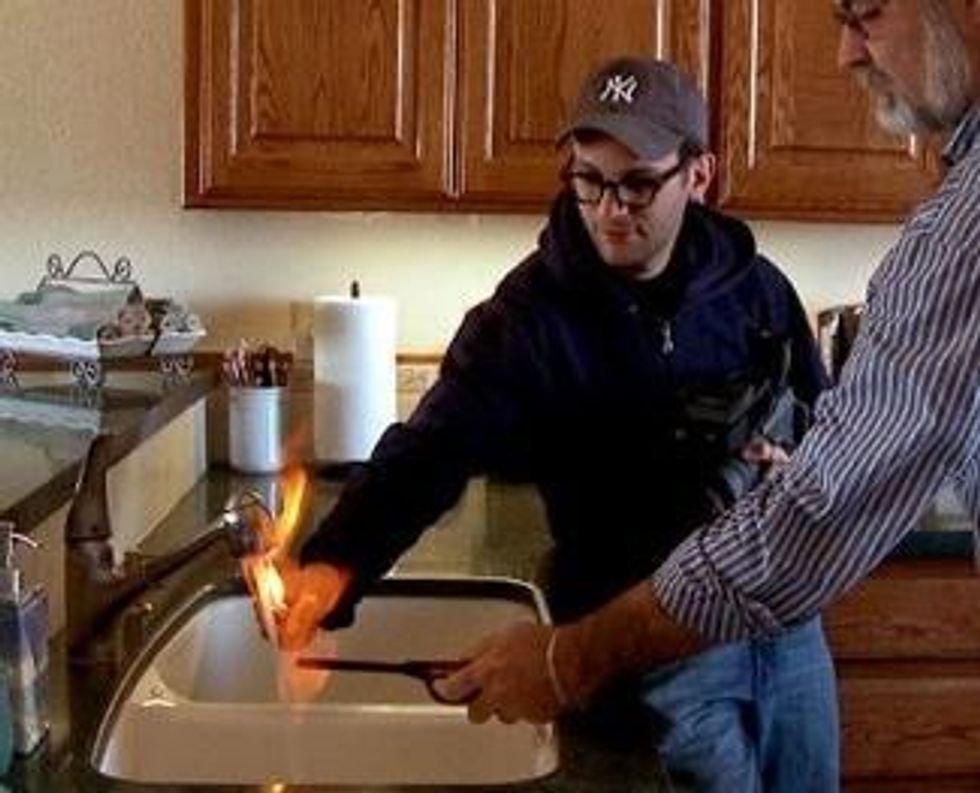
Then there's the groundwater contamination. Chemicals considered "trade secrets" for the gas industry (thanks to an energy policy developed in secret meetings by former Vice President Dick Cheney) are killing cattle and deer. Residents living near fracking wells complain of health problems. In some cases, they can literally light the water coming out of their taps on fire.
In addition, scientists have started to link earthquakes -- such as the rare ones that have been shaking Ohio, New York, and Arkansas -- with fracking.
It's frightening that only a handful of politicians are voicing strong concerns about this increasingly common gas extraction method, including Rep. Ed Markey, a Massachusetts Democrat, and Greg Ball, a Republican member of New York's state senate.
Why is this kind of courage so rare? In a word, money. The natural gas industry has spent hundreds of millions of dollars on campaign contributions over the last decade to smother efforts to regulate fracking, as Common Cause has documented.
We need to stop relying on fossil fuels and instead embrace a bold "Green New Deal" that generates significant jobs for unemployed workers around the country while ramping up already booming investments in wind, solar, and geothermal electricity.
Let's invest in a grid that would allow us to drive electric cars and buses powered by the wind, to heat our homes with the sun, and to totally break our dependence on oil. Imagine full employment, with millions of public- and private-sector jobs developing this clean-energy infrastructure.
This kind of jobs program would both benefit our workers and our local economy -- and cut the umbilical cord, finally and completely, from foreign oil. And, unlike fracked gas, these resources would be truly limitless, benefiting us and future generations.
Folks, I've got some good news and some bad news about the nation's ever-elusive quest for a sound energy policy. The good news: Finally there's some under-the-radar bipartisan consensus in Washington. The bad news: Both parties are dead wrong.
What's up? An ardent (and well-financed) belief on both sides of the aisle that hydraulic fracturing for natural gas -- a process better known as "fracking" -- is "cleaner" than coal and will result in greater U.S. energy independence. When President Barack Obama delivered his annual State of the Union address, he pledged his allegiance to continued exploration for natural "shale gas."
Fracking uses pressurized liquids to create cracks in shale deposits located deep underground to force pockets of natural gas to the surface. Recent discoveries in the Marcellus shale, a natural gas deposit that stretches from New York to West Virginia, suggest the U.S. could exploit this energy resource for what seems like an eternity by Washington standards: a century or more, if estimates prove accurate. But this seemingly endless form of energy will only be exploited rapidly and cheaply if critics and expensive regulations are kept at bay.
With mountaintop removal losing favor with the public, coal-fired power plants implicated in a host of health problems, and coal waste a burden no state wants to deal with, this "cleaner" form of energy -- natural gas -- has gotten a boost in the marketplace at a particularly auspicious time.
But it turns out gas has a host of environmental problems unique to fracking. Recent studies emerging from Cornell University suggest that gas could be far more heat-trapping than previously thought, and gas extracted by fracking could be twice as bad as coal from a climate perspective. This is because about 8 percent of the gas escapes into the atmosphere, where it is 105 times more potent than CO2 over its 20-year lifespan.
Then there's the groundwater contamination. Chemicals considered "trade secrets" for the gas industry (thanks to an energy policy developed in secret meetings by former Vice President Dick Cheney) are killing cattle and deer. Residents living near fracking wells complain of health problems. In some cases, they can literally light the water coming out of their taps on fire.
In addition, scientists have started to link earthquakes -- such as the rare ones that have been shaking Ohio, New York, and Arkansas -- with fracking.
It's frightening that only a handful of politicians are voicing strong concerns about this increasingly common gas extraction method, including Rep. Ed Markey, a Massachusetts Democrat, and Greg Ball, a Republican member of New York's state senate.
Why is this kind of courage so rare? In a word, money. The natural gas industry has spent hundreds of millions of dollars on campaign contributions over the last decade to smother efforts to regulate fracking, as Common Cause has documented.
We need to stop relying on fossil fuels and instead embrace a bold "Green New Deal" that generates significant jobs for unemployed workers around the country while ramping up already booming investments in wind, solar, and geothermal electricity.
Let's invest in a grid that would allow us to drive electric cars and buses powered by the wind, to heat our homes with the sun, and to totally break our dependence on oil. Imagine full employment, with millions of public- and private-sector jobs developing this clean-energy infrastructure.
This kind of jobs program would both benefit our workers and our local economy -- and cut the umbilical cord, finally and completely, from foreign oil. And, unlike fracked gas, these resources would be truly limitless, benefiting us and future generations.
Folks, I've got some good news and some bad news about the nation's ever-elusive quest for a sound energy policy. The good news: Finally there's some under-the-radar bipartisan consensus in Washington. The bad news: Both parties are dead wrong.
What's up? An ardent (and well-financed) belief on both sides of the aisle that hydraulic fracturing for natural gas -- a process better known as "fracking" -- is "cleaner" than coal and will result in greater U.S. energy independence. When President Barack Obama delivered his annual State of the Union address, he pledged his allegiance to continued exploration for natural "shale gas."
Fracking uses pressurized liquids to create cracks in shale deposits located deep underground to force pockets of natural gas to the surface. Recent discoveries in the Marcellus shale, a natural gas deposit that stretches from New York to West Virginia, suggest the U.S. could exploit this energy resource for what seems like an eternity by Washington standards: a century or more, if estimates prove accurate. But this seemingly endless form of energy will only be exploited rapidly and cheaply if critics and expensive regulations are kept at bay.
With mountaintop removal losing favor with the public, coal-fired power plants implicated in a host of health problems, and coal waste a burden no state wants to deal with, this "cleaner" form of energy -- natural gas -- has gotten a boost in the marketplace at a particularly auspicious time.
But it turns out gas has a host of environmental problems unique to fracking. Recent studies emerging from Cornell University suggest that gas could be far more heat-trapping than previously thought, and gas extracted by fracking could be twice as bad as coal from a climate perspective. This is because about 8 percent of the gas escapes into the atmosphere, where it is 105 times more potent than CO2 over its 20-year lifespan.
Then there's the groundwater contamination. Chemicals considered "trade secrets" for the gas industry (thanks to an energy policy developed in secret meetings by former Vice President Dick Cheney) are killing cattle and deer. Residents living near fracking wells complain of health problems. In some cases, they can literally light the water coming out of their taps on fire.
In addition, scientists have started to link earthquakes -- such as the rare ones that have been shaking Ohio, New York, and Arkansas -- with fracking.
It's frightening that only a handful of politicians are voicing strong concerns about this increasingly common gas extraction method, including Rep. Ed Markey, a Massachusetts Democrat, and Greg Ball, a Republican member of New York's state senate.
Why is this kind of courage so rare? In a word, money. The natural gas industry has spent hundreds of millions of dollars on campaign contributions over the last decade to smother efforts to regulate fracking, as Common Cause has documented.
We need to stop relying on fossil fuels and instead embrace a bold "Green New Deal" that generates significant jobs for unemployed workers around the country while ramping up already booming investments in wind, solar, and geothermal electricity.
Let's invest in a grid that would allow us to drive electric cars and buses powered by the wind, to heat our homes with the sun, and to totally break our dependence on oil. Imagine full employment, with millions of public- and private-sector jobs developing this clean-energy infrastructure.
This kind of jobs program would both benefit our workers and our local economy -- and cut the umbilical cord, finally and completely, from foreign oil. And, unlike fracked gas, these resources would be truly limitless, benefiting us and future generations.