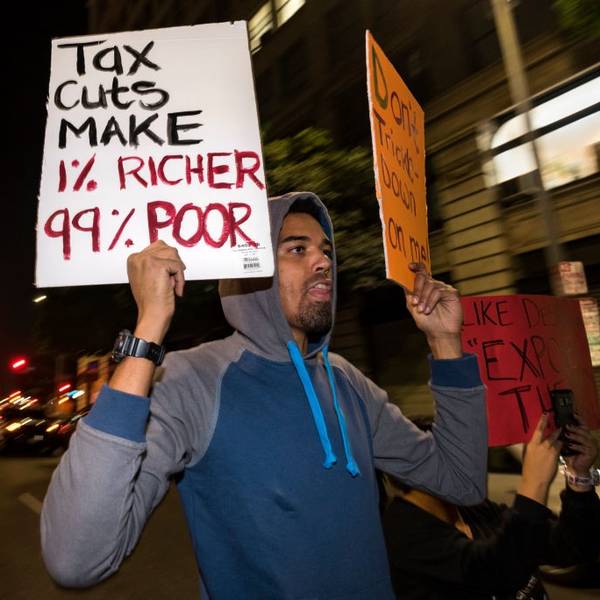
There are two ways of cutting a deficit: raising taxes or reducing spending. Raising taxes means taking money from the rich. Cutting spending means taking money from the poor. Not in all cases of course: some taxation is regressive; some state spending takes money from ordinary citizens and gives it to banks, arms companies, oil barons and farmers. But in most cases the state transfers wealth from rich to poor, while tax cuts shift it from poor to rich.
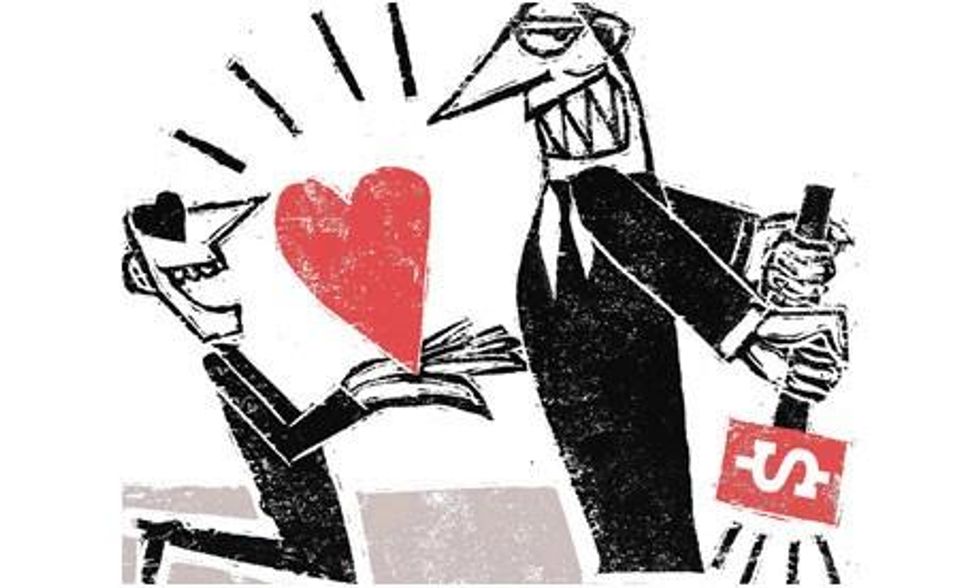
So the rich, in a nominal democracy, have a struggle on their hands. Somehow they must persuade the other 99% to vote against their own interests: to shrink the state, supporting spending cuts rather than tax rises. In the US they appear to be succeeding.
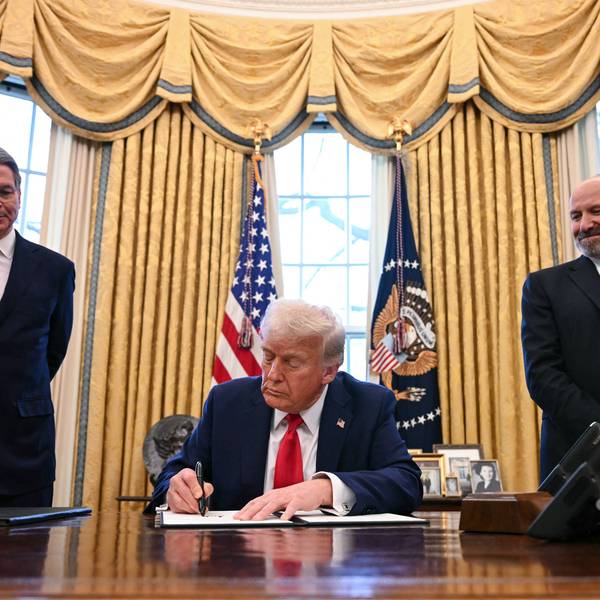
Partly as a result of the Bush tax cuts of 2001, 2003 and 2005 (shamefully extended by Barack Obama), taxation of the wealthy, in Obama's words, "is at its lowest level in half a century". The consequence of such regressive policies is a level of inequality unknown in other developed nations. As the Nobel laureate Joseph Stiglitz points out, in the past 10 years the income of the top 1% has risen by 18%, while that of blue-collar male workers has fallen by 12%.
The deal being thrashed out in Congress as this article goes to press seeks only to cut state spending. As the former Republican senator Alan Simpson says: "The little guy is going to be cremated." That means more economic decline, which means a bigger deficit. It's insane. But how did it happen?
The immediate reason is that Republican members of Congress supported by the Tea Party movement won't budge. But this explains nothing. The Tea Party movement mostly consists of people who have been harmed by tax cuts for the rich and spending cuts for the poor and middle. Why would they mobilise against their own welfare? You can understand what is happening in Washington only if you remember what everyone seems to have forgotten: how this movement began.
On Sunday the Observer claimed that "the Tea Party rose out of anger over the scale of federal spending, and in particular in bailing out the banks". This is what its members claim. It's nonsense.
The movement started with Rick Santelli's call on CNBC for a tea party of city traders to dump securities in Lake Michigan, in protest at Obama's plan to "subsidise the losers". In other words, it was a demand for a financiers' mobilisation against the bailout of their victims: people losing their homes. On the same day, a group called Americans for Prosperity (AFP) set up a Tea Party Facebook page and started organising Tea Party events. The movement, whose programme is still lavishly supported by AFP, took off from there.
So who or what is Americans for Prosperity? It was founded and is funded by Charles and David Koch. They run what they call "the biggest company you've never heard of", and between them they are worth $43bn. Koch Industries is a massive oil, gas, minerals, timber and chemicals company. In the past 15 years the brothers have poured at least $85m into lobby groups arguing for lower taxes for the rich and weaker regulations for industry. The groups and politicians the Kochs fund also lobby to destroy collective bargaining, to stop laws reducing carbon emissions, to stymie healthcare reform and to hobble attempts to control the banks. During the 2010 election cycle, AFP spent $45m supporting its favoured candidates.
But the Kochs' greatest political triumph is the creation of the Tea Party movement. Taki Oldham's film (Astro)Turf Wars shows Tea Party organisers reporting back to David Koch at their 2009 Defending the Dream summit, explaining the events and protests they've started with AFP help. "Five years ago," he tells them, "my brother Charles and I provided the funds to start Americans for Prosperity. It's beyond my wildest dreams how AFP has grown into this enormous organisation."
AFP mobilised the anger of people who found their conditions of life declining, and channelled it into a campaign to make them worse. Tea Party campaigners take to the streets to demand less tax for billionaires and worse health, education and social insurance for themselves.
Are they stupid? No. They have been misled by another instrument of corporate power: the media. The movement has been relentlessly promoted by Fox News, which belongs to a more familiar billionaire. Like the Kochs, Rupert Murdoch aims to misrepresent the democratic choices we face, in order to persuade us to vote against our own interests and in favour of his.
What's taking place in Congress right now is a kind of political coup. A handful of billionaires have shoved a spanner into the legislative process. Through the candidates they have bought and the movement that supports them, they are now breaking and reshaping the system to serve their interests. We knew this once, but now we've forgotten. What hope do we have of resisting a force we won't even see?
There are two ways of cutting a deficit: raising taxes or reducing spending. Raising taxes means taking money from the rich. Cutting spending means taking money from the poor. Not in all cases of course: some taxation is regressive; some state spending takes money from ordinary citizens and gives it to banks, arms companies, oil barons and farmers. But in most cases the state transfers wealth from rich to poor, while tax cuts shift it from poor to rich.
So the rich, in a nominal democracy, have a struggle on their hands. Somehow they must persuade the other 99% to vote against their own interests: to shrink the state, supporting spending cuts rather than tax rises. In the US they appear to be succeeding.
Partly as a result of the Bush tax cuts of 2001, 2003 and 2005 (shamefully extended by Barack Obama), taxation of the wealthy, in Obama's words, "is at its lowest level in half a century". The consequence of such regressive policies is a level of inequality unknown in other developed nations. As the Nobel laureate Joseph Stiglitz points out, in the past 10 years the income of the top 1% has risen by 18%, while that of blue-collar male workers has fallen by 12%.
The deal being thrashed out in Congress as this article goes to press seeks only to cut state spending. As the former Republican senator Alan Simpson says: "The little guy is going to be cremated." That means more economic decline, which means a bigger deficit. It's insane. But how did it happen?
The immediate reason is that Republican members of Congress supported by the Tea Party movement won't budge. But this explains nothing. The Tea Party movement mostly consists of people who have been harmed by tax cuts for the rich and spending cuts for the poor and middle. Why would they mobilise against their own welfare? You can understand what is happening in Washington only if you remember what everyone seems to have forgotten: how this movement began.
On Sunday the Observer claimed that "the Tea Party rose out of anger over the scale of federal spending, and in particular in bailing out the banks". This is what its members claim. It's nonsense.
The movement started with Rick Santelli's call on CNBC for a tea party of city traders to dump securities in Lake Michigan, in protest at Obama's plan to "subsidise the losers". In other words, it was a demand for a financiers' mobilisation against the bailout of their victims: people losing their homes. On the same day, a group called Americans for Prosperity (AFP) set up a Tea Party Facebook page and started organising Tea Party events. The movement, whose programme is still lavishly supported by AFP, took off from there.
So who or what is Americans for Prosperity? It was founded and is funded by Charles and David Koch. They run what they call "the biggest company you've never heard of", and between them they are worth $43bn. Koch Industries is a massive oil, gas, minerals, timber and chemicals company. In the past 15 years the brothers have poured at least $85m into lobby groups arguing for lower taxes for the rich and weaker regulations for industry. The groups and politicians the Kochs fund also lobby to destroy collective bargaining, to stop laws reducing carbon emissions, to stymie healthcare reform and to hobble attempts to control the banks. During the 2010 election cycle, AFP spent $45m supporting its favoured candidates.
But the Kochs' greatest political triumph is the creation of the Tea Party movement. Taki Oldham's film (Astro)Turf Wars shows Tea Party organisers reporting back to David Koch at their 2009 Defending the Dream summit, explaining the events and protests they've started with AFP help. "Five years ago," he tells them, "my brother Charles and I provided the funds to start Americans for Prosperity. It's beyond my wildest dreams how AFP has grown into this enormous organisation."
AFP mobilised the anger of people who found their conditions of life declining, and channelled it into a campaign to make them worse. Tea Party campaigners take to the streets to demand less tax for billionaires and worse health, education and social insurance for themselves.
Are they stupid? No. They have been misled by another instrument of corporate power: the media. The movement has been relentlessly promoted by Fox News, which belongs to a more familiar billionaire. Like the Kochs, Rupert Murdoch aims to misrepresent the democratic choices we face, in order to persuade us to vote against our own interests and in favour of his.
What's taking place in Congress right now is a kind of political coup. A handful of billionaires have shoved a spanner into the legislative process. Through the candidates they have bought and the movement that supports them, they are now breaking and reshaping the system to serve their interests. We knew this once, but now we've forgotten. What hope do we have of resisting a force we won't even see?
There are two ways of cutting a deficit: raising taxes or reducing spending. Raising taxes means taking money from the rich. Cutting spending means taking money from the poor. Not in all cases of course: some taxation is regressive; some state spending takes money from ordinary citizens and gives it to banks, arms companies, oil barons and farmers. But in most cases the state transfers wealth from rich to poor, while tax cuts shift it from poor to rich.
So the rich, in a nominal democracy, have a struggle on their hands. Somehow they must persuade the other 99% to vote against their own interests: to shrink the state, supporting spending cuts rather than tax rises. In the US they appear to be succeeding.
Partly as a result of the Bush tax cuts of 2001, 2003 and 2005 (shamefully extended by Barack Obama), taxation of the wealthy, in Obama's words, "is at its lowest level in half a century". The consequence of such regressive policies is a level of inequality unknown in other developed nations. As the Nobel laureate Joseph Stiglitz points out, in the past 10 years the income of the top 1% has risen by 18%, while that of blue-collar male workers has fallen by 12%.
The deal being thrashed out in Congress as this article goes to press seeks only to cut state spending. As the former Republican senator Alan Simpson says: "The little guy is going to be cremated." That means more economic decline, which means a bigger deficit. It's insane. But how did it happen?
The immediate reason is that Republican members of Congress supported by the Tea Party movement won't budge. But this explains nothing. The Tea Party movement mostly consists of people who have been harmed by tax cuts for the rich and spending cuts for the poor and middle. Why would they mobilise against their own welfare? You can understand what is happening in Washington only if you remember what everyone seems to have forgotten: how this movement began.
On Sunday the Observer claimed that "the Tea Party rose out of anger over the scale of federal spending, and in particular in bailing out the banks". This is what its members claim. It's nonsense.
The movement started with Rick Santelli's call on CNBC for a tea party of city traders to dump securities in Lake Michigan, in protest at Obama's plan to "subsidise the losers". In other words, it was a demand for a financiers' mobilisation against the bailout of their victims: people losing their homes. On the same day, a group called Americans for Prosperity (AFP) set up a Tea Party Facebook page and started organising Tea Party events. The movement, whose programme is still lavishly supported by AFP, took off from there.
So who or what is Americans for Prosperity? It was founded and is funded by Charles and David Koch. They run what they call "the biggest company you've never heard of", and between them they are worth $43bn. Koch Industries is a massive oil, gas, minerals, timber and chemicals company. In the past 15 years the brothers have poured at least $85m into lobby groups arguing for lower taxes for the rich and weaker regulations for industry. The groups and politicians the Kochs fund also lobby to destroy collective bargaining, to stop laws reducing carbon emissions, to stymie healthcare reform and to hobble attempts to control the banks. During the 2010 election cycle, AFP spent $45m supporting its favoured candidates.
But the Kochs' greatest political triumph is the creation of the Tea Party movement. Taki Oldham's film (Astro)Turf Wars shows Tea Party organisers reporting back to David Koch at their 2009 Defending the Dream summit, explaining the events and protests they've started with AFP help. "Five years ago," he tells them, "my brother Charles and I provided the funds to start Americans for Prosperity. It's beyond my wildest dreams how AFP has grown into this enormous organisation."
AFP mobilised the anger of people who found their conditions of life declining, and channelled it into a campaign to make them worse. Tea Party campaigners take to the streets to demand less tax for billionaires and worse health, education and social insurance for themselves.
Are they stupid? No. They have been misled by another instrument of corporate power: the media. The movement has been relentlessly promoted by Fox News, which belongs to a more familiar billionaire. Like the Kochs, Rupert Murdoch aims to misrepresent the democratic choices we face, in order to persuade us to vote against our own interests and in favour of his.
What's taking place in Congress right now is a kind of political coup. A handful of billionaires have shoved a spanner into the legislative process. Through the candidates they have bought and the movement that supports them, they are now breaking and reshaping the system to serve their interests. We knew this once, but now we've forgotten. What hope do we have of resisting a force we won't even see?