

SUBSCRIBE TO OUR FREE NEWSLETTER
Daily news & progressive opinion—funded by the people, not the corporations—delivered straight to your inbox.
5
#000000
#FFFFFF
To donate by check, phone, or other method, see our More Ways to Give page.
Daily news & progressive opinion—funded by the people, not the corporations—delivered straight to your inbox.
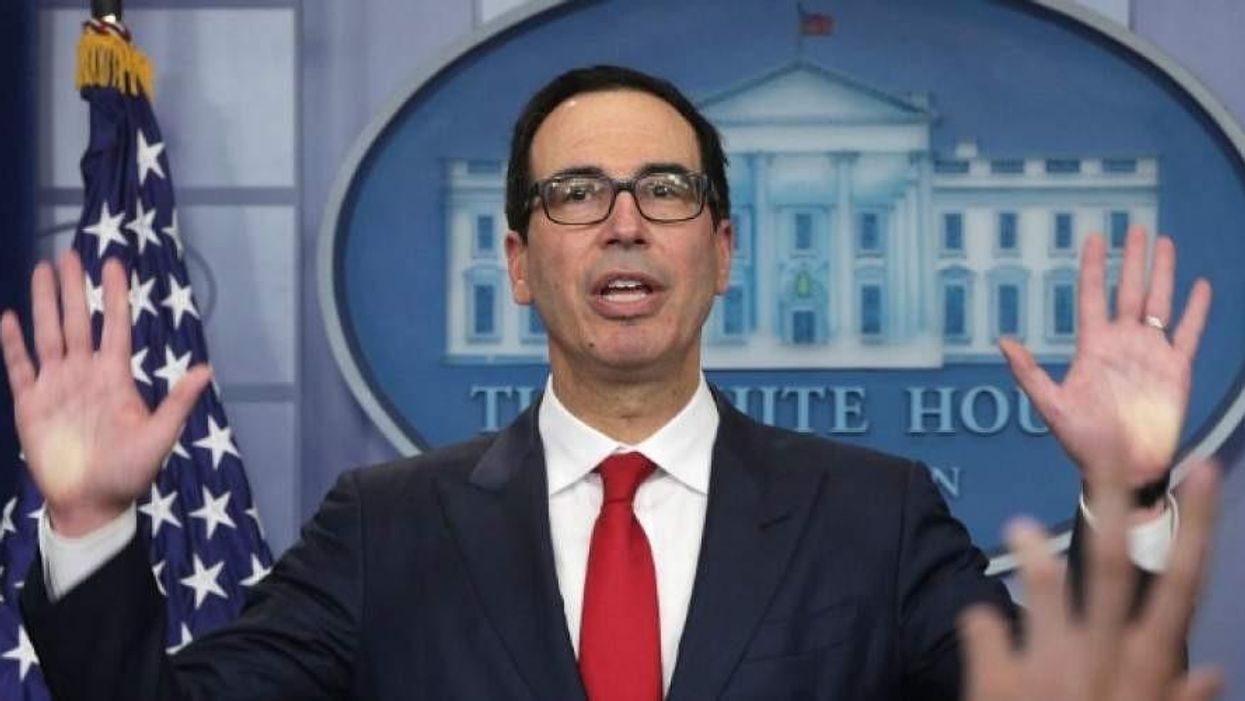
The following is an adapted excerpt from the new book Fat Cat: The Steve Mnuchin Story by Rebecca Burns and David Dayen (Strong Arm Press, 2018), available for purchase from Amazon and IndieBound:
In February, two months after the Trump administration pulled off one of the biggest wealth transfers in U.S. history, Treasury Secretary Steve Mnuchin gave a public lecture on economic policy at UCLA. To his apparent surprise, it did not go well.
Mnuchin was a key architect of the GOP's $1.5 trillion tax cuts, passed last December, which over the next decade will funnel 83 percent of its benefits to the top 1 percent of U.S. earners--including to himself. With a net worth of half a billion dollars, Mnuchin and his wife are in the top one-one hundredth of one percent.
Arriving on UCLA's leafy campus, he was greeted by student protesters who had dressed as Marie Antoinette and were serving cake to passersby. It was a nice touch, but the dramatization was hardly necessary: Mnuchin's own performance quickly betrayed him as a man as aggressively out of touch with his audience as an 18th-century monarch staring down starving peasants.
Introduced as a man who is "a financier in his DNA"--a reference to his Goldman Sachs pedigree--Mnuchin looked taken aback when his arrival on stage drew hisses from the audience. "This is a new experience for me," he said petulantly. "I usually go speak to people who want to listen to me speak."
Nonetheless, Mnuchin pressed on with his standard talking points about tax reform. After years of stagnant wages, he proclaimed, more than 4.5 million workers were finally getting a boost this year thanks to the Tax Cuts and Jobs Act. Not an actual raise, mind you, but the one-time bonuses that Republicans have been touting relentlessly since the bill's passage. Never mind that the handful of $1,000 checks given out by large companies amount to a fraction of their tax cuts savings, or that most workers at the bottom of the bracket will pay more in taxes by 2027, regardless of whether they ever get a raise. Let them eat one-time bonuses.
The audience continued their subdued heckling and, after about five minutes, Mnuchin began to unravel. "Who hissed?" he snapped awkwardly.
"Can I at least get a hand on who hissed on that one?"
"If you were getting paychecks in February, when your withholdings went down, you wouldn't be hissing."
About seven minutes in, the peasants began revolting. One person screamed that the tax bill was "the politics of cruelty" and was carried out by security. Matters grew even worse when Mnuchin's interlocutor for the conversation, Marketplace's Kai Ryssdal, took a shot at the aforementioned bonuses, asking, "What would you rather have? Would you rather have a one-time bonus or a consistent wage increase over the next couple of years?" Mnuchin accused the public radio host of bias. "For people who are getting these thousand-dollar bonuses, these are not crumbs," the multi-millionaire protested.
All of this culminated in a comically preventable PR disaster for Mnuchin: he tried to block UCLA from releasing video of the event. Of course, this had the opposite effect of ensuring that the otherwise low-profile incident remained in the news cycle for weeks.
All of this culminated in a comically preventable PR disaster for Mnuchin: he tried to block UCLA from releasing video of the event. Of course, this had the opposite effect of ensuring that the otherwise low-profile incident remained in the news cycle for weeks. After several news organizations filed public-records requests, the university posted the video nearly three weeks later, saying that it had received Mnuchin's consent. The massive, unforced error seems to have been caused only by the treasury secretary's vanity.
One might expect that a man who posed, smirking, with a sheet of newly minted $1 bills--and delighted at the inevitable comparison to a James Bond villain--might be more prepared to own his overwhelming unpopularity. But this isn't the first time that Mnuchin has shrunk from the spotlight turned on him through his own immiserating policies.
As chairman of OneWest Bank, Mnuchin began having his address scrubbed from the internet after anti-foreclosure protesters marched on his 9-bedroom, 10-bathroom Bel-Air mansion in 2011.
"Without the ... large LAPD presence on scene, I do not think the protest would have been as placid as it was," Mnuchin pled in a 2014 divorce filing in which he asked the judge to keep his address private. "I can only imagine the psychological harm that would have come to our minor children if they were at the house to see over 100 people protesting at their home."
Never mind that the victims of OneWest's operation included seniors reportedly foreclosed on over $0.27, and a family with young twin sons evicted abruptly while still in the process of applying for a loan modification. Won't someone please think of the children?
Stories like these earned Mnuchin, who ran OneWest from 2009 to 2015, the nickname "Foreclosure King." This apparently wounded him: During his confirmation hearings, he complained to senators that he has "been maligned as taking advantage of others' hardships in order to earn a buck. Nothing could be further from the truth."
This kind of self-righteous indignation might be no more than a bit of political theater on the part of someone used to getting his hands dirty. But it's equally possible that over the course of a preternaturally fortunate career, built through no discernable virtue of his own, Steven Terner Mnuchin has grown an extraordinarily thin skin.
Born into Wall Street royalty, Mnuchin ascended easily from a job in the mortgage department of Goldman Sachs into the brave new early-aughts world of hedge funds. There, he assembled a consortium of investors to buy a bank that was imploding (thanks to the type of financial products he peddled for years at Goldman) and proceeded to run that bank abominably for a few years before selling it to a bigger bank at enormous profit. A series of train wrecks, in other words, from which he has always managed to jump clear.
That trajectory inspired one of Senator Elizabeth Warren's better quips. "Steve Mnuchin is the Forrest Gump of the financial crisis," she said in a statement after his appointment was announced in November 2016.
Indeed, like the Best Picture-winning tale of Tom Hanks' humble everyman, Mnuchin's story has a compelling sense of continuity to it. The 1994 film starts and ends with the image of a white feather floating through the air; Mnuchin got his own, slightly less whimsical, recurrence when the same protesters who marched on his Bel-Air mansion in 2011 returned on a bleak January day in 2017, the day before his confirmation hearings, carrying signs that read "Stop Trump's Foreclosure King."
They were led by Rose Gudiel, a homecare worker who fought a years-long battle with OneWest to save the Los Angeles home where she lives with her parents, husband and young daughter. The trouble began in 2009, when the family missed a mortgage payment following the devastating murder of Gudiel's brother. Two weeks later, the family got the money together and attempted to send in the payment, but OneWest refused to accept it and started the foreclosure process. The bank relented only after the 2011 protest at Mnuchin's house.
"Mnuchin doesn't care about ordinary people," Gudiel told the rain-soaked crowd six years later.
Mnuchin doesn't appear to understand just how many ordinary people revile him and the ongoing economic ruin he represents in their lives.
What's more, Mnuchin doesn't appear to understand just how many ordinary people revile him and the ongoing economic ruin he represents in their lives. In comparison to some of the career white supremacists on the Trump team, the confirmation of "hedge fund guys" like Mnuchin was welcomed in some quarters as a moderating force: He's been described in our papers of record as "pragmatic" and "non-ideological." It's possible, given the treasury secretary's shock at his cold reception at UCLA, that even he believes himself to be a clear-eyed technocrat rather than a Wall Street ideologue.
But the intense condemnation from people like Gudiel, or Los Angeles county health worker Robert Strong, who left a bag of horse manure on the secretary's doorstep on Christmas Eve with the note "We're returning the 'gift' of the Christmas tax bill... Warmest wishes, The American people," suggests that most of us understand exactly which side Mnuchin is on--even if he himself does not.
The King of Foreclosures
Mnuchin's biggest coup, and the start of his reign as foreclosure king, came in 2009. In a generous deal with the FDIC, Mnuchin led an investment team that bought the predatory lender IndyMac, saddled with tens of thousands of failing mortgages, for $1.65 billion. The FDIC had a standard deal for buyers of crisis-era banks; they would cover all losses above the first 20 percent on loan defaults.
Mnuchin, who became CEO and later chairman, treated this as a money-printing machine: his bank, renamed OneWest, could foreclose on homeowners, harvest fees for appraisals and inspections and late payments, and get protected by a federal backstop.
Mnuchin, who became CEO and later chairman, treated this as a money-printing machine: his bank, renamed OneWest, could foreclose on homeowners, harvest fees for appraisals and inspections and late payments, and get protected by a federal backstop.
The FDIC lost at least $13 billion on IndyMac; the bank made $3 billion in profits in the five years after it was purchased by Mnuchin and company, much of that coming directly from the FDIC in loss-sharing costs. In 2014, CIT Group announced an agreement to acquire OneWest Bank for $3.4 billion. For six years of ownership, Mnuchin's personal payout was a reported $10.9 million.
According to a Wall Street Journal analysis, Mnuchin's predatory lender OneWest Bank started foreclosure proceedings on some 137,000 homes nationwide between early 2009 and the middle of 2015.
Some of the worst foreclosure horror stories involve OneWest's involvement with reverse mortgages, a product marketed to an especially vulnerable group--elderly individuals and couples on fixed incomes.
A 103-year-old, Myrtle Lewis, slipped into foreclosure after a one-month lapse in her homeowner's insurance coverage. A 92-year-old widow from Florida was evicted by Financial Freedom, OneWest's reverse mortgage arm, over a 27-cent underpayment.
Sandra Jolley, a whistleblower who eventually filed a complaint against Financial Freedom, first fought the company over a reverse mortgage sold to her parents in 2005.
At the time, Jolley's father was dying from terminal cancer and heavily medicated for pain; her mother was in the throes of Alzheimer's disease. A long-term care salesman "knew exactly what he was looking at," according to Jolley, and pushed the couple into a reverse mortgage. She says it was "the last thing they needed." Interest from an investment portfolio covered their bills, and their mortgage was almost paid off. In the meantime, the couple had built up more than $400,000 of equity in the house in Thousand Oaks, California, where they had lived for 35 years.
Through the 2005 reverse mortgage, Financial Freedom paid Jolley's parents a lump sum of $80,000--a loan that came due, with fees and interest, when her father died later the same year. Jolley had moved back in with her parents as a caregiver, but did not learn of the loan until after her father's death. That started a protracted legal battle to hang on to the house.
After connecting with other consumers, Jolley went on to document more than a dozen ways that Financial Freedom had allegedly violated federal and state regulations, including refusing to allow heirs to repay the loan balance, backdating documents, force placing insurance, and illegally accelerating foreclosure and auction following the death of a borrower.
Jolley says that Financial Freedom repeatedly dodged her attempts to communicate with them and repay the loan. Finally, she says the company sold the house at auction, giving her just two days' notice. The buyer was Colony America--a single-family rental company owned by another member of Trump's inner circle, Tom Barrack. After a year of paying rent on the house her parents used to own, Jolley decided to cut her losses and move away. Her mother died in 2011.
The reverse mortgage "completely destroyed our family," says Jolley. "I didn't have time to grieve my father for six years." A years-long legal battle against Financial Freedom cost nearly $100,000, and "trapped my mother in a two-story house that was unsafe for her, with me as her full-time caregiver, because we couldn't access the equity in our home."
But through her ordeal, Jolley began documenting the depths of abuses in the reverse mortgage industry. She set up a website where reverse mortgage borrowers and their families could contact her and offered them free consultation, often helping others succeed where she had failed. Last year, Jolley launched her own organization, Consumer Advocates Against Reverse Mortgage Abuse, to advocate for improved regulations.
"I learned that Financial Freedom was the absolute worst lender and servicer," says Jolley. "They would sell these things to anyone with a beating heart. And when Mnuchin took over, their aggression only got worse."
"I learned that Financial Freedom was the absolute worst lender and servicer," says Jolley. "They would sell these things to anyone with a beating heart. And when Mnuchin took over, their aggression only got worse."
In 2014, CIT Group announced an agreement to acquire OneWest Bank for $3.4 billion. For six years of ownership, Mnuchin's personal payout was a reported $10.9 million.
The 2015 merger of OneWest with CIT, which Mnuchin helped engineer, put the combined institution over a key regulatory threshold of $50 billion in assets, requiring bank officials to clear the unusual hurdle of public hearings staged by the OCC.
Armed with data on OneWest's foreclosure and banking practices, advocacy groups like the California Reinvestment Coalition (CRC) turned a typically dry, procedural hearing into an indictment of the bank's record. Sandra Jolley and other reverse mortgage victims were among those who testified against the merger, citing OneWest's ownership of sleazy reverse mortgage company Financial Freedom.
"It was probably the largest protest of a bank merger in U.S. history," says CRC's deputy director, Kevin Stein.
Community groups also charged that the bank was failing in its obligations to communities of color--both by locating its branches overwhelmingly in white neighborhoods, and by putting forward a woefully inadequate plan to increase lending in low- and moderate-income neighborhoods. One of the factors regulators must consider when banks merge is whether the institutions are meeting the requirements of the Community Reinvestment Act (CRA), a federal law passed in 1977 in response to the history of redlining in black and Latino communities.
As part of its application, OneWest had outlined a plan for $5 billion of lending in low- and moderate-income neighborhoods over four years. CRC Executive Director Paulina Gonzalez charged during the hearings that the effect of the public subsidies the bank had received from the FDIC and TARP funds "dwarfs the measly CRA plan offered by the bank and dwarfs the public benefit of this merger."
The merger went through regardless. In November 2016, CRC and Fair Housing Advocates of Northern California filed a fair housing complaint with the Department of Housing and Urban Development, alleging that OneWest Bank had engaged in discriminatory lending. According to data submitted by OneWest to federal regulators, black and Latino borrowers were significantly underrepresented in the bank's lending. In 2015, for example, just 8.4 percent of OneWest's mortgage loans in Southern California went to Latino borrowers, even though they comprised 22.4 percent of borrowers across the industry and 43 percent of the area's population.
While new loans were few and far between, the majority of OneWest's foreclosures in Southern California took place in neighborhoods of color. "The foreclosure to loan ratio in these neighborhoods was 9:1," notes Stein. The coalition's redlining complaint is still pending with HUD.
Regulatory Meltdown
Mnuchin's special blend of incompetence and ill intent leaves the field wide open for rampant Wall Street deregulation. In an April report, the agency boasted that it had already reduced its regulatory agenda by nearly 100 regulations. As with most reports that Mnuchin has had a hand in, the math here is a little unclear. But there are several areas where Treasury or related bodies have already pulled off some dramatic slash-and-burn.
In an April report, the agency boasted that it had already reduced its regulatory agenda by nearly 100 regulations.
Take the Financial Stability Oversight Council (FSOC), a 10-member body created by Dodd-Frank to identify and constrain risk in the financial system. Although Treasury only has one vote, the secretary chairs FSOC and tends to have outsized sway. In that capacity, Treasury has pushed successfully to change the designation criteria for "systemically important financial institutions" that are subject to enhanced supervision. The process began with a vote to de-designate AIG, freeing the insurance giant from stricter prudential standards a decade after the Fed rescued it from bankruptcy.
"The original test for designation was, 'if a bank got in trouble, would it create a threat to the financial system?'" says Marcus Stanley, policy director for Americans for Financial Reform. "They've changed that to, 'do we think it is likely to get in trouble?' even though the whole point was to regulate banks before they're about to fail."
The Community Reinvestment Act is also in the crosshairs of Mnuchin's Treasury. After months of alluding to plans to "modernize" the CRA, in April Treasury released a report proposing sweeping changes to its implementation. Among other suggestions, Treasury wishes to expand the "universe of CRA-eligible activities" and increase the "clarity and flexibility" of CRA examinations, even though banks almost always receive passing grades from regulators as it is.
The Office of the Comptroller of the Currency (OCC), an independent bureau within Treasury that charters, regulates, and supervises all national banks, is now taking the lead on rewriting CRA rules, based on Treasury's guidance. Though Trump's other banking regulators have blanched at undermining regulations to ensure low-income communities aren't left behind by the financial system, the OCC under its new head Joseph Otting is thundering ahead on its own.
Who is Joseph Otting? His previous experience includes--wait for it--helming OneWest bank during its 2015 merger. This put both OneWest CEOs in its short history, prior to being swallowed up by CIT, in key regulatory positions in the government.
A career banker without an advanced degree or any previous government experience, Otting has made no bones about where his sympathies lie. "I like bankers," was his opening line in an April speech before the Independent Community Bankers of America. In what's now standard nomenclature for Trump regulators, Otting went on to describe banks as his "customers," and his own job as improving "responsiveness" to them. That responsiveness was on full display when, in the wake of the Wells Fargo fake account scandal, Otting's OCC investigated sales practices at major banks and found over 250 separate problems that needed fixing, including several banks opening accounts in their customers' names without consent. But OCC refused to make these findings public, instead asking politely that the banks please refrain from lawbreaking if they can help it.
The Office of the Comptroller of the Currency has broad leeway to make far-reaching deregulatory changes. In August 2017, the OCC announced that it was beginning the process of reforming the Volcker rule, another Dodd-Frank regulation that aims to prevent banks that accept taxpayer-insured deposits from making risky market bets. According to Reuters, the changes being considered include shifting the burden of proof for compliance to regulators and narrowing the definition of which funds are considered risky.
This year, the OCC has also proposed amendments to the rules governing banks' leverage ratio, or how much debt they can assume relative to their capital. After lifting a longstanding prohibition on partnerships between national banks and payday lender ACE Cash Express, giving the chain a means to circumvent state-level interest rate caps, in May the OCC issued guidance essentially encouraging banks to start hawking their own payday loans. And in July, the OCC began accepting applications for so-called "fintech" firms--online lenders and other tech companies--to acquire national bank charters, which could immunize them from state consumer protection laws. The move came hours after Mnuchin's Treasury Department released a report recommending the action.
"It's my viewpoint that consumers should have more choices," said Otting in a press briefing.
All this is shaping up to be Mnuchin's next "Forrest Gump" moment. He and Otting are within arm's reach of unraveling the post-2008 rules that hemmed them in, albeit insufficiently, as bankers. But the assault on key regulatory cornerstones like the Community Reinvestment Act signals that they're preparing to go much further. All told, Mnuchin's Treasury could easily roll back the clock on not just years, but decades, of reforms.
This has been an adapted excerpt from the new book Fat Cat: The Steve Mnuchin Story by Rebecca Burns and David Dayen (Strong Arm Press, 2018), available for purchase from Amazon and IndieBound.
This article was produced by Economy for All, a project of the Independent Media Institute.
If the Department of Housing and Urban Development (HUD) and the Department of Justice (DOJ) have any documents related to the "pernicious, discriminatory practices" conducted while Donald Trump's pick for treasury secretary, Steven Mnuchin, was at the helm of the notorious OneWest bank, they must release them immediately.
So urged Rep. Maxine Waters (D. Calif.), the ranking member on the House Financial Services Committee, in a letter (pdf) issued Friday, the same day she urged her colleagues in the U.S. Senate to reject Mnuchin's nomination, saying "it shocks the conscience" that Trump "would give the keys to the Treasury to a man whose bank engaged in massive fraud and profited off the backs of Americans that his company threw out on the street."
HUD and the DOJ, she wrote, must "do everything in [their] power to ensure that justice is served for those homeowners that fell victim to the illegal activities of OneWest."
That bank, "which Mnuchin and a group of investors bought from the carcass of IndyMac in 2009 for pennies on the dollar before flipping it for millions in 2015, has been charitably referred to as a 'foreclosure machine,'" as Bess Levin writes at Vanity Fair. As journalist David Dayen has pointed out,
Even among the many bad actors in the national foreclosure crisis, OneWest stood out. It routinely jumped to foreclosure rather than pursue options to keep borrowers in their homes; used fabricated and "robo-signed" documents to secure the evictions; and had a particular talent for dispossessing the homes of senior citizens and people of color.
Criticism over his role at the bank has dogged Mnuchin since his nomination, with Sen. Elizabeth Warren (D-Mass.) declaring him "the Forrest Gump of the financial crisis--he managed to participate in all the worst practices on Wall Street." Her colleague Sherrod Brown (D-Ohio) last month wrote to the "foreclosure king," demanding his make clear how his Wall Street background as well as his time at OneWest will influence his views and actions. And just last week, in revelations that further "paint a damning picture of Mnuchin's time as CEO" of OneWest, The Intercept dug up a 2013 document that pointed to the bank's having hamstrung an investigation into its practices, engaged in "widespread misconduct," and displayed a "blatant disregard for the law."
Waters' letter points to such practices, as well as to a complaint filed with HUD in November by two nonprofits--the California Reinvestment Coalition (CRC) and Fair Housing Advocates of Northern California--calling for an investigation into what they charge are ongoing violations of the Fair Housing Act (FHA) by OneWest.
"I have grave concerns about the ability of the incoming administration to take unbiased action towards one of its own cabinet members, and I urge you to do everything in your power to ensure that justice is served for those homeowners that fell victim to the illegal activities of OneWest," she wrote.
She added: "Mr. Mnuchin profited from his role at Goldman Sachs, helping to push the kinds of risky mortgage products that ultimately crashed the housing market and our economy. He then went on to profit from his role at OneWest, pushing families out of their homes without proper due process despite the fact that they were struggling as a direct result of the crisis and the risky mortgage products that he himself had helped bring about. He should not now be allowed off the hook only because he is poised to be in a position wherein a sympathetic new administration fails to properly investigate his actions. The homeowners that were unfairly pushed out of their homes deserve better than that, and I urge you to fight for them until your very last day in office."
CRC also last week said The Intercept findings should spark the Senate Finance Committee to carry out an investigation into Mnuchin and demand the previously obstructed documents.
Paulina Gonzalez, executive director of CRC, stated: "Voting on Mr. Mnuchin before a full airing of the facts would send a troubling message to taxpayers who bailed out the banks, to families who may have been harmed by these practices, and is a dangerous signal to other bank executives that flagrant violations of state laws are not only to be expected, but could earn you a cabinet level position."
A confirmation hearing for Mnuchin has not yet been scheduled.
Donald Trump has reportedly picked his presidential campaign's finance chairman to be the next U.S. Secretary of the Treasury. Steve Mnuchin is a Wall Street insider, a 17-year-veteran of Goldman Sachs, and currently the head of the hedge fund Dune Capital Management.
The Financial Services Roundtable, a Wall Street lobby group, was quick to praise Trump's choice. "Steve is a seasoned and results-oriented leader who is really smart, interested in public policy, and understands the urgent need to boost economic growth and opportunity," the group's leader, Tim Pawlenty, said in a statement.
Mnuchin may be a leader who gets results, but they are not exactly the results we need if we're to reverse extreme inequality.
Alys Cohen, an attorney with the National Consumer Law Center, responded to Trump's choice by pointing out that Mnuchin "has a track record of profiting by foreclosing on older homeowners and homeowners in communities of color."
Hedge Clippers, a campaign to reduce the undue political influence of private investment fund managers, documented this disturbing part of Mnuchin's past in a report released prior to the election. A major focus is Dune Capital's ownership of OneWest Bank, one of the major villains in California's foreclosure crisis. Mnuchin served as the bank's chair from 2009 to 2015. During this period, OneWest foreclosed on more than 36,000 families. According to the California Reinvestment Coalition, 68 percent of these foreclosures occurred in zip codes with a majority non-white population and 35 percent were in zip codes where the non-white population was more than 75 percent of the total population.
According to the Hedge Clippers report, OneWest was also notorious for engaging in predatory practices, including robo-signing of loan agreements and pushing reverse mortgages on older Americans.
The coalition Americans for Financial Reform is ringing alarm bells about a bill the House of Representatives is expected to consider any day now that would further enrich Mnuchin. In a letter to members of Congress, AFR charged that H.R. 6392, the "Systemic Risk Designation Improvement Act of 2016," would increase the likelihood of bank failures by loosening financial regulations on financial institutions that have assets of more than $50 billion but are not among the eight largest U.S. banks.
One bank that happens to fit into that category is CIT. The bank topped the $50 billion threshold only recently after purchasing another bank -- Mnuchin's infamous OneWest. The expected Treasury nominee, who could soon be in a position to make major decisions regarding banking regulation, sits on CIT's board of directors.
Say goodbye to the candidate who promised to fix a rigged system.
At the Center on Budget and Policy Priorities, Chuck Marr was quick to rebut a statement by Mnuchin on CNBC this morning regarding tax policy, which also comes under the purview of the Treasury Secretary. In response to concerns about Trump's proposals to slash taxes on the wealthy, Mnuchin claimed on air that these cuts would be offset by new restrictions on deductions. Marr pointed out that this assertion "is completely at odds with the tax plan that Trump announced during the campaign." While Trump is in favor of some limits on itemized deductions for high-income taxpayers (to $100,000 for individuals, $200,000 for joint filers), Marr says his proposed tax cuts would far outweigh these limits.
Frank Clemente, head of the coalition Americans for Tax Fairness, piled on to say that Mnuchin is simply the wrong choice for Treasury. "Strong proactive leadership in the Treasury Department is necessary to challenge wealthy special interests that seek to preserve or expand tax loopholes and subsidies," Clemente said. "The Treasury secretary must stand for a fairer, more inclusive economy, not one that only works for those already at the top. Steven Mnuchin's history indicates he will do the opposite."
In his response to Trump's choice, Public Citizen President Robert Weissman zeroed in on the president-elect's hypocrisy. Just this past August, Weissman pointed out, Trump declared that "We can't fix a rigged system by relying on the people who rigged it in the first place."
By tapping Mnuchin for Treasury, Weissman says it's obvious that we've been had. "Say goodbye to the candidate who promised to fix a rigged economic and political system. And say hello to the incoming president intent on turning over the machinery of government to the corporate elite against whom he railed just a few short months ago."
A new attack ad put out by the Hillary Clinton campaign this week achieves the near-impossible, making Donald Trump look wronged and (almost) like a victim. More believably, it makes the Democrats look sleazy and disingenuous in comparison.
The ad begins with a picture of a grinning Trump and the words, "In 2006, Donald Trump was hoping for a real estate crash."
It proceeds to a series of grim scenes from the financial crisis. Against a Roger and Me-esque montage of blighted neighborhoods, it reads off stats: "9 million Americans lost their jobs. 5 million people lost their homes."
Then it returns to a grinning Trump, and another line:
"And the man who could be our next president...
was rooting for it to happen."
Then we hear Trump talking about how a bursting of the real-estate bubble would be an opportunity for rich folks like himself.
"I sort of hope that happens, because then people like me would go in and buy," Trump says, in an interview from 2006. "If there is a bubble burst, as they call it, you know, you could make a lot of money."
Cut to: "If Donald wins, you lose."
This ad is disingenuous in a dozen different ways. For one thing, the destruction that the Clinton campaign describes was not caused by people swooping in after the bubble burst, buying at the bottom of the market.
It was caused by the existence of a speculative bubble in the first place. And that bubble was inflated not by Donald Trump, but by the people who have at least in part bankrolled Hillary Clinton's career: namely, Wall Street banks.
In the mid-2000s, a speculative mania swallowed up the real-estate markets largely because Wall Street discovered a new (and often criminally fraudulent) way to peddle mortgage securities.
The basic trick involved big banks buying up the risky home loans of subprime borrowers -- the loans of people who often lacked verified incomes and had poor credit histories -- and repackaging them as highly rated mortgage securities.
Basically they took risky loans and presented them as somewhat safer investments to a range of investors, all of whom later got clobbered: pension funds, hedge funds, unions, even Fannie Mae and Freddie Mac.
This technique, of turning rancid home loans into a kind of financial hamburger and then selling it off as grade-A beef to institutional investors, created artificial demand in the real-estate markets, which in turn led to the speculative mania.
The bubble stayed inflated for a few years because a continual influx of new investors kept the old investors from losing their shirts for a while. The layman's term for this is a Ponzi scheme.
So when Donald Trump in 2006 says, "If there is a bubble burst, you could make a lot of money," he might sound crass, but he wasn't wrong. That bubble was always going to burst. Those investors who got creamed were always going to get creamed.
And the fault was with the people who drove this speculative craze by knowingly peddling bad merchandise and continually driving the markets upward. Think, for example, of Citigroup, which was selling huge masses of mortgage securities even as its traders were saying things to each other like, "We should start praying... I would not be surprised if half of these loans went down."
We know the names of many of these companies because many of them have agreed to pay huge settlements for their involvement in selling mismarked mortgage securities.
Four of them -- the aforementioned Citigroup, along with Goldman Sachs, Morgan Stanley, and JP Morgan Chase -- are among Hillary Clinton's top six contributors for her career.
The new Clinton ad references people in foreclosure -- it even shows a big, scary foreclosure sign. Many of the same banks also agreed to massive settlements for, among other things, using fraudulent documents to kick people out of their houses. Major Clinton donors Citigroup and JP Morgan Chase were signatories to the original $25 billion foreclosure settlement, for instance.
As for the whole issue of "rooting" for a crash so as to make money off the misery of others, what Donald Trump was talking about -- and it's galling to the point of being physically painful to have to defend him here -- may sound scummy, but was neither illegal nor even unethical, unless you want to call this kind of capitalism unethical (which some might).
Trump wasn't rooting for an avoidable disaster, like a 9/11. With this bubble, the disaster had already happened. The properties were already overvalued. Trump or not, that pain was coming.
Taking advantage of market inefficiencies is what investors are supposed to do, a la the traders in The Big Short who spotted the corruption in the real-estate markets early and bet accordingly. Personally I doubt Trump was smart enough to bet so much as a penny out of his alleged billions on the market collapsing, but if he did, it wouldn't have been unethical, just cold.
The same can't be said for Goldman Sachs, the company famous for paying Hillary Clinton $675,000 for three speeches.
In the spring of 2011, the Senate Permanent Subcommittee on Investigations, led by Michigan's Carl Levin, released a giant report about the way Goldman profited from the crash by shorting the market even as it was advising clients in the opposite direction.
This report detailed how in 2006, the same year that Donald Trump was talking out loud about the bubble bursting, Goldman found itself stuck with what amounted to a $6 billion bet on the housing market.
But at the end of the year the firm analyzed its position, saw the coming trouble, and realized it needed a change in strategy. Goldman's leaders, including CEO Lloyd Blankfein (seen here warmly embracing Hillary Clinton) and CFO David Viniar, decided that they needed to unload as many of their mortgage holdings as possible.
One particular quote the Senate investigators dug up stands out. In late December of 2006, Viniar wrote an email to his chief mortgage officer (emphasis mine):
"Let's be aggressive distributing things," he said, "because there will be very good opportunities as the markets [go] into what is likely to be even greater distress, and we want to be in a position to take advantage of them."
This, coming from the chief financial officer of a firm that has been among Hillary Clinton's top donors, is exactly what Donald Trump said.
The difference was, Donald Trump was just talking about making money for himself. Goldman executives were talking about making money at their own clients' expense.
Two months after that Viniar memo, in February of 2007, Blankfein wrote an email of his own.
"Could/should we have cleaned up these books before," Blankfein wrote, "and are we doing enough right now to sell off cats and dogs in other books throughout the division?"
By "cats and dogs," Blankfein meant the toxic mortgage holdings he wanted off his company's books. How did they get rid of them? They sold them off to customers.
In one particular deal, called Hudson, Goldman unloaded $1.2 billion worth of "cats and dogs." They neglected to tell the client that these came from their own inventory, saying instead that the holdings were "sourced from the street."
By the spring of 2007, Goldman executives were in a panic about the likely meltdown of the real-estate markets. In May, a senior exec gave a presentation saying, "There is real meltdown potential."
The execs scanned the earth for suckers willing to buy up their doomed products. They found a hedge fund in Australia willing to buy a $100 million mortgage-based deal called Timberwolf, promising returns as high as 60 percent while privately laughing about finding the ultimate sucker.
"I found a white elephant, flying pig and unicorn all at once," clucked one of the bank's sales reps. A few days later, after the deal was off their books, another Goldman exec famously trumpeted, "Boy, that Timberwolf was one shitty deal."
I spent most of the last eight years poring through disgusting stories like this, reporting on the dreary question of what caused the 2008 crash. All of that work was done before Hillary Clinton announced she would run for president. This isn't about Hillary Clinton for me. It's about the continuing influence of these companies.
These firms have mostly avoided blame for the crisis, partly because this subject is complicated, but also because mainstream politicians from both parties have refused to point a finger at them. For that, Hillary Clinton probably is at fault now, contributing to a failure among major-party politicians to be straight with the public that dates back to the first days of the crisis.
It's bad strategy. Trump is a lunatic, but he's gaining strength because his supporters believe his story about being so rich that he's free to tell it like it is. They equally believe his windy diatribes about Beltway pols like Jeb Bush and Hillary being compromised by the great gobs of money they take from corporate donors.
By blaming Trump for a problem caused by their own political patrons, Hillary and the Democrats are walking face-first into Trump's rhetorical buzz-saw. Couldn't they find something else to hit him with?
Sen. Elizabeth Warren (D-Mass.) on Wednesday took part in a Washington, D.C. rally to urge the U.S. Department of Housing and Urban Development (HUD) and the Federal Housing Finance Agency (FHFA) to quit selling home loans to hedge funds and private financial firms.
Warren joined Rep. Michael Capuano (D-Mass.) and a group of community activists at the Lutheran Church of the Reformation on Capitol Hill to protest predatory lending schemes that allow financiers to foreclose on struggling borrowers without first modifying loan terms. Warren blasted HUD and the FHFA for their role in the crisis and called on the government to make it easier for nonprofit housing groups to buy distressed mortgages at auction.
"HUD and FHFA have been lining up with the Wall Street speculators," Warren said in a speech before the march. "This should surprise absolutely nobody.... Wall Street is interested in profits, not in working out a way for people to stay in their homes."
"These Wall Street investors made money by crashing the economy, got bailed out and now they're back to feed at the trough again, scooping up these loans at rock-bottom prices so that they profit off them a second time--and it is up to us to stop that!" Warren said to a cheering crowd.
"We need to get something straight: These federal agencies don't work for Wall Street. They work for the American people," she continued. "HUD and FHFA could make these changes right now if they just had the courage to stand up for families instead of bowing to Wall Street."
Following Warren's speech, the activists--many dressed in orange T-shirts that read, "Communities for Change"--marched to protest outside FHFA headquarters, where they reportedly met with agency chief Mel Watt and HUD officials.
Speaking to Warren's credibility on Capitol Hill, Dana Milbank, a Washington Post columnist who attended the rally, writes:
Given Warren's record, Watt has reason for concern. After my Post colleagues Tom Hamburger, James Hohmann and Elise Viebeck reported Tuesday on letters Warren sent to Brookings [Institution] protesting research by Robert Litan that was both corporate-backed and corporate-friendly, Brookings forced Litan to resign.
According to Edward Golding, HUD's principal deputy assistant secretary, the meeting between activists and HUD officials included discussions over how federal agencies could "make better use of one of its tools, the Distressed Asset Stabilization Program (DASP), to further the Department's goal of stabilizing communities and assisting them as they, and their public-minded partners, work to address severely distressed mortgages that are on the verge of foreclosure."
Unlike so many industrial innovations, the revolving door was not developed in Detroit. It took its first spin in Philadelphia in 1888, the brainchild of Theophilus Van Kannel, the soon-to-be founder of the Van Kannel Revolving Door Company. Its purpose was twofold: to better insulate buildings from the cold and to allow greater numbers of people easier entry at any given time.
On March 31st at the Wayne Country Treasurer's Office, that Victorian-era invention was accomplishing neither objective. Then again, no door in the history of architecture -- rotating or otherwise -- could have accommodated the latest perversity Detroit officials were inflicting on city residents: the potential eviction of tens of thousands, possibly as many as 100,000 people, all at precisely the same time.
Little wonder that it seemed as if everyone was getting stuck in the rotating doors of that Wayne County office building on the last day residents could pay their past-due property taxes or enter a payment plan to do so. Those who didn't, the city warned, would lose their homes to tax foreclosure, the process by which a local government repossesses a house because of unpaid property taxes.
"Oh, my lord," exclaimed one bundled-up woman when she first spotted the river of people, their documents in envelopes and folders of every sort, pouring out of cars, hunched over walkers, driving electric scooters, being pushed in wheelchairs, or simply attempting to jam their way on foot into the building. The afternoon was gray and unseasonably cold. The following day, in the middle of a snowless meadow in the Sierra Nevada Mountains, the governor of California would announce the state's first-ever water restrictions as a result of an unprecedented, climate-change-influenced drought. Here in Michigan, city residents were facing another type of man-made disaster: possibly the largest single tax foreclosure in American history.
"It's the last day to pay," one woman heading toward the rotating glass chamber yelled to a pedestrian who had slowed to watch the commotion. Inside, a Wayne County Sheriff's Department officer-turned-traffic-controller boomed instructions to a snaking line of people. "When you get to the eighth floor, you will get a number. Keep that number! Then go to the fifth floor.'"
The eighth floor, however, turned out to be little more than another human traffic jam, a holding space for thousands of anxious homeowners who faced hours of waiting before reaching the desk of some overworked city representative down on five. Yet, as a post office delivery worker gaping at the fiasco told me, this was less hectic than it had been a only few days earlier, when the treasurer's office had rented out the Second Baptist Church across the street. There, people waited for the opportunity to enter the revolving doors to take the elevator to the eighth floor before heading for the fifth floor to... you get the gist.
In fact, the whole week had been a god-awful mess. A day earlier, rumors had it, a woman had passed out in the elevator between the eighth and fifth floors en route to "making arrangements," the euphemism for getting on a payment plan that might save your home.
"What happens if you can't pay?" a slender man asked me as we dodged a new wave of people surging through the glass cylinder.
"Then they sell your house at auction," I replied.
"For real?" he asked, amazed.
He was waiting for his sister to make those "arrangements." He didn't have to worry about all this, he explained, because ever since he'd lost his job, which had provided him with housing, he'd been staying in motels. The Victory Inn over in Dearborn and the Viking across from the Motor City casino were both reasonable enough places, he assured me, but the Royal Inn on Eight Mile was the cheapest of all -- $35 a night plus a $10 key deposit. That establishment's single enigmatic Yelp review read: "This is definitely someplace you want to go where totally normal things happen."
A Blueprint for Civic Hell
Detroit was once famous for creating the largest, most spectacular versions of whatever its residents set their minds to, be they assembly lines, record labels, or revolutionary workers' associations. The city is often credited with inventing and mass-producing the twentieth century, while its workers simultaneously took the lead in revolting against the injustices of the era. Its factories put the world on wheels and labor laws on the books. Its workers and thinkers sparked and fanned a number of this country's most influential resistance movements.
Detroit: every article about you should include a love letter, a thank-you note, a history lesson, for without you...
Few care to admit, however, that the city that was the arsenal of the twentieth century may also provide the blueprint for a more precarious era. Which brings us to those massive tax foreclosures of the present moment. Just over 60,000 homes, about half of them occupied, are slated for the auction block. As many as 100,000 of the city's residents -- about a seventh of the total number -- are now on track for what many are calling an eviction "conveyor belt."
Such an image easily springs to mind in this city whose auto factories were famous for their oh-so-efficient shop floors. These days, sadly enough, it's all-too-easy to imagine a twenty-first-century version of a classic Detroit assembly line dedicated to processing its own residents, workers, and retirees -- all the ones it claims to no longer need, all those too old, too young, too ill-trained, too inefficient for a post-bankruptcy city. These undesirables, it seems, are to be turned into so many economic refugees on a conveyor belt to nowhere. While everyone loves to hear about legendary industrial Detroit, no one wants to hear about its de-industrialized progeny, and especially not about foreclosures -- not again.
Mike Shane, a Detroit resident and organizer with the anti-foreclosure group Moratorium Now!, knows this better than anyone. "We call the press, and they say, give us anything but foreclosures," he tells me ruefully.
Connecting the Dots
On March 31st, some people did manage to make the necessary "arrangements" to save their homes. That included one woman with a Hillary Clinton-style hairdo who had lived on Winthrop Street since the 1960s, but like so many in the working-class sections of the city had fallen behind on her taxes. "They asked, 'Why didn't you pay your property taxes?'" she explained as she rested on one of the first-floor benches. "And I said, 'Because I had a heart attack.'"
Last year, she recalled, a neighbor's home fell into tax foreclosure. A man who lived on the same block noticed the familiar address on the auction list. He bought it back for her, she tells me. "He said to the woman, 'Pay me back when you can, if you can.'"
Detroit is full of similar stories, filled with a stubborn sense of hope. But there are so many more addresses on the foreclosure list than angelic neighbors. By early afternoon that March day, the building still bursting at its seams with thousands of people, the county office conceded its inability to cope and extended the foreclosure deadline another six weeks.
"I don't know if it's because they're so damn overwhelmed," wondered Mary Crenshaw, a sunken-eyed woman who was relieved by the announcement, as it gave her time to wait for a lump-sum retirement payout from British Airways, her former employer. She had come to save her family home in Highland Park, a small city enclosed by Detroit whose once occupied homes sported oak floors and beveled glass windows. Now, more than half of them are empty, lawns overgrown, windows boarded up, the former homeowners having already ridden earlier foreclosure conveyor belts out of the neighborhood.
After all, this current tax foreclosure crisis comes right on the heels of the city's last great displacement: the 2008 housing crash, which descended on Detroit like a tidal wave, sweeping nearly a quarter of a million people out of the city and leaving in its wake tens of thousands of vacant properties.
The fact that the city is now threatening to evict a seventh of its remaining inhabitants in a single year, all because of unpaid property taxes, seems like an absurd proposition until you begin to connect the dots: the mass water shutoffs, the shuttering of dozens of public schools, the neglect of fire hydrants in particular neighborhoods, and now this deluge of foreclosures.
Looking at the pattern that emerges, you can see that Detroit is not only a city in the midst of a "revival," as enterprising investors and the national media often claim. It's true that redevelopment is taking place in some neighborhoods, and city officials do claim that big changes are coming, often illustrating them with colorful documents that look like they were formatted by a team of graphic design wizards from the back of San Francisco's Google Bus.
But that's just one part of the Detroit story. For the city's low-income, black, and elderly residents, Detroit isn't a city on the rise, but one under siege.
An Emergency That Never Ends
On a blustery Saturday afternoon just two weeks before the day of the foreclosure deadline, an Emergency People's Assembly Against Tax Foreclosures was held at Old Christ Church to address this siege. It was one of a set of "people's assemblies" called to deal with the latest crisis in a city where, in recent years, crises have never been lacking. Before the tax foreclosure assemblies there had been the Emergency People's Assemblies Against Bank Foreclosures, the Emergency Pack-The-Court Actions to Defend Homeowners from Eviction, the Emergency Town Halls to Defend City Pensions & Services, the Emergency Meetings Against the Emergency Financial Manager, and so on.
"Emergency" had, in other words, been the word of the moment for years and years. That invasive sense of never-ending urgency could similarly be seen in the literature of such groups -- in the words always screamingly in capital letters, in the typographical equivalents of exclamation points. When I'd first heard about the most recent event, I was in a meeting with Mike Shane and I said to him, "Over the three years I've been visiting Detroit, I've never arrived at a time you weren't holding an Emergency People's Assembly the following Saturday."
Shane laughed on cue. "Well, yes, that's right," he replied. "We've been at this since about 2007."
The Old Christ Church that day was shiveringly cold. From the pew behind me came the sound of rustling coats as two children squirmed. Beside them sat their grandmother and grandfather, Lula and Daryl Burke, who had come to describe how their home had been sold at a tax foreclosure auction last year. With the help of the grassroots community group Detroit Eviction Defense, Lula explained, the Burkes had convinced the home's buyer to sell it back to the family.
A little bit of gumption on her part helped, too. As she recalled explaining to the investor who had bought her home at auction, he could try to sell the house to someone else. But before he did that, she planned to strip every last thing out of it. "It won't have a furnace, a toilet, doors, windows, all the way down to the light switch," she warned him.
On the wall behind the altar three white-robed angels were suspended in mid-frolic, oblivious to the current condition of their once regal city. In front of them stood anti-foreclosure lawyer Jerry Goldberg. "Are we going to allow 62,000 more foreclosures this year?" he thundered, his face growing redder. I later learned that, years ago, Goldberg had sold peanuts down at the old Tigers stadium (now a bulldozed parking lot) and his unrelenting voice had apparently made him very good at it.
"No!" he responded emphatically to his own question. "Are we going to allow them to make our neighborhoods into a bunch of ponds?"
Perhaps I should have led with this information: in some of the city's latest flashy Adobe InDesign-ed planning documents, certain of Detroit's more down-and-out neighborhoods have been transformed into ponds. Or, to be more precise, they have been turned into "water retention basins" that planners believe will offer the Detroit of the future superior management of storm water runoff.
Minutes earlier, Alice Jennings, one of the most celebrated social justice lawyers in the city, had explained that, according to Detroit's planning documents, those retention basins are slated to be built on top of now populated neighborhoods. In other words, ponds are also what we're talking about when we talk about Detroit's tax foreclosures.
"No!" Goldberg shouted yet again. "We need to stop these foreclosures with a moratorium, a halt! The idea that this can't be done is hogwash! The Supreme Court held in 1934 that, during a period of emergency, the people's need to survive supersedes any financial contract! The governor has a responsibility to declare a state of emergency!"
His sentences all ended in exclamation points, as his torrent of words resounded off the church's high ceilings. In an upside-down universe, Goldberg would have made a skilled auctioneer rather than a man desperate to save all those homes and their inhabitants.
To be clear, Goldberg isn't suggesting another of the emergency proclamations that Michigan's governors have used to impose unelected emergency managers on school districts and municipalities from Detroit to Muskegon Heights. Rather, he's calling for the governor to declare a state of emergency under Michigan law 10.31, which would allow him to "promulgate reasonable orders, rules, and regulations as he or she considers necessary to protect life and property" -- including, of course, halting the tax foreclosures. In 1933, similar actions allowed Michigan's legislature to pass the Mortgage Moratorium Act, later upheld by the Supreme Court, mandating a five-year halt on property foreclosures.
Winning that moratorium took, among other things, a well-organized national Communist Party, hundreds of worker councils, thousands of eviction blockades, and -- I'd be willing to bet, although I don't have the archival evidence -- an incredible number of "emergency meetings."
Woe to Those Who Plan Iniquities
By late afternoon, Goldberg was resting his vocal chords and about a dozen people from the audience were lining up to take the microphone, including Cheryl West, a tiny, gray-haired woman clutching a thick Bible to her stomach. When it was her turn to speak, she began: "I lost my home of 60 years." There was no trace of bitterness in her voice, just a touch of awe and disbelief. "It's been quite a journey. Quite a journey."
"Let me give you a little background," she continued. "My entire family is now deceased. My father was the first African American to teach music in Detroit, possibly in the entire state of Michigan. He worked for the school system. He lived in that very house. He lived there through the 1967 riots and we were right at the hub of where the riots started. My sister was a journalist, and during the riots she was one of the people getting the story out to the media, because she was working for UPI at the time. My sister was on the front page of the London Times, that's how far her news traveled of the city burning down around us."
Then, after a few more background comments on her life, she opened up her bible. "Since we're in a church," she said by way of explanation and began to read from the Book of Micah. She skipped its beginning.
"Woe to those who plan iniquity,
to those who plot evil on their beds!
At morning's light they carry it out
because it is in their power to do it.
They covet fields and seize them,
and houses, and take them.
They defraud people of their homes,
they rob them of their inheritance..."
Undoubtedly, she assumed that everyone in the church was already familiar with such "iniquities" and the biblical lines that went with them. After all, in the previous few years, they had lived through the 2008 foreclosure crisis, the imposition of an emergency manager on their city, mass water shutoffs, and significant pension cuts for retired city workers, not to speak of all the evils that had come before.
Instead, she read the verses she liked best, the ones that, as she said, God led her to just about the time she lost her home.
"You strip off the rich robe
from those who pass by without a care,
like men returning from battle.
You drive the women of my people
from their pleasant homes.
You take away my blessing
from their children forever."
She paused, then suddenly, in a surprisingly powerful voice, yelled the next line: "Get up! Go away!"
The church reverberated with her admonishment. And then, with a smile at her own audacity, she added, "The end."
Shortly afterwards, we filed out of the church. And yet it was not the end. It never is.
There is now, for instance, that new deadline -- May 12th -- for residents to get on a payment plan to avoid losing their homes to tax foreclosure. That offers more time for people to navigate the revolving doors of the Wayne County Treasurer's Office, head up to the eighth floor, then down to the fifth, all in an effort to fight their way off of the city's conveyor belt to nowhere. And, of course, it gives residents more time to host emergency people's assemblies aimed at throwing a monkey wrench -- once and for all -- into this assembly line of eviction and displacement.
Even if that happened, however, these gatherings, called for in all capital letters and exclamation points, undoubtedly wouldn't end. They've become as much a fixture of this city as the women and men who organize them, the churches that host them, and the neighborhoods whose survival may depend on them. After all, the worst injustice would not be whatever provokes the next emergency people's assembly, but the possibility of a future Detroit without such gatherings, one in which all these meetings and people are gone, all the stories have been suppressed. Imagine, then, the worst iniquity of all, the one so many are fighting against: a Detroit where once inhabited streets have been submerged in the silence of water retention ponds, where longtime residents have been scattered and displaced by the foreclosure conveyor belt and no one left in the city knows the history of what's been drowned.
As the holidays recede and millions of Americans look ahead to a year of slashed federal food aid and discontinued unemployment benefits, Wall Street bankers are preparing for a $92 billion windfall in end-of-the-year bonuses.
In what is being described as a win/win for the much maligned banking industry, nearly 50,000 people are calling on those bankers to donate that cash to the ten million Americans made homeless by the housing crisis.
"That $91.44 Billion a year could go a very long way towards undoing the vast damage done by Wall Street's megabanks that have engaged in megafraud," reads an online petition, organized by Occupy Wall Street spinoff organization, The Other 98 Percent.
Roughly 1,500 signatures shy of their 50,000 goal, the petition is calling on employees of Chase, Citigroup, Wells Fargo, Goldman Sachs, Morgan Stanley and Bank of America to "help the folks that you Scrooged out of their homes and end the homelessness crisis you created."
According to analysts with compensation consulting firm Johnson Associates, in the first nine months of 2013, big wall street banks set aside $91.44 billion for bonuses with many in the banking sector seeing a rise of as much as 15 percent in their end of year compensation.
"This is from the industry that made ten million people homeless from the foreclosure crisis and also spent the majority of 2013 dodging criminal prosecutions for their many crimes," notes Alexis Goldstein, former wall street professional and current Occupy Wall Street activist.
"You know what Wall Street can do with that money instead of spending it on watches, gadgets and cars? The could help homeowners," she adds.
"Megabankers might not spend too much time outside of the financial district, but we do, and we know that bankers are unbelievably unpopular right now," the group writes. "It doesn't take a genius to know this is good PR - it's a win/win for the banks!"
They continue:
The National Affordable Housing Trust is a program that, if funded for $30 billion a year for 10 years, could END homelessness in America. The banks could pay for the first two years of funding with one year of bonuses alone! Meanwhile, public housing--y'know, the place that the foreclosed have largely been pushed into?--has needed $21 Billion in repairs for a long time. That means $10.44 Billion left over--more than enough bonuses for every Wall Street banker to take many, many, many trips to Disney World, or whatever Wall Street bankers spend their money on.
Wall Street employees are typically told in January how much their year-end bonus, which includes cash and stock awards, will be.
"Our enemies are innovative and resourceful, and so are we. They never stop thinking about new ways to harm our country and our people, and neither do we." - George W Bush
Much in the same way that US investors were "steered" into rip-off mortgage loans, the entire country has been "steered" into an economic crisis. The question is how to get out of it.
"Our enemies are innovative and resourceful, and so are we. They never stop thinking about new ways to harm our country and our people, and neither do we." - George W Bush
Much in the same way that US investors were "steered" into rip-off mortgage loans, the entire country has been "steered" into an economic crisis. The question is how to get out of it.
In the subprime loan scandal, unscrupulous brokers conned home buyers with poor credit histories into deals designed to profit lenders and bleed borrowers. Contract "teasers" hid ballooning monthly payments while a lack of regulation allowed the scam to continue unabated. Millions of more Americans now face losing their homes.
The Bush administration similarly used promises of cakewalks and increased security to con the US public into wars with Iraq and Afghanistan. US taxpayers have spent over $450 billion on Iraq alone, while Bush/Cheney cronies continue making a killing from military contracts. Meanwhile, global security has degenerated and over 4,100 US service members have died in Iraq and Afghanistan, along with an untold number of coalition troops, contractors and civilians.
Bush's military adventurism, not to mention his administration's exorbitant tax cuts for the wealthy, gutted the surplus of $128 billion Clinton handed him in 2001 into a deficit of well over $200 billion today. And Bush has simultaneously increased the national debt by over $3 trillion (to roughly $9 trillion), effectively nailing each and every US citizen with a bill for almost $30,000.
While heavy borrowing from Asia has mopped up some stateside red ink, there's an inherent threat: China, for example, has an estimated $900 billion in US bonds and can increasingly call the shots on the US economy and foreign policy.
Just weeks ago, Beijing warned that if the Bush administration pushed for a revaluation of the Chinese currency, then Beijing would sell dollars, thereby threatening the greenback's reserve currency status. Washington backed down. It had little other option.
In other words, the US itself has become as vulnerable to its lenders as any other subprime borrower.
Overall, the US debt situation looks so dire that the non-partisan Government Accountability Office Comptroller recently warned, " America is on a path toward an explosion of debt. And that indebtedness threatens our country's, our children's, and our grandchildren's futures. With the looming retirement of the baby boomers, spiraling health care costs, plummeting savings rates, and increasing reliance on foreign lenders, we face unprecedented fiscal risks."
Financial analysts say credit markets are facing a Minsky moment - the inevitable downward spiral when over-leveraged investors have to sell valued assets just to pay back their loans. Some analysts have even coined a new term, suggesting we are in a "Minsky meltdown" - the prelude to a wider market crash.
But it looks more like a "Minsky massacre," not an unavoidable economic downturn but rather a coldly-calculated hit, with the intention of transferring wealth from the lower and middle classes to an unaccountable few at the top.
Bottom line, this economic downturn isn't hurting everyone. Select brokers and lenders made a fortune off the backs of subprime borrowers, and now that the related hedge funds are collapsing, well-leveraged private equity firms can buy assets at fire-sale prices.
And as Jim Hightower recently noted, a "hands-off regulatory ideology" is complicit: "There are no less than five financial agencies at the federal level that could have protected people, yet the subprime surge was allowed to proceed .... The Federal Reserve Board, for example, has direct authority under the Home Ownership and Equity Protection Act to 'prohibit acts or practices in connection with mortgage loans that the board finds to be unfair, deceptive or ... associated with abusive lending practices, or that are otherwise not in the interest of the borrower.' The Fed simply ignored this law."
The US has been down this road before. The Savings and Loan (S&L) crisis of the late 1980s was also characterized by loose lending requirements, lax regulation, obscene profits for the few - and US taxpayers left holding the bag for $125 billion.
Ironically, the Bush family was involved in that scandal too, with Bush Jr.'s brother Neil serving on the board of the disgraced Silverado Savings and Loan, which went bust and stuck US taxpayers with a $1.3 billion debt. Regulators accused Neil of "multiple conflicts of interest" but he never did jail time - thanks at least in part to the S&L bailout engineered by his father, Bush Sr., who happened to be President at the time.
Just as in the S&L crisis, the poor and middle class have borne the brunt of the current subprime disaster, an especially nasty fact given the nation's huge wealth gap. As Inequality.org points out, "The richest one percent of U.S. households now owns 34.3 percent of the nation's private wealth, more than the combined wealth of the bottom 90 percent. The top one percent also owns 36.9 percent of all corporate stock."
It's probably no coincidence that terms associated with both corporate and developing country indebtedness are being used to discuss the US subprime meltdown (payment defaults, vulture funds, distressed debt, etc). Perhaps the US hasn't reached banana republic status yet, but the increasing wealth gap, not to mention ballooning budget deficits, low capital spending and reliance on foreign capital are disturbing signs.
Doesn't help either that the Federal Reserve stopped releasing M3 money-supply data in 2006. M3 data (covering Eurodollars, repurchase agreements and large-denomination time deposits) is critical in determining how fast the Fed is printing money, which in turn impacts inflation.
So, what further fallout from the subprime scandal can be expected? Millions more Americans will lose their homes, and as The New York Times recently reported, "for the first time since federal housing agencies began keeping statistics in 1950," the median price of homes in the US will fall.
Rating agencies, such as Standard & Poor's and Moody's, will take some heat for their role in the scandal, but the Bush administration will focus on bailing out predatory lenders rather than helping Americans keep their homes. Congress and most presidential candidates will protect financial services campaign donors by not pursuing true reform.
Meanwhile, Asia and Europe will continue "decoupling" from increasingly volatile US markets, threatening the dollar's reserve currency status even more. Fresh off its recent war games with China and four Central Asian republics, Russia will more actively confront the US on the world stage. The Bush administration will move closer to a war with Iran.
Of course, these dire predictions don't have to materialize - we can regroup and fight back. One avenue is by urging Congress members to take action, such as changing foreclosure rules to protect homeowners and supporting Rep. Barney Frank's (D-MA) National Affordable Housing Trust Fund Act (H.R. 2895). Rep. Ron Paul's (R-TX) push to have the Fed start releasing M3 data again (H.R.4892 ) is also urgent.
At the very least, we must frame the Bush administration's war-making as a direct threat to the US economy, not to mention national security, and just like maxed out home buyers, confront our nation's culture of debt.
Action Tips: