SUBSCRIBE TO OUR FREE NEWSLETTER
Daily news & progressive opinion—funded by the people, not the corporations—delivered straight to your inbox.
5
#000000
#FFFFFF
To donate by check, phone, or other method, see our More Ways to Give page.
Daily news & progressive opinion—funded by the people, not the corporations—delivered straight to your inbox.
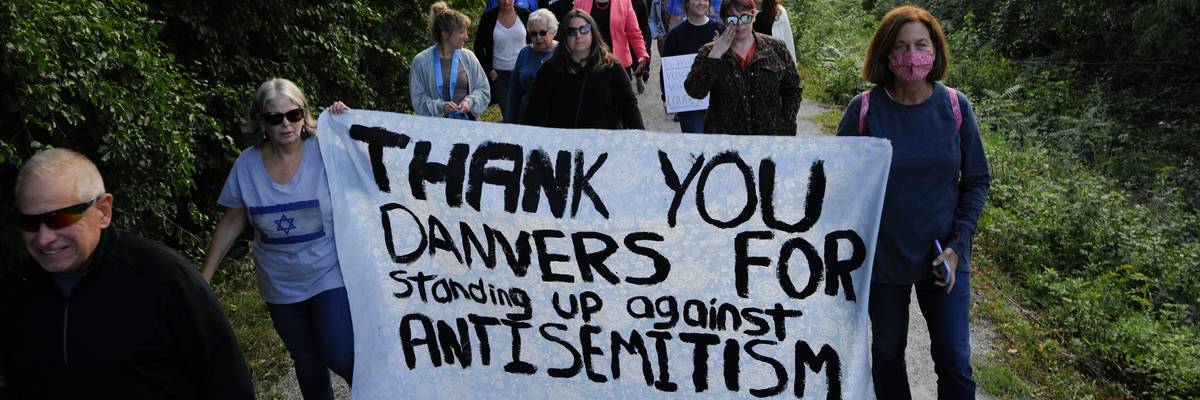
Danvers, Massachusetts community members march against antisemitism to reclaim the Rail Trail bridge over Route 114 that neo-Nazis tarnished on the 21st anniversary of the Sept. 11 terror attacks.
Whether your views align with the right or the left, many of us are clear that antisemitism among white supremacists, militant extremists, Christian nationalists, and other bigots poses a deadly threat to all of us.
Jewish communities across the country have been targeted with violence or harassment as anti-semitic hate crimes reach record levels.
In late January, a man tossed a Molotov cocktail — a firebomb — into the entrance of a New Jersey synagogue in the middle of the night.
In early February, a man walked into a San Francisco synagogue firing blank shots from a gun during a religious gathering. And in the suburbs of Atlanta that same week, Jewish families found flyers with antisemitic images and messages littering their driveways.
These terrifying incidents are only a fraction of a disturbing trend in American culture. That trend is especially visible on the far right, whose anti-semitism is now louder, bolder, and more aggressive than it’s been in most of our lifetimes .
At times like these, all of us need to be better neighbors to each other. This got me thinking about an experience I had 15 years ago as a city council member in Ithaca, New York.
A local rabbi approached me then and explained that in traditional Jewish communities, certain types of work and activities — like carrying objects outside the home — are prohibited on the Sabbath.
Tradition accommodates this restriction by creating a larger area called an eruv: a space that defines home as several houses and streets within a community. The boundaries of the eruv are designated by markers around the neighborhood, often attached to utility poles and wires.
The eruv symbolically enlarges the home, so the necessities of faith and of daily life can coexist.
For years, the rabbi said, the Jewish community had asked to put up eruv markers in parts of Ithaca, but the city council hadn’t responded. I was happy to help and even happier that we got it done. But there was some pushback from some of my colleagues, who opposed what they called “catering” to a religious community.
That deeply saddened me then and now. Here’s why.
Whether your views align with the right or the left, many of us are clear that antisemitism among white supremacists, militant extremists, Christian nationalists, and other bigots poses a deadly threat to all of us.
That has been true for a long time — it’s one reason Black, Jewish, and progressive communities were such strong allies to each other during the civil rights era. But for a variety of cultural and political reasons, I now worry these alliances are fraying. When good people are not aligned in opposition, tolerance for division and evil becomes commonplace.
Think of Nick Fuentes, the far-right activist who grabbed headlines for his dinner with Donald Trump and Ye (formerly known as Kanye West). Fuentes and Ye have openly praised Adolf Hitler. Not long ago, this would have been unthinkable in public life.
The way to combat the rising tide of hate and fragmented solidarity is with a strong, progressive, multiracial coalition. All of us must come together to dismantle the forces behind the divide-and-conquer agendas intended to harm Jewish and Black people, along with immigrants, women, LGBTQ people, and indeed most communities in one way or another.
In other words, like the eruv, our communities need to symbolically enlarge our home.
I’m reminded of a quote by Rabbi Leonard Beerman: “We need those who have the courage to be ashamed, who have the muscle to care. And more than caring, we need those who will preserve and cultivate an enduring vision of the good, who will maintain a vision of the future as a permanent possibility in the present.”
Our real and symbolic home should be with each other, where we are united by our shared humanity and where hate by any name is excluded. Let’s make that space, and welcome each other in.
Dear Common Dreams reader, It’s been nearly 30 years since I co-founded Common Dreams with my late wife, Lina Newhouser. We had the radical notion that journalism should serve the public good, not corporate profits. It was clear to us from the outset what it would take to build such a project. No paid advertisements. No corporate sponsors. No millionaire publisher telling us what to think or do. Many people said we wouldn't last a year, but we proved those doubters wrong. Together with a tremendous team of journalists and dedicated staff, we built an independent media outlet free from the constraints of profits and corporate control. Our mission has always been simple: To inform. To inspire. To ignite change for the common good. Building Common Dreams was not easy. Our survival was never guaranteed. When you take on the most powerful forces—Wall Street greed, fossil fuel industry destruction, Big Tech lobbyists, and uber-rich oligarchs who have spent billions upon billions rigging the economy and democracy in their favor—the only bulwark you have is supporters who believe in your work. But here’s the urgent message from me today. It's never been this bad out there. And it's never been this hard to keep us going. At the very moment Common Dreams is most needed, the threats we face are intensifying. We need your support now more than ever. We don't accept corporate advertising and never will. We don't have a paywall because we don't think people should be blocked from critical news based on their ability to pay. Everything we do is funded by the donations of readers like you. When everyone does the little they can afford, we are strong. But if that support retreats or dries up, so do we. Will you donate now to make sure Common Dreams not only survives but thrives? —Craig Brown, Co-founder |
Jewish communities across the country have been targeted with violence or harassment as anti-semitic hate crimes reach record levels.
In late January, a man tossed a Molotov cocktail — a firebomb — into the entrance of a New Jersey synagogue in the middle of the night.
In early February, a man walked into a San Francisco synagogue firing blank shots from a gun during a religious gathering. And in the suburbs of Atlanta that same week, Jewish families found flyers with antisemitic images and messages littering their driveways.
These terrifying incidents are only a fraction of a disturbing trend in American culture. That trend is especially visible on the far right, whose anti-semitism is now louder, bolder, and more aggressive than it’s been in most of our lifetimes .
At times like these, all of us need to be better neighbors to each other. This got me thinking about an experience I had 15 years ago as a city council member in Ithaca, New York.
A local rabbi approached me then and explained that in traditional Jewish communities, certain types of work and activities — like carrying objects outside the home — are prohibited on the Sabbath.
Tradition accommodates this restriction by creating a larger area called an eruv: a space that defines home as several houses and streets within a community. The boundaries of the eruv are designated by markers around the neighborhood, often attached to utility poles and wires.
The eruv symbolically enlarges the home, so the necessities of faith and of daily life can coexist.
For years, the rabbi said, the Jewish community had asked to put up eruv markers in parts of Ithaca, but the city council hadn’t responded. I was happy to help and even happier that we got it done. But there was some pushback from some of my colleagues, who opposed what they called “catering” to a religious community.
That deeply saddened me then and now. Here’s why.
Whether your views align with the right or the left, many of us are clear that antisemitism among white supremacists, militant extremists, Christian nationalists, and other bigots poses a deadly threat to all of us.
That has been true for a long time — it’s one reason Black, Jewish, and progressive communities were such strong allies to each other during the civil rights era. But for a variety of cultural and political reasons, I now worry these alliances are fraying. When good people are not aligned in opposition, tolerance for division and evil becomes commonplace.
Think of Nick Fuentes, the far-right activist who grabbed headlines for his dinner with Donald Trump and Ye (formerly known as Kanye West). Fuentes and Ye have openly praised Adolf Hitler. Not long ago, this would have been unthinkable in public life.
The way to combat the rising tide of hate and fragmented solidarity is with a strong, progressive, multiracial coalition. All of us must come together to dismantle the forces behind the divide-and-conquer agendas intended to harm Jewish and Black people, along with immigrants, women, LGBTQ people, and indeed most communities in one way or another.
In other words, like the eruv, our communities need to symbolically enlarge our home.
I’m reminded of a quote by Rabbi Leonard Beerman: “We need those who have the courage to be ashamed, who have the muscle to care. And more than caring, we need those who will preserve and cultivate an enduring vision of the good, who will maintain a vision of the future as a permanent possibility in the present.”
Our real and symbolic home should be with each other, where we are united by our shared humanity and where hate by any name is excluded. Let’s make that space, and welcome each other in.
Jewish communities across the country have been targeted with violence or harassment as anti-semitic hate crimes reach record levels.
In late January, a man tossed a Molotov cocktail — a firebomb — into the entrance of a New Jersey synagogue in the middle of the night.
In early February, a man walked into a San Francisco synagogue firing blank shots from a gun during a religious gathering. And in the suburbs of Atlanta that same week, Jewish families found flyers with antisemitic images and messages littering their driveways.
These terrifying incidents are only a fraction of a disturbing trend in American culture. That trend is especially visible on the far right, whose anti-semitism is now louder, bolder, and more aggressive than it’s been in most of our lifetimes .
At times like these, all of us need to be better neighbors to each other. This got me thinking about an experience I had 15 years ago as a city council member in Ithaca, New York.
A local rabbi approached me then and explained that in traditional Jewish communities, certain types of work and activities — like carrying objects outside the home — are prohibited on the Sabbath.
Tradition accommodates this restriction by creating a larger area called an eruv: a space that defines home as several houses and streets within a community. The boundaries of the eruv are designated by markers around the neighborhood, often attached to utility poles and wires.
The eruv symbolically enlarges the home, so the necessities of faith and of daily life can coexist.
For years, the rabbi said, the Jewish community had asked to put up eruv markers in parts of Ithaca, but the city council hadn’t responded. I was happy to help and even happier that we got it done. But there was some pushback from some of my colleagues, who opposed what they called “catering” to a religious community.
That deeply saddened me then and now. Here’s why.
Whether your views align with the right or the left, many of us are clear that antisemitism among white supremacists, militant extremists, Christian nationalists, and other bigots poses a deadly threat to all of us.
That has been true for a long time — it’s one reason Black, Jewish, and progressive communities were such strong allies to each other during the civil rights era. But for a variety of cultural and political reasons, I now worry these alliances are fraying. When good people are not aligned in opposition, tolerance for division and evil becomes commonplace.
Think of Nick Fuentes, the far-right activist who grabbed headlines for his dinner with Donald Trump and Ye (formerly known as Kanye West). Fuentes and Ye have openly praised Adolf Hitler. Not long ago, this would have been unthinkable in public life.
The way to combat the rising tide of hate and fragmented solidarity is with a strong, progressive, multiracial coalition. All of us must come together to dismantle the forces behind the divide-and-conquer agendas intended to harm Jewish and Black people, along with immigrants, women, LGBTQ people, and indeed most communities in one way or another.
In other words, like the eruv, our communities need to symbolically enlarge our home.
I’m reminded of a quote by Rabbi Leonard Beerman: “We need those who have the courage to be ashamed, who have the muscle to care. And more than caring, we need those who will preserve and cultivate an enduring vision of the good, who will maintain a vision of the future as a permanent possibility in the present.”
Our real and symbolic home should be with each other, where we are united by our shared humanity and where hate by any name is excluded. Let’s make that space, and welcome each other in.