

SUBSCRIBE TO OUR FREE NEWSLETTER
Daily news & progressive opinion—funded by the people, not the corporations—delivered straight to your inbox.
5
#000000
#FFFFFF
To donate by check, phone, or other method, see our More Ways to Give page.
Daily news & progressive opinion—funded by the people, not the corporations—delivered straight to your inbox.
The following is the text of the keynote address delivered to the conference on Anti-Fascism in the 21st Century, held at Hofstra University on November 2 and 3.
The answer to the first question posed in my title, I believe most here will agree, is easy--very serious indeed. In fact, it's not unreasonable to fear that next week's election could be the last real one in this country for a long time. And, even if reactionaries don't win Congressional majorities or tighten their grip on state legislatures and governorships at the polls, there is little reason to doubt that some or many of them may attempt, as Bolsonaro's forces are doing now in Brazil, to take apparent electoral defeat as the pretext for provoking political crisis by refusing to accept results as legitimate to the point of mobilizing violent opposition.
Of course, the dangerous, anti-democratic tendencies did not emerge with Trump. He became a useful symbol around which they have been able to condense strategically and advance rapidly as an electoral movement. However, those tendencies have been present in U.S. politics and have been building in this direction for a long time. And it's important to stress that Democrats and liberals have accommodated and abetted their growth by ceding important interpretive and policy ground to them all along. With your indulgence, I'm going to rehearse some points I made a little more than a year ago. I wrote:
Discrediting government and the idea of the public has been a component of the GOP game plan since Reagan, and Democrats have reinforced that message in their own way. Jimmy Carter ran for the party's presidential nomination in 1976 partly on his record of having cut the size of Georgia's government as governor, and as president, he initiated deregulation as a policy priority and imposed the economic shock that paved the way for Reagan. And it was Bill Clinton who announced in his 1996 State of the Union Address, "The era of big government is over," and he followed through by terminating the federal government's sixty-year commitments to provide direct income support and housing for the indigent. Reagan attacked the social safety net as a wasteful giveaway for frauds and losers. Clinton, as avatar of what my son described at the time as the Democrats' "me too, but not so much" response to Reaganism, insisted that publicly provided social benefits should go only to those who "play by the rules." Four decades of retrenchment and privatization of the public sector--often under the guise of "outsourcing" for greater efficiency or "doing more with less," which Clinton and Gore sanitized as "reinventing" government to make it "leaner" and "smarter"--combined with steadily increasing economic inequality and government's failure to address it in any meaningful way to fuel lack of confidence, distrust, and hostility toward government and public goods, and eventually even to the idea of the public itself. And the reactionary capitalist interests that bankroll the ultraright have taken advantage of that unaddressed economic insecurity and stoked frustration and rage into a dangerously authoritarian political force.
It wasn't such a big step from Rick Santelli's faux populist 2009 meltdown calling, from the floor of the Chicago Mercantile Exchange, of all places, for a Tea Party rising to the January 6, 2021 Capitol insurrection. McConnell's openly declared strategy of stalemating Democratic initiatives of whatever sort made clear that the Republicans have no commitment to democratic government; every move they made was directed, consciously or not, toward takeover via putsch or putsch dressed up as election. The outcome of the 2000 presidential election was an early augury, as the George W. Bush campaign strongarmed a victory by means of actively partisan intervention by Katherine Harris, the Florida Secretary of State, mobilization of corporate goons to storm the Miami-Dade recount, and turning to a reactionary bloc of Supreme Court Justices to place a fig leaf of legitimacy onto theft of the election. The Gore campaign's reluctance to fight back aggressively was also an augury of the implications of Clintonism's victory within the party, as Gore, Kerry, and Obama all ran, and Obama governed, in pursuit of a bipartisan coalition anchored normatively by nonexistent "moderate" Republicans. Hillary Clinton tried that approach as well and thus did her part to put Trump in the White House.
Some of the reactionary, authoritarian tendencies that condensed around Trump and Trumpism have been festering and growing in American politics at least since the end of World War II. First Barry Goldwater, then Ronald Reagan brought them out of the shadowy underworld populated by such groups as the John Birch Society, the World Anti-Communist League, various McCarthyite tendencies, Klansmen and other white supremacists, America Firsters, ultra-reactionary groups with ties to shadowy international entities like Operation Condor that has specialized in state-centered terror and death squads in Latin America and its equivalent in other regions, Christian Nationalists, anti-Semites and Islamophobes. During the Reagan presidency the treasonous Iran-Contra operation illustrated these reactionaries' contempt for democratic government. The guide-dog corporate news media sanitized Iran-Contra as a "scandal," and dutifully shepherded public discussion of it away from the magnitude of the crimes against constitutional government and toward the puerile, soap operatic question "What did he [Reagan, etc.] know and when did he know it?" They've been joined in the Trump years by a cornucopia of more or less organized thugs, militant racists and misogynists, open fascists, reactionary libertarians, delusional conspiracists, damaged true believers, and utterly venal grifters--a category that cuts across all the others--and they're bankrolled by the American equivalent of German Junkers, billionaire reactionaries whose wealth largely derives from extractive and defense industries and other sectors that are particularly sensitive to the federal regulatory environment.
The ultra-reactionary Federalist Society was founded in 1982 by Yale, Harvard, and University of Chicago law students and now has stocked the federal judiciary up to the Supreme Court, including a hefty complement of Catholic fascists. Justice Neil Gorsuch, a Federalist Society member, is the son of Anne Gorsuch Burford, Reagan's administrator of the Environmental Protection Agency, where her mission--like that of current Justice Clarence Thomas as Reagan's director of the Equal Employment Opportunity Commission--was to gut the agency. Political economist Gordon Lafer documents in The One Percent Solution: How Corporations Are Remaking America One State at a Time (ILR Press, 2017) how right-wing corporate lobbying groups like the American Legislative Exchange Council (ALEC), Americans for Prosperity, the U.S. Chamber of Commerce, and the National Federation of Independent Business--all funded by the Koch brothers and other rich reactionaries--have organized at the state level to produce and pass anti-worker, anti-democratic legislation and to secure and fortify Republican control of state governments. In an August 2022 New Yorker article ["The Big Money Behind the Big Lie"] that, along with her book Dark Money: The Hidden History of the Billionaires Behind the Radical Right, should be required reading for anyone who still diminishes the threat or clings to the view that neoliberal Democrats are somehow the greater danger for progressive interests, Jane Mayer examines the vast dark money network--the American Junkers whose immense wealth underwrites the accelerated assault on democratic institutions we face at this moment.
I'm not suggesting that some deep cabal has orchestrated an elaborate, decades long conspiracy to seize power. That's not how politics, certainly not insurgent politics, in a mass society works. I'm also not interested in hashing out counterfactuals like whether this could have happened without James Buchanan, the Cato Institute, or the Koch brothers. What we do know that's pertinent to what we're up against at this moment is that after Goldwater's presidential run was crushed by Lyndon Johnson in 1964, enough of the militant ultra-reactionary core of his campaign took the lesson that they'd been talking too much only to themselves and went out into localities among largely suburban potential constituencies to agitate and field-test messages and issue bundles that could enable building an alliance that extends far beyond the ranks of those who would benefit from realizing the capitalist class agendas that lie at the movement's core. Historian Lisa McGirr [Suburban Warriors: The Origins of the New American Right] examines what was then called the "New Right" militants' organizing strategies and the relatively homogeneous suburban ecological niches--typified by Orange County, California--within which their efforts gained traction. Political scientist Daniel Parker's doctoral dissertation on the Conservative Political Action Conference is a distinctly informative account of how the ultra-right approaches building, sustaining, and directing the movement.
To be sure, elements of the reactionary right have held onto and are oriented by visions of the society as they'd like it to be organized, and those visions are neither democratic nor egalitarian. As their mundane political practice has evolved and their institutional power has grown, the movement's engineers have also improvised, balancing the practical objective of expanding and deepening a base and disciplined attentiveness to building power toward overturning all egalitarian reforms that have been won since the New Deal and imposing an authoritarian government. That means, among other things, taking advantage of or concocting new issues that both inflame their broader base and permit them to set the terms of national or local political debate. Recall how quickly and thoroughly the GOP establishment went from trying to stop Trump to playing Renfield to his Count Dracula?
I have no idea how extensive the consciously putschist tendency has been among the right. The best that one might say for Mitch McConnell, for example, is that his aspiration perhaps didn't extend much beyond immobilizing government, precluding any progressive legislation or appointments. Nor do I imagine that the likes of Lindsey Graham or Kevin McCarthy had been impelled by radical ideological commitments more elaborate than advancing the immediate interests of the class they represent and suppressing those who might want to do anything else. That doesn't really matter; the policy steps necessary to prepare for ultimate authoritarian victory are the same as those favored by less far-sighted reactionaries: rolling back the regulatory apparatus, which includes civil rights enforcement, politicizing and attacking climate science, using taxation and other federal policies to generate massive upward redistribution, stocking the judiciary, gutting the social safety net and demonizing government at all levels, undermining labor rights and unionization, and more, expunging even the very idea of the public.
Watching Rand Paul doing his best Joe McCarthy impression going after Anthony Fauci brought home to me that Trumpism helped to bring the notion of extra-Constitutional takeover of government in from the fringes of national politics and out from the dark ideological core of the Republican right. Trump's preemptive refusal, months before the election, to accept a defeat as legitimate opened a portal through which the goal of authoritarian transformation could move closer to explicit political strategy. The dangerous rubes who were foot soldiers of the January 6 insurrection were only acting out in public, albeit as a kayfabe lynch mob that was a hair's breadth away from becoming a real one, a political objective that had already condensed among a popular right-wing base.
The notion that any Democrat officeholder is by definition illegitimate and inauthentic isn't new of course. Birtherism was predicated on that general conviction; Obama's race facilitated spreading the claim about him, but it was already visible within rhetoric positing Republicans as the "real Americans;" it underlay fervor around the 2000 election theft, as well as right-wing jeremiads that electing Democrats threatened the end of civilization, long before Obama even became a glimmer in Wall Street's eye. Restriction of the franchise to property owners and the rich has been a strain in ultra-right politics across the sweep of the twentieth century and into the twenty-first. (It's interesting in this respect as an illustration of the deep, antediluvian character of the right's anti-democratic reflexes that the arcane demand for repeal of the 17th Amendment to the Constitution, which since 1913 has mandated the direct election of the U.S. Senate, has routinely popped up on right-wing political laundry lists.) And the "real Americans like us" qualifier gives this hostility to democracy a popular appeal for those outside the upper class who can be suckered into identifying with them. That qualifier also underscores the work that race ideology, broadly understood, does to provide the illusion of commonality among those identifying with the right.
The rallying cry that the 2020 presidential election was stolen or rigged, or both, is a fantasy originating from Trump's malignant narcissism. It's also a convenient vehicle for exhortation of putschism. The novel coronavirus pandemic and Trump's militant denialism opened another portal. There's no need to catalogue the many ways the Republican right has actively sought to undermine public health efforts to control, limit, or slow the virus's spread and minimize the harm it causes. We're living with them every day, and because having any basis in fact isn't a limitation on their proliferation, the fantastic claims grow and morph even more quickly than the virus itself. A couple of stratagems in the ongoing anti-public health panic are worth noting because they echo really old-school reactionary ideology, from a time before when the fiction of appeal to a popular audience encouraged public politesse. Recall that early in the pandemic, Texas Lt. Gov. Dan Patrick urged elderly Americans to go out and contract the virus and "sacrifice" themselves to keep the economy open, referring to it as their patriotic duty. Nor was he alone in floating that suggestion. (It's a parochial reference, I know, but that call brings to mind the up to 20,000 immigrant Irish workers who were buried where they fell from yellow fever and malaria while digging the New Basin Canal in 1830s New Orleans, along with the untold scores of millions of others around the world who've been sacrificed for the sake of "the economy.") More recently, Newsmax talking head Rob Schmitt contended that vaccination goes against nature, opining "if there is some disease out there--maybe there's just an ebb and flow to life where something's supposed to wipe out a certain amount of people, and that's just kind of the way evolution goes. Vaccines kind of stand in the way of that." Schmitt and Patrick give voice to the element of the ultra-right that frets about propagation of unworthy populations, or losers, or, to capture that snappy old-school sensibility more directly, Lebensunwertes leben. Pandemic denial and opposition to public intervention to address dangers to public health come organically to this element, which has been part of the institutional foundation of ultra-right politics since the late nineteenth century, among them bankrollers of the eugenics movement from its beginnings. Recently, Nafeez Ahmed--"The Dark Heart of Trussonomics: The Mainstreaming of Libertarian Theories of Social Darwinism and Apartheid," Byline Times, October 10, 2022--examines the "key ideological driving force" of Truss's and her allies' economic program in the UK, which he identifies as "the reshaping of neoliberalism into an extreme nationalist economics rooted in a form of social Darwinism. Under this ideology, it is impossible to reduce inequality because characteristics such as race, gender, and class that cause disparities are fixed." Ahmed perceptively notes the centrality of underclass ideology as a normative foundation of this essentialized inegalitarianism.
With a startling quickness that bespeaks the depth and breadth of their organizational capacity, the Republican right has mobilized an alliance of committed reactionaries, opportunist political operatives, anti-vaxxers, survivalists, and other more or less dangerous anti-government hobbyists, internet conspiracists, unhinged psychopaths, militant anticommunists, zealous anti-abortionists and other Christian fanatics, would-be libertarians, gun nuts, unambiguous fascists and ethnonationalists, actual (i.e., not simply people who say or do things that affront liberal anti-racists) white supremacists, xenophobes, sexists and anti-LGBTQ militants, desperate people seeking answers and solutions to the material and emotional insecurities that overwhelm their lives, and, of course, the grifters who follow alongside the herd looking to pick off the weak and vulnerable. Even the right-wing Catholic bishops have gotten into the act, at least when they can stay off Grindr, defying the Pope in pressing to deny Biden the Sacrament, if not to excommunicate him. Notwithstanding their idiosyncratic identities and issues, Trumpism has developed as the umbrella under which they converge, with MAGA as the symbol that condenses all their disparate aspirations. And that didn't just happen either; it's the result of years of propaganda and organizing.
Birtherism and Pizzagate built on the kayfabe principle to establish the movement's foundation in a truer Truth than the world of facts and contradictions. That's how Trump supporters can declare sincerely that he's "the only one telling the truth," even though practically every other word out of his mouth is a lie. No matter where he was born, Obama's essence was not American; if Democrats and cosmopolitan liberals are hidden pedophiles--and the image of the pedophile as quintessential, unqualifiable, conversation-stopping evil is the product of a bipartisan sex panic in the 1980s--and, more recently, cannibals (the latter presumably included to inflame those who may be softer on pedophilia), then the problem is not what they stand for, what positions or policies they advance. And that's why belief in the Stolen Election is so impervious to rational argument; Biden stole the election because real Americans' votes were not permitted to prevail. Votes cast for him were fraudulent by definition because people who voted for him could not be legitimate Americans. (In Oklahoma, where Biden didn't carry a single county, a Republican legislator petitioned, unsuccessfully, for a "forensic and independent audit" of the 2020 vote in Oklahoma City and other counties in the state on the pretext that the Biden vote was in his view nonetheless suspiciously high. This is shades of the high period of disfranchisement in the late nineteenth-century South, when Democrat putschists considered even one Republican vote too many.)
Perhaps most important and most telling is how COVID conspiracy and resistance to masking and vaccination have been articulated and fed into widespread, round-the-clock, frenzied agitation asserting the absolute primacy of individual "rights" over any public concern. This is the fruit of the half-century of relentless, right-wing attack--again, abetted by neoliberal Democrats--on the very idea of the public, which was already evident in proliferation of the belief that my "right" to carry an assault rifle into any public space overrides concern for the public safety and now that my "right" to refuse to wear a mask even in establishments that require them or vaccination in the throes of a pandemic supersedes regulations intended to safeguard public health. That narrative reinforces castigation of any public intervention as government overreach or even tyranny. The apparent irrationality superficially driving the hysteria stands out and prompts bewilderment and astonishment. Yet, although characterizations of the Republican party as having become a "death cult" and the like can be arresting as metaphor, they miss the vector plotted by this movement's political trajectory and the gravest dangers it poses. It is useful to recall Margaret Thatcher's three most infamous dicta: 1) "There is no such thing [as society]! There are individual men and women and there are families, and no government can do anything except through people and people look to themselves first"; 2) "Economics are the method: the object is to change the soul"; and 3) when asked to identify her greatest achievement, she replied "Tony Blair and New Labour. We forced our opponents to change their minds." The extent to which that sort of solipsistic individualism has spread in American life, irrational or not, reflects the success of the Thatcherite vision.
Many liberals, and not a few leftists, may dismiss the account I give here as wildly hyperbolic, although in the past year more liberals have come around to acknowledging the real threat to democracy and what they fetishize as "rule of law." Liberals have an abiding faith in the solidity of American democratic institutions; some bookish leftists have internally consistent arguments demonstrating why a putsch can't happen because it wouldn't be in capital's interests. It always seems most reasonable to project the future as a straight-line extrapolation from the recent past and present; inertia and path dependence are powerful forces. But that's why political scientists nearly all were caught flat-footed by the collapse of the Soviet Union. To be clear, I'm not predicting the possible outcome I've laid out. My objective is to indicate dangerous, opportunistic tendencies and dynamics at work in this political moment which I think liberals and whatever counts as a left in the United States underestimated or, worse, dismissed entirely for far too long. If forced to bet, based on the perspective on American political history since 1980, or even 1964, that I've laid out here, I'd speculate that the nightmare outline I've sketched is between possible and likely, I imagine and hope closer to the former than the latter.
A key practical reason to stress the danger on the horizon is the possibility that the national and global political-economic order we've known as neoliberalism has evolved to a point at which it is no longer capable of providing enough benefits, opportunity, and security to enough of the population to maintain its popular legitimacy. I am hardly alone in suggesting that we may have come to a significant crossroad. People with much greater faith in and commitment to contemporary capitalism than I have, and who have much more sophisticated knowledge of its intricate inner dynamics, also have expressed that view, though in somewhat different terms and in relation to different political concerns. And that's in addition to a broader consensus among globalist economic technocrats that the tendency to financial crises is chronic and that the goal of management of the global financial system must center more on recognizing them quickly and mitigating their effects than on preventing them. No less decorated a Doctor of the neoliberal Church than Lawrence Summers as early as 2013 invoked, albeit gingerly, the language of "secular stagnation," long rejected by his brand of economists, as perhaps useful for making sense of chronic underperformance of U.S. GDP. He elaborated further on the stagnationist tendency in the national economy in a co-authored 2019 Brookings paper ["On Falling Neutral Real Rates, Fiscal Policy, and the Risk of Secular Stagnation"]. BlackRock, Inc., the world's largest asset management firm which has a significant voice in the Biden administration, most prominently through Brian Deese, Director of the National Economic Council, also sounded the alarm about stagnation and discussed heterodox responses, including industrial policy, another neoliberal bugbear, in a 2019 report, "Dealing with the Next Downturn." At the same time, the already astonishing patterns of regressive redistribution of wealth and income that largely have defined neoliberalism globally, and in the U.S. particularly, have accelerated since the Great Recession, and even more during the coronavirus pandemic. How could such an order not slide into the throes of legitimation crisis? That's even more likely to the extent that approaches to mitigation of the effects of periodic fiscal crises mainly are intended to protect the investor class at the expense of taxpayers and public goods.
If neoliberalism has reached such an impasse, I've argued, there are only two possible directions forward politically: one is toward social democracy and pursuit of solidaristic, downwardly redistributive policy agendas within a framework of government in the public good; the other is toward authoritarianism that preserves the core neoliberal principle of accumulation by dispossession by suppressing potential opposition. The latter direction, commonly anchored rhetorically by what Colin Crouch has described as "politicized pessimistic nostalgia," has proliferated since before the Great Recession. Parties or movements organized around that sort of reactionary politics have come to power, electorally or otherwise, in Hungary, Poland, India, Turkey, Ukraine, Brazil, and I'd add Boris Johnson's Tory government in the UK and Trump's here. Elsewhere--e.g., France, Austria, Germany and throughout the EU--they're significant enough to require being taken into account in electoral political calculations. It's short-sighted not to note that similar forces are on the rise in this country and that Trumpism has emerged as a vessel for cultivating and deploying that politicized pessimistic nostalgia as an alternative to more social-democratic response.
The reality that the processes of neoliberalization at their core rest uneasily with popular democracy makes reckoning with this right-wing tendency's growth all the more urgent. Insulation of policy processes as much as possible from popular oversight--at local, national, and international levels--is at the heart of neoliberal accumulation. To that extent, it's naive to presume a capitalist class preference for democratic over authoritarian government, particularly if the democratic form comes with an opening for efforts to impinge on capital's prerogatives. Even if we take the corporate rush to affirm support for racial justice after George Floyd's murder as expressing genuine endorsements of anti-racist equality of opportunity and opposition to unequal and criminal hyper-policing, and not tainted by opportunism, is it reasonable to expect that, say, Uber, Amazon, McDonald's, or Goldman Sachs would actively fight for a form of government that might regulate their labor market practices and methods of accumulation and force them to pay taxes against one that promised to protect them? As Walter Benn Michaels and I have observed repeatedly, earnest institutional and individual commitment to an anti-disparitarian ideal of justice is entirely compatible with support for a society that becomes ever more sharply class-skewed and unequal in the aggregate.
So far, I've focused on the nature of the authoritarian threat, an assessment with which I assume many may agree at least in general terms. Although the two are related, the more important question is how to combat that threat. I want to stress that in my view the only hope for thwarting that tendency is to concentrate our efforts on formulating, organizing around, and agitating for an ensemble of policies that reinvigorate the notion of government in the public good, which has been a casualty of more than four decades of bipartisan neoliberalism. The "pessimistic nostalgia" that Trumpists and other authoritarians propagate and mobilize around is most consequentially the result of decades of bipartisan failure to provide concrete remedies that address the steadily intensifying economic inequality and insecurity that have driven so much of the working class to the wall. We need to provide an alternative vision that proceeds unabashedly from the question: What would be the thrust and content of public policy if the country were governed by and for the working-class majority?
Of course, for the moment, very much hinges on Democrats' beating back or holding off the Republican electoral efforts next Tuesday. But building a broad working-class based movement is the only way we might successfully defeat the reactionary right wing, and we need between now and 2024 to begin trying to build the sort of popular movement that we need. And we must be clear that such a left movement does not yet exist, no matter how many internet announcements of imminent victory show up daily on our various electronic devices. There are many leftists and people who support leftist causes and programs, but a left with real political capacity has been absent for so long in the United States that even most sympathetic people can't conceptualize what one would look like, how we could distinguish it from the "pageantry of protest" or the effluvia of premature proclamation and branding. Several years ago, Mark Dudzic and I suggested salient features of an institutionally significant left.
By left we mean a reasonably coherent set of class-based and anti-capitalist ideas, programmes and policies that are embraced by a cohort of leaders and activists who are in a position to speak on behalf of and mobilize a broad constituency. Such a left would be, or would aspire to be, capable of setting the terms of debate in the ideological sphere and marshalling enough social power to intervene on behalf of the working class in the political economy. Some measures of that social power include: ability to affect both the enterprise wage and the social wage; power to affect urban planning and development regimes; strength to intervene in the judicial and regulatory apparatus to defend and promote working-class interests; power not only to defend the public sphere from encroachments by private capital but also to expand the domain of non-commoditized public goods; and generally to assert a force capable of influencing, even shaping, public policy in ways that advance the interests and security of the working-class majority.
Clearly, this is not the sort of formation that can be generated overnight. And that has long been a catch-22 for leftists, especially those whose political thinking is shaped by moral outrage or its practical expression, activistism. On the one hand, the magnitude of the immediate dangers we face is so great that we don't have time to concentrate only on the sort of slow organizing that building such a movement necessitates, and this moment's urgency is at least as great as any other any of us has faced in our lifetimes. On the other hand, arguably one of the reasons we're in the current predicament is that a left as Dudzic and I describe has been absent for decades. So, even as surviving the 2022 election looms in our political calculations (as Walter Benn Michaels notes regarding the stakes of the current moment, "even those of us who don't love liberal democracy will love even less what we'll get from [Josh] Hawley et al."), we aren't going to be able to turn the tide against the rising reaction unless we begin to organize in that way and to rebuild broad working-class confidence in a public good approach to government. It's clearer now than ever that only by agitating for a solidaristic political agenda and perspective on politics can we even hope to forestall, much less defeat the assault that has already moved well in from the horizon.
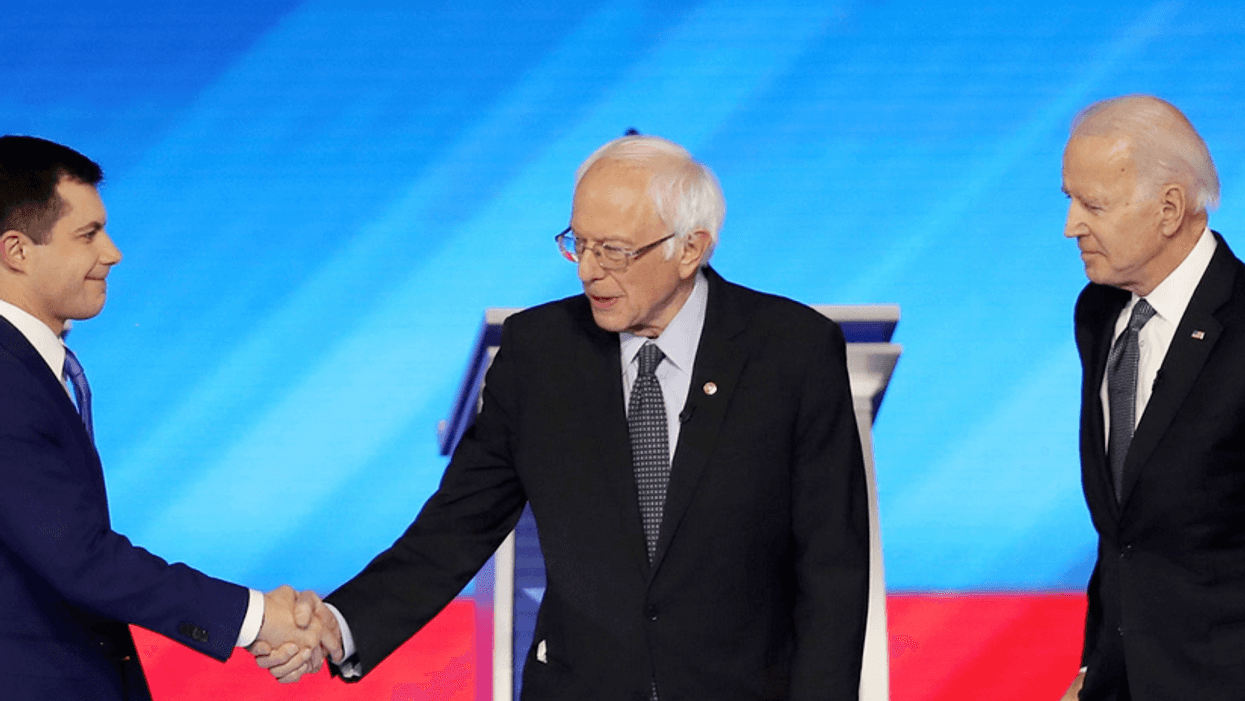
An implication of that imperative is that the challenge of beating back surging reaction must go well beyond electing Democrats. In fact, since 2015 we've seen ample evidence--first in their intense mobilizations against the Bernie Sanders insurgencies in 2016 and 2020 -- that mainstream Democratic elites are more concerned with preempting emergence of a left faction within the party than with combating the rising authoritarian or fascist tide in the polity. (I know some object that the Pelosi/Schumer/Clinton wing of the party were so hostile toward Sanders not because he was too far left but because they were convinced that he couldn't win. However, that is a distinction without a difference. They were convinced that he couldn't win because they embraced the view, associated with the Clintonite party's embrace of neoliberalism, that winning elections requires chasing the phantasm of the moderate--socially liberal, fiscally conservative--Republican voter or what the pollsters' and political scientists' fetishize as the median voter.)
This offers a sharper perspective on the flood of support for antiracist arguments and gestures after George Floyd's murder. It also, in addition to however genuine the political and business elites were who embraced it, shifted the focus of progressive politics away from economic inequality. Antiracism in this way functioned much as Trumpist and other reactionary forces did in mobilizing race and other ideologies of ascriptive difference to undermine politics based on fashioning working-class solidarities. It is telling in this regard as well that in 2022 Democrats more or less concertedly solicited people of color, women, or LGBTQIA candidates to embody--literally--"progressive" values rather than candidates who first of all stood for working-class programs and agendas.
Of course, we can't possibly generate anything on the scale of what Dudzic and I describe by 2024, and next week's outcomes as likely as not will pose new, more immediate, and possibly desperate challenges and dangers. The larger goal of building a grounded working-class movement, however, should inform how we go about responding to the immediate imperative of turning back the reactionary assault.
Trumpism's success also has shown that making headway on this front will require undoing decades of bipartisan disparagement of public goods and propagation of both the Thatcherite fiction that there is no realm beyond the individual and Democrats' at best self-deluding fantasies about doing more with less. Many readers will recall from the 2008 presidential campaign the agitated cries among McCain supporters to "Keep your government hands off my Medicare." There is an ample social science literature finding that whether or not one recognizes that government is the source of benefits one receives has an impact on trust in and regard for government. I'll cite only one study I know most intimately. Political scientist Ashley Tallevi, in a sophisticated study of Medicaid managed care and federal contraceptive policies, ["Making the Political Personal: Health Insurance, State Visibility, and Civic Perceptions" (unpublished Ph.D. diss., Department of Political Science, University of Pennsylvania, 2017)], found that recipients of the services who knew they were provided by the state had more favorable views of government than those who, principally because service provision had been privatized or outsourced, did not know. This research, which dovetails with experience from the Debs-Jones-Douglass Institute's (DJDI) trainings with rank-and-file union workers on economic inequality and the healthcare crisis, underscores that privatization and outsourcing are not merely objectionable insofar as they turn the public sector into a woodlot for profiteers. They also have been instrumental in implanting Thatcher's first dictum as common sense. Proliferation of that common sense marks the success of her second dictum, and the Democratic Party's trajectory from Bill Clinton to the Biden presidency is testament to the boast in her third. We can only even chip away at those critical setbacks on the ideological front if leftists--including left or progressive-leaning advocacy and interest groups and most of all the labor movement--lobby and agitate for that public good perspective and approach.
Concretely, that means taking advantage of the openings--ambivalent and limited as they may be--to press where possible, in our own networks, workplaces, civic engagements, and institutional affiliations, in the public realm for those with ready access to it, for the administration's infrastructure plans to reinvigorate the public sector, not simply stimulate private investment opportunities. It means similarly working to anchor climate change policy to job creation and a serious commitment to make whole those workers who are displaced in the economic and social reorganization that addressing climate change requires. It means also agitating and building public support for initiatives like postal banking and eliminating the income cap on social security tax, even though the latter may produce little more than a holding action against Biden's long-demonstrated proclivities regarding "entitlements."
In the electoral domain, at DJDI we have observed in our worker trainings that even allusion to candidates or signature partisan issues for many workers sets off alarm bells of distrust, barriers of unnecessary resistance to our training program. Others have recorded the same phenomenon, noting that even in states that characteristically vote Republican, voters have also passed ballot initiatives that raise the minimum wage and legislate other pro-worker initiatives that Republicans steadfastly oppose. This underscores the importance of getting outside the Democrat/Republican divide and gearing electoral interventions to push clear working-class programs and policies. That in turn suggests that electoral engagement can be more productively directed toward pursuit of ballot initiatives that place clear working-class oriented proposals before the electorate without all the noise and confusion--e.g., personalism--that accompany candidate-centered campaigns. Issue-centered ballot initiatives also can be useful tools of political education. The new episode of DJDI's podcast, classmatterspodcast.org [https://classmatterspodcast.org] discusses one such campaign, the Massachusetts Fair Share Amendment, which will levy a 4% tax on incomes over $1 million a year, and which is projected to generate $2 billion revenue annually that will support education, transportation, and public infrastructure.
Finally, I sometimes hear that I don't want people ever to be happy or to celebrate political victories. So I'll close with what may at first blush may not seem like an upbeat note, which I'll preface by pointing out that a few years ago, I binged-watched several political films from the 1960s and early 1970s--"The Organizer," "Battle of Algiers," "Z," and "State of Siege"--all in one day. I was struck that each film ends with a defeat but that each was broadly understood in its moment as a profoundly optimistic film. I realized that such films couldn't be made now--what! no superheroes or magical intervention?! Fast forward to the present and the perils facing us. During this past summer, I faced up to the likelihood that, even if we began to generate a working-class movement of the sort that could meet the challenge, the greater likelihood is that we won't be able to defeat the fascist tide; it has too great a head start because it is so deeply rooted institutionally. And that led me to consider that our efforts now may be more for those who'll be around when the authoritarian regime begins to unravel, and who will be looking for ways forward. I found that thought immediately somewhat depressing, if not defeatist, which is why I more or less consciously repressed it for a while. After all, an implication of that realization is that, as a 75-year-old, not only could this November 8, or maybe at best 2024, well be the last real election in the U.S. in my lifetime; another, more significant implication is that we simply can't hope to fend off the authoritarian threat at this juncture. However, I mentioned my sad little epiphany to a colleague who has been experiencing the same concerns about our lack of capacity for mounting responses to the reactionary horrors. I was surprised that the response was elation because, like the sensibilities of that earlier left, the colleague understands and is rooted in appreciation of protracted struggle and saw in that observation the basis for a practical sense of purpose. And that recognition of the protracted character of our struggle is a reminder, first, that as a left we face the same imperative to build a politics of broad, working-class solidarity no matter whether we hope to defeat fascism now or farther down the road than we can currently envision, and that a realistic source of optimism in a moment like this is recognition that the ruling class's fantasies of its omnipotence are just that.
Thank you.
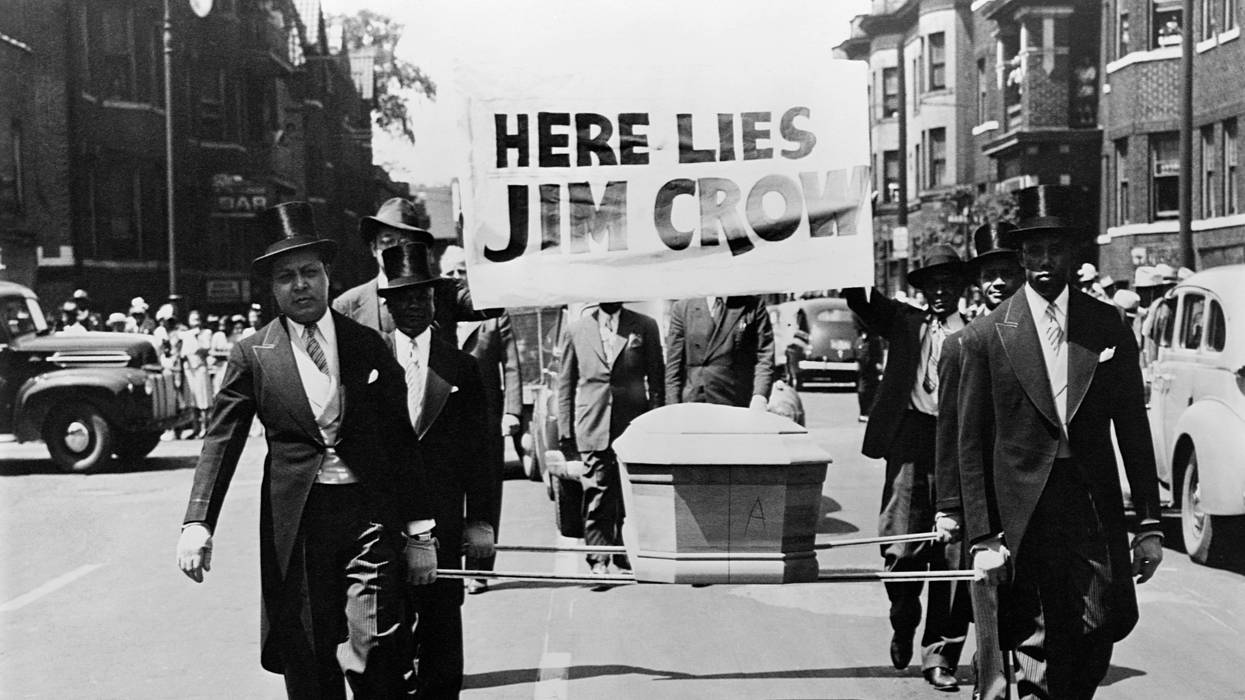
With a new book out Tuesday reflecting on his years growing up within--and moving through--the racist apartheid order that loomed over the U.S. South in the 1950s and 60s during his upbringing and early adulthood, political scientist Adolph Reed Jr. offers his unique perspective on the Jim Crow era, but please do not call it a memoir.
Reed, professor emeritus of political science at the University of Pennsylvania, left teaching in 2019 but has hardly slowed down in terms of his desire to educate or be involved in the national debate surrounding issues of race, grotesque levels of economic inequality, and the necessity of a politics that puts working people at the very center.
Separate from the book, entitled The South: Jim Crow and Its Afterlives, Reed is also working on a new podcast project with friends and allies from the labor movement that recently has its debut. In an exchange over email ahead of The South's launch, Reed shared his thoughts with Common Dreams about the new book that takes a critical and unique look at the past and his ideas about contemporary politics that should be vital for anyone thinking seriously about the perils the nation is facing today and into the future.
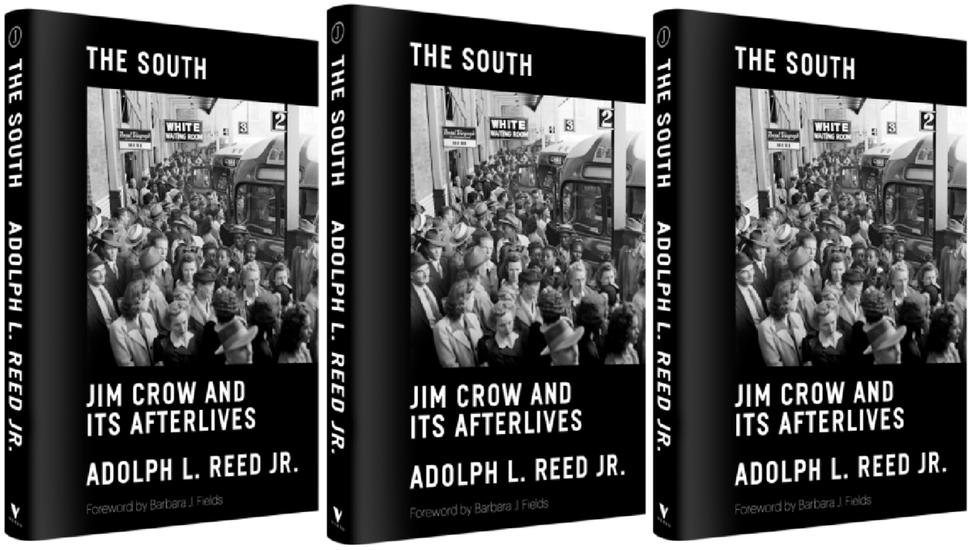
Common Dreams: The South feels like a reluctant memoir, one born out of obligation as much as other possible motivations. One key reference made toward the beginning of the book is the "indelible" mark left on those of a specific age (yours) who "reached adulthood under that system's heel." You were born in 1947. You turned 18 the same year the Voting Rights Act of 1965 was signed into law. In the book you write, "My age cohort is basically the last, black or white, for which the Jim Crow regime is a living memory--for good or ill." How long has this book been stewing and were there any specific dynamics or trends over more recent years that ultimately compelled you to tell these stories and share these observations in the manner that you have?
Adolph Reed Jr.: The book, or something, had been stewing since the late '90s, when a couple of friends with southern roots--one seven years older, the other ten years younger--and I began musing that probably only the most precocious of those people the younger friend's age would have any lived recollection of what the Jim Crow social order and quotidian world were like. At that point I was in my early 50s, and it didn't take a lot of imagination to reflect that living memory would be gone with us. I began writing in 2002 or 2003 with no particular end in mind and, therefore, wrote myself into that uncertain terrain--about 15,000 words--of too long for an article, too short for a book. The manuscript languished on my computer in that state for more than a decade.
The point of the book is to capture at least one perspective on the complex social order that was the Jim Crow South--where it came from, what it was about, its point, how people lived it and reproduced it at the everyday level as well as its formal or official strictures of racial regulation.
I appreciate that you describe it as a "reluctant memoir" because the one thing I definitely did not want to write was a memoir of my life or a coming-of-age tale.There's already far too much of that sort of writing out there, which generally comes down to something somewhere between personality journalism and inspirational narrative of overcoming adversity. Besides, I'm simply not that interesting as a person. The point of the book is to capture at least one perspective on the complex social order that was the Jim Crow South--where it came from, what it was about, its point, how people lived it and reproduced it at the everyday level as well as its formal or official strictures of racial regulation. Recently, I've thought about--without the arrogance of the Du Bois comparison--the subtitle Du Bois gave to Dusk of Dawn, An Essay Toward an Autobiography of a Race Concept. That magisterial book was a narrative of his life that was simultaneously a rumination on the genesis and evolution of race thinking. This book is vastly less ambitious; it's a rumination on a social order recorded by something like a participant-observer. I'm grateful to Barbara Jeanne Fields and Faith Childs for having encouraged me to pursue publication, which I'd done only tepidly or tentatively theretofore, and to expand the manuscript with more texture and to explore topics I hadn't, or had only alluded to before, and, yes, to put more of my own circumstances into the narrative. I'll resist to the death the book's characterization as a memoir, though; my sense is that the personal stuff in it is mainly lubricant to move the narrative along. I'll add, just for more texture, that 1965 was also the year that Malcolm X was assassinated (months before passage of the VRA), the first really big troop build-up in Vietnam (also months after Malcolm's assassination) and significantly therefore the year I had to register for the draft, and the Watts riot, less than a week after the VRA was passed. These comments should underscore that the South wasn't so much detached from the rest of the US.
Far from a recollection of anecdotal injustices, the book goes beyond recounting "the bad old days when bigots and bigotry reigned" by examining the ways in which Jim Crow created a "coherent social order" for those who experienced it--one not as easily reduced to segregated lunch counters and designated waiting rooms at the bus station. Busting a few myths about what the system was and what it wasn't, you describe how even as segregated black communities "were excluded from political and civic life," Jim Crow was not designed to exclude them from economic life. "The point was not to remove them from the mainstream economy," you write, "but to enforce their subordinate position within it." Was "the point" of Jim Crow to keep black Americans separate and relegated, or was it to keep them poor?
Another interesting question. I'd say the answer is both, and more still. And that's partly what's wrong with how people are inclined at this point to think about that period, as well as what's wrong with how people are, and have been inclined to think about remedies. Like all social orders or governing regimes that succeed--and 60 years or more qualifies as success--the Jim Crow order was improvised. Its main precipitant was the threat to southern ruling class hegemony asserted by the Populist insurgency at the end of the 19th century. Racial scapegoating did what racial scapegoating does; it's why "race" exists as a socially meaningful category in the first place. The Jim Crow order imposed white supremacy and apartheid, and most of all racial disfranchisement at the state level by constitutional action. The "point" certainly was to turn black people into a population without citizenship rights, which made them all vulnerable to labor discipline without recourse and therefore to keep them poor. Also, disfranchisement eliminated the closest potential electoral ally for white popular classes--workers and farmers--and thereby reshuffled the patterns of alliance available to them and altered the potential stakes of class politics.
So how big a dent did the civil rights victories of the 1960s put in that hegemonic power of the ruling class? Were opportunities missed to further upend the economic order in the more immediate wake of Jim Crow's collapse?
Well, I don't know about the opportunities missed; I tend not to go far down that road. Bayard Rustin pointed out in 1965, I think somewhat mechanistically, but I take his point nonetheless, that the Jim Crow order in the South was a backwater, and that challenging it was basically a rearguard action in relation to larger problems of inequality and injustice generated by American capitalism. And support for the apartheid system had softened in the South under pressures of the New Deal, CIO unionism, federal interventions like Smith v. Allwright, the 1944 U.S. Supreme Court ruling that outlawed the "white primary," that was a major impediment to black voting, and other cultural and demographic shifts, and, increasingly after World War II, the U.S.'s Cold War image peddling. All that said, there was no shortage of elite opposition in the South to ending Jim Crow. When all was said and done, however, the terms on which the governing arrangements were improvised were totally acceptable to the ruling class.
I mentioned Rustin's assessment. He made it in the context of arguing where the movement should go next, after the Jim Crow system had been defeated. That debate is where we can see, not so much a road not taken as an alternative approach defeated. In the mid-1960s a big debate among policy operatives and politicians in the Kennedy and Johnson administrations determined, simply put, whether what was becoming "anti-poverty" policy would focus on addressing economic inequality produced as a systemic byproduct of the capitalist political economy or as the product of conditions affecting individuals, e.g., low-skills or education, racism, or other "cultural" or "behavioral" factors. The latter side won and since then policies ostensibly addressing economic inequality, conveniently redefined as "poverty," focus on fixing or compensating for inadequacies supposedly affecting individuals. This approach also encourages means-testing, that is, providing support only to those considered the worst-off or, perversely, most deserving. As we've seen, all that approach does is enflame resentment from those a little bit less worse-off who don't qualify for the benefits. From this perspective, that defeat set the stage for Reaganism and all the slightly different bipartisan flavors of Reaganism we've lived under since.
As the mid-70s materialize in the book, you write that developments made clear that while the "Jim Crow order was explicitly and definitively about race, at the same time it was fundamentally not really about race at all." Is that the kind of insight you were already having at the time? Can you explain a little bit more what you mean by that and when or how that started to become more clear to you and others?
Well, to the extent I was already having that insight, or slouching toward it, I have to credit my father, who had been making that point all my life, as he said his father had before him. I can still recall my father joking from the mid-'70s onward that he didn't understand why it took the ruling class so long to figure out that all that was necessary for racial peace was, basically, to open avenues of mobility for black people into the governing class. I know I've mentioned several places that my happening to be in Atlanta during racial transition in local government during the mid-1970s was probably important for my political and social-scientific education.
The point was also to shore up ruling class dominance that had been under threat from white workers and farmers and blacks with whom they were not unwilling to coalesce to pursue common interests.
Anyway, what I mean by the maybe cryptic statement is that "race," like "gender" and other artificial categories for dividing people that come with just-so stories about the "natural" characteristics of the sets of people created by those categories (and those aren't the only two; there are as many others as the invidious imagination can generate, e.g., "illegal immigrants" in the contemporary U.S. and generic "communists" during the McCarthy era), is and has always been a justification for imposing hierarchies and for scapegoating. The race idea came into existence, developed its familiar character, in relation to that practice over the 17th and 18th centuries. The explosion of ruling-class driven, pornographically vicious white supremacist scapegoating at the end of the 19th century in the South was clearly and explicitly about suppressing black people. The reciprocal of that goal was creating or imposing a sense that all white people were together and wanted, or should want, the same things. So suppressing black people was the point, on one level; the point of the point was also to shore up ruling class dominance that had been under threat from white workers and farmers and blacks with whom they were not unwilling to coalesce to pursue common interests. And it was not only imposition of white supremacist ideology that did the trick, as it were. Disfranchisement of the vast majority of black voters also (and significant numbers of white were disfranchised as well) divested white workers and poor farmers of potential allies at the ballot box as well, which meant that the terms for all whites' political participation were defined by the ruling class.
You will still hear it said that "nothing has changed" when it comes to the racial barriers and economic injustices faced by black Americans since the Civil Rights Era. Whoopi Goldberg told Chuck Schumer during an interview last month that black people in the U.S. are still "where we were under the Emancipation Proclamation"--which takes that even further. The book objects to these kinds of tropes--and you have written and spoken about this strikingly over the years--but could you briefly review, especially in light of the recent collapse of voting rights legislation in Congress, what has changed most (or most significantly) since the era of an operating Jim Crow regime in the South?
Yeah, this one takes my breath away because it's an assertion that is so clearly contradicted by the lives of those making it. As you know, I've finally come to the view that, as a rhetorical gesture, there's a silent clause that precedes that assertion, namely that some particular outrage or incident could make it seem as though nothing has changed. From that perspective, the assertion is in effect a call for redress to demonstrate the reality that things have changed. That said, the most significant changes since 1865, or for that matter 1965, have had to do with opening up myriad opportunity structures for black and other nonwhite Americans and women. And those changes have had massive sociological entailments. One reason the changes may not be so obvious as they might statistically--e.g., as in the apparent persistence in the racial wealth or income gaps since the 1960s--is that the tendencies toward racial equalization have been countered by increasing income and wealth polarization at the top overall during the same period. Matt Bruenig's work in this area is great. So what looks like lack of racial change is in fact more meaningfully an expression of the rich getting richer at the expense of everyone else. Nevertheless, simple common sense reflection should make clear, except at least among those too young to have experienced passage of time and social change, that more and more blacks and other people of color work jobs that would have been, if not unthinkable, at least much less rare, 40, much less 60, years ago, and are correspondingly more likely to hold positions of authority in the public and private world.
In light of that, is there anything you think too many people miss or get wrong about the current attack on democracy by the Republicans?
That's a great and important question. I think one thing that needs to be jettisoned from a left perspective on this moment is the moralizing tendency to treat political attitudes as given and fixed, especially those that qualify as bigoted. The right has been working overtime for decades to provide people with explanations for the insecurities in their lives that center on scapegoats--nonwhites, immigrants, LGBTQ people, etc. Democratic or "left" neoliberals haven't effectively countered those explanations. It's the left's job to do so. At the same time, there's a very disturbing, historically all too familiar tendency among some who identify as leftists--largely intellectuals and would be opinion shapers--to cater to the backward tendencies--bigoted, irrational, etc.--that have taken hold in the right's sphere of influence, presumably in hopes that catering to backwardness can win people over. It seems to me to express a shriveled political imagination to assume that the only positions available are catering to fascism or condescending liberal moralizing or hectoring about it. Vying to be part of the left wing of National Socialism didn't work out so well last time, and it won't this time either.
So what's the alternative course to that tendency? How can the left do a better job of providing those explanations? Let's assume more left-wing websites and magazines are not the answer.
Well, considering that we have Common Dreams, how many more left-wing websites and magazines do we need anyway? I think the most important thing leftists need to do is connect directly with working people and attempt to engage through their institutions--unions, most of all--to counter lies and disinformation AND at the same time talk honestly about who is responsible for the insecurities, fear, and misery people are genuinely suffering. As you know, this has always been our central focus with the Debs-Jones-Douglass Institute and before that the Labor Party. It's the point of our new Class Matters Podcast--as well. We don't need to get drawn into clever-seeming scholastic debates, e.g., as to whether Trumpism deserves the label fascist or is something else. (This inclination reminds me of a comrade's observation some months ago that it seems like too many who identify as leftists see the task as narrating the movement rather than generating and advancing it.) If the question even comes up, that means the only really important imperative is to determine how to fight against it.
Very glad you brought up the new podcast. The key question the "Class Matters" podcast asks, as DJDI's executive director Katherine Isaac asks at the outset, is straightforward: "What would our country look like if it was governed by and for the working?" Can you explain more about the Debs-Jones-Douglas Institute for those who don't know, and the origins and purpose of the podcast?
The most important thing leftists need to do is connect directly with working people and attempt to engage through their institutions--unions, most of all--to counter lies and disinformation AND at the same time talk honestly about who is responsible for the insecurities, fear, and misery people are genuinely suffering.
Sure. The Debs-Jones-Douglass Institute, named after the three great labor leaders Eugene V. Debs, Mother Jones, and Frederick Douglass, is a 501(c)(3) nonprofit educational organization founded in 1998 with the mission of promoting a government and an economy that work for working people. It was initially created as the educational arm of the Labor Party. One of DJDI's main activities, but not the only, has been conducting worker-led training for union members and staff on the economy, the health care crisis, the mounting problem of runaway inequality--how to understand the nature and sources of the problem and how to think about responding to them. The pandemic has made organizing those trainings more difficult, even though we have done a good number by zoom. At the same time, both the pandemic and our growing concern about the perils of the political moment since 2020 encouraged us to think about starting a podcast as a way to get our message out more widely than through the trainings and perhaps at the same time to generate more interest in doing the trainings among a broader network of trade unionists. We believe the paramount political objective at this moment is to cultivate serious discussion among workers concerning the actual sources of economic insecurity and powerlessness in this society and to stimulate both diagnoses and responses that begin from addressing the direct material concerns that most people who have to work for a living spend most of their time anxious about. Those are the issues the Class Matters podcast will center on.
The premiere episode features you, political economist Gordon Lafer of the University of Oregon, and Samir Sonti, who teaches at the City University of New York School of Labor and Urban Studies. In addition to your academic work, all three of you are steeped in labor organizing and the 45-minute discussion stayed very much focused on the practical--though by no means simple--challenges facing the viability of a working-class politics today. People can listen for themselves (full audio below), but a key dynamic you discuss is whether the liberal elites--essentially those that retain control of the Democratic Party--are more afraid of the growing threat from "the dangerous right" represented by the Trumpist GOP or the alternate threat posed by an "assertive" working class demanding material improvements in their lives. Can you briefly speak to that?
I think some of us have felt for some time that there are elements in the Democratic Party that would just as soon jettison the working class, and its institutional expression, the labor movement, from the core constituencies of the Democratic electoral and governing coalition. That's one way to make sense of how quickly and enthusiastically so many mainstream Dems rushed to quash the momentum Sen. Bernie Sanders generated in both 2016 and 2020. I know as well that you recall Hillary Clinton's infamous quip on the eve of the 2016 Nevada primary, dismissing Sandrers' call for much greater banking regulation but asserting that breaking up the banks wouldn't end racial discrimination, and I know you recall as well that in that same year Sen. Chuck Schumer and former Pennsylvania Gov. Ed Rendell boasted that for every blue-collar vote the Dems lost in western PA they'd pick up two Republican votes from the Philadelphia and Pittsburgh suburbs. And everyone else on the debate stage in 2020 was clearly there with one mission--to stop Bernie Sanders and his campaign's focus on pressing working-class concerns. I know some people object to characterizing the liberals' motives in this way and insist that Pelosi, Schumer et al. simply didn't think Sanders could win. But one reason they didn't believe he could win is that they've long since convinced themselves of the priority of Wall Street's concerns over those of working people. That's why every four, or two, years they come up with another version of the magical, non-existent crossover Republican constituency--usually women, usually suburban--who will be turned off by the Republicans' boorishness and backwardness.
Gordon's observation speaks to another reality as well. Substantial sectors of the capitalist class in the U.S. hate unions and actively want to get rid of them. And few are more rabidly anti-union than the tech sector capitalists who are closer to the Dems than to the Republicans, at least for the moment. I'm certain that Jeff Bezos et al. would much rather working people disappeared as such and understood themselves only through ethnic or other identities or sexual orientation and that everyone in the U.S. followed Joy-Ann Reid in treating "working class" as a euphemism for "white racist."
In the context of unionization, Sonti and Lafer raise a very interesting point about what large corporations and those that control them--and the lawmakers beholden to them--fear more than simply paying workers better wages or providing increased benefits. Can you explain what this fear is and how that fits into the larger political landscape you now see?
Well, it's kind of as old as the hills, or at least as capitalism. Employers, especially in large corporations, can be more concerned with maintaining managerial prerogative than with wages. What many people don't realize until they've been working for a while is that, unless we're covered by a union contract or some sort of civil service protection, we have no rights on the job at all, that the doctrine of "at-will" employment means that we serve at employer's whim and can be fired for no reason. Whatever rights and regular expectation of fair treatment we have as workers can be experienced as impediment to managerial authority and right to impose even draconian work discipline.
We have to cultivate and broaden a base for a working-class politics in the country no matter what... there are no shortcuts, no technical or otherwise quick fixes or gimmicks.
That's why, for instance, although at one point decades ago there were some rumblings that a few major industrial employers might get on board the movement for national health care in the US because they'd realize vast savings from a single-payer system, those rumblings never came to anything because those big employers considered the cost of employer-provided health insurance worth it as a deterrent to strikes. Similarly, two UK-based economists in the 1940s wrote interesting articles on the impossibility of full employment under capitalism, at a time when shift to a full-employment based economy seemed to be a real possibility. Michal Kalecki, "Political Aspects of Full Employment," Political Quarterly (1943) and Joan Robinson, "The Problem of Full Employment" (1948) argued that, even though it would be possible to overcome the concerns about inflation that were generally asserted to oppose full employment, it couldn't hold because employers would lose the power of the "sack" as a sword to hold over workers' heads.
What's next for the podcast and the other political work you're focused on?
The second episode of the podcast (now available for streaming or download), is what we think is an enlightening discussion with President Mark Dimondstein of the American Postal Workers Union. We discuss the centrality of a public postal system to a democratic society and the role that postal workers and their unions performed in saving the 2020 national and state elections, the danger of privatization of public goods generally, and the mounting danger of fascism in this country.
Returning to the book for one final question. The era of the Jim Crow, you write in The South, was "a very particular moment in history"--of course. It was also one, you observe, not nearly as stable as it may have seemed at the time. How stable do you think this current moment in the nation's history is?
You know I end The South reflecting on an incident involving my former doctor and old friend, Quentin Young, who pointed out to a despairing med student early in the George W. Bush presidency, that the one virtue of living a long time is that you get to see first-hand how suddenly change can occur. Every ruling order cultivates the fantasy that it is Nature, or some version of the 1,000 Year Reich. At the same time, the national and international capitalist order that we've lived under for the past forty years or so is impressively, frustratingly durable. That's partly because so much of what we understand to be oppositional to it--anti-statism, aversion to a politics pursuing broad solidarities, valorization of self-help over collective action, etc.--actually reinforces its logic and premises. Those are markers of neoliberalism's hegemonic cultural and ideological, as well as political-economic and institutional, power. So for the foreseeable future, things don't look great for our side, and, realistically, I doubt very seriously that I'll ever get to see anything better. But we have to do the same things no matter what. We have to cultivate and broaden a base for a working-class politics in the country no matter what or under what conditions, and--this is another lesson that is very much overdue--there are no shortcuts, no technical or otherwise quick fixes or gimmicks, no election of Progressive or Justice Democrats as an easier, flashier alternative to organizing a working-class politics. End of story.
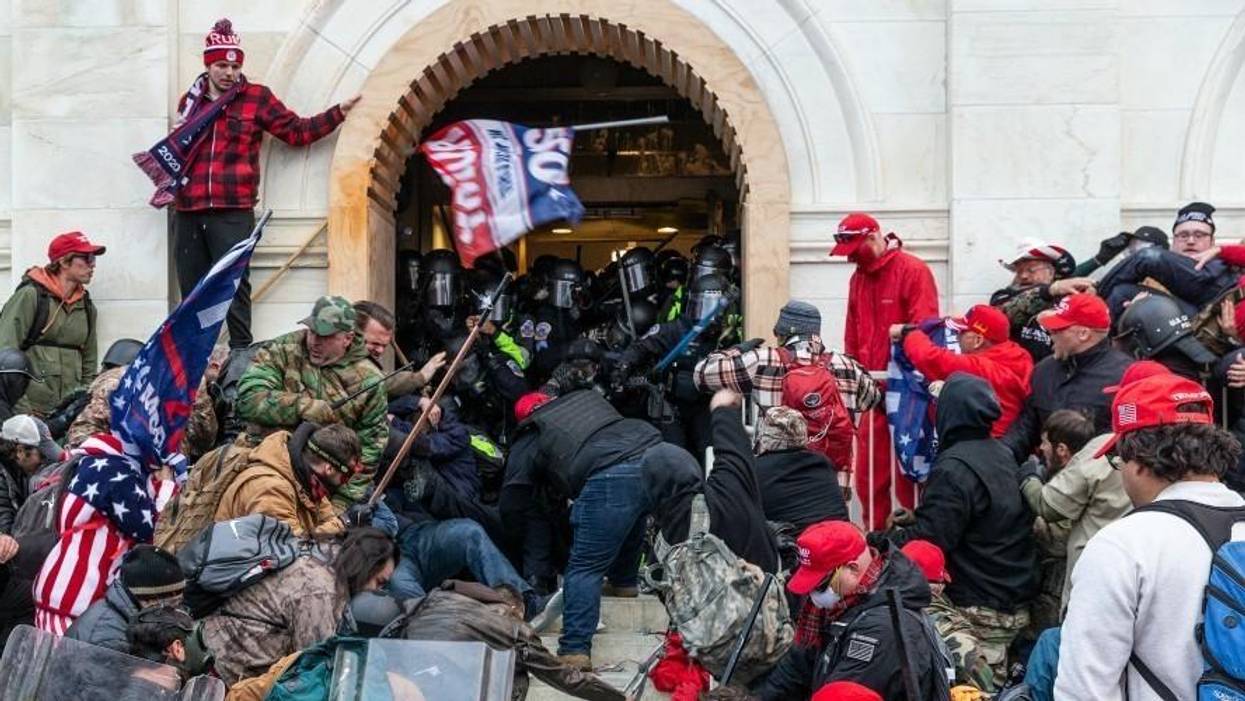
Warning that the Republican Party--which "remains under the sway" of former President Donald Trump--poses a "serious danger" to U.S. democracy, a group of writers, academics, and political activists spanning the ideological spectrum published an open letter Wednesday imploring Americans to come together despite their differences to "defend the things we value in common."
"The threat to liberal democracy has never been greater in our lifetime."
"Some of us are Democrats and others Republicans. Some identify with the left, some with the right, and some with neither," the letter states. "But right now we agree on a fundamental point: We need to join together to defend liberal democracy."
"Liberal democracy depends on free and fair elections, respect for the rights of others, the rule of law, a commitment to truth, and tolerance in our public discourse," the authors assert. "All of these are now in serious danger."
The letter continues:
The primary source of this danger is one of our two major national parties, the Republican Party, which remains under the sway of Donald Trump and Trumpist authoritarianism. Unimpeded by Trump's defeat in 2020 and unfazed by the January 6 insurrection, Trump and his supporters actively work to exploit anxieties and prejudices, to promote reckless hostility to the truth and to Americans who disagree with them, and to discredit the very practice of free and fair elections in which winners and losers respect the peaceful transfer of power.
The signers--who run the gamut from leftists including Noam Chomsky and Adolph Reed Jr. to right-wing figures like Max Boot and Mona Charen--"vigorously oppose" GOP-led voter disenfranchisement laws, as well as efforts to overturn elections.
They also urge the Democrat-controlled U.S. Congress to "pass effective, national legislation to protect the vote and our elections, and if necessary to override the Senate filibuster rule."
"We urge all responsible citizens who care about democracy--public officials, journalists, educators, activists, ordinary citizens--to make the defense of democracy an urgent priority now," the letter implores. "Now is the time for leaders in all walks of life--for citizens of all political backgrounds and persuasions--to come to the aid of the republic."
Related Content

Author and Indiana University political science professor Jeffrey C. Isaac, one of the letter's three authors, wrote Wednesday for Common Dreams that "the threat to liberal democracy has never been greater in our lifetime" than it is right now.
"Some of our signatories have long been aligned with the anti-war movement and with the Sanders wing of the Democratic party," Isaac noted. "Some have been aligned with the more centrist Obama-Clinton-Biden wing. Some were supporters of John McCain or Mitt Romney, and some--most notably Bill Kristol--were supporters of George W. Bush and of Ronald Reagan before him... And yet we have come together behind the letter."
"My collaborators and I believe it is important to come together with all of those who are willing to join in defense of democracy."
"We have not checked our differences at the door," Isaac said, noting that "many who will read this will be angry about what some of our signatories have said or done in the past."
However, he stressed that "my collaborators and I believe it is important to come together with all of those who are willing to join in defense of democracy."
Issac stressed that the moment demands "coming together, across differences, to defend the things that we value in common."
"Perhaps Benjamin Franklin said it best," he added, "at another moment when some very different people came together to oppose the tyranny of their time: 'We must, indeed, all hang together or, most assuredly, we shall all hang separately.'"
Twenty-four years ago, I published an essay titled "Liberals, I Do Despise" in the Village Voice, which Common Dreams reprinted as an enduring oldie in 2009. The title was a play on an old doggerel, in this case rendering it:
Liberals and flies, I do despise
The more I see liberals, the more I like flies.
I wrote the essay in disgust after Bill Clinton concluded his and other New Democrats' deal with the devil by signing the 1996 Personal Responsibility and Work Opportunity Reconciliation Act--welfare reform--that ended the federal government's sixty-year commitment to direct income provision for the indigent. That emphatically punctuated Clinton's bulldozing of the left in Democratic politics and ushered in the bipartisan neoliberal regime under which we've lived ever since. Welfare "deform," as many characterized it at the time, was a culmination of the year that began with Clinton using his State of the Union address to declare that "The era of big government is over." As New Labour neoliberal Tony Blair was, by her own account, Margaret Thatcher's greatest achievement, Bill Clinton consolidated Reaganism as hegemonic in American politics, defined the neoliberal regime of upward redistribution and repression of the poor as the unchallengeable horizon of political aspiration. The essay comes to mind at this moment because so many liberal Democrats now in their dismissals and attacks regarding Bernie Sanders' campaign for the party's presidential nomination seem to be rehearsing the kind of smug, self-righteous, and backward arguments they made then about why it was necessary to sacrifice poor people--ultimately variants of a contention that commitment to egalitarian principles is naive.
In the mid-1990s I reflected on how often it is liberals who enable, even abet, the rise of reactionary forces by accommodating them and treating them as legitimate, looking the other way at the dangerous aspects and implications of their agendas. Mass disfranchisement of black Americans in the South at the end of the nineteenth century was on its face in clear violation of the Fourteenth and Fifteenth Amendments. Southern Democrats used gossamer thin subterfuge--like the eight-box rule that required ballots to be deposited into as many different boxes; literacy tests, which could be waived if the registrar vouched for the registrant's character or if the applicant had a grandfather who was eligible to vote before 1867 (found unconstitutional in 1915); and poll taxes--that enabled northern Republicans to take the violations of African Americans' basic citizenship rights in stride with a wink and nod because those exclusions weren't based explicitly on race. Or at least most of them; the white primary required a little more active denial.
Later in our history, proto-fascistic Cold War anticommunism got a sanitizing boost from liberals who, while wringing their hands, wrinkling their brows and privately tut-tutting about supposedly extraordinary "excesses," validated persecution with their embrace of the notion that the dangers of "subversion" could necessitate denial of victims' civil liberties, criminalization of ideas, and witch-hunting. Americans for Democratic Action, long the avatar of Democratic liberalism, was founded specifically as an engine of Cold War attack on the left, and high-minded liberal institutions like the American Association of University Professors (AAUP) and the ACLU, as well as most prominent liberal intellectuals, capitulated to and rationalized anticommunist witch-hunting, most of all by accepting the premise that a shadowy "subversion" threatened the republic, which then justified persecution of those held to endorse it. With the collapse of the Soviet Union and nominal end of the Cold War, and especially in the post-9/11 world, "subversion" has been recast as "terrorism," and liberals' concerns with process and appearance of judicious orderliness shifted accordingly, to parse such issues as how to occupy a country humanely, at what point aggressive interrogation becomes torture, under what conditions killing civilians is acceptable, etc.
Liberal complicity stands out especially in its unwavering support for American imperialism and denial of other nations' sovereignty--most dramatically in the form of military intervention--notwithstanding a sleight of hand that can make support for war-making seem like opposition to it. Even before the genocidal Vietnam War, American liberals supported and rationalized U.S. interference and perpetration of coups in other nations across the globe, from Iran to Guatemala and elsewhere, well before "regime change" became a coinage. [For a more general compendium, see here and here.] Indeed, liberals played a central role in crafting the idea of humanitarian intervention, which, perversely, represents bombing people as somehow for their own good.
"This history is important for understanding the seriousness of the political moment that confronts us between now and November and beyond."
Mainstream liberals' main criterion for assessing a military intervention is whether or not it can attain U.S. objectives neatly and with limited American casualties. Under Bill Clinton, George W. Bush, Barack Obama, and Donald Trump, they've supported and rationalized military adventurism and extrajudicial killing of non-combatants, among other horrors, in the Middle East and elsewhere. Closer to home, Democratic liberals in the post-9/11 period have colluded in fictions that U.S.-backed coups and coup attempts in Honduras and Venezuela were the product of popular uprisings, and that the constitutional coups--when reactionary plotters seized power through claiming bogus constitutional authority and levying bogus charges of corruption--in Brazil and Bolivia were also expressions of popular will. Liberals have embraced and rehearsed obviously false golpista narratives and accusations against legitimately elected leftist governments without hesitation or shame.
This history of liberal support for authoritarianism and dictatorship is especially significant at this moment as a tide of authoritarian neoliberalism has been rising all over the world. Orban in Hungary, Erdogan in Turkey, Modi in India, Bolsonaro in Brazil, Salvini in Italy, Poroshenko in Ukraine, and for that matter Boris Johnson in the United Kingdom demonstrate that the neoliberal program of regressive transfer does not require popular democracy. Popular oversight instead has been a hindrance to regimes of neoliberalization since Reagan and Thatcher, and those pursuing such agendas have commonly sought to insulate their programs from popular democratic processes, behind special commissions and other unelected bodies.
Watching Speaker of the House Nancy Pelosi proudly applauding and then standing for a photo-op with Venezuelan fraud and third-rate coup-plotter Juan Guaido during and after Trump's 2020 State of the Union message and recalling her and other liberal Democrats' collusion in the boldfaced lie that duly elected President Nicolas Maduro is a ruthless dictator and their propagation of the preposterous fiction that Guaido, though all but unknown in Venezuela, is somehow the country's legitimate "interim president" (a title more recently claimed also by religio-fascist usurper Jeanine Anez Chavez in Bolivia) underscores the lack of regard, even contempt, these Democratic neoliberals have for popular democracy. They've shown it before, of course.
Many of them remain livid to this day about what they perceive as Ralph Nader's irresponsible third-party challenge 2000, when the Democrats put forth a Republican-in-all-but-name ticket of Al Gore and Joe Lieberman. Not only did Nader not cost Gore the election: the Vice-President would not fight for Florida because he didn't want to be identified with the militant groups urging him to do so; even so, if he'd won Tennessee--his home state--Florida wouldn't have mattered. Most telling about the Democrats' outrage at Nader, though, is the astounding, profoundly anti-democratic sense of entitlement on which it rested, the idea that Democrats in effect own every left-of-center vote without having to do anything to earn them. Their outrage was very much of the "Who does he think he is to try to take our vote" variety, never acknowledging that the party's having put forward the most conservative Democratic ticket since Woodrow Wilson may have influenced Nader's decision to run. By that point in time, Democratic elites were already fully committed to their course of dismissing working people and their concerns only to say in effect, as a close comrade put it at the time: "Don't worry; we'll come back for you after we take care of the investor class; besides, what else can you do? Look at how terrible the other guy is!" Hillary Clinton and her confederates at the Democratic National Committee showed the same contemptuous, anti-democratic sense of entitlement in 2016.
This history is important for understanding the seriousness of the political moment that confronts us between now and November and beyond. In the past several weeks the level of hysteria in the nonstop corporate media and Democratic Party elite effort to dismiss or discredit Bernie Sanders' campaign for the party's presidential nomination has ratcheted up. This isn't really a surprise, or it shouldn't be. Since 2016, it has become ever clearer that much of the Democratic establishment and its propaganda organs--MSNBC first among them--are more worried about a victory of the left than about Trump's re-election. As the Sanders campaign and the political movement propelling it continue to make headway, those forces have become more shrill and over-the-top, with many openly calling for coalescence around a need to stop Sanders from becoming the party's nominee as the central Democratic objective for 2020. Corporate Democrat hacks and retainers like Chris Matthews, Chuck Todd, et al. have begun hysterically evoking paranoid Birchite fantasies, like Matthews' recent assertion that Medicare for All will ensue in mass executions in Central Park. Second-string hack Maria Teresa Kumar put her finger on the neoliberal Democrats' dilemma when she insisted that attacking the billionaire class will backfire on the party if it follows the Sanders line because "there's not an American that wakes up every single morning and doesn't say 'I'm going to get up in the morning so that I someday either can be rich or my kid can be rich.'"
"Since 2016, it has become ever clearer that much of the Democratic establishment and its propaganda organs--MSNBC first among them--are more worried about a victory of the left than about Trump's re-election."
The problem for Kumar, Todd, et al. and the interests they serve is that no one is saying that any more--if many grown people ever did--because hegemonic neoliberalism has lost the confidence of masses of working-class people. As a moral economy, after forty years of false promises, scapegoating, and subterfuge, it has largely run out of steam. It delivers for fewer and fewer people, which after all was always the point, and the bromides of its free-market utopian ideology ring increasingly hollow. It doesn't take long to recognize that what has been sold as sky's-the-limit/you-can-be-as-rich-as-you-want-to-be flexible entrepreneurialism in the new gig economy is in reality precarious employment with no rights or benefits, or that promises to improve the quality of public goods and services from education to water and sanitation by introducing "choice" into vital public institutions means turning them into profit centers for private interests at the expense of the public good. People notice a health care system geared far more to profit-taking by insurance and pharmaceutical companies than to their own health and wellbeing.
We may be rapidly approaching a point at which there are only two credible roads forward electorally. Both authoritarian neoliberalism and the populist leftism represented by the Pink Tide in Latin America, Jeremy Corbyn in the U.K., and Bernie Sanders in the U.S. have emerged and gained momentum as alternative responses to the bankruptcy of the familiar neoliberal regime as both rhetoric and practice. It is understandable that corporate Democrats and investor class liberals will fight to preserve the current order with its shibboleths and flimflam, supported by the fictions of groupist identity politics, that present individual upward mobility as the equivalent of collective security. Hillary Clinton was a terrible candidate, to be sure, but Trump's victory, along with the advances made by authoritarian neoliberals elsewhere, points to something else as well, something far more sinister.
Just after the 2016 election, I reflected on the late labor leader Anthony Mazzocchi's warning more than two decades prior that Democratic neoliberals would have nothing to offer those people who have been or fear being ground up by the decades of relentless capitalist attack on living and working conditions. He warned that if the left and the labor movement didn't find ways to connect with that growing population of those hurting and to offer credible explanations of the sources of their condition and plausible strategies for fighting back, other, nasty and dangerous tendencies would. Here we are. Trump and Trumpism are committed to galvanizing the most reactionary and dangerous elements in the society and must be defeated. If not, things could become very ugly in this country.
I have no doubt that the Democratic liberals who fear that Sanders is "unelectable" are genuine in their belief. They also want and need for him to be unelectable because for them the really significant divisions in the society must not be those between economic classes. As Kumar puts it, "There's plenty of billionaires that are actually aligned with this whole proposal of what America should look like," by which she meant a country in which any one individual can become rich without regard to identity-group status. Todd picked up the baton to suggest that opposition to the billionaire class hurts Democrats with voters of color in particular, who in his mind aspire to be rich. (Neoliberal Democrats' propensity for ventriloquizing black people is amazing, and often amazingly ridiculous.) From the standpoint of those liberals tied to investor-class interests, a Trump victory in 2020, even if it were to raise a serious threat of authoritarianism, could be less disturbing than a Sanders-led, left-tacking political realignment. And, much as the Clinton administration's liberal architects of welfare reform dismissed their left critics as tendentious and naive--until those critics were proven right--liberals' insistence that Sanders can't win preempts, at least for now, questions about what they would do if he were to win the nomination. Would they support him? Would they follow Bloomberg, or someone else, on a third-party ticket?
"From the standpoint of those liberals tied to investor-class interests, a Trump victory in 2020, even if it were to raise a serious threat of authoritarianism, could be less disturbing than a Sanders-led, left-tacking political realignment."
We don't know the answers to those questions, but I have my suspicions. I suspect that there's a decent likelihood that some neoliberal Democratic elites would try to bring Sanders' candidacy down while blaming him for forcing them to do so by standing for a clear working-class agenda, which they "know" can't win. Contrary to that view, my sense is that Sanders is the Democrat with the best chance to defeat Trump in November, not least because we know that in 2016 millions of Trump voters had previously voted for Sanders in the primaries and for Obama--no doubt under the same sort of mistaken identity from which they voted for Trump--at least once. And they voted for Sanders as a clear and uncompromising voice for working people's concerns.
Here's what it comes down to: to what extent are liberal Democrats' commitments to democracy and democratic institutions greater than their commitments to current forms of capitalist hierarchy? That's what we'll determine between now and November, and the answer might have everything to say about the future of American politics and of the left within it. This may be a political moment when one or the other commitment must take precedence. Liberals characteristically embrace high-minded ideals of constitutionalism, due process, tolerance and "rule of law," which they've been chattering about quite a bit lately.
We know as well, however, that, when they've perceived their class's interests to be threatened, they've also found ways to justify suspension of the rule of law and due process and to tolerate death squads. I suppose we'll just see.

After the San Francisco Board of Education unanimously voted to paint over a Depression-era mural cycle depicting George Washington as a slaveholder and perpetrator of genocide against Native Americans, 139 academics, artists, and activists signed an open letter this week decrying the board's decision as a "display of contempt for history" and urging it to reverse course.
"In a recent vote, the board of the San Francisco Unified School District voted unanimously to destroy the murals," reads the letter, which is expected to be delivered Friday to the San Francisco school board. "To repeat: they voted to destroy a significant monument of anti-racism. This is a gross violation of logic and sense."
"The undersigned oppose the school board's decision and the wrong-headed approach to art and to history that lie behind that decision. We urge the school board to reverse its decision and take all reasonable steps to preserve the mural and to teach it as a work of art and as a representation of our history."
--open letter
Located in San Francisco's George Washington High School, the 1,600-square foot mural was painted by Russian-born immigrant and communist Victor Arnautoff in 1937 as part of Franklin Delano Roosevelt's Works Progress Administration.
As the Associated Press described the mural, "The first president's rise to power is shown across 13 frescoes, including one that depicts slaves working on Washington's property and white men stepping past the body of a slain Native American."
The work has been a source of heated controversy for decades, with some students and activists characterizing it as an offensive and racist portrayal of Native and African Americans. Others have said the mural has historical value and should be preserved, but is not appropriate for a public high school.
The San Francisco school board said it plans to archive the mural in digital form.
"No one has the right to tell us as native people--or our young people who walk those halls everyday--how they feel," Paloma Flores, the San Francisco school district's Native American education program coordinator, said during a hearing on the mural last month. "You're not in those shoes."
But the George Washington High School Alumni Association expressed opposition to destruction of the paintings in a statement earlier this year, saying the murals "should be preserved for their artistic, historical, and educational value."
"There are many New Deal murals depicting the founding of our country; very few even acknowledge slavery or the Native genocide," the association said. "Whitewashing them will simply result in another 'whitewash' of the full truth about American history."
Speaking to the AP on the controversy, Richard Walker, a professor emeritus of geography and director of the "Living New Deal" project at the University of California, Berkeley, explained that Arnautoff's mural was specifically conceived and painted to show the "uncomfortable facts" about Washington's life and legacy.
Though not a signatory to the open letter, Walker also opposes the mural's destruction.
"We on the left ought to welcome the honest portrayal," he told AP, adding that destroying a piece of art "is the worst way we can deal with historic malfeasance, historic evils."
In their open letter, the scholars and activists deploring the school board's decision argue that the "meaning and commitments" of Arnautoff's work "are not in dispute."
"It exposes and denounces in pictorial form the U.S. history of racism and colonialism," the letter reads. "The only viewers who should feel unsafe before this mural are racists."
"Let's set aside the question of the voices calling for the murals' destruction and their authority to speak for the communities they claim as their own," the letter continues. "What remains is a mistake in the way we react to historical works of art--ignoring their meaning in favor of our feelings about them--and a mistake in the way we treat historical works of art--using them as tools for managing feelings, rather than as objects of interpretation."
"Let's stand up for the integrity of art as well as for historical interpretation," the letter adds, "and for a shared analysis of the political reality of the United States in the past and the present."
Read the full open letter, originally posted to Nonsite.org, below:
Open Letter on the Proposed Destruction of a Mural Cycle
A Federal Art Project mural cycle of thirteen panels devised and painted by Victor Arnautoff in 1936 in a San Francisco high school portrays George Washington as a slave owner and as the author of Native-American genocide. It is an important work of art, produced for all Americans under the auspices of a federal government seeking to ensure the survival of art during the Great Depression. Its meaning and commitments are not in dispute. It exposes and denounces in pictorial form the U.S. history of racism and colonialism. The only viewers who should feel unsafe before this mural are racists.
Now, however, activists including a number of students are seeking the destruction--not the concealment or contextualization--of the mural. The reasons they give--in public comment, in interviews, in the board's statements--are various, but they all depend on rejecting the objective analysis of historical exploitation and colonial violence the mural offers and replacing it with activists' valorization of their experiences of discomfort with the imagery and the authorship of the murals. On this account, a Russian immigrant cannot denounce historical wrongs by depicting them critically. On this account, only members of the affected communities can speak to such issues and only representations of history that affirm values they approve are suitable for their communities. On this account, representing historical misdeeds is degrading to some members of today's student body. In a recent vote, the board of the San Francisco Unified School District voted unanimously to destroy the murals. To repeat: they voted to destroy a significant monument of anti-racism. This is a gross violation of logic and sense.
Let's set aside the question of the voices calling for the murals' destruction and their authority to speak for the communities they claim as their own. What remains is a mistake in the way we react to historical works of art--ignoring their meaning in favor of our feelings about them--and a mistake in the way we treat historical works of art--using them as tools for managing feelings, rather than as objects of interpretation. Let's stand up for the integrity of art as well as for historical interpretation, and for a shared analysis of the political reality of the United States in the past and the present.
The undersigned oppose the school board's decision and the wrong-headed approach to art and to history that lie behind that decision. We urge the school board to reverse its decision and take all reasonable steps to preserve the mural and to teach it as a work of art and as a representation of our history. We oppose this display of contempt for history.
To hear public comment preceding the board's vote, follow this link. (Discussion of the mural begins about ten minutes into the recording.)
At the end of the week, we will send this letter and list of signatories to the board members of the SFUSD. To add your signature, e-mail your name and institutional affiliation (if desired) to SanFranciscoMuralOutrage@yahoo.com
Signed,
Thomas J. Adams, University of Sydney
Bridget Alsdorf, Department of Art & Archaeology, Princeton University
Jennifer Ashton, English Department, University of Illinois at Chicago
Jerry August, Los Angeles Unified School District
Leslie Bary, University of Louisiana
Barbara Bernstein, New Deal Art Registry
Jennifer Bethke, Department of Art and Art History, Sonoma State University
Elizabeth Bishop, Universite d'Oran 2 Mohamed Ben Ahmed
Michele Bogart, Stony Brook University
Cale Brooks, NYC Democratic Socialists of America Medicare for All campaign
Nicholas Brown, Departments of English and African American Studies, University of Illinois at Chicago
Joanna Bujes, SIG Docs, San Francisco
Stephen Campbell, Department of the History of Art, Johns Hopkins University
Michael Cavadias, actor, writer, NYC-DSA Citywide Leadership Committee
Sarah Cate, Department of Political Science, Saint Louis University
Bi-Ling Chen, University of Central Arkansas
Robert W. Cherny, emeritus, San Francisco State University
Merlin Chowkwanyun, Columbia University
Kevin Chua, Texas Tech University
Nicholas Copeland, Virginia Polytechnic Institute
Todd Cronan, Art History Department, Emory University
Michael Davis, emeritus, University of California, Riverside
Bindu Desai, M.D., Albany, Calif.
Martha Louise Deutscher
Eugenio Di Stefano, Foreign Languages & Literature, University of Nebraska, Omaha
Geert Dhondt, Department of Economics, John Jay College, CUNY
Jed Dodd, Vice President, BMWED-Teamsters
Madhu Dubey, Departments of English and African American Studies, University of Illinois at Chicago
Jacob Edwards, Tulane University
Robert Eshelman-Hakansson, Columbia Journalism School
Sarah Evans, School of Art and Design, Northern Illinois University
Liza Featherstone, The Nation and Jacobin, New York University and Columbia University
Michael Fiday, College-Conservatory of Music, University of Cincinnati
Carlos Figueroa, Ithaca College
Anne-Lise Francois, University of California, Berkeley
Amy Freund, Department of Art History, Southern Methodist University
Michael Fried, emeritus, Johns Hopkins University
Amber A'Lee Frost, writer and journalist
Judith K. Gardener, Chicago, Ill.
Joy Garnett
Sarah Gleeson-White, Department of English, University of Sydney
Hon. Ruth Y. Goldway, ret. chair and commissioner, U.S. Postal Regulatory Commission, former mayor, Santa Monica, Calif.
Marie Gottschalk, Political Science Department, University of Pennsylvania
Steven Hahn, New York University
John Halle, composer and pianist
Theodore Hamm, St. Joseph's College, Brooklyn, N.Y.
Jonathan Harwitz, Low Income Investment Fund
David Harvey, Graduate Center, CUNY
Charles Hatfield, University of Texas at Dallas
Andrew Hemingway, emeritus, Department of the History of Art, University College London
Andrew Hsiao, Verso Books
Forrest Hylton, Ciencia Politica, Universidad Nacional de Colombia-Sede Medellin
William Issel, San Francisco State University
Anton Jager, Cambridge University
Cedric G. Johnson, University of Illinois at Chicago
Robert Flynn Johnson, emeritus, Fine Arts Museums of San Francisco
Ramsey Kanaan, publisher, PM Press
Cindi Katz, Graduate Center, CUNY
Christina Kiaer, Department of Art History, Northwestern University
Phil King, artist and editor
Joel Kohen
Anna Kornbluh, University of Illinois at Chicago
Steven Kovacs, School of Cinema, San Francisco State University and George Washington High School alumnus
Brandon Kreitler, CUNY
Benjamin Kunkel, author
Gordon Lafer, University of Oregon
Roger N. Lancaster, George Mason University
Denis Lavinski, artist, Los Angeles
Virginia Leavell, University of California, Santa Barbara
Anthony W. Lee, Mount Holyoke College
Robert Lehman, English Department, Boston College
Robert D. Leighninger Jr.
Yasha Levine, author, investigative journalist, Washington High School alumnus
Howard Levy
Ruth Leys, emeritus, Johns Hopkins University
Siv B. Lie, School of Music, University of Maryland, College Park
Sasha Lilley, KPFA Radio
Leslie Lopez, LaborFest Hawai'i
Kilynn Lunsford, Philadelphia DSA, Unite Here local 274
Seth Kahn, Professor of English, West Chester University of Pennsylvania
Carl G. Martin, Norwich University
Anna McKittrick, Emory University
Christopher Mead, University of Utah
Elizabeth Mead, Department of Art and Art History, College of William & Mary
William J. Mello, Indiana University
Walter Benn Michaels, English Department, University of Illinois at Chicago
Mark Crispin Miller, Department of Media, Culture, and Communication, New York University
Daniel Moak, African American Studies, Ohio University
Balaji Narasimhan, Los Altos, Calif.
Zoika Naskova
Deborah Nelson, University of Chicago
Anne Norton, Political Science Department, University of Pennsylvania
James Oakes, Graduate Center, CUNY
Charles Palermo, Department of Art and Art History and Film and Media Studies Program, College of William & Mary
Christian Parenti, Department of Economics, John Jay College, CUNY
Michael Pierce, Department of History, University of Arkansas
Lawrence N. Powell, Tulane University
Paul Prescod, Philadelphia Federation of Teachers
Adam Proctor, Dead Pundits Society
Joseph G. Ramsey, Departments of English and American Studies, University of Massachusetts, Boston
Courtney Rawlings, Emory University
Orlando Reade, English Department, Princeton University
Adolph Reed, Jr., emeritus, Political Science Department, University of Pennsylvania
Toure Reed, Department of History, Illinois State University
Laurie Jo Reynolds, Art Department, University of Illinois at Chicago
Mark Rosen, University of Texas at Dallas
James H. Rubin, Department of Art, Stony Brook University
David Schaafsma, Department of English, University of Illinois at Chicago
Jesse Schaefer, former George Washington High School student
Michael Schreyach, Department of Art and Art History, Trinity University
Julie Seville, History Department, University of Chicago
Joseph Shieber, Lafayette College
Korey Simeone, Los Angeles
Lisa Siraganian, Southern Methodist University
Jedidiah Sloboda, Philadelphia School District
John Curtis Smith, Wake Technical Community College
Preston H. Smith II, Mount Holyoke College
Rogers M. Smith, Political Science Department, University of Pennsylvania
Davis Smith-Brecheisen, University of Illinois at Chicago
Daniel Spaulding, Getty Research Institute
Michael Spear, Kingsborough Community College, CUNY
Joni Spigler, artist and art historian
Amy Dru Stanley, Department of History and the Law School, University of Chicago
Timothy Stewart-Winter, Department of History, Rutgers University--Newark
Steve Striffler, Anthropology Department, University of Massachusetts, Boston
Ted Swedenburg, Department of Anthropology, University of Arkansas
Rei Terada, University of California, Irvine
Lisa Thompson, The Living New Deal
Joe Tompkins, Department of Communication Arts and Theatre, Allegheny College
James A. van Dyke, University of Missouri
Robert Vitalis, Political Science Department, University of Pennsylvania
Christian Viveros-Faune, Contemporary Art Museum, University of South Florida
Kenneth Warren, Department of English, Center for the Study of Race, Politics, and Culture, University of Chicago
Shilyh Warren, University of Texas at Dallas
Mark W. Wolfe, Emory University
George Wright, emeritus, California State University, Chico
Joanna Wuest, Princeton University
Marnin Young, Art History Department, Stern College for Women, Yeshiva University
Daniel Zamora, Universite Libre de Bruxelles
In a party that officially condemns dog-whistle appeals to racism, Joe Biden is running on Orwellian eggshells. Whether he can win the Democratic presidential nomination may largely depend on the extent of "doublethink" that George Orwell described in 1984 as the willingness "to forget any fact that has become inconvenient."
It is an inconvenient fact that Biden has a political history of blowing into dog whistles for racism. More than ever, the Democratic electorate is repelled by that kind of pitch. If his dog-whistling past becomes a major issue, the former vice president and his defenders will face the challenge of twisting themselves into rhetorical pretzels to deny what is apparent from the video record of Biden oratory on the Senate floor that spanned into the last decade of the 20th century.
Biden is eager to deflect any prospective attention from his own history of trafficking in white malice and racial division. When he tweeted this week that "our politics today has become so mean and petty--it traffics in division and our president is the divider in chief," Biden was executing a high jump over the despicably low standards set by Donald Trump.
A key question remains: Does it matter that Biden was a shrill purveyor of tropes, racist stereotypes and legislation aimed at African Americans? During pivotal moments in the history of race relations in this country, from the 1970s to the 1990s, Biden's hot air manifested as pitches to white racism. From the outset of his career on Capitol Hill, he even stooped to reaching out to some of the worst segregationist senators from the South to advance his legislative agenda against busing.
As Adolph Reed and Cornel West noted this month in the Guardian, Biden began his racially laced approach to lawmaking soon after arrival in the Senate, when he "earned sharp criticism from both the NAACP and ACLU in the 1970s for his aggressive opposition to school busing as a tool for achieving school desegregation."
That was no fluke. "In 1984," Reed and West recount, Biden "joined with South Carolina's arch-racist Strom Thurmond to sponsor the Comprehensive Crime Control Act, which eliminated parole for federal prisoners and limited the amount of time sentences could be reduced for good behavior. He and Thurmond joined hands to push 1986 and 1988 drug enforcement legislation that created the nefarious sentencing disparity between crack and powder cocaine as well as other draconian measures that implicate him as one of the initiators of what became mass incarceration."
It's likely that no lawmaker did more to bring about the mass incarceration of black people during recent decades than Joe Biden. In an understated account last week, The Hill newspaper reported that Senator Biden "was instrumental in pushing for the [1994] crime bill, which critics have said led to a spike in incarceration, particularly among African Americans."
Yet Biden is now eager to project an image as a longtime ally of people of color. In short, journalists Kevin Gosztola and Brian Sonenstein wrote recently, he is in a race between his actual past and his PR baloney.
As the leading advocate for what became the infamous 1994 crime bill, Biden stood on the Senate floor and declared: "We must take back the streets. It doesn't matter whether or not the person that is accosting your son or daughter or my son or daughter, my wife, your husband, my mother, your parents, it doesn't matter whether or not they were deprived as a youth. It doesn't matter whether or not they had no background that enabled them to become socialized into the fabric of society. It doesn't matter whether or not they're the victims of society. The end result is they're about to knock my mother on the head with a lead pipe, shoot my sister, beat up my wife, take on my sons."
And Biden proclaimed with fervor that echoed right-wing dogma: "I don't care why someone is a malefactor in society. I don't care why someone is antisocial. I don't care why they've become a sociopath. We have an obligation to cordon them off from the rest of society."
Paste writer Shane Ryan pointed out the unsubtle subtexts of Biden's speechifying: "This is the language of demonization, and even without the underlying racial element, it would be offensive to describe Americans this way, and to brush aside the societal conditions that lead to violent crime as though they're irrelevant. But, of course, the racial element is not just present, but profound. It's impossible to read these remarks, complete with dehumanizing rhetoric, without coming to the conclusion that Biden is, in fact, talking about black crime."
At the time, even some of the members of Congress who ended up voting for the crime bill loudly warned about its dangerous downsides. One of them was Bernie Sanders (who I actively support in his run for president). While swayed by inclusion of the Violence Against Women Act in the bill, Sanders said in an April 1994 speech on the House floor: "A society which neglects, which oppresses and which disdains a very significant part of its population--which leaves them hungry, impoverished, unemployed, uneducated, and utterly without hope--will, through cause and effect, create a population which is bitter, which is angry, which is violent, and a society which is crime-ridden. And that is the case in America, and it is the case in other countries throughout the world."
In 2016, Biden was continuing to defend his key role in passage of the landmark crime bill. During recent months, gearing up for his current campaign, Biden acknowledged some of the law's negative effects while still defending it and denying its huge impacts for mass incarceration. And Biden has avoided copping to--much less expressing remorse for--the toxic, racially laced rhetoric that he used to promote the bill. He simply refuses to renounce the Senate-floor oratory that he deployed to propel the legislation to President Clinton's desk.
Unfortunately for Biden, online video is available that conveys not only his words but also the audibly arrogant tone with which he delivered them.
What does all this add up to? Anyone who doubts that Biden methodically mined racist political shafts for decades should read the well-documented New York magazine piece "Will Black Voters Still Love Biden When They Remember Who He Was?" It's devastating.
The New York article, by journalist Eric Levitz, begins with the tip of a very cold white iceberg: "Biden once called state-mandated school integration 'the most racist concept you can come up with,' and Barack Obama 'the first sort of mainstream African American who is articulate and bright and clean.' He was a staunch opponent of 'forced busing' in the 1970s, and leading crusader for mass incarceration throughout the '80s and '90s. Uncle Joe has described African-American felons as 'predators' too sociopathic to rehabilitate--and white supremacist senators as his friends."
Such clear overviews of Biden's racial behavior in politics have been rare. And news media have not illuminated what all this has to do with "electability." Turnout from the Democratic Party's base will be crucial to whether Trump can be defeated in November 2020. Biden's record of dog-whistling is made to order for depressing enthusiasm and turnout from that base, especially among African Americans.
Apt to be a big political liability among voters who normally vote Democratic in large numbers, Joe Biden's historic dog-whistling for racism is an incontrovertible reality. Denial of that reality could help him win the party's nomination--and then help Donald Trump get re-elected.

Amid growing fears that Democratic political leaders are not taking seriously the possibility that President Donald Trump could refuse to yield power if he loses in the 2020 election, progressive critics are voicing concern over Trump's retweet over the weekend of a post calling for two years to be added to his first term as "pay back for time stolen" by the Mueller investigation.
Written by right-wing Liberty University head Jerry Falwell, Jr. and boosted by the president Sunday evening, the tweet stated Trump "should have 2 yrs added to his 1st term" as "reparations" for the recently completed Mueller probe.
"It may seem nuts," Adolph Reed, Jr., professor of political science at the University of Pennsylvania, said of Falwell's tweet in an email to Common Dreams, "but I do think this is worth paying attention to."
"The Trump administration," said Reed, "obviously is contemptuous of procedural democracy, as are Republicans in Congress and elsewhere."
From Reed's perspective, "the Republicans' decades-long campaign to demonize and undermine popular and democratic institutions, suppress voting, forge a political alliance based on the most dangerously reactionary and irrationalist elements of the society and committed to eliminating all restraint to capitalist class power is particularly chilling."
"The confrontation between the House Democrats and the Trump administration over access to his tax returns and the executive branch's requirement to honor congressional subpoenas," said Reed, could prove far more consequential in the long run than "the daily theater of palace politics."
In a column on Monday, Esquire's Jack Holmes echoed Reed's alarm at the president's apparent endorsement of a two-year term extension:
Even if this is just another absurd trial balloon, it is the latest sign that the president may have little intention of leaving office no matter the circumstances. He has already been named--albeit as "Individual-1"--in one federal indictment, which led to his longtime fixer, Michael Cohen, going to prison this Monday morning. The evidence he abused his power and obstructed justice is damning...
Democratic leaders in particular must come to grips with the fact that he probably won't leave willingly. He can't afford to--it could land him in jail.
Trump's retweet came as House Speaker Nancy Pelosi (D-Calif.) warned that Trump would refuse to give up power if Democrats don't win resoundingly in 2020. In order to to achieve such a victory, Pelosi said, the party should not run too far to the left.
"We have to inoculate against that, we have to be prepared for that," Pelosi told the New York Times. "Own the center left, own the mainstream."
Progressives were quick to reject and denounce Pelosi's suggestion that running on bold left-wing policies would be electorally harmful for Democrats.
And as historian Kevin Kruse pointed out, Trump could contest unfavorable election results regardless of the Democratic Party's approach or policy platform.
In a column published by Common Dreams on Tuesday, Jeffrey Isaac, political science professor at Indiana University, expressed concern that Pelosi herself is not sufficiently worried about the possibility that Trump could refuse to leave office.
Responding to Pelosi's remark that Trump may not "respect the election," Isaac wrote: "I don't believe that commentators have treated this comment with the seriousness that it deserves. And yet, alas, I fear that neither has Pelosi herself taken the full measure of the comment."
"What cannot be right is to claim that Trump is a danger to the republic, and to orchestrate House investigations in a politically serious way that focuses attention on this, and at the same time to meet with Trump in the White House and even feign to do deals with him," Isaac wrote, citing Pelosi's negotiations with Trump on infrastructure. "This president must be opposed, consistently and unambiguously. Period."

Vietnam came to my attention when I was maybe eleven or twelve, during the last years of the Eisenhower administration.
There must have been some uptick that prompted public anticommunist saber-rattling about what really was already the U.S. war there. My father explained to me what was going on, that the military forces of the Viet Minh, a broad coalition struggling for national independence, led by the Communist Party of Vietnam, had defeated the French army in its seven-year attempt to restore colonial rule after having been displaced by the Japanese, against whom the Viet Minh also fought, during World War II.
After that defeat an international conference--in which the U.S. participated along with Cambodia, the People's Republic of China, France, Laos, the Soviet Union, United Kingdom, the Viet Minh, and the "State of Vietnam," created by France in 1949 as a colonial puppet government--at Geneva in 1954 agreed that Vietnam would be divided temporarily at the 17th Parallel into northern and southern administrative zones and that in 1956 an election would be held to reunify the country. The State of Vietnam, later re-christened the Republic of Vietnam as a US rather than French puppet, rejected the agreement, and the United States did not sign onto it but "took note" of the ceasefire agreements and declared that it would "refrain from threat or use of force to disturb them." In fact, the U.S. openly blocked the agreed-upon reunification election because, as President Eisenhower freely acknowledged, all indications were that Ho Chi Minh, leader of the Viet Minh and Communist Party and a widely revered national patriotic figure, would have won the election. Even as a kid, I was astounded that the U.S. could so blatantly arrogate to itself a right to determine which governments or election outcomes were legitimate in other countries and to depose or impose them unilaterally, including by force and violence up to terror and assassination.
"Even as a kid, I was astounded that the U.S. could so blatantly arrogate to itself a right to determine which governments or election outcomes were legitimate in other countries and to depose or impose them unilaterally, including by force and violence up to terror and assassination."
My dad, responding to my reaction, informed me of the much more general history of U.S. interventionism, partly through introducing me to the story of Smedley D. Butler, former Marine Commandant. Butler's striking 1935 testimony is worth repeating in this political moment:
I spent 33 years and 4 months in active service as a member of our country's most agile military force--the Marine Corps. I served in all commissioned ranks from a second lieutenant to Major-General. And during that period I spent most of my time being a high-class muscle man for Big Business, for Wall Street and for the bankers. In short, I was a racketeer for capitalism. I suspected I was just part of a racket at the time. Now I am sure of it. Like all members of the profession I never had an original thought until I left the service. My mental faculties remained in suspended animation while I obeyed the orders of the higher-ups. This is typical of everyone in the military service.
Thus, I helped make Mexico and especially Tampico safe for American oil interests in 1914. I helped make Haiti and Cuba a decent place for the National City Bank boys to collect revenues in. I helped in the raping of half a dozen Central American republics for the benefit of Wall Street. The record of racketeering is long. I helped purify Nicaragua for the international banking house of Brown Brothers 1909-12. I brought light to the Dominican Republic for American sugar interests in 1916. I helped make Honduras "right" for American fruit companies in 1903. In China in 1927 I helped see to it that Standard Oil went its way unmolested. During those years, I had, as the boys in the back room would say, a swell racket. I was rewarded with honors, medals, promotion. Looking back on it, I feel I might have given Al Capone a few hints. The best he could do was to operate his racket in three city districts. We Marines operated on three continents. (Smedley D. Butler, "America's Armed Forces: In Time of Peace," Common Sense 4 [November 1935])
My father also told me about the 1954 military coup against the legitimately elected government of Jacobo Arbenz in Guatemala. The U.S. government--through the CIA--armed, trained, and funded a military force to overthrow Arbenz and install a brutal military dictatorship, on the claim that Arbenz was soft on communism and, oh by the way, had ended exploitative labor practices from which the US-based United Fruit Company had benefitted.
And he also told me about the joint U.S./British coup in 1953 against Mohammad Mosaddegh, prime minister of the government of Iran, who had had the temerity to propose auditing the books of the Anglo-Iranian Oil Company and limiting the company's control over Iranian oil reserves. The coup installed a brutal dictatorship led first briefly by the military and then until the late 1970s by the repressive, kleptocratic monarchy of the Shah, Mohammad Reza Pahlavi. It was the U.S. imposition of the Shah, and its continuing support of his rule, that gave the 1979 revolution that overthrew him its anti-American character, not any bullshit like opposition to "modernity" or hating us for our freedom.
"It was the U.S. imposition of the Shah, and its continuing support of his rule, that gave the 1979 revolution that overthrew him its anti-American character, not any bullshit like opposition to 'modernity' or hating us for our freedom."
The U.S. remained a dominant political force in Guatemala after the 1954 coup against Arbenz. From the 1960s until well into the 1990s, one military dictatorship after another unleashed death squads and perpetrated massacres of indigenous populations suspected of alignment with the insurgent opposition - all with knowledge and ongoing support of the U.S. government. The more than half century of political and economic destabilization, repression, and terror encouraged and sustained by our government, although seldom discussed in this regard, has much to do with creating the conditions that send Guatemalans northward in desperate, often dangerous pursuit of safety and economic opportunity.
From the late 1950s forward I was old and aware enough to watch U.S. interventionism unfold in real time. The intervention in Vietnam expanded into a genocidal horror that continued until I was in my late twenties, of course. But there were others along the way. Like many progressives here and around the world, we followed the Cuban revolution closely, perhaps with a particular attentiveness because of our family there, and celebrated defeat of the brutal, U.S. backed dictator Fulgencio Batista. I was fourteen when the Bay of Pigs invasion, led by reactionary Cuban exiles, many of them former Batista cronies--and bankrolled, trained and supported by the John F. Kennedy administration--was repulsed by the Cuban military and militias. Less broadly known were the multiple attempts the U.S. made to assassinate Fidel Castro and its support of terrorist acts against the Cuban people, including the 1976 bombing of a Cuban airliner that killed seventy-three people. The U.S. also shielded the bombing's perpetrator, Luis Posada Carriles, from prosecution for that and other crimes until his death last year.
I was sixteen in 1963 when Juan Bosch, the first freely elected president of the Dominican Republic in nearly forty years, was overthrown by a military coup backed by the Kennedy administration. When a popular insurgency was poised to return Bosch to power in 1965, President Lyndon Johnson sent 42,000 US troops to shore up the regime installed by the coup. In 1964 the US backed a military coup in Brazil against the democratically elected government of Joao Goulart, who had, like Bosch, pursued an agenda of mildly egalitarian redistribution. Both Kennedy and Johnson administrations had plotted with the Brazilian right-wing and military to prepare and eventually execute the coup. In its aftermath Brazil was ruled by a murderous military junta until 1985.
The pattern of U.S. interventionism persisted and, if anything, increased in scale during the 1970s. In 1971 the CIA supported and participated in planning a bloody coup against the left-oriented government of Bolivia and installed reactionary Hugo Banzer's military dictatorship. The most blatant and egregious, and bloodiest, intervention during the decade--apart from the on-going carnage in Vietnam--was the 1973 coup against the popularly elected government of Salvador Allende in Chile.
"The pattern of U.S. interventionism persisted and, if anything, increased in scale during the 1970s." The military coup assassinated President Allende and unleashed a regime of extreme repression, death squads and all, and economic plunder and immiseration that beset the country until at least into the 1990s. U.S. corporations and government agencies mounted an open, concerted campaign--employing many of the techniques now on display in Venezuela, e.g., lies, disinformation, terror, economic sabotage--over several years before the coup to destabilize the Chilean economy and undermine the democratically elected government. As Ariel Dorfman and Armand Mattelart demonstrated in their wonderful book, The Empire's Old Clothes: What the Lone Ranger, Babar, and Other Innocent Heroes Do to Our Minds, even Disney and other comic books and cartoons were part of the increasingly bloodthirsty propaganda effort directed against Allende and his Unidad Popular government.
The Chilean coup installed the vicious dictatorship of Gen. Augusto Pinochet, who combined violent political repression and terror with giving control of economic policy to free-market ideologue Milton Friedman and his colleagues from the University of Chicago. Under Pinochet, Chile privatized public goods on a massive scale, became radically more unequal, and was a laboratory for the "Washington Consensus" that imposed austerity and neoliberal "reform" throughout Latin America and much of the rest of the world in the 1980s and 1990s. The misery that regime produced in Latin America eventually led to its repudiation in the "Pink Tide" of leftist governments elected in Venezuela, Bolivia, Brazil, Ecuador, Uruguay, and elsewhere in Latin America in this century.
Two years after the Chilean coup, in 1975, the U.S. and its right-wing allies, particularly in the southern cone of South America, implemented Operation Condor, a clandestine campaign of terror and assassination aimed at leftists, trade unions, and opposition political tendencies throughout the region. Operation Condor was supported by Nixon, Ford, Carter, and Reagan administrations and was a joint effort conducted by US-backed dictatorships in the region, mainly Argentina, Bolivia, Brazil, Chile, Paraguay, and Uruguay. Estimates are that under its aegis as many or more than 60,000 people were killed throughout the hemisphere, including the murder of Orlando Letelier, former Allende government official, along with co-worker Ronni Moffitt at the Institute for Policy Studies, by a car bomb in Washington, DC in 1976. The regional right-wing networks that came together in Operation Condor have persisted, as is reflected in the several joint meetings of ultra-right parties and organizations in Brazil and Venezuela as the campaigns against the governments led by the Workers Party in Brazil and the United Socialist Party of Venezuela intensified over the past decade.
In the late 1970s and 1980s, the U.S. interventionism in Central America that had continued unabated throughout the twentieth century rose to public consciousness and generated a significant protest movement in this country. In 1979, the Sandinista National Liberation Front overthrew the dynastic dictatorship of the Somoza family in Nicaragua. Instructively, the front was named for Augusto Cesar Sandino, who led resistance to the US occupation of the country from 1912 to 1934. The U.S., of course, supported the Somozas' rule until the bitter end, when President Jimmy Carter withdrew official support because of the regime's conspicuous human rights violations.
The Reagan administration, however, intensified "counterinsurgency" efforts in Central America. It waged a proxy war against the Sandinista government in contravention of Congress's specific prohibition and financed it through equally illegal arms sales to the new U.S. enemy, Iran. The U.S. proxy forces in Nicaragua--clustered in four groups of thugs known collectively as the "contras"--also apparently financed their operations via cocaine smuggling, allegedly with CIA support. The Carter administration also supported the right-wing coup in El Salvador in 1979, as well as the military dictatorship it installed, and the U.S., through both Carter and Reagan administrations, continued to bankroll that murderous dictatorship--which mounted atrocity upon atrocity, assassinations and massacres of civilians--and support it with materiel, money, and troops (euphemistically called "advisors") throughout its engagement in a twelve-year civil war against the left and other popular democratic forces. Reagan's architect/liaison to the Nicaraguan contras and the savage Salvadoran right-wing was Elliott Abrams, who recently crawled out of the sewer to serve a similar role for the Trump administration vis-a-vis Venezuela.
"The U.S. is an imperialist power that routinely disregards other nations' sovereignty, often enough violently."
This thumbnail sketch touches on most of the bigger, more dramatic cases of imperialist U.S. interventionism during the Cold War era, but it is schematic. Missing, for example, are the CIA's early 1960s machinations in the overthrow of successive governments in Ecuador, which led to sixteen years of military dictatorship and authoritarian rule; U.S. intervention in the newly independent Congo, including participating in the assassination of former prime minister Patrice Lumumba, or its plotting and participating in the bloody coup against the Sukarno government in Indonesia and subsequent atrocities.
My intention isn't to be exhaustive, only to cut through the fog of historical amnesia that obscures the reality that the U.S. is an imperialist power that routinely disregards other nations' sovereignty, often enough violently. Both Democratic and Republican administrations presume universal U.S. prerogative. It is telling that the U.S. does not recognize the authority of the International Criminal Court (ICC), which prosecutes war crimes, crimes against humanity, and genocide; indeed, Secretary of State Mike Pompeo has denied visas to ICC investigators conducting an inquiry into alleged U.S. war crimes in Afghanistan. From this perspective, it seems ironic, maybe even Freudian, that the U.S. foreign policy establishment in the Clinton administration created the notion "rogue state" to classify other governments it targeted as threats. This history also suggests something of a chickens-coming-home-to-roost quality about Russian interference in U.S. elections.
Considering that history should call for pause as the bipartisan interventionist consensus gears up once again, this time in an effort to topple the legitimately elected government of Venezuela. When I watched U.S. corporate media's straight coverage of what should have been the manifestly absurd spectacle of political unknown--less than 20 percent of the Venezuelan population had heard of him before the US anointed him--Juan Guaido's press conference declaring himself president and then swearing himself in, I couldn't decide whether it was so viscerally appalling because it reflects the extent to which post-Cold War interventionism has been normalized or because it brought to mind the automatically self-justificatory anticommunist interventionism of the pre-Vietnam years. In a matter of days, the media went from describing Guaido first as "the man who proclaimed himself president," then "the man the US recognizes as president," and then "interim president" and the elected president, Nicolas Maduro, as "self-proclaimed."
"History should call for pause as the bipartisan interventionist consensus gears up once again, this time in an effort to topple the legitimately elected government of Venezuela."
Moreover, a rhetoric centering on proclamation of "humanitarian crisis" freezes discussion of the situation in Venezuela on images of the immediate moment, ultimately not much more than captions for the decontextualized visuals, and sidesteps the political issues at stake as well as the origins of the nominal crisis. Absent from the discussion is the fact that the U.S. backed a failed 2002 coup against then second-term elected president Hugo Chavez. Similarly absent are references to other moves from the standard interventionist playbook--efforts to manipulate global commodities markets to reduce prices on key exports (e.g., oil in Venezuela, copper in Allende's Chile); freezing international assets and blockading exports and imports and then blaming the targeted government for economic instability; supporting economic and political sabotage (selective food shortages caused by grocery distributors' holding back shipments and trucking company strikes that paralyze commerce, accompanied by bogus stories of mass starvation). Nor does the overheated discussion uncritically retailed by corporate media from the official US disinformation campaign mention the right-wing opposition's history of openly inciting, provoking, and perpetrating violence, including assassination of United Socialist Party of Venezuela (PSUV) and government officials and activists, not to mention its militant denunciation of the PSUV government's egalitarian social and economic policy initiatives. And, as Max Blumenthal makes clear there is little reason to doubt that the recent countrywide blackout was the result of sabotage. [For credible, more comprehensive alternatives to the mainstream propaganda on Venezuela see here and here.]
We can only hope that the legitimately elected government of Venezuela will be able to withstand this onslaught, and that the U.S. will back away from its saber-rattling. It's a sign of the left's weakness that we can't do much more to affect U.S. policy. Nearly as disturbing as the reality of the U.S. government's disruptive efforts in Venezuela is the fact that the campaign aimed at demonizing and delegitimizing the Maduro government has provoked so little skepticism or protest in this country. In part, that lack of opposition is the product of nearly two decades of steady anti-Chavista propaganda--through Clinton, Bush, Obama, and Trump administrations--and a public discourse that has been primed to accept any outrageous charges aimed at the Bolivarian movement and government.
"Nearly as disturbing as the reality of the U.S. government's disruptive efforts in Venezuela is the fact that the campaign aimed at demonizing and delegitimizing the Maduro government has provoked so little skepticism or protest in this country."
The current effort to topple the Venezuelan government throws into relief another factor that undermines opposition to U.S. adventurism--the extent to which opposition to imperialism has been displaced by concerns with human rights violations or "humanitarian crisis" in debates about U.S. interventionism and the implications of that displacement. Others have examined the ease with which human rights discourse can accommodate imperialist agendas [see, e.g., Jean Bricmont, Humanitarian Imperialism: Using Human Rights to Sell War (Monthly Review, 2007); Samuel Moyn, Not Enough: Human Rights in an Unequal World (Belknap, 2018)]. Characterization of the situation in Venezuela as a humanitarian crisis has depoliticized discussion of the issues at stake there and debate about U.S. response. Thus proposals for a negotiated settlement, presumably with power-sharing, seem a plausible alternative to direct overthrow of the Maduro government. But the conflict in Venezuela doesn't stem from some abstract partisan polarization that could be ameliorated with the assistance of clever political scientists; it's a clash of two fundamentally and diametrically opposed understandings of how and in whose interests Venezuelan society should be organized and governed.
The opposition is rooted in the rabid right-wing and upper classes that have been militantly hostile to all of the social legislation and redistributive policies of the Chavez and Maduro governments. In addition to the failed coup against Hugo Chavez, the right has assassinated numerous local PSUV leaders and made multiple assassination attempts on President Maduro. Like its counterpart in Brazil, the Venezuelan right wing confronted the likelihood that the PSUV government was so popular with the poor and working classes that it was no longer possible to defeat it electorally. In Brazil, that concern led to a constitutional coup that impeached President Dilma Rousseff on trumped up charges and then convicted Workers Party leader and former president Luiz Inacio Lula da Silva, far and away the most popular politician in the country, on bogus corruption charges with what is effectively a life sentence behind bars [see William J. Mello and Altemar da Costa Muniz, "Class Struggle in Brazil: Who Will Defend the Working Class?"(nonsite.org, May 16, 2016); William J. Mello, "Class Struggle in Brazil: The Neoliberal Coup, an Attack on Workers and the Poor" (nonsite.org, July 11, 2018); and Andre Singer, "From a Rooseveltian Dream to the Nightmare of Parliamentary Coup"(nonsite.org, July 18, 2018)].
Humanitarian crisis cannot capture the deep, substantive, zero-sum political-economic nature of the conflict in Venezuela. That characterization seems to warrant a non-ideological call for urgency and compromise, but it is moralistic, not political. Moreover, much of the crisis has a Potemkin quality, produced through what Dan Cohen and Max Blumenthal describe as the "regime change laboratory" of the United States. I discuss below Marcie Smith's important examination of that apparatus and its links to "strategic nonviolence" as the equivalent of a left politics, also disconnected from class and political economy. This is politics that makes use of the symbolic architecture of insurgent social movement action to project an illusion of popular rising against tyranny. (One giveaway of the real focus of the demonstrations is that many of the signs brandished by demonstrators are in English.) Human rights discourse, because it ignores class and political economy, works well with that Potemkin activism, which mimes popular insurgency. For that reason it is important to consider how concern with human rights came to displace the earlier left focus on egalitarian social transformation.
"Humanitarian crisis cannot capture the deep, substantive, zero-sum political-economic nature of the conflict in Venezuela."
As Steve Striffler points out in his timely new book, Solidarity: Latin America and the US Left in the Era of Human Rights, human rights discourse gained currency as a framework for critique of U.S. foreign policy in the 1970s partly because it gave liberals a way to claim moral high ground in criticizing the Nixon administration for its support of horrible dictatorships in Latin America without confronting the imperialist political objectives they shared with Nixon. At the same time, those dictatorships extirpated or drove underground much of the left in the region; therefore, in the absence of a vibrant left with which to align, progressives in the U.S. committed to a politics of international solidarity with Latin America also increasingly were drawn toward human rights discourse. As Striffler indicates, this orientation toward a fundamentally non-political approach to international solidarity would have serious consequences down the line. He stresses the important role the Central America peace movement, and the Committee In Solidarity with the People of El Salvador (CISPES)--which was a committed, ideologically left organization--in particular, played in challenging the Reaganite agenda for the region and even mitigating the carnage the U.S. and its allies were able to perpetrate. He notes as well, however, regarding the broader solidarity movement that "lack of a mass-oriented organization limited the movement's capacity to act with coherence, with focus, or with the kind of political power necessary for changing the fundamentals of U.S.-Latin American relations."
The extent to which human rights discourse has displaced discussion of actual differences of and conflicts over political program also has facilitated military interventionism. What qualify as human rights abuses can be amorphous, and transgressions can exist in the eye of the beholder. How, for instance, does the United States not figure among the world's worst human rights violators with the highest per capita rate of incarceration, a third of its population with no or inadequate access to health care, the most extreme inequality in the world, indefinite incarceration at Guantanamo and elsewhere without due process or trial, extrajudicial killings of American citizens and others around the world? As Striffler argues regarding the emergent mobilization in the U.S. against Pinochet's human rights violations in Chile,
Liberal versions of human rights offered an anti-interventionism that was politically soft, one whose central requirement was that the US government not support military regimes that committed the grossest of human rights violations (in itself a worthy goal). The politics and policies of these regimes, as well as the politics of their opponents, were essentially irrelevant, as were the deeper motivations of the U.S. government and corporations in other parts of the world. This is an anti-interventionism that moves beyond the politics of the Cold War by ignoring it, in effect declaring traditional politics irrelevant and left solidarity obsolete, undesirable, or anachronistic (Solidarity, 117).
In the 1990s, U.S. foreign interventionism took on a new rhetorical patina. During the Cold War, violations of other nations' sovereignty, when justified at all, were cast as noble efforts to "save" the targeted countries from possible communist domination. In the heady moment after the Soviet Union's collapse some in the chattering classes enthused about an openly imperial vision, touting the new "unipolar" world and the US role as "hegemon." George H. W. Bush's 1991 US-led invasion of Iraq seemed to punctuate that enthusiasm. Enforcing human rights emerged over the Elder Bush and Clinton administrations as a high-minded defense of intervention.
For example, alongside exulting in the global hegemon narrative, the Bush administration concocted a hoax--retailed by a fifteen year-old girl who only much later, after the hoax had done its work, was exposed as the daughter of the Kuwaiti Ambassador to the United States and, of course, a member of the royal family--alleging that Iraqi soldiers had removed incubators from a Kuwaiti hospital and let hundreds of babies die. Perhaps the fictitious atrocity was intended to overcome the absurdity that the U.S. was concerned about Iraqi human rights violations in Kuwait in light of the Kuwaiti government's own horrible human rights record. The dead babies hoax was joined by preposterously hyperbolic claims about the power of the Iraqi army that included literal comparisons to Hitler. The corporate newsfotainment industry swallowed and regurgitated all those ridiculous claims hook, line, and sinker, just as they are now doing regarding Venezuela.
Since then, charges of human rights violations have been a standard fig leaf over U. S. military interventionism, in much the same way as the British marched through Africa in the late nineteenth century to stamp out the slave trade and, incidentally, expand an empire. The Clinton administration invaded Haiti in 1994 ostensibly to restore deposed President Jean-Bertrand Aristide, who had been elected with two-thirds of the vote in perhaps the first honest election in the country's history and who embraced a social-democratic program for Haiti. As later became clear, the U.S., while officially supporting Aristide's presidency, supported the coup plotters who deposed him as well [See Nathan J. Robinson, "Haiti's Clinton Problem" (Jacobin, October 22, 2016)]. Tellingly, when the Clinton administration restored Aristide to the presidency, it was with the stipulation that he drop his redistributive program and adopt the austerity regime proposed by the U.S.-backed opponent he'd handily defeated.
The elder Bush and Clinton administrations were instrumental in legitimizing humanitarian interventionism. After the Gulf War, the lame-duck Bush sent 25,000 combat troops to Somalia in support of a U.N. peacekeeping mission; the Clinton administration reduced the troop commitment significantlly but shifted the mission's focus to something more like what would now be called regime change, as U.S. forces turned to pursuit of "fugitive warlord" Gen. Mohammed Farah Aidid. Over his two terms Clinton--again with the assistance of the guide-dog news media--normalized the fundamentally Orwellian notion of "humanitarian bombing" with aerial bombing campaigns and/or missile attacks in Bosnia, Kuwait, Iraq, Afghanistan, Sudan, and Serbia. Some of those campaigns advanced a template for doubling down on humanitarian interventionism by invoking the imperative of stopping genocide as the reason for intervention. As Mahmood Mamdani argues in his important book examining the bases of the early 2000s' Darfur genocide hoax, Saviors and Survivors: Darfur, Politics, and the War on Terror, the genocide charge often is a gambit intended to preempt debate or calls for nuance in analysis or action because the charge implies a moral urgency that renders such calls for judiciousness as effectively complicit with evil. Salacious charges of human rights atrocities function in the same way to undercut debate about military interventionism.
Everyone knows the carnage that the U.S. has unleashed on the world during the George W. Bush, Obama, and Trump administrations, especially but by no means only, in the Middle East and Afghanistan, as well as how the "war on terror" has made permanent war everyday life and underwritten cartoonish characterizations like "failed state," "rogue state," and "axis of evil" that take the place of sober analysis. Jeremy Scahill's Dirty Wars: The World is a Battlefield provides an eye-opening and chilling account of the truly global scope and extent of U.S. interventionism.
Parallel to post-Cold War effusions about a "New World Order" led by the United States as sole superpower, elements of reactionary stab-in-the-back ideology about Vietnam infiltrated popular common sense even among liberals. Reaganites and other rightists had long yearned to purge themselves of the bad taste of defeat in Vietnam, particularly as they convinced themselves that the war was lost not on the battlefield but through the perfidy of spineless politicians and disloyal critics at home. This line--all too reminiscent of German reactionaries' great lie about the causes of defeat in World War I--had been reinforced as common sense through popular culture, e.g., in the Chuck Norris Missing in Action films and Sylvester Stallone's Rambo series in the 1980s, and propagation of the P.O.W./M.I.A. fantasy. Where in the 1970s liberals were likely to understand the lesson of the Vietnam War to be skepticism regarding military intervention, in the Reagan/Bush/Clinton years liberals generated their own sanitized version of overcoming the bad taste of Vietnam line, in the form of calls for national healing.
Part of the liberal posture of judiciousness was a mea culpa for the left's supposed sin of having been antagonistic to the soldiers who returned from Vietnam, despite the facts that a) no substantial evidence exists to support a claim that antiwar protesters assaulted returning GIs and b) it was ultimately the antiwar movement in the military that brought the war to an end (See H. Bruce Franklin, Vietnam and Other American Fantasies and MIA, or Mythmaking in America as well as Jerry Lembcke, The Spitting Image: Myth, Memory, and the Legacy of Vietnam). Franklin and Lembcke discuss how, for example, constant repetition of the lie that antiwar activists spat on returning soldiers in San Francisco has colonized Americans' consciousness to the extent that even veterans whose service records demonstrate that it couldn't possibly have happened to them came to believe that they'd personally had that experience.
"The liberal discourse of healing from Vietnam muddled opposition to the 1991 Gulf War, as it encouraged framing opposition to the war with declarations that it was opponents who really supported the troops, a claim that backhandedly legitimized the right-wing lie about the anti-Vietnam War movement."
A similar, and similarly telling, fiction is that only self-centered hippies and elitist students opposed the war. As Penny Lewis reports in Hardhats, Hippies, and Hawks: The Vietnam Antiwar Movement as Myth and Memory, opinion polls during the war showed that "working-class people were never more likely than their middle-class counterparts to support the war, and, in many instances, they were more likely to oppose it" and that "Johnson and Nixon found their most consistent support among more affluent and educated groups."
The liberal discourse of healing from Vietnam muddled opposition to the 1991 Gulf War, as it encouraged framing opposition to the war with declarations that it was opponents who really supported the troops, a claim that backhandedly legitimized the right-wing lie about the anti-Vietnam War movement by insisting that we take care not to repeat a non-existent earlier transgression. The sensibility underlying that odd "we support the troops" formulation--after all, when do rank-and-file soldiers decide whether or not to make war?--was consistent with representations of the war in late 1980s popular films like "Platoon" (1986) and "Full Metal Jacket" (1987), which focused on the horrors and irrationalities of the war as experienced by soldiers in the field. To that extent, the films could seem to occupy the space of antiwar narratives, but they were actually much closer to the right's stab-in-the-back line. ("The Deer Hunter" and "Apocalypse Now" in the late 1970s had similarly dressed up right-wing narratives about the war in antiwar garb--the former by depicting North Vietnamese soldiers as sadistic monsters and projecting onto them images and practices associated with the U.S. military; the latter by asserting, albeit subtly, at least before release of the extended version, "Apocalypse Now, Redux" with forty-nine minutes cut from the original release that make the point bluntly, that the U.S. failed because the politicians and desk generals didn't have the will to do what was necessary to win. "The Deer Hunter" and "Apocalypse Now" were more powerful as films than the pair from the late 1980s, but the latter films appeared at a moment more generally receptive to rehabilitation of the war.)
Although rumination on the experiences and perspectives of grunt troops in the field gives a sense of capturing the war's most immediate and authentic reality, it obscures the war's purposes, logic and contexts, especially its place in the long pattern of anti-democratic arrogance that has driven U.S. foreign policy against any regimes or movements that indicate greater regard for the well-being of their own citizenries than for U.S. corporate and geopolitical interests. In contrast to the field troops who embody that authenticity, the distant headquarters' commanders appear in those films as clueless bureaucrats and hamstrung, deskbound generals committed to managing a public relations war more than one on the battlefield. This view is essentially the same as the stab-in-the-back story, minus only explicit allegations of betrayal, and that distinction says much about the limits of liberal opposition to U.S. military interventionism in general, particularly in the Cold War and post-Cold War period.
Tellingly, the films dissolve into superficially apolitical hand-wringing about senseless, tragic irrationalities, perverse incentives, and naive, self-defeating good intentions. None of those banalities even acknowledge, much less object to, how that war fit into a pattern of U.S. interventionism. Worse, all that cheap moralism leaves the implication that a more carefully and rationally managed intervention might have been acceptable, perhaps even successful, while not copping to a coherent notion of what success might have been. The imperialist right, never squeamish in its views of the extent of U.S. prerogative, was and remains on hand to fill in clear, and bloody and repressive, standards for both what a better-managed intervention would have been like, what criteria would have defined success, and how it would have been attained. This is one of the ways that liberals can differ from reactionaries only insofar as nominal commitments to civility hold them back from admitting the implications of the actions and policy courses they support. They thus bring to mind Bertolt Brecht's caustic 1935 comparison of liberal anti-fascists to "those who wish to eat their veal without slaughtering the calf. They are willing to eat the calf, but they dislike the sight of blood. They are easily satisfied if the butcher washes his hands before weighing the meat" (Bertolt Brecht, Writing the Truth: Five Difficulties). This is also a helpful perspective to keep in mind when considering the phenomenon of "constitutional coup," which the U.S. and its anti-democratic allies have pursued in recent years against duly elected leftist governments in Paraguay, Brazil and Venezuela. And the Obama administration, lest we forget, backed an old-fashioned coup in 2009 against the elected leftist government of Manuel Zelaya in Honduras.
In the nearly two decades since the September 11, 2001 attacks, sentimental expressions of support for military personnel have become an everyday ritual stifling dissent from militarist foreign policy. Not long after the invasions of Afghanistan and Iraq came the conformist convention of exhortation to make public expressions of support and appreciation for military personnel for "keeping us safe," or "protecting our freedom," when the truth is that U.S. intervention across the globe more likely does exactly the opposite. Then came small gestures of special consideration--e.g., boarding flights early, etc.--and special discounts and perqs in commercial transactions, often enough limiting to military personnel what might have been decent customer service for all. Eventually, that acknowledgment morphed into the ubiquitous, banal "thank you for your service" greeting. The gesture's banality obscures its more deeply insidious character. Some years ago, as my flight approached Orlando, a flight attendant instructed passengers to pull down the shades and turn on the flight attendant call button lights, while she dimmed the cabin lights and read the horrid poem, "It Is the Soldier," which begins "It is the soldier, not the minister, Who has given us freedom of religion," and includes such other gems as "It is the soldier, not the campus organizer, Who has given us the freedom to protest." She then urged us to give a round of applause to acknowledge all the active duty military personnel and veterans on board. I usually keep my head buried in a book during these demands for public display of militarism dressed up as patriotism. Fortunately, in this case the other person in my row seemed just as put off as I was.
"In the nearly two decades since the September 11, 2001 attacks, sentimental expressions of support for military personnel have become an everyday ritual stifling dissent from militarist foreign policy."
It has been chilling to watch as this society has become steadily more militarized since Sept 11. An effect of nearly two decades of war is that a large enough percentage of the population has participated directly in military action in Iraq, Afghanistan or elsewhere--2.8 million individuals (more than in Vietnam) and more than 5.4 million deployments--that shared experience in either invasion or occupation is now a common basis for bonding among random strangers, especially those under forty-five years of age, that is, those with no memory of Vietnam or even Grenada, the Caribbean island nation of 100,000 that the Reagan administration invaded in 1983 to topple a government it didn't like or even George H. W. Bush's 1989 invasion of Panama.
Moreover, the stab-in-the-back lie about Vietnam has become so thoroughly embedded as cultural common sense that, two decades after the Gulf War and phony antiwar films, even President Barack Obama rehearsed a version of the right-wing fantasy in 2012 by asserting that Vietnam veterans had "often been blamed for a war you didn't start when you should have been commended for serving your country with valor...It was a national shame, a disgrace that never should have happened. And that's why here today we resolve that it will not happen again." Obama's speech was part of an effort explicitly intended to rehabilitate the Vietnam War as a worthy and patriotic undertaking (pdf) through honoring and recognizing Veterans. Nor was this a one-off move for Obama. In his "patriotism speech" on the campaign trail, just after he'd secured the nomination in 2008, he complained that
some of those in the so-called counter-culture of the '60s reacted not merely by criticizing particular government policies, but by attacking the symbols, and in extreme cases the very idea of America itself, by burning flags; by blaming America for all that was wrong with the world; and, perhaps most tragically, by failing to honor those veterans coming home from Vietnam, something that remains a national shame to this day.
Increasing militarization and proliferation of an empty, depoliticized human rights discourse, especially as aided by corporate news media that function all too enthusiastically as a steno pool for the State Department and military establishment, have produced a way of thinking and talking about international affairs that never rises above the level of puerile morality plays and Manichaean battles of Good and Evil. Reagan described the Soviet Union as an "evil empire." The George W. Bush administration began with straining to link governments which it opposed to international terror networks. Cuba, Venezuela, Iran, North Korea, Syria have been lumped together with no particular justification. Bush's minions began referring to President Hugo Chavez as a dictator, despite the fact that he was repeatedly re-elected with larger margins than any American president and in elections universally rated among the cleanest and most open in the world. "Dictator" is a pejorative applied to the head of any government the U.S. opposes.
Of course, the corporate media and the liberal chattering class seldom object to aggressive U.S. interventions, military or otherwise, in the affairs of other states on the principle of respecting other nations' sovereignty. Instead, in delineating what it's supposed to mean to be "informed," they reinforce the imperialist--what other term could reasonably apply?--view that reduces the world to a morphing, unstable assortment of global "threats" that the U.S. must manage, contain, neutralize, or overcome. Television commercials for the armed forces that, e.g., tout the U.S. Navy as a "global force for good" or the Marines as "the first to move towards the sounds of tyranny, injustice and despair," [See Smedley D. Butler above] hammer on that same message. A new Air Force ad manages to go a step further and joins militarism with neoliberal feminism and superhero fantasy in celebrating female pilots.
"Of course, the corporate media and the liberal chattering class seldom object to aggressive U.S. interventions, military or otherwise, in the affairs of other states on the principle of respecting other nations' sovereignty."
It was only a matter of time before human rights anti-interventionism would become human rights interventionism. As human rights activism was removed from conventional left projects of social transformation and took on an intentionally apolitical character, it accommodated ever more easily to a tit-for-tat liberal moralism that defines human rights violations in abstract ways that conveniently ignore both the sources of conflict in other countries and domestic U.S. conditions and practices. In the 1990s, allegations of genocide raised the moral stakes of non-intervention. In addition to charges emerging from the wars in the Balkans, human rights advocates' responses to the mass murder of Tutsi people by the Hutu majority government in the Rwandan civil war helped impel toward the transition from anti-interventionist to interventionist human rights ideology. Assertions that the West stood idly by as the Hutu government slaughtered Tutsis and moderate Hutus sparked comparisons to Nazi exterminism and provoked declarations that no similar travesty should ever again be permitted to occur. Suggestions that western inaction stemmed from lack of concern for Africans' suffering only redoubled the sense of righteousness that attached to the indignation.
Genocide thus became the gold standard for justifying demands for intervention in contravention of national sovereignty because, as Mamdani argued regarding Darfur, charging genocide raises the bar of moral urgency to the highest height, from which any skepticism or hesitation is tantamount to criminal complicity. (The genocide charge vis-a-vis western Sudan was ratified by U.S. Secretary of State Colin Powell, who certainly was familiar enough with genocide, given his record in Vietnam and role in retailing the lies that sold George W. Bush's trumped up war on Iraq.) Others may recall as well how curious it was for those with anti-imperialist sensibilities to see Save Darfur activists contemptuously dismiss concerns for Sudanese sovereignty as immoral pettifoggery and demand that the U.S., NATO, or whatever western military force invade western Sudan immediately to stop the purported genocide.
Moral panic completely displaced sober political analysis, and the Save Darfur movement, which was largely propelled by boutique fashion consumption and celebrity endorsement, was a moral panic with little possibility of unpalatable consequences for the righteous. Indeed, Mamdani suggested that an element of the Save Darfur movement's appeal was that it gave Americans a vehicle for acting out antiwar protest without risking hostility for opposing the U.S. wars of aggression simultaneously engulfing Afghanistan and Iraq. Genocide claims appeal also because human rights activism is largely conducted by and through NGOs, which depend on performance-based fundraising, and that in turn requires metrics of atrocity--body counts--to demonstrate both urgency of need and organizational accomplishment. Much interest-group agitation and advocacy proceeds through urging a perspective that glosses over nuance in order to stress the extent and significance of issues or groups advocated for, and that can provide a material springboard for launching moral panic, e.g., as we have seen regarding such issues as sex trafficking and ritual satanic child abuse. And once underway, moral panic warrants cavalier attitudes toward protections like due process, right to confront one's accuser, or national sovereignty. It's not difficult to see how human rights activism can become human rights imperialism, particularly because moral panic eschews consideration of both the concrete sources of conflict and the possible consequences of actions taken in favor of commitment to righteous, and depoliticized, moral urgency. In anthropologist Roger Lancaster's succinct judgment, "Nothing but nothing good can come of this approach. It paves the way for public emotion, not public opinion. It degrades the public sphere and cretinizes the public."
Beginning in the early 2000s a series of highly visible insurgencies erupted in several former republics of the Soviet Union, the Balkans, the Middle East and elsewhere, often lumped together not quite accurately as the "color revolutions" and eventually including the "Arab Spring." These have generally followed similar scripts - large, mediagenic, and militant street demonstrations, generic charges of corruption and authoritarianism, calls for equally generic democracy, and, instructively, many protest signs written in English for consumption by international media. To a more hard-bitten political sensibility many of these eruptions seemed to have a Potemkin quality, in part because a) their complaints and demands were so diffuse, b) they didn't seem clearly rooted in particular sectors of the population, and c) they were so conspicuously directed toward foreign, English-speaking audiences. I couldn't figure out why the New York Times seemed so enthralled with some of them, especially the so-called Arab Spring insurgencies. Then the picture began to clear up.
The object of these insurgencies, or "revolutions," has been "regime change," the familiar nickname--it's really not a euphemism any more--for U.S.-led efforts to topple other governments. As Marcie Smith shows in a powerful forthcoming article, "A False Peace: Gene Sharp, Nonviolence, and Class Struggle," (nonsite.org, April 2019), those color revolutions were largely orchestrated with US assistance, typically from the National Endowment for Democracy, a Reagan era nonprofit created in 1983 to subvert governments around the world, and the Albert Einstein Institution (AEI), a related nonprofit formed the same year and committed to "defending democratic freedoms and institutions; opposing oppression, dictatorship and genocide; and reducing reliance on violence as an instrument of policy." As Smith reports:
Through the 1980s, 1990s, and 2000s, AEI and its affiliates would track, build relationships with, and train nonviolent protesters. AEI did not prioritize fighting dictators in U.S. client states like Saudi Arabia, Zaire, Chile, El Salvador, or Guatemala. Rather, it consistently focused its efforts in countries where political leadership was resisting NATO's geostrategic priorities and/or the privatization-focused economic programs being pushed by the World Bank, International Monetary Fund, and U.S. Treasury: countries like the Soviet Union, Burma, Thailand, Tibet, Yugoslavia, China, Cuba, Venezuela, Iran, and post-collapse Belarus, Ukraine, and Georgia. Most of these target regimes were corrupt and dictatorial to varying degrees; the citizenry had plenty of reason to want change. But always, "the social demands for bread, for work, for effective public services, even for an end to police repression, that drove people into the streets" remained unmet. Rather, where AEI's nonviolent revolution succeeded, the policies of the International Monetary Fund-enforced "Washington Consensus" followed: selling off state assets, deregulating and privatizing state or worker-owned industry, removing price controls, establishing free trade zones, and making cuts to social spending.
Smith recounts an extraordinary history through which U.S. subversion has been staged as a popular-seeming pageantry of protest marches, demonstrations, and calls for democracy, evoking imagistic comparisons to the mass protests of the US civil rights, antiwar and student movements. She tracks that history partly through the career of Gene Sharp, a founder of the Albert Einstein Institution, and widely understood to be a "guru" of nonviolent political resistance. Sharp, she points out, "was compared to Gandhi, praised by progressive heavyweights like Howard Zinn and Noam Chomsky [and] was, in general, viewed as an ally of the downtrodden and a friend of the left."
She argues, however, that Sharp "is better understood as one of the most important U.S. defense intellectuals of the latter twentieth century. Sharp developed his core theories between the 1960s and 1980s at the Center for International Affairs at Harvard, an elite Cold War institute initially co-directed by Henry Kissinger and future CIA chief Robert Bowie, where he worked closely with Nobel prize winning game theorist Thomas Schelling. Sharp held the appointment for thirty years. He advocated for a 'politics of nonviolent action' on the basis of strategy, not sentiment, and his ideas were embedded in a steady, demonstrable commitment to laissez-faire economics and a vanguard neoliberal hostility to the 'centralized state.'"
She elaborates,
With the rise of the Reagan-era foreign policy of communist "rollback," Sharp began promoting "strategic nonviolence" internationally through the Albert Einstein Institution (AEI), which he co-founded with Peter Ackerman, then right hand man to "junk bond king" Michael Milken, and later a Cato Institute board member. With the help of AEI consultant Colonel Robert Helvey, a former Defense Intelligence Agency attache and Dean of the National Defense Intelligence College, AEI trained activists around the world, consistently in countries with administrations opposing the International Monetary Fund, World Bank, and U.S. Treasury-led "Washington Consensus." Sharp's symbolic warfare did not offer opposition activists strategies for organizing toward, winning, and using state power to transform social relations or even invigorate democracy. Rather, it was designed to collapse governments by dissolving the common will that buttresses them. Sharp's nonviolent "ju-jitsu" was effective, distinguishing itself as a powerful weapon of entropy in the U.S. "regime change" arsenal. In the wake of nonviolent regime collapse in places like the Soviet Union and Yugoslavia, life was re-ordered according to the dictates of Wall Street and the City.
It is particularly significant that Smith argues that Sharp, who died in 2018, and the tendency with which he was associated, contributed substantially to shaping the mindset and strategic orientations of the U.S. left during the 1970s and 1980s.
Sharp also had a major impact on the domestic politics of the U.S. left, most importantly through something called Movement for a New Society (MNS), a national activist network started in 1971. Though Sharp was never a member, he was a mentor to MNS founder George Lakey, and his ideas helped form the bedrock of MNS ideology: "revolutionary nonviolence." Echoing Sharp, "revolutionary nonviolence" sought to topple governments through cross-class, consensus-based direct action, called "strategic nonviolence," in order to usher in a decentralized world society. MNS argued that this plan was better than pursuing state power or engaging in class struggle. In the 1970s and 1980s, MNS widely promoted these ideas through then-novel mass activist training programs in the anti-nuclear, peace, environmental, feminist, LGBT, and Central American solidarity movements. MNS disbanded in 1987, but their legacy is far-reaching: strategic nonviolence is the dominant strategy of U.S. protest movements today, and revolutionary nonviolence the strongest ideological tendency, with significant effects on attitudes about the state, class struggle, and political organization and culture.
This perspective on Sharp and the nature of his political involvements is controversial. Many highly regarded progressives who associated with him have denounced Sharp's left critics, claiming that charges linking him, AEI and their activities to U.S. foreign policy interests are ill-intended lies and slander. In 2008 Stephen Zunes assembled 138 signatories--including Zinn, Chomsky, and Daniel Ellsberg--to an "Open Letter in Support of Gene Sharp and Strategic Nonviolent Action" (pdf) that retails such denunciations and allows that, at best, criticisms "represent a gross misunderstanding of the nature of strategic nonviolent action in the struggle for political freedom."
It's understandable that those with personal connections to Sharp and his initiatives would be inclined to think well of and defend them. Yet, Smith's article is deeply researched, carefully argued, and persuasive. It's noteworthy as well that the defenses of Sharp, AEI, and "strategic nonviolent action in the struggle for political freedom" miss the point in an instructive way. Zunes's statement asserts, "The nature of the Institution's work, however, is transpartisan, cutting across political boundaries and conceptions, making its resources available to virtually anyone who is interested in learning about strategic nonviolent action. Providing educational materials and consultation on strategic nonviolent action to particular individuals, therefore, should not be misinterpreted as endorsing their ideological agenda or as evidence of collaboration with any government."
Smith demonstrates that that claim is hardly true in practice: as she points out, the list of regimes targeted for campaigns of "strategic nonviolent action" overlaps far too closely with those on the U.S. hit list. The assertion that "[p]roviding educational materials and consultation on strategic nonviolent actions to particular individuals should not be misinterpreted as endorsing their ideological agenda or as evidence of collaboration with any government" at best is incredibly naive or illustrates, in the spirit of the Brecht quote above, what's wrong with proceduralist liberalism. That people with a history of opposition to U.S. imperialism can take it seriously also illustrates a fundamental problem with a notion of progressive politics that subordinates pursuit of an affirmative vision of social transformation to a belief, which is at the same time technicistic and mystical, that action--or "resistance"--is a politics in itself. Liza Featherstone, Doug Henwood, and Christian Parenti--in their essay titled "Action Will Be Taken: Left Anti-Intellectualism and Its Discontents"--sounded the alarm more than a decade ago about the rise of that tendency in the cultural space that would be occupied by a serious left.
The young troublemakers of today do have an ideology and it is as deeply felt and intellectually totalizing as any of the great belief systems of yore. The cadres who populate those endless meetings, who bang the drum, who lead the "trainings" and paint the puppets, do indeed have a creed. They are Activismists. That's right, Activismists. This brave new ideology combines the political illiteracy of hyper-mediated American culture with all the moral zeal of a nineteenth century temperance crusade. In this worldview, all roads lead to more activism and more activists. And the one who acts is righteous.
"The cadres who populate those endless meetings, who bang the drum, who lead the "trainings" and paint the puppets, do indeed have a creed. They are Activismists. That's right, Activismists."
That turn in part is an accommodation to a history of defeat for a programmatic left. If it's not possible to win anything bold, it's understandable that some who want a better world will be drawn to views that emphasize different standards of success. Smith shows, however, that the notion that nonviolent action is a politics in itself marks the convergence point of naive, purely formalist liberal proceduralism, mendacity, willful self-delusion, self-gratifying moralistic activistism, understandable impatience in the face of clear outrages, and acceptance--intentional or not--of neoliberal capitalism as nature.
As Smith observes, this is a "progressive" activism that is largely blind to political economy and class struggle. It doesn't seriously examine the political and structural conflicts that underlie unrest in the countries toward which activists direct their judgments. It relies on what Lancaster describes as a degraded and cretinized public discourse in which moralistic cliches stand in for analysis. Corruption, for example, is an ambiguous charge, as is tyranny, or state repression; as characterizations, they can depend on perspective and social position - the concrete interests with which one aligns in a particular social order. A presumptive mindset that governments' actions are oppressive and protest demonstrations express popular will reflects the extent to which a fundamentally reactionary anti-statism is embedded in several political tendencies that operate as a left in the United States. Without moorings to definite constituencies or need to consider strategic realpolitik as a constraint on one's own political practice, freelance radicals have little basis for making nuanced, pragmatic judgments about left movements and governments that have to navigate maintaining broad, internally contradictory coalitions while trying not to undermine their larger transformative objectives. Such disconnected radicals often don't grasp the reality that movements actually contesting for and trying to consolidate power and to govern inevitably have to improvise through messiness and contradictions.
That mindset has fueled ultraleft denunciations of the SYRIZA government in Greece for not leaving the Eurozone, despite the massive hardships that move would have imposed on the Greek population and, perhaps more to the point, SYRIZA wouldn't have been able to win if they hadn't pledged not to withdraw. Similar pro forma ultraleft denunciations were directed toward the Workers Party governments of both Lula and especially Dilma Rousseff in Brazil for conciliating capital and toward the Chavista government in Venezuela for cronyism, corruption, and caudillismo. Nominal leftists have attacked Evo Morales on similar grounds for his pursuit of a fourth presidential term. In part this inclination to pontificate is an expression of the arrogance that only ignorance can produce; the absence of sophisticated knowledge and understanding can make for a superficial clarity that facilitates making clean, peremptory judgments. Some western leftists' hyper-judgmental disposition regarding the perceived political inadequacies of leftist governments may partly stem from frustration that those governments don't live up to expectations projected onto them by radicals in the advanced capitalist world hoping for revolutionary inspiration. (Trotskyists, of course, are never satisfied with any movement that actually can attain power.) To some extent also the tendency to judge those governments smacks of a characteristically American presumption that we get to pass judgment on any and every government in the world by standards we propound. That mindset also can play neatly into, even perfume, our own state's imperialist agendas, which, to put it mildly, are never blind to political economy and capitalist class power.
Brazil offers a concrete example of how the left in form, right in essence regime change game plan can work. What became the Potemkin demonstrations against Dilma began as an insignificant student protest against a small increase in bus and train fares, which the right joined and overwhelmed to transform it into an anti-Workers Party/anti-Dilma mobilization. The knee-jerk anti-statist, anti-political party stances embraced at least rhetorically by some social movement activists provided easy portals for the right's entry and takeover. The fantasy of politically pure, spontaneous popular uprising gave cover to the right's systematic efforts to undermine the genuinely popular Workers Party government. Right-wing forces turned the demonstrations into an anti-government campaign driven by their signature charges of corruption. As the demonstrations continued, their reactionary character became clearer; signs in English disclosed one intended audience, and those in Portuguese calling for return of the dictatorship indicated another.
Consistent with Smith's account of how strategic nonviolence campaigns aim to destabilize governments by undermining their legitimacy, the spectacle of the demonstrations left an exaggerated impression of the breadth of the social base those in the streets represented. In both Brazil and Venezuela, the popular governments threatened to become so deeply institutionalized and broadly popular that they'd be nearly invincible electorally. In both cases, generic charges of corruption and militant street demonstrations of dubious origin carried the right's campaigns of destabilization. In Brazil the effects of this campaign were a) to neutralize or immobilize, cast suspicion on or block politically organized sectors from engaging in immediate debates and b) in the longer term to weaken the prevailing mechanisms of political engagement and dispute, as well as the options available for political change. That politics as spectacle and its constant drumbeat of condemnation of the government helped to disorganize politics and create fertile ground for the right. It led to withdrawal of sectors of society that had in the past supported the left, which in turn led to low voter turnout and prompted politically less committed elected officials to flee to political parties outside the Workers Party's coalition. Most of all, in disconnecting politics from concrete issues, it muddled and debased political debate and--along with Dilma's impeachment and Lula's arrest and incarceration--ultimately weakened the political alliance needed to govern.
"Even many of those who consider themselves radicals, while denouncing corporate bias and ideological censorship, assume that progressive political strategy should require pressuring capitalist media to provide a neutral forum for anti-imperialist and anti-capitalist perspectives. They won't; they're on the other side."
The signs in English gave away that those demonstrations were partly intended to discredit the Workers Party government in U.S. public opinion. And, as with the similar but more violent demonstrations in Venezuela, they were successful at least in clouding the actual issues at stake in the political struggle within the country. The drift of much of the internationally oriented U.S. left away from political economy and toward a reflexive anti-statism also contributed to confusion and misunderstanding here about what was actually going on in Brazil. Since Dilma's removal from office, the government has been on a mission to dismantle the apparatus of social protections the Workers Party had secured and now may even be moving toward a second stage of the coup that will return the country to military rule.
A non-, or perhaps worse, consciously "post"-ideological left in the U.S. can fail to notice class struggle in disruptive or violent politics elsewhere. That myopia no doubt is reinforced by a U.S. politics that is primarily an electoral and interest-group affair and without deep ideological differences between the dominant parties. No matter how much political scientists and the commentariat from which they take their cues go on about the problem of partisan polarization, the putative remedy of bipartisanship gives away the reality that the substantive differences in mainstream political debate are incremental, all neatly encompassed within hegemonic neoliberalism. Thus, as Steve Striffler noted in his essay at Common Dreams earlier this week, "Venezuela, US Solidarity, and the Future of Socialism," a left that is both institutionally weak and operates within that hegemonic neoliberal politics can be swayed or immobilized by charges framed on decontextualized proceduralist allegations and depoliticized human rights rhetoric. Because this sort of left is not animated by a vision of socialist transformation and is understandably motivated to move in from the margins of political discourse, its adherents sometimes even join in U.S. propaganda campaigns against demonized governments in the interest of preserving "credibility." I can't count how many entreaties I've received since the 1980s to sign onto some ritual denunciation of purported human rights abuses by governments the U.S. opposed. The rationale has always been the same: if we expect our defenses of left governments or political programs to be taken seriously, we must show that we're even-handed in denouncing abuses. These entreaties beg questions like, "Taken seriously by whom? Credibility in whose eyes?" The answer to those questions can be only the public "conversation" conducted through corporate media by opinion-shaping elites, i.e., credibility in the eyes of the principal architects and propagandists of imperialist interventionism.
The inclination is an artifact of the broader progressive movement's powerlessness and retreat from a coherent vision of social transformation, as is reflected in the commonly expressed call to resist oppression. Smith and Striffler both discuss the problem of a broader U.S. left that has no clear social base or class politics. Not being tied to a particular base or political program encourages seeking to inform and appeal to a diffuse, general population--the "people" or the "public"--as a political approach. And the goal of reaching a diffuse public underwrites concern with gaining or maintaining access to mainstream media, which in turn disposes toward projecting watered-down, moralistic formulations that seem acceptable to liberal sensibilities. In "Ritual Protest and the Theater of Dissent" (nonsite.org, March 3, 2017), Virginia Hotchkiss examines this phenomenon's perverse impact on protest and mass demonstrations as a form of political expression. Her description of the emergence of an industry that facilitates formulation of ostensibly insurgent politics as a public relations project tracks closely to Smith's description of Sharp et al.'s "politics of nonviolent action." Cautioning about what she calls "Social Movement, Inc.," Hotchkiss observes:
The politics that inform these actions, where not entirely opaque, are based on a semi-spiritual belief that the right recipe of symbolism, passion, and powerful visuals will inspire significant political action that will alter the course of this or that unjust policy or state of affairs. Organizers want to inspire the people who view their protest images on their phones. To this end, they reach for cliched tropes of earlier social movements to galvanize the imagination of onlookers. They sing the familiar songs, sometimes with their own lyrics added in, and steel themselves in the unimpeachable credentials of social justice saints of yore. In one characteristic overreach, an organizer told a crowd that they were the "Harriet Tubmans" of the environmental movement, freeing people from the slavery of fossil fuels. Historical inspiration belongs in these fights, but an equation with Tubman exposes the delusion of demonstrators who believe they are in the midst of a powerful social movement instead of a tired ritual.
Alongside this myth of the spark that will set the prairie on fire, there is generally the belief that the person targeted, be it a governor, CEO, or even the President, will "do the right thing" if confronted with demonstrations that make a powerful appeal to his or her moral compass. Both "theories of change" rely almost entirely on a media strategy, and thus the steady drift of Social Movement Inc. into PR land.
Even many of those who consider themselves radicals, while denouncing corporate bias and ideological censorship, assume that progressive political strategy should require pressuring capitalist media to provide a neutral forum for anti-imperialist and anti-capitalist perspectives. They won't; they're on the other side. The stubborn belief that corporate media must give opposition voices an honest hearing is an effect of decades of defeat and the incoherence that has resulted from it, including a "left" political imagination whose horizons have retracted to incremental modifications of liberal capitalism. The reality of powerlessness feeds a sense that the exigencies of the moment supersede the need to struggle to build the power necessary for pursuing a transformative agenda. Inability to mobilize mass action in support of unconventional positions--e.g., defense of the PSUV government in Venezuela or its PT counterpart in Brazil against U.S.-backed right-wing attacks--calls forth, simultaneously, public expressions of existentially defiant but politically impotent rhetoric and opportunistic appeals to a moralistic least common denominator like objection to alleged atrocities and human rights violations.
As Striffler makes clear in his essay, that failure is not only one for international solidarity; failure to articulate a clear defense of efforts to build socialism in Venezuela and elsewhere also undermines our own struggle for socialist transformation here.

Miguel Salazar in a recent essay purporting to address the question "Do America's Socialists Have a Race Problem?" (The New Republic, December 20, 2018), seconds a perspective on current debates within the Democratic Socialists of America (DSA) that answers his question in the affirmative.
DSA, as a result of the energies unleashed around the Bernie Sanders campaign and the 2016 election, has experienced such massive growth as to have become essentially a new organization. And the current controversy within the organization condenses a larger challenge facing the left in the United States as we confront the lessons of the victory of Trumpism and the need to struggle to contain and defeat it. The debate within DSA sharpens the tensions and contradictions around defining strategies for charting a way forward in that larger struggle. Those tensions resolve down to two basic alternatives: a strategy focused centrally on agitating for social-democratic programs--such as Medicare for All, free public higher education, public investment in physical and social infrastructure--intended to appeal broadly to working people of all races, genders, and sexual orientations and one that rejects that focus in favor of efforts to mobilize around issues purported to reflect the concerns of groups marginalized on the basis of race, immigration status, sexual orientation, gender or other categories of ascribed identity.
"The current controversy within [DSA] condenses a larger challenge facing the left in the United States as we confront the lessons of the victory of Trumpism and the need to struggle to contain and defeat it."
Within DSA, the debate is anchored, at least in principle, to the longer-term goal of social transformation along socialist lines. In that context, the first alternative is rooted in a longstanding, conventional approach based on mass movement-building. The second proceeds from a conviction that, because of the overwhelming power of white supremacy (and related systems of oppression) in the United States, the route to socialism must give priority to challenging those hierarchies. This view rests on a determinist account that construes racism--commitment to white, male, heteronormative supremacy--as the driving imperative in American political history and a corollary contention that that commitment has vitiated all progressive initiatives in the past and will continue to do so. Therefore, albeit incongruously in light of the determinism it posits, this approach insists that defeating that imperative is a necessary precursor to pursuit of any more general leftist agendas. Thus I and others argue that its guiding perspective is race-reductionist.
One means through which Salazar seeks to validate that second, identitarian alternative entails repeating a familiar line of attack on Melissa Naschek's critical review in Jacobin of Asad Haider's book, Mistaken Identity: Race and Class in the Age of Trump. And, because her review has become a flashpoint for attacks from identitarians in DSA and elsewhere, it is worth considering what she actually argues.
Naschek's judgment, correct in my view, is that Haider's book fails because of "the shakiness of his historical narrative" and its "shopworn account of the failure of the Civil Rights movement to provide an institutional pathway out of poverty, causing the emergence of black nationalist ideology in response." In part because of this inadequate reading of history, she argues, Haider, in asserting that "black self-determination and socialism are mutually dependent" embraces a "'do both'" approach to movement-building that enables "powerful enemies of the Left (and allies of capital) [to] worm their way into our coalition and play up identity to reshape working-class demands until they're neutralized."
Oddly, Salazar contends that I "helped Naschek craft her review." That claim is false and, frankly, offensive. Melissa is a friend and comrade politically. When she was working on the review, she asked me, as a scholar who specializes in the study of postwar black American politics, to offer comments on her draft, which I did. I told her I thought the review was great, and that was about that. Salazar's assertion may simply reflect his lack of understanding of how processes of careful intellectual production work; asking colleagues, particularly those with pertinent expertise, for comments on work in progress is a normal feature of intellectual practice. In context, however, the assertion seems suspiciously like a slur, possibly even sexist, carrying an implication that Naschek's critique isn't entirely her own, or perhaps an effort to attack her by association with someone who has a public track record of objection to current strains of race-reductionist politics, like that advocated by Haider and others, that seek to define opposition to struggles for universalist policies as consistent with a socialist politics.
Salazar also quotes me as having referred on a podcast to Haider's arguments as smelling "like a truckload of rotten fish." My point in the interview (around the 39-minute mark) was not about Haider's book at all; I made that comment in reference to a much more general, persistent, and corrosive problem in political interpretation, of which Mistaken Identity is only a recent, and relatively trivial expression. Salazar's misrepresentation may stem from faulty memory or a naive flattening of what I said into what he takes to be the implication of what I said. It is in either case inaccurate and tendentious.
I am sharply critical of Haider's book, as are other specialists in the study of black American political history, because it is dilettantish and profoundly wrong in its accounts of the dynamics and forces shaping black political development since the mid-1960s. Indeed, Haider gives away that dilettantism in his response to Naschek's criticism of his assertion that the Combahee River Collective is an exemplary guide to contemporary political strategy. Naschek notes that "the collective was never connected to any mass political organization." She goes on:
To say that they offer a model to building such a program implies that any group of academics meeting in a coffee shop has somehow altered the landscape of capitalism. Haider takes Combahee's declarations of political import as self-evident rather than engaging in any critical history of the group's accomplishments.
And further:
It is unfortunately a common practice among modern left public intellectuals to assert that the will to pursue political change is more important than a group's ability to actually do so. Still it is bizarre that a book, which claims to expose the damage liberal identity politics has done to socialist politics, should prominently showcase one of the former's favorite shibboleths.
Rather than engage seriously with this legitimate critical observation, Haider pirouettes to a cheap quip: "Naschek dismissively [sic] proclaims that the [Combahee River Collective] was not a mass movement. Neither is the DSA." That, however, is a disingenuous and wrong-headed non-response. Whatever the Combahee River Collective may have been in its brief and generally unnoticed existence, it never demonstrated aspirations to building a mass political movement. That is, at least in its current incarnation, DSA's central mission.
To be clear, I am not and never have been a member of DSA and am not a partisan in those internal debates. I do believe, though, that the race-reductionist perspective--even in its "both/and" variant--is, as Naschek and others argue, vulnerable to, if not actively aligned with the decidedly anti-Left Democratic tendencies associated with Clintonism. That is the key issue at stake in the debate over left political strategy, quite apart from positional struggle within DSA as an organization, and it is one that those, apparently including Salazar and Haider, who object to a strategy based on appealing to concerns shared broadly among working people of all races, genders, and sexual orientations attempt to finesse.
"In the race-reductionist, identitarian world, being displaces doing; what one supposedly is, that is, can mean more than what one does or advocates concretely."
Naschek's observation regarding contemporary left public intellectuals' elevation of the will to pursue political change over the capacity to do so is especially important in this regard. Haider and others who tout the Combahee River Collective as a model for our time do so because its members were black lesbians who espoused a generic commitment to "liberation," not because of their approach to or record of movement-building. In the race-reductionist, identitarian world, being displaces doing; what one supposedly is, that is, can mean more than what one does or advocates concretely. We saw enough of that during the 2018 mid-term elections when we were exhorted to celebrate candidacies of various nonwhite, female, gay or lesbian, and gender-nonconforming aspirants because of the identity categories they embodied rather than the programs they advanced. To be sure, some of them embraced left agendas; some decidedly did not, even though they may nonetheless have been better options than their Republican opponents.
Tensions around that identitarian approach erupted in what apparently has become a notorious conflict within DSA regarding endorsement of Cat Brooks, a black, female candidate in the 2018 Oakland, Califorinia mayor's race. Salazar adduces that controversy in his brief against the organization's socialist left majority, whom their identitarian opponents accused of racial insensitivity for denying Brooks the chapter's endorsement. I don't intend to assess that particular debate; I don't have adequate local knowledge. I do know that those opposing endorsement were circumspect - see, for example, this dispatch on the East Bay DSA's website about the recency of Brooks's reversal of stance on the charter school issue, after several years of prominent association with the charter movement.
Salazar invokes a person he describes as "Oakland's loudest anti-charter activist," who backed her candidacy and who characterized his relationship with the candidate as "complicated," to support a claim that, in effect, she and others hadn't understood charterization's destructive force because charters "were sold to residents as a way to give them agency over their own schools." Charterization, his informant said, "'was tied to the self empowerment theme that goes back to the Black Panthers.'" But that justification seems uncomfortably akin to "I didn't know where I was or what I was doing" or "I was young and needed the money." Whether or not Brooks's conversion is genuine, wouldn't the earlier error--particularly considering the depth and duration of her commitment to it--justify skepticism with regard to how she might respond to other shiny new neoliberal interventions?
Recourse to the charge that those who opposed Brooks' endorsement were driven by bad racial motives, rather than principled political concerns, underscores the dangers of race-reductionist politics. (Salazar is in general too willing to retail DSA identitarians' charges of racial insensitivity. In concluding the essay he quotes a tweet from Shanti Singh, a San Francisco DSA identitarian, implying that Naschek and her Philadelphia chapter co-chair Scott Jenkins were insensitive to the need to counter "right-wing antisemitism" when they proposed not canceling a scheduled chapter meeting in order to attend a counter protest of a pathetic demonstration by two-dozen equally pathetic wannabe fascist Proud Boys. It's unlikely, however, that Naschek, who is Jewish, would need sensitivity training about the evils of antisemitism.)
This politics is open to the worst forms of opportunism, and it promises to be a major front on which neoliberal Democrats will attack the left, directly and indirectly, and these lines of attack stand out in combining red-baiting and race-baiting into a new, ostensibly progressive form of invective. Hillary Clinton's infamous 2016 campaign swipe at Sanders that his call for breaking up big banks wouldn't end racism was only one harbinger of things to come. Indeed, we should recall that it was followed hard upon by even more blunt attacks from prominent members of the black political class.
When the campaign turned to South Carolina, with its large bloc of black Democratic voters, the state's black Congressman James Clyburn joined Georgia Congressman and icon of the civil rights movement, John Lewis, and Louisiana Congressman Cedric Richmond in denouncing Sanders as "irresponsible" in calling for non-commodified public goods in education, healthcare and other areas. Lewis sneered: "It's the wrong message to send any group. There's not anything free in America. We all have to pay for something. Education is not free. Health care is not free. Food is not free. Water is not free. I think it's very misleading to say to the American people we're going to give you something free." As I pointed out in The Baffler, "Richmond's rebuke was especially telling in that he couched it in terms of his role as chair of the Congressional Black Caucus and the group's 'responsibility to make sure that young people know that' a social-democratic agenda is 'too good to be true.'"
"There have been signs since before the 2016 election that both many Wall Street Democrats and nominally progressive identitarians would rather lose than embrace the social-democratic left."
This points to precisely what is limited, and in the context of the current debate over ways forward for the broader left, dangerous about the simplistic race-reductionism that Salazar, Haider, and others advocate as a necessary accompaniment of, and in practical terms precursor, or even alternative to a pursuit of a socialist, or social-democratic political agenda. The juxtaposition they assert between "race" or identity and class is bogus. It presumes both the fiction that "(working) class" means "white" and that blacks or other nonwhites and the like are somehow outside the capitalist class dynamics that shape American life and, most important in this context, politics. As the ideological and programmatic commitments of Clyburn, Lewis, Richmond and others in the black political elite and chattering classes illustrate, that is hardly the case. Moreover, most black people, like other Americans, are concerned with finding or keeping decent jobs, housing, health care, education, etc.--the stuff of a social-democratic agenda. Hence Bernie Sanders's approval ratings remain higher among black Americans than any other group.
Simply put, one either supports such an agenda, or one does not. For the first time in most of our lifetimes, we have an opportunity to make commitment to that sort of agenda the definitive fault-line in American politics for 2020 and beyond. There have been signs since before the 2016 election that both many Wall Street Democrats and nominally progressive identitarians would rather lose than embrace the social-democratic left. As we approached the 2018 mid-term elections and since, it has become ever clearer that a major struggle between now and 2020 will be over how we define the "progressive" electoral agenda, whether it should be weighted toward advancing candidates who are nonwhite, female, and gender-nonconforming or those who support such policy initiatives as Medicare For All. Of course, those goals are not necessarily in conflict. The question, though, is which should take priority when they are. We must be clear that they are not interchangeable.
That is also a critical point to keep in mind, as we have been and increasingly will be confronted with "don't let the perfect be the enemy of the good" liberals, who want, in the name of electability or bringing the party together, or whatever else, to water down Medicare For All or other components of a social-democratic agenda before we've ever had a serious effort to organize a popular base in support of them. It has been and will be all too easy for the occasion to elect "the first" black/Native American/woman/lesbian to substitute for the need to advance an agenda that can appeal broadly to working people of all races, genders and sexual orientations. Our side's failure to struggle for that sort of agenda is one reason Trump is in the White House. We can't afford to repeat the mistakes that helped bring about that result.
The question of the moment is, in the spirit of Florence Reece and her brother and sister coalminers in the 1931 Harlan County War, Which Side Are You On?

American presidents lie. They always have. Just Google "Lyndon Johnson and the Gulf of Tonkin," "Bill Clinton and NAFTA" or "George Bush and weapons of mass destruction." Even Honest Abe likely told a fib or two.
But no U.S. president has ever lied as prolifically, constantly, insidiously and dangerously as Donald Trump. He never stops. He's the Energizer Bunny of endless falsehood.
It's enough to make even Orwell's head explode.
Trump, who received votes from just one in four U.S. adults in 2016, claimed that he would have won the popular vote over Hillary Clinton were it not for the voter fraud of undocumented immigrants. The alleged criminal votes were never cast.
Trump lied about the size of his inauguration crowd even as aerial photographs of the event contradicted his boasts.
He has repeatedly and preposterously claimed that the Latinx immigrant population is full of murderers, rapists and gang-members. It is not.
Trump claimed that President Obama "had my "save 1,100 jobs" at a Carrier plant in Anderson, Ind. He did no such thing.
He absurdly concocted a terrorist attack that never occurred, in Sweden, during his first month in office.
He claimed that the head of the Boy Scouts called him to say his speech was the best ever delivered to the Boy Scouts Jamboree. No such call ever took place. Trump's terrible oration was widely reviled.
Trump claimed to have fired James Comey because the FBI director mishandled Hillary Clinton's email scandal prior to the 2016 election, not because he was continuing to investigate Trump and the Trump campaign's ties to Russia. That was another bald-faced lie.
He claimed that white-nationalist and neo-Nazi marchers in Charlottesville, Va., were "protesting very quietly," and that liberal and left counter-protestors "didn't have a [protest] permit." False and false.
Trump laughably told oil workers in North Dakota that environmentalists "didn't know why" they opposed the eco-cidal, petro-capitalist Dakota Access and Keystone-XL pipelines. Ridiculous.
Trump lied repeatedly and viciously about the number of people who died during and after Hurricane Maria in Puerto Rico.
He ludicrously claimed to have led a strong federal response to the devastating storm in Puerto Rico. (He gave himself a "ten.")
Trump absurdly claimed that his former national security adviser Michael Flynn didn't do "anything wrong." Flynn was later convicted for lying about his communications with the Kremlin during Trump's presidential transition.
Trump farcically claimed that Paul Manafort never played a major role in his 2016 campaign. (Manafort chaired the Trump campaign up through the Republican National Convention that year.)
Trump falsely claimed that a Justice Department Inspector General Report exonerated him of collusion with Russia and obstruction of justice. The report did neither of those things.
Trump ridiculously claimed that Michael Cohen was never a big player in his career or campaign. Cohen was Trump's longstanding personal attorney and "fixer," and he too has been convicted on federal charges.
Trump has claimed to know nothing about the illegal campaign finance payoff of Stormy Daniels and Karen McDougal. Cohen exposed that lie this summer.
After Cohen turned himself in to federal authorities, Trump said that Cohen pled guilty to two counts of campaign finance violations that "were not crimes." False. The violations are indeed federal crimes.
Trump unbelievably claimed not to have known that his son and son-in-law met with Russians claiming to have dirt on Hillary Clinton in Trump Tower in June 2016.
Trump helped concoct the White House lie that the real subject matter of that June 2016 meeting was U.S. adoption policy.
He says that China "has been attempting to interfere in the upcoming 2018 elections." There is no evidence to support that charge.
He falsely claims to be a self-made billionaire, something that The New York Times shows to have been a lie. (His father staked his entire business.)
Trump says that he and the Republican Party passed a "middle class" tax "reform." He certainly knows that they enacted a plutocratic tax cut, a great windfall for big corporations and the richest 1 percent.
Trump absurdly claimed before the tax cut that "we [U.S.-Americans] pay more taxes than anybody in the world" (we don't) and that the tax "reform" would "cost me a fortune."
He absurdly said that "public lands will once again be available for public use" while handing over 2 million acres to private corporations for coal mining, oil-drilling, uranium extraction and other environmentally disastrous industrial activities.
He falsely claimed that he was legally compelled to order a "zero tolerance" border policy last spring that separated Mexican and Central American children from their parents.
In defense of his good friends in the House of Saud, which sends kill teams to torture, kill and vivisect dissenting journalists in foreign embassies, Trump claims that Saudi Arabia has purchased $110 billion worth of military equipment from the U.S., and that this purchase has created upward of people of Middle Eastern descent" in the latest Central American migrant caravan moving through Mexico toward the U.S.' southern border.
He baselessly insisted that "Democrats are paying members of the caravan to try and get into the U.S. to harm Republicans in the midterms."
He has sent U.S. troops to guard the border on the absurd lie that the beleaguered caravan constitutes a "national emergency."
He preposterously claims that it is the mainstream media, which he calls "the enemy of the people," and not him that has created our current climate of hatred and violence--even as he applauds a Montana congressman for body-slamming a young reporter.
Trump's evasion of responsibility follows a hate-filled campaign and 21 months of axe-grinding in the Oval Office that has seen him call immigrants criminal gang-members, murderers and rapists, while maliciously describing his political enemies and media critics and journalists as "evil," "low lifes," "low IQ" and "the most dishonest people on Earth." Along the way, the openly sexist Trump has referred to women as "animals," "dogs," "horse-face," "fat" and worse. The white supremacist who killed 11 people in a Jewish synagogue last Saturday was egged into violent action by Trump's ridiculous and hateful caravan rhetoric.
The Trump Lie Machine is going into head-spinning and soul-numbing overdrive as the midterm elections draw closer.
Trump claimed earlier this year that leftist violence will break out across the country if Democrats reclaim Congress in the upcoming midterm elections. The absurdity speaks for itself.
Trump said in Arizona recently that immigrants had illegally taken over a city council in California. The claim was complete nonsense.
Trump has recently and insanely suggested that people are "rioting" in California "to get out of Sanctuary Cities. ...They're demanding to be released from sanctuary cities." (This may be the single craziest thing I've ever seen Trump claim. It is truly bizarre.)
Trump is ridiculously claiming the Democrats will kick seniors off health insurance, abolish insurance protections for people with health problems, destroy Social Security, abolish U.S. borders and (I am not making this up) give "illegal" immigrants "free cars." That's right: "free cars" for "illegals."
Trump repeatedly--36 times across seven political speeches this fall--called the Democrats "radicals." Of course, the Democrats are a deeply conservative, Big Business-friendly, imperial/pro-military, and depressingly centrist apparatus. There's isn't a single genuine radical in their entire party.
Trump says that "The new platform of the supposedly 'radical' Democrats is to abolish ICE" (Immigrations and Customs Enforcement). That is flatly false.
Trump lies and distorts so relentlessly and profusely that tracking and fact-checking his false statements has become a full-time job for journalists at home and abroad.
One of these journalists is Daniel Dale, the Washington Bureau chief of the Toronto Star. He calculates that Lyin' Don has made four false claims per day since being sworn into the presidency 21 months ago with his hand on the Bible.
When Dale was first assigned the Trump beat in September 2016, he found the Republican candidate "so incessantly dishonest" that his habit of twisting and inverting reality required a specific focus "separate from the day-to-day news coverage I was doing." Dale looked forward to being "freed from this [ugly] task" of covering Trump's persistent untruths once Hillary Clinton prevailed, as was widely expected. Trump won "and so, [he] had to continue."
What accounts for this endless mendacity and rhetorical manipulation? Speaking to "Public" Broadcasting System NewsHour anchor and Council on Foreign Relations (CFR) member Judy Woodruff last week, Dale theorized that Trump and the Republican allies and outlets who repeat his outlandish and bogus assertions want to drive media coverage and political discourse away from topics they wish to avoid--health care, the Mueller investigation and "anything else the president doesn't want us to talk about," such as Trump's still unreleased tax returns, climate change and the party's regressive tax cuts.
Dale is on to something there, no doubt, but the real meaning of the president's Twitter-amplified Fibby Pulpit is deeper and darker than mere diversion and partisan spin. As Chris Hedges suggests in his latest book, "America: The Farewell Tour," Trump and his party's continuing defiance of reality suggests that the United States is sliding into "corporate totalitarianism":
Trump and the Republican Party represent the last stage in the emergence of corporate totalitarianism. Pillage and oppression are intensified by the permanent lie. The permanent lie is different from the falsehoods and half-truths uttered by politicians like Bill Clinton, George W. Bush, and Barack Obama. The common political lie these politicians employed was not designed to cancel out reality. It was a form of manipulation. ... But Clinton did not pretend that NAFTA was beneficial to the working class when reality proved otherwise. Bush did not pretend that Iraq had weapons of mass destruction once none were found.
The permanent lie is not circumscribed by reality. It is perpetuated even in the face of overwhelming evidence that discredits it. It is irrational. Those who speak in the language of truth and fact are attacked as liars, traitors and purveyors of 'fake news.' They are banished from the public sphere once totalitarian elites accrue sufficient power, a power now granted them with the revoking of net neutrality. ... "The result of a consistent and total substitution of lies for factual truth is not that the lie will now be accepted as truth and truth be defamed as a lie, but that the sense by which we take our bearings in the real world - and the category of truth versus falsehood is among the mental means to this end - is being destroyed," Hanna Arendt wrote in The Origins of Totalitarianism. ...
The permanent lie turns political discourse into absurdist theater. ... Treasury Secretary Steven Mnuchin claims he has a report that proves the tax cuts will pay for themselves and will not increase the deficit - only there never was a report. ... The permanent lie is the apotheosis of totalitarianism. It no longer matters what is true. ... When reality is replaced by the whims of opinion and expediency, what is true one day becomes false the next. Consistency is discarded. Complexity, nuance, and depth and profundity are replaced with the simpleton's faith in threats and force.
Consistency is discarded. The Trump administration has cited "states' rights" in trying to roll back federal requirements that out-of-date coal and nuclear plants be viciously challenging that provision in court.
Trump blames the nation's bourgeois media and a timid, centrist Democratic Party for the hatred, incivility and demonization that pollutes U.S. politics while he calls his opponents "evil" and celebrates violence against liberals and journalists.
It is important to understand, as Hedges does, that the Trump-led assault on veracity, evidence and our very ability to separate truth from falsehood has been able to gain traction only because a decades-long corporate coup has devastated and discredited public education, academia, organized labor and the legal and criminal justice systems. It has done all this and more while turning the Democratic Party into what the late Princeton political scientist Sheldon Wolin called the nation's Inauthentic Opposition.
Think of this distinctively American "corporate-managed democracy" and "inverted totalitarianism" as the nation's pre-existing authoritarian condition for the rise of an Amerikaner-style fascism.
In the face of what an authoritarian like Trump and his white-nationalist Republican Party have done over the last two years of one-party rule--an annulment of what's left of the U.S. Constitution's much-ballyhooed "checks and balances"--there's no credible moral argument against the notion that progressives living in contested districts should choose the lesser of two evils in next week's midterm elections. Adolph Reed Jr., Noam Chomsky and Arun Gupta's warnings about the dangers of a Trump presidency have been richly born out. I, for one, should have paid them more heed.
Still, we on the Left, what's left of it, should nonetheless retain our capacity to be properly nauseated by a yard sign I recently saw in arch-liberal, super-blue Iowa City, Iowa. Surrounded by other, smaller signs with the names of a handful of dismal local and state-wide Democratic candidates, it read "MAKE AMERICA GOOD AGAIN: Vote."
Please. The notion that the richly bipartisan corporate totalitarianism of which Trump is the apotheosis can be reversed, and the nation made "good" simply by voting Herr Donald and the Republicans out of office is a childish fantasy.
That, too, is a Great Lie. As marchers celebrating a rare legal victory over a white supremacist U.S. police state in Democratically-controlled Chicago chanted last month, "The whole damn system is guilty as Hell." It's the whole damn system that must be democratized from the bottom up. From the dismal dollar Democrats, The New York Times, The Washington Post, CNN, MSNBC, "P"BS, Tom Steyer, the Gates Foundation, the Brookings Institution, the CFR, the Atlantic Council, the Obama and Clintons on the so-called left, to the radically reactionary Republicans, the Koch brothers, the Mercers, the Heritage Foundation, the American Enterprise Institute, Fox News, the Weekly Standard, the Hudson Institute, the Hoover Institution, and the American Legislative Exchange Council, Breitbart, right-wing talk radio, the Sinclair Broadcasting Company, the Federalist Society and more on the actual right, imperialism, racial inequality and class rule have brought us to this menacing pre-fascist moment.