SUBSCRIBE TO OUR FREE NEWSLETTER
Daily news & progressive opinion—funded by the people, not the corporations—delivered straight to your inbox.
5
#000000
#FFFFFF
To donate by check, phone, or other method, see our More Ways to Give page.
Daily news & progressive opinion—funded by the people, not the corporations—delivered straight to your inbox.
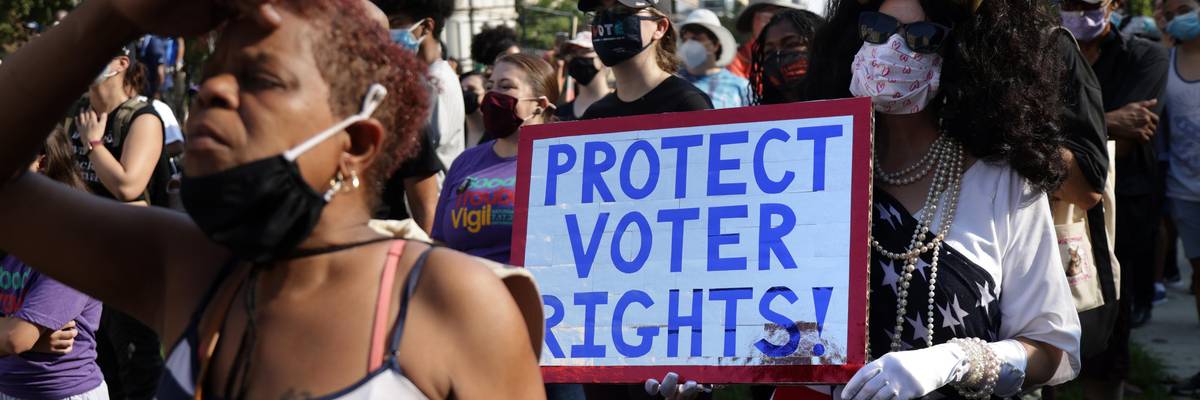
A pending ruling on in Allen v. Milligan could be one of the most damaging yet by the supermajority of John Roberts' right-wing court.
June is the cruelest month. Today begins the weeks of decisions to be announced by the Supreme Court as its term draws to a close. Once again we will wait to find out how far the six conservative justices will push — and what kind of country we will live in. I discuss the perils of this moment in my new book, The Supermajority, out next Tuesday.
One of the most important rulings will come in a major case on the Voting Rights Act, Allen v. Milligan. It could also be one of the most damaging. That statute was by some measures the most effective civil rights law on the books. And over the past decade, the Court led by Chief Justice John Roberts has demolished it, bit by bit.
The background of the Voting Rights Act will be familiar to readers of this newsletter. Although the 15th Amendment, ratified in 1870, guaranteed Black Americans the right to vote, states found countless ways to deter, dilute, and deny those votes for nearly a century.
Then came Bloody Sunday. Violent attacks on civil rights protesters horrified the nation, awoke a collective sense of justice, and galvanized our political leaders to act. On August 6, 1965, less than five months after the march, President Lyndon Johnson signed the Voting Rights Act into law. It created our modern, multiracial democracy — an American success story.
But in the early 1980s, a young lawyer in the Reagan administration named John Roberts furiously opposed a bill renewing and clarifying the act. He lost that battle, but his war on the law was just beginning. He would in many ways make his crusade against the Voting Rights Act the signature issue of his career.
First came Shelby County v. Holder in 2013. The law’s Section 5 required states with a history of racial discrimination to get permission from the Justice Department or a federal court before changing voting practices. At the argument, Antonin Scalia called this a “racial entitlement.” The audience gasped. Scalia did not write the opinion, though; Roberts did, and he was more decorous. The South had changed, he explained. That was then, this is now. The Court effectively ended Section 5.
Within hours, states began to implement discriminatory voting laws. Texas, for example, implemented a voter identification law that instantly disenfranchised 608,000 registered voters, according to a federal judge.
Weak and wobbly, there was something left of the Voting Rights Act: Section 2. That lets you sue after the fact to prove discriminatory voting practices. Voting rights groups including the Brennan Center began to use it to challenge the new wave of voter suppression laws — with heartening success. We won our case against the Texas law, for example. Then in 2021, in Brnovich v. Democratic National Committee, the Court made it much, much harder to use Section 2 against discriminatory voting laws.
All of which brings us to the upcoming case. For decades, Section 2 has been a potent protection against racial gerrymandering, the drawing of legislative lines to dilute the power of the vote for communities of color. In fact, challenging gerrymandering is the main way Section 2 has been used before. That law’s strength may soon be a memory.
In the case, Alabama’s mapmakers packed as many Black voters as possible into an already existing majority-black district, then surgically distributed the remainder among other districts to ensure that they could not assert political power. Black voters could elect a candidate of choice in only one of seven districts despite making up over a quarter of the state’s voting age population. The Court may bless that. (Talk about “racial entitlements”!)
Ruth Bader Ginsburg wrote a memorable dissent in Shelby County. She warned, “Throwing out preclearance when it has worked and is continuing to work to stop discriminatory changes is like throwing away your umbrella in a rainstorm because you are not getting wet.” In the decade since, the white-Black voter turnout gap grew between 9 and 21 percentage points across five of the six states originally covered by Section 5 of the Voting Rights Act. Maybe other factors caused this gap to grow. But an eviscerated rights law surely won’t help.
On many things, John Roberts has been prudent, canny, an institutionalist. When it comes to the law of democracy, he has been the activist leader of a disciplined conservative cadre. The supermajority, I fear, is just getting warmed up.
Dear Common Dreams reader, It’s been nearly 30 years since I co-founded Common Dreams with my late wife, Lina Newhouser. We had the radical notion that journalism should serve the public good, not corporate profits. It was clear to us from the outset what it would take to build such a project. No paid advertisements. No corporate sponsors. No millionaire publisher telling us what to think or do. Many people said we wouldn't last a year, but we proved those doubters wrong. Together with a tremendous team of journalists and dedicated staff, we built an independent media outlet free from the constraints of profits and corporate control. Our mission has always been simple: To inform. To inspire. To ignite change for the common good. Building Common Dreams was not easy. Our survival was never guaranteed. When you take on the most powerful forces—Wall Street greed, fossil fuel industry destruction, Big Tech lobbyists, and uber-rich oligarchs who have spent billions upon billions rigging the economy and democracy in their favor—the only bulwark you have is supporters who believe in your work. But here’s the urgent message from me today. It's never been this bad out there. And it's never been this hard to keep us going. At the very moment Common Dreams is most needed, the threats we face are intensifying. We need your support now more than ever. We don't accept corporate advertising and never will. We don't have a paywall because we don't think people should be blocked from critical news based on their ability to pay. Everything we do is funded by the donations of readers like you. When everyone does the little they can afford, we are strong. But if that support retreats or dries up, so do we. Will you donate now to make sure Common Dreams not only survives but thrives? —Craig Brown, Co-founder |
June is the cruelest month. Today begins the weeks of decisions to be announced by the Supreme Court as its term draws to a close. Once again we will wait to find out how far the six conservative justices will push — and what kind of country we will live in. I discuss the perils of this moment in my new book, The Supermajority, out next Tuesday.
One of the most important rulings will come in a major case on the Voting Rights Act, Allen v. Milligan. It could also be one of the most damaging. That statute was by some measures the most effective civil rights law on the books. And over the past decade, the Court led by Chief Justice John Roberts has demolished it, bit by bit.
The background of the Voting Rights Act will be familiar to readers of this newsletter. Although the 15th Amendment, ratified in 1870, guaranteed Black Americans the right to vote, states found countless ways to deter, dilute, and deny those votes for nearly a century.
Then came Bloody Sunday. Violent attacks on civil rights protesters horrified the nation, awoke a collective sense of justice, and galvanized our political leaders to act. On August 6, 1965, less than five months after the march, President Lyndon Johnson signed the Voting Rights Act into law. It created our modern, multiracial democracy — an American success story.
But in the early 1980s, a young lawyer in the Reagan administration named John Roberts furiously opposed a bill renewing and clarifying the act. He lost that battle, but his war on the law was just beginning. He would in many ways make his crusade against the Voting Rights Act the signature issue of his career.
First came Shelby County v. Holder in 2013. The law’s Section 5 required states with a history of racial discrimination to get permission from the Justice Department or a federal court before changing voting practices. At the argument, Antonin Scalia called this a “racial entitlement.” The audience gasped. Scalia did not write the opinion, though; Roberts did, and he was more decorous. The South had changed, he explained. That was then, this is now. The Court effectively ended Section 5.
Within hours, states began to implement discriminatory voting laws. Texas, for example, implemented a voter identification law that instantly disenfranchised 608,000 registered voters, according to a federal judge.
Weak and wobbly, there was something left of the Voting Rights Act: Section 2. That lets you sue after the fact to prove discriminatory voting practices. Voting rights groups including the Brennan Center began to use it to challenge the new wave of voter suppression laws — with heartening success. We won our case against the Texas law, for example. Then in 2021, in Brnovich v. Democratic National Committee, the Court made it much, much harder to use Section 2 against discriminatory voting laws.
All of which brings us to the upcoming case. For decades, Section 2 has been a potent protection against racial gerrymandering, the drawing of legislative lines to dilute the power of the vote for communities of color. In fact, challenging gerrymandering is the main way Section 2 has been used before. That law’s strength may soon be a memory.
In the case, Alabama’s mapmakers packed as many Black voters as possible into an already existing majority-black district, then surgically distributed the remainder among other districts to ensure that they could not assert political power. Black voters could elect a candidate of choice in only one of seven districts despite making up over a quarter of the state’s voting age population. The Court may bless that. (Talk about “racial entitlements”!)
Ruth Bader Ginsburg wrote a memorable dissent in Shelby County. She warned, “Throwing out preclearance when it has worked and is continuing to work to stop discriminatory changes is like throwing away your umbrella in a rainstorm because you are not getting wet.” In the decade since, the white-Black voter turnout gap grew between 9 and 21 percentage points across five of the six states originally covered by Section 5 of the Voting Rights Act. Maybe other factors caused this gap to grow. But an eviscerated rights law surely won’t help.
On many things, John Roberts has been prudent, canny, an institutionalist. When it comes to the law of democracy, he has been the activist leader of a disciplined conservative cadre. The supermajority, I fear, is just getting warmed up.
June is the cruelest month. Today begins the weeks of decisions to be announced by the Supreme Court as its term draws to a close. Once again we will wait to find out how far the six conservative justices will push — and what kind of country we will live in. I discuss the perils of this moment in my new book, The Supermajority, out next Tuesday.
One of the most important rulings will come in a major case on the Voting Rights Act, Allen v. Milligan. It could also be one of the most damaging. That statute was by some measures the most effective civil rights law on the books. And over the past decade, the Court led by Chief Justice John Roberts has demolished it, bit by bit.
The background of the Voting Rights Act will be familiar to readers of this newsletter. Although the 15th Amendment, ratified in 1870, guaranteed Black Americans the right to vote, states found countless ways to deter, dilute, and deny those votes for nearly a century.
Then came Bloody Sunday. Violent attacks on civil rights protesters horrified the nation, awoke a collective sense of justice, and galvanized our political leaders to act. On August 6, 1965, less than five months after the march, President Lyndon Johnson signed the Voting Rights Act into law. It created our modern, multiracial democracy — an American success story.
But in the early 1980s, a young lawyer in the Reagan administration named John Roberts furiously opposed a bill renewing and clarifying the act. He lost that battle, but his war on the law was just beginning. He would in many ways make his crusade against the Voting Rights Act the signature issue of his career.
First came Shelby County v. Holder in 2013. The law’s Section 5 required states with a history of racial discrimination to get permission from the Justice Department or a federal court before changing voting practices. At the argument, Antonin Scalia called this a “racial entitlement.” The audience gasped. Scalia did not write the opinion, though; Roberts did, and he was more decorous. The South had changed, he explained. That was then, this is now. The Court effectively ended Section 5.
Within hours, states began to implement discriminatory voting laws. Texas, for example, implemented a voter identification law that instantly disenfranchised 608,000 registered voters, according to a federal judge.
Weak and wobbly, there was something left of the Voting Rights Act: Section 2. That lets you sue after the fact to prove discriminatory voting practices. Voting rights groups including the Brennan Center began to use it to challenge the new wave of voter suppression laws — with heartening success. We won our case against the Texas law, for example. Then in 2021, in Brnovich v. Democratic National Committee, the Court made it much, much harder to use Section 2 against discriminatory voting laws.
All of which brings us to the upcoming case. For decades, Section 2 has been a potent protection against racial gerrymandering, the drawing of legislative lines to dilute the power of the vote for communities of color. In fact, challenging gerrymandering is the main way Section 2 has been used before. That law’s strength may soon be a memory.
In the case, Alabama’s mapmakers packed as many Black voters as possible into an already existing majority-black district, then surgically distributed the remainder among other districts to ensure that they could not assert political power. Black voters could elect a candidate of choice in only one of seven districts despite making up over a quarter of the state’s voting age population. The Court may bless that. (Talk about “racial entitlements”!)
Ruth Bader Ginsburg wrote a memorable dissent in Shelby County. She warned, “Throwing out preclearance when it has worked and is continuing to work to stop discriminatory changes is like throwing away your umbrella in a rainstorm because you are not getting wet.” In the decade since, the white-Black voter turnout gap grew between 9 and 21 percentage points across five of the six states originally covered by Section 5 of the Voting Rights Act. Maybe other factors caused this gap to grow. But an eviscerated rights law surely won’t help.
On many things, John Roberts has been prudent, canny, an institutionalist. When it comes to the law of democracy, he has been the activist leader of a disciplined conservative cadre. The supermajority, I fear, is just getting warmed up.