SUBSCRIBE TO OUR FREE NEWSLETTER
Daily news & progressive opinion—funded by the people, not the corporations—delivered straight to your inbox.
5
#000000
#FFFFFF
To donate by check, phone, or other method, see our More Ways to Give page.
Daily news & progressive opinion—funded by the people, not the corporations—delivered straight to your inbox.
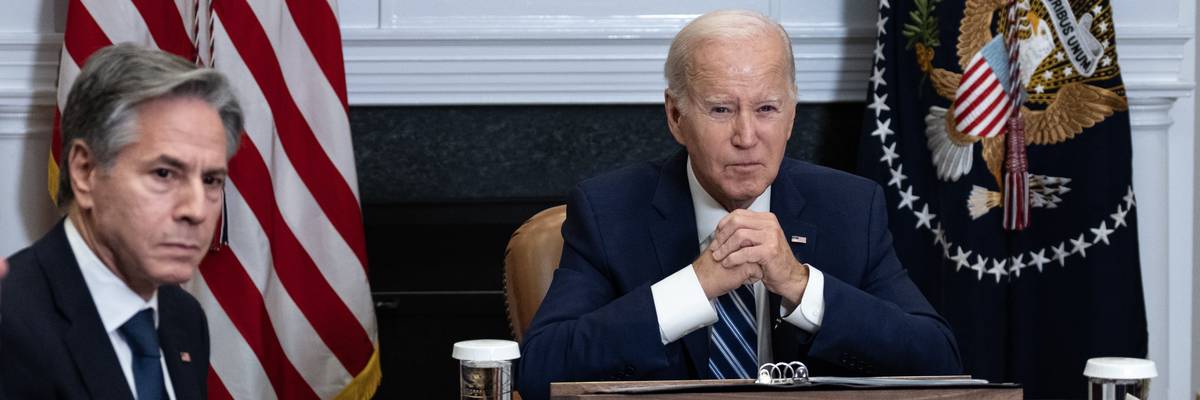
U.S. Secretary of State Antony Blinken looks on as U.S. President Joe Biden speaks during a meeting in the Roosevelt Room of the White House on November 21, 2023.
On the things that should but can’t be said.
Four months into Israel’s genocidal assault on Gaza, one might have thought that American policymakers and commentators would have learned some lessons. Instead, their discussions about the conflict appear to remain trapped in the same tiresome and, at times, delusional framing that existed before the current fighting began. As a result, they frustratingly tie themselves in knots struggling to explain what’s happening and what’s to be done in the future. They refuse to step outside the constraints imposed by conventional wisdom and dare not venture beyond the accepted terms of what is defined as correct political discourse. Conditioned, in this manner, there are things that should be said that they will not say.
For example, despite the ruling of the International Court of Justice that Israel’s behaviors establish a plausible case for genocide, that word is verboten. When presented with the numbers of those killed, those facing starvation, and clear evidence of mass destruction of Gaza’s infrastructure, policymakers and commentators shift the discussion to the crimes committed by Hamas on October 7th or blame the civilian deaths on Hamas’ use of “human shields.”
They also seek to absolve the U.S. from any responsibility for the deaths insisting that the president and his administration continue to urge the Israelis to take measures to avoid civilian casualties. They then ignore the fact that Israel pays no attention to our “urging” while they continue to resupply Israel’s deadly munitions and block international efforts at a ceasefire.
Equally frustrating is the U.S. insistence that it stands behind efforts to provide humanitarian assistance to the desperate Palestinian population in Gaza, while at the same time refusing to hold Israel responsible for the fact that its cumbersome, duplicative inspection regime and continued bombing in the south of Gaza impedes delivery of supplies to those in need. Additionally, the recent US decision to withhold funds for UNWRA—the only agency with the capacity to deliver aid—makes a mockery of our commitment to providing humanitarian assistance. As obvious as these linkages may be, they may not be said.
In acceptable U.S. discourse Israel is never blamed. It’s all Hamas’ fault and the U.S. is doing everything it can to alleviate suffering. As for the decision to cut off UNWRA thereby punishing the entire Palestinian population for the alleged crimes of about 12 of the agencies thousands of staff, it is not allowed to refer to this as collective punishment.
After ignoring the reality that daily Israeli raids into West Bank Palestinian cities and towns have resulted in the murders of over 400 Palestinians and that 500 settler attacks on Palestinians in their homes, cars or fields have resulted in the deaths of eight and the destruction of thousands of olive trees, the U.S. decided to take action by sanctioning four settlers. This was heralded by the pundits as “unprecedented” and “dramatic,” but scoffed at by the settlers as a hollow gesture—which, in fact, it was. But that cannot be said.
What is not discussed are the root problems with the Israeli occupation (a term that Democrats have never allowed in the party’s platform), the ever-expanding settlement enterprise, the apartheid (another word that is not allowed) system that creates impunity for both settlers and the Israeli military. This self-censorship of terms that can be used is infuriating.
Equally troubling are discussions about the “day after” that is gaining momentum in the US media and policy circles. In the first place, this topic is insensitive at best and racist at worst. What is the “day after” for 2.2 million in Gaza? Are they supposed to forget the tens of thousands who’ve died? Their homes and entire neighborhoods that have been reduced to rubble? Where will they live? And what of the trauma to the hundreds of thousands of children who’ve been physically and psychologically maimed by this war? And what of the tens of thousands who are expected to die in the coming months from disease or starvation?
These questions aren’t asked by pundits or policymakers. They’re not part of the accepted discourse.
While official Washington has not yet presented its own plan, they have provided hints of their thinking in speeches and in discussions with journalists. From these we can discern an outline of ideas, that amount to “much ado about nothing.”
It appears that the cornerstone of “the day after” construct is nothing more than “a pathway to an eventual Palestinian state”—reminiscent of the famous ancient Greek philosophers Heraclitus-Parmenides’ debate about the endless “half-the-way to half-the-way to half-the-way” to the never reachable goal. In this fantasy “pathway,” the burden is placed on the Palestinians to create a credible, viable, democratic, functioning state that will pose no threat to Israel. The problem, of course, is that Palestinians must do this while the occupation continues with no restraints on the occupiers’ control over land, resources, borders, and economy. This is no different than the bizarre plan proposed by then President George W. Bush in 2002. The lesson that should have been learned then, but was not, is that as long as the Palestinians are not free to grow their economy and protect their land and people from the acquisitiveness and repression of the Israelis, no such credible state can come into being. The proposal, if it can be called that, is a mirage designed by the US to place the burden on the weakest party, while absolving the Israelis and ourselves from responsibility.
When blame is directed at Israel, it is focused solely on Benjamin Netanyahu and his extremist partners, whom the pundits say are the major obstacle to moving forward. This fails to pass muster because any close examination of the Israeli electorate and their views would note that while Netanyahu and company are extreme, there is no conceivable coalition that can replace them that would be willing to end the occupation and withdraw from territories and settlements to allow for a viable independent Palestinian state to come into being. A recent Israeli poll showed that a majority of Israelis would reject the creation of a Palestinian state even if that were accompanied by recognition by Saudi Arabia and security guarantees.
When confronted with the fact that any future Israeli government would either be unwilling or afraid to withdraw from the occupied lands because of negative public reaction, the pundits fall silent out of their concern for Israeli public opinion. This underlies the racism that causes the entire fantasy to evaporate. I say racism, because in the American mind, the opinions and fears of Israeli public opinion are always placed above those of those of Palestinians. But, of course, this cannot be said.
And so Israel’s genocidal assault continues as does the detached-from-reality U.S. political discussion. Change will not occur until we can free ourselves from the shackles of acceptable discourse that has led us into this dead end.
Dear Common Dreams reader, It’s been nearly 30 years since I co-founded Common Dreams with my late wife, Lina Newhouser. We had the radical notion that journalism should serve the public good, not corporate profits. It was clear to us from the outset what it would take to build such a project. No paid advertisements. No corporate sponsors. No millionaire publisher telling us what to think or do. Many people said we wouldn't last a year, but we proved those doubters wrong. Together with a tremendous team of journalists and dedicated staff, we built an independent media outlet free from the constraints of profits and corporate control. Our mission has always been simple: To inform. To inspire. To ignite change for the common good. Building Common Dreams was not easy. Our survival was never guaranteed. When you take on the most powerful forces—Wall Street greed, fossil fuel industry destruction, Big Tech lobbyists, and uber-rich oligarchs who have spent billions upon billions rigging the economy and democracy in their favor—the only bulwark you have is supporters who believe in your work. But here’s the urgent message from me today. It's never been this bad out there. And it's never been this hard to keep us going. At the very moment Common Dreams is most needed, the threats we face are intensifying. We need your support now more than ever. We don't accept corporate advertising and never will. We don't have a paywall because we don't think people should be blocked from critical news based on their ability to pay. Everything we do is funded by the donations of readers like you. When everyone does the little they can afford, we are strong. But if that support retreats or dries up, so do we. Will you donate now to make sure Common Dreams not only survives but thrives? —Craig Brown, Co-founder |
Four months into Israel’s genocidal assault on Gaza, one might have thought that American policymakers and commentators would have learned some lessons. Instead, their discussions about the conflict appear to remain trapped in the same tiresome and, at times, delusional framing that existed before the current fighting began. As a result, they frustratingly tie themselves in knots struggling to explain what’s happening and what’s to be done in the future. They refuse to step outside the constraints imposed by conventional wisdom and dare not venture beyond the accepted terms of what is defined as correct political discourse. Conditioned, in this manner, there are things that should be said that they will not say.
For example, despite the ruling of the International Court of Justice that Israel’s behaviors establish a plausible case for genocide, that word is verboten. When presented with the numbers of those killed, those facing starvation, and clear evidence of mass destruction of Gaza’s infrastructure, policymakers and commentators shift the discussion to the crimes committed by Hamas on October 7th or blame the civilian deaths on Hamas’ use of “human shields.”
They also seek to absolve the U.S. from any responsibility for the deaths insisting that the president and his administration continue to urge the Israelis to take measures to avoid civilian casualties. They then ignore the fact that Israel pays no attention to our “urging” while they continue to resupply Israel’s deadly munitions and block international efforts at a ceasefire.
Equally frustrating is the U.S. insistence that it stands behind efforts to provide humanitarian assistance to the desperate Palestinian population in Gaza, while at the same time refusing to hold Israel responsible for the fact that its cumbersome, duplicative inspection regime and continued bombing in the south of Gaza impedes delivery of supplies to those in need. Additionally, the recent US decision to withhold funds for UNWRA—the only agency with the capacity to deliver aid—makes a mockery of our commitment to providing humanitarian assistance. As obvious as these linkages may be, they may not be said.
In acceptable U.S. discourse Israel is never blamed. It’s all Hamas’ fault and the U.S. is doing everything it can to alleviate suffering. As for the decision to cut off UNWRA thereby punishing the entire Palestinian population for the alleged crimes of about 12 of the agencies thousands of staff, it is not allowed to refer to this as collective punishment.
After ignoring the reality that daily Israeli raids into West Bank Palestinian cities and towns have resulted in the murders of over 400 Palestinians and that 500 settler attacks on Palestinians in their homes, cars or fields have resulted in the deaths of eight and the destruction of thousands of olive trees, the U.S. decided to take action by sanctioning four settlers. This was heralded by the pundits as “unprecedented” and “dramatic,” but scoffed at by the settlers as a hollow gesture—which, in fact, it was. But that cannot be said.
What is not discussed are the root problems with the Israeli occupation (a term that Democrats have never allowed in the party’s platform), the ever-expanding settlement enterprise, the apartheid (another word that is not allowed) system that creates impunity for both settlers and the Israeli military. This self-censorship of terms that can be used is infuriating.
Equally troubling are discussions about the “day after” that is gaining momentum in the US media and policy circles. In the first place, this topic is insensitive at best and racist at worst. What is the “day after” for 2.2 million in Gaza? Are they supposed to forget the tens of thousands who’ve died? Their homes and entire neighborhoods that have been reduced to rubble? Where will they live? And what of the trauma to the hundreds of thousands of children who’ve been physically and psychologically maimed by this war? And what of the tens of thousands who are expected to die in the coming months from disease or starvation?
These questions aren’t asked by pundits or policymakers. They’re not part of the accepted discourse.
While official Washington has not yet presented its own plan, they have provided hints of their thinking in speeches and in discussions with journalists. From these we can discern an outline of ideas, that amount to “much ado about nothing.”
It appears that the cornerstone of “the day after” construct is nothing more than “a pathway to an eventual Palestinian state”—reminiscent of the famous ancient Greek philosophers Heraclitus-Parmenides’ debate about the endless “half-the-way to half-the-way to half-the-way” to the never reachable goal. In this fantasy “pathway,” the burden is placed on the Palestinians to create a credible, viable, democratic, functioning state that will pose no threat to Israel. The problem, of course, is that Palestinians must do this while the occupation continues with no restraints on the occupiers’ control over land, resources, borders, and economy. This is no different than the bizarre plan proposed by then President George W. Bush in 2002. The lesson that should have been learned then, but was not, is that as long as the Palestinians are not free to grow their economy and protect their land and people from the acquisitiveness and repression of the Israelis, no such credible state can come into being. The proposal, if it can be called that, is a mirage designed by the US to place the burden on the weakest party, while absolving the Israelis and ourselves from responsibility.
When blame is directed at Israel, it is focused solely on Benjamin Netanyahu and his extremist partners, whom the pundits say are the major obstacle to moving forward. This fails to pass muster because any close examination of the Israeli electorate and their views would note that while Netanyahu and company are extreme, there is no conceivable coalition that can replace them that would be willing to end the occupation and withdraw from territories and settlements to allow for a viable independent Palestinian state to come into being. A recent Israeli poll showed that a majority of Israelis would reject the creation of a Palestinian state even if that were accompanied by recognition by Saudi Arabia and security guarantees.
When confronted with the fact that any future Israeli government would either be unwilling or afraid to withdraw from the occupied lands because of negative public reaction, the pundits fall silent out of their concern for Israeli public opinion. This underlies the racism that causes the entire fantasy to evaporate. I say racism, because in the American mind, the opinions and fears of Israeli public opinion are always placed above those of those of Palestinians. But, of course, this cannot be said.
And so Israel’s genocidal assault continues as does the detached-from-reality U.S. political discussion. Change will not occur until we can free ourselves from the shackles of acceptable discourse that has led us into this dead end.
Four months into Israel’s genocidal assault on Gaza, one might have thought that American policymakers and commentators would have learned some lessons. Instead, their discussions about the conflict appear to remain trapped in the same tiresome and, at times, delusional framing that existed before the current fighting began. As a result, they frustratingly tie themselves in knots struggling to explain what’s happening and what’s to be done in the future. They refuse to step outside the constraints imposed by conventional wisdom and dare not venture beyond the accepted terms of what is defined as correct political discourse. Conditioned, in this manner, there are things that should be said that they will not say.
For example, despite the ruling of the International Court of Justice that Israel’s behaviors establish a plausible case for genocide, that word is verboten. When presented with the numbers of those killed, those facing starvation, and clear evidence of mass destruction of Gaza’s infrastructure, policymakers and commentators shift the discussion to the crimes committed by Hamas on October 7th or blame the civilian deaths on Hamas’ use of “human shields.”
They also seek to absolve the U.S. from any responsibility for the deaths insisting that the president and his administration continue to urge the Israelis to take measures to avoid civilian casualties. They then ignore the fact that Israel pays no attention to our “urging” while they continue to resupply Israel’s deadly munitions and block international efforts at a ceasefire.
Equally frustrating is the U.S. insistence that it stands behind efforts to provide humanitarian assistance to the desperate Palestinian population in Gaza, while at the same time refusing to hold Israel responsible for the fact that its cumbersome, duplicative inspection regime and continued bombing in the south of Gaza impedes delivery of supplies to those in need. Additionally, the recent US decision to withhold funds for UNWRA—the only agency with the capacity to deliver aid—makes a mockery of our commitment to providing humanitarian assistance. As obvious as these linkages may be, they may not be said.
In acceptable U.S. discourse Israel is never blamed. It’s all Hamas’ fault and the U.S. is doing everything it can to alleviate suffering. As for the decision to cut off UNWRA thereby punishing the entire Palestinian population for the alleged crimes of about 12 of the agencies thousands of staff, it is not allowed to refer to this as collective punishment.
After ignoring the reality that daily Israeli raids into West Bank Palestinian cities and towns have resulted in the murders of over 400 Palestinians and that 500 settler attacks on Palestinians in their homes, cars or fields have resulted in the deaths of eight and the destruction of thousands of olive trees, the U.S. decided to take action by sanctioning four settlers. This was heralded by the pundits as “unprecedented” and “dramatic,” but scoffed at by the settlers as a hollow gesture—which, in fact, it was. But that cannot be said.
What is not discussed are the root problems with the Israeli occupation (a term that Democrats have never allowed in the party’s platform), the ever-expanding settlement enterprise, the apartheid (another word that is not allowed) system that creates impunity for both settlers and the Israeli military. This self-censorship of terms that can be used is infuriating.
Equally troubling are discussions about the “day after” that is gaining momentum in the US media and policy circles. In the first place, this topic is insensitive at best and racist at worst. What is the “day after” for 2.2 million in Gaza? Are they supposed to forget the tens of thousands who’ve died? Their homes and entire neighborhoods that have been reduced to rubble? Where will they live? And what of the trauma to the hundreds of thousands of children who’ve been physically and psychologically maimed by this war? And what of the tens of thousands who are expected to die in the coming months from disease or starvation?
These questions aren’t asked by pundits or policymakers. They’re not part of the accepted discourse.
While official Washington has not yet presented its own plan, they have provided hints of their thinking in speeches and in discussions with journalists. From these we can discern an outline of ideas, that amount to “much ado about nothing.”
It appears that the cornerstone of “the day after” construct is nothing more than “a pathway to an eventual Palestinian state”—reminiscent of the famous ancient Greek philosophers Heraclitus-Parmenides’ debate about the endless “half-the-way to half-the-way to half-the-way” to the never reachable goal. In this fantasy “pathway,” the burden is placed on the Palestinians to create a credible, viable, democratic, functioning state that will pose no threat to Israel. The problem, of course, is that Palestinians must do this while the occupation continues with no restraints on the occupiers’ control over land, resources, borders, and economy. This is no different than the bizarre plan proposed by then President George W. Bush in 2002. The lesson that should have been learned then, but was not, is that as long as the Palestinians are not free to grow their economy and protect their land and people from the acquisitiveness and repression of the Israelis, no such credible state can come into being. The proposal, if it can be called that, is a mirage designed by the US to place the burden on the weakest party, while absolving the Israelis and ourselves from responsibility.
When blame is directed at Israel, it is focused solely on Benjamin Netanyahu and his extremist partners, whom the pundits say are the major obstacle to moving forward. This fails to pass muster because any close examination of the Israeli electorate and their views would note that while Netanyahu and company are extreme, there is no conceivable coalition that can replace them that would be willing to end the occupation and withdraw from territories and settlements to allow for a viable independent Palestinian state to come into being. A recent Israeli poll showed that a majority of Israelis would reject the creation of a Palestinian state even if that were accompanied by recognition by Saudi Arabia and security guarantees.
When confronted with the fact that any future Israeli government would either be unwilling or afraid to withdraw from the occupied lands because of negative public reaction, the pundits fall silent out of their concern for Israeli public opinion. This underlies the racism that causes the entire fantasy to evaporate. I say racism, because in the American mind, the opinions and fears of Israeli public opinion are always placed above those of those of Palestinians. But, of course, this cannot be said.
And so Israel’s genocidal assault continues as does the detached-from-reality U.S. political discussion. Change will not occur until we can free ourselves from the shackles of acceptable discourse that has led us into this dead end.