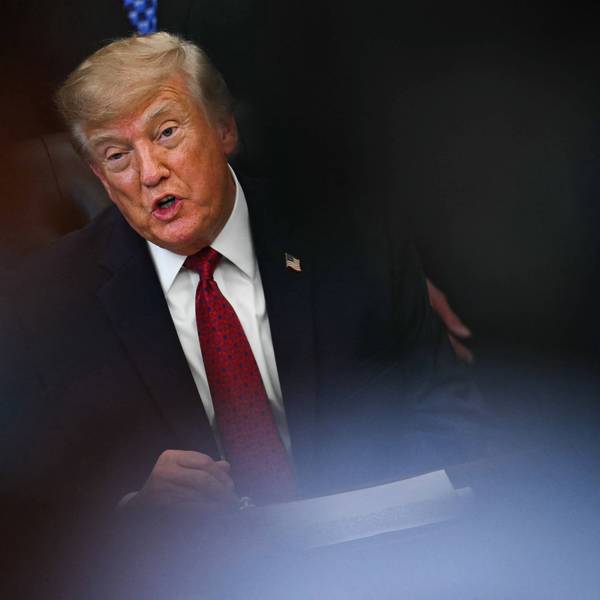
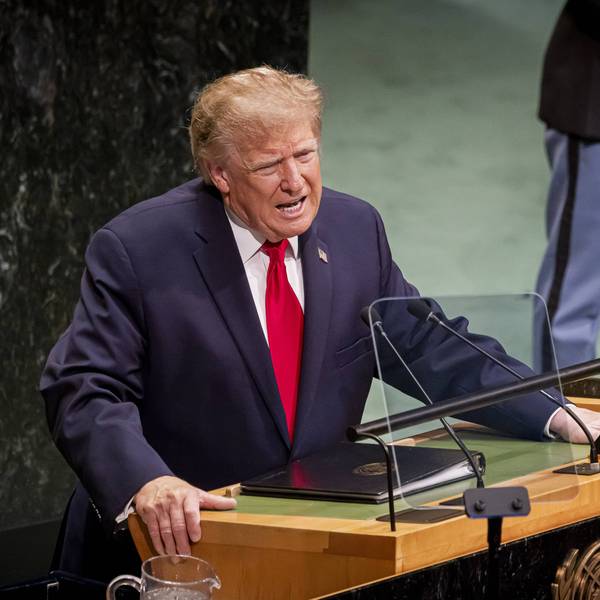

Donald Trump, President of the United States of America, addresses the general debate of the General Assembly’s eightieth session.
Trump Tells the UN He Does Not Like the UN
The United Nations is running short of funds, partly but not solely because of the United States.
President Donald Trump wants to emasculate the United Nations, but he will not leave it. Where else can he address an audience with delegations from 193 countries? And the US seat on the UN Security Council gives it a veto.
Well before his 23 September speech, Trump interfered in the UN roster, in violation of the world body's agreement with the United States as the host country.
For one, the 89-year old Palestinian president, Mahmoud Abbas was not granted a visa. He spoke to the Assembly by video. Then Brazilian president President Luiz Inácio Lula da Silva, (known as Lula) who traditionally opens the high-level debate, was unable to get visas for his health minister, Alexandre Padilha, and his justice minister, Ricardo Lewandowski. Why? Because Lula opposed former president Jair Bolsnaro, someone Trump admires, of attempting a coup.
Trump's speech received applause when he demanded the release of hostages in captivity in Gaza. But delegates let out sounds of exasperation when he called climate change a "con job."
In general, he said the United States was entering a "golden age." But Western European nations, once our allies, were collapsing because of immigration, green energy, and faulty leadership.
Trump wants to slash UN funding for the world body and its various programs and agencies. He has stopped US engagement with the UN Human Rights Council, extended a halt to funding for the Palestinian relief agency, UNRWA, and quit the UN cultural agency UNESCO. He has also announced plans to pull out of the Paris climate deal and the World Health Organization.
The United Nations is running short of funds, partly but not solely because of the United States. Whereas Washington had sponsored USAID in developing nations, the world body has to cope with more gaps than ever in meeting its obligations.
What humanitarian work does the UN do?
The UN attempts to supply aid through its agencies such as the World Food Program (WFP), the World Health Organization (WHO), the UN children’s fund UNICEF, the Office of the UN High Commissioner for Refugees (UNHCR), the UN Population Fund (UNFPA), the Food and Agriculture Organization (FAO), the International Organization for Migration (IOM) and the UN Office for the Coordination of Humanitarian Affairs (OCHA), among others.
This does not mean just distributing food. When they are able, it hands out tents, or special "dignity" kits for women. Without a ceasefire in Gaza, many of its efforts fall by the wayside. Israel has restricted peanut butter as a luxury food. But in many other countries, the supplies continue.
UN Secretary-General Antonio Gutteres, a former Portuguese prime minister, aims to cut the operating budget by 15 percent, or $3.3 billion, and eliminate 2,681 posts. He also met with President Trump for the first time. Earlier requests had been ignored.
Of course, the staff is protesting any cuts. They have families, children in schools, and lives in New York, Geneva, or elsewhere.
The United Nations has turned into a sprawling project of resolutions, agencies, programs and agencies, initiated by member states. So calling it good, evil, or corrupt is the lazy way without investigating its projects, many of them overlapping.
One of Guterres’ major aims is to generate support for his plans to reform the United Nations and make it more responsive to the world. Because of funding cuts by the US and others (on defense spending) the UN announced last week that its regular operating budget for 2026 needs to be cut by 15% to $3.2 billion along with a 19% cut in that budget’s staff positions — 2,681 posts.
As a veteran UN correspondent, "reform" of the United Nations has been a battle cry from the United States and others for years. But no one really says what they mean.
The UN’s efforts at providing humanitarian aid are led by multiple UN agencies such as the World Food Program (WFP), the World Health Organization (WHO), the UN children’s fund UNICEF, the Office of the UN High Commissioner for Refugees (UNHCR) , the UN Population Fund (UNFPA), the Food and Agriculture Organization (FAO), the International Organization for Migration (IOM) and the UN Office for the Coordination of Humanitarian Affairs (OCHA), among others.
Who is here?
Chief UN spokesman Stephane Dujarric told reporters there will be 89 heads of state, 5 vice presidents, one crown prince, and 45 heads of government at UN headquarters this week.
Delegates spend a lot of time talking to each other, so 1642 bilateral meetings have been scheduled in a pile of temporary meeting booths.
We are at a crossroads
This country and this world are at a monumental crossroads. In a few short weeks, US voters will have an opportunity to beat back the forces of fascism and confront the billionaires who are rigging the economy, our media system, and our democracy, making it increasingly impossible for ordinary people to get by. We’re not just talking about the election. We’re talking about what must be done once these fascist elements are vanquished from power. We need a bolder set of solutions than what either major party has so far been willing to offer and a working-class movement ready to fight like hell for it. Trump didn't emerge from nowhere. The conditions that fueled MAGA authoritarianism were created by decades of radical neoliberal economic policies and a corrupt political system dominated by corporate interests. They slashed taxes on the super-rich, promising that the benefits would trickle down. They said giveaways to the corporate titans would make life more affordable for the rest of us. It was all bullshit. And when a bitter, betrayed populace searches for someone to blame, right-wing demagogues have little trouble finding scapegoats. People know when they're being lied to, but you won't hear any of this from the corporate media. Only independent journalism—powered and funded by people who believe in building a better world—can deliver truly trustworthy daily news. Our Fall Campaign is underway, and we need your help. To power our newsroom through the rest of the year, we need to raise $125,000 by midnight on October 31. So if you share our vision, please contribute whatever you can to sustain our work. |
President Donald Trump wants to emasculate the United Nations, but he will not leave it. Where else can he address an audience with delegations from 193 countries? And the US seat on the UN Security Council gives it a veto.
Well before his 23 September speech, Trump interfered in the UN roster, in violation of the world body's agreement with the United States as the host country.
For one, the 89-year old Palestinian president, Mahmoud Abbas was not granted a visa. He spoke to the Assembly by video. Then Brazilian president President Luiz Inácio Lula da Silva, (known as Lula) who traditionally opens the high-level debate, was unable to get visas for his health minister, Alexandre Padilha, and his justice minister, Ricardo Lewandowski. Why? Because Lula opposed former president Jair Bolsnaro, someone Trump admires, of attempting a coup.
Trump's speech received applause when he demanded the release of hostages in captivity in Gaza. But delegates let out sounds of exasperation when he called climate change a "con job."
In general, he said the United States was entering a "golden age." But Western European nations, once our allies, were collapsing because of immigration, green energy, and faulty leadership.
Trump wants to slash UN funding for the world body and its various programs and agencies. He has stopped US engagement with the UN Human Rights Council, extended a halt to funding for the Palestinian relief agency, UNRWA, and quit the UN cultural agency UNESCO. He has also announced plans to pull out of the Paris climate deal and the World Health Organization.
The United Nations is running short of funds, partly but not solely because of the United States. Whereas Washington had sponsored USAID in developing nations, the world body has to cope with more gaps than ever in meeting its obligations.
What humanitarian work does the UN do?
The UN attempts to supply aid through its agencies such as the World Food Program (WFP), the World Health Organization (WHO), the UN children’s fund UNICEF, the Office of the UN High Commissioner for Refugees (UNHCR), the UN Population Fund (UNFPA), the Food and Agriculture Organization (FAO), the International Organization for Migration (IOM) and the UN Office for the Coordination of Humanitarian Affairs (OCHA), among others.
This does not mean just distributing food. When they are able, it hands out tents, or special "dignity" kits for women. Without a ceasefire in Gaza, many of its efforts fall by the wayside. Israel has restricted peanut butter as a luxury food. But in many other countries, the supplies continue.
UN Secretary-General Antonio Gutteres, a former Portuguese prime minister, aims to cut the operating budget by 15 percent, or $3.3 billion, and eliminate 2,681 posts. He also met with President Trump for the first time. Earlier requests had been ignored.
Of course, the staff is protesting any cuts. They have families, children in schools, and lives in New York, Geneva, or elsewhere.
The United Nations has turned into a sprawling project of resolutions, agencies, programs and agencies, initiated by member states. So calling it good, evil, or corrupt is the lazy way without investigating its projects, many of them overlapping.
One of Guterres’ major aims is to generate support for his plans to reform the United Nations and make it more responsive to the world. Because of funding cuts by the US and others (on defense spending) the UN announced last week that its regular operating budget for 2026 needs to be cut by 15% to $3.2 billion along with a 19% cut in that budget’s staff positions — 2,681 posts.
As a veteran UN correspondent, "reform" of the United Nations has been a battle cry from the United States and others for years. But no one really says what they mean.
The UN’s efforts at providing humanitarian aid are led by multiple UN agencies such as the World Food Program (WFP), the World Health Organization (WHO), the UN children’s fund UNICEF, the Office of the UN High Commissioner for Refugees (UNHCR) , the UN Population Fund (UNFPA), the Food and Agriculture Organization (FAO), the International Organization for Migration (IOM) and the UN Office for the Coordination of Humanitarian Affairs (OCHA), among others.
Who is here?
Chief UN spokesman Stephane Dujarric told reporters there will be 89 heads of state, 5 vice presidents, one crown prince, and 45 heads of government at UN headquarters this week.
Delegates spend a lot of time talking to each other, so 1642 bilateral meetings have been scheduled in a pile of temporary meeting booths.