

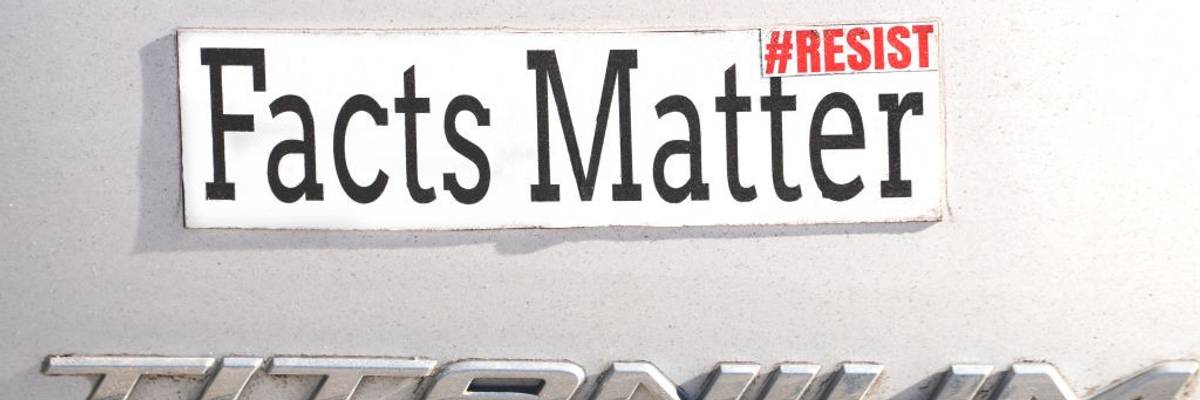
A Facts Matter Resist bumper sticker is seen on a car in Santa Fe, New Mexico.
Trump Is Attacking Our Ability to Find Out What Is Going On in Our Country
Erosion of the ability to accurately describe our reality hobbles every aspect of our collective decision-making. The current program of erosion is steady, deliberate, and already well underway.
Alarms are sounding across the political and ideological spectrums about America’s collapsing federal data structure. But what is the big deal? Why does access to data, specifically from the federal government, matter so much?
At the heart of all work in this space are three questions:
- What happened before?
- What is happening now?
- What might happen?
A society cannot make good decisions without knowing how prior decisions turned out, assessing the current situation, and developing reasonable predictions about possibilities under consideration.
Federal statistical work is how we find out what is going on with the 300 million people and 11 million businesses across the complex network of federal, state, and local systems that make up the world’s largest economy. Issues at that scale are too big for intuition or “common sense.” We need comprehensive information produced by rigorous, capable people who are not afraid to tell us the truth. We should be deeply and profoundly alarmed by the offer of anything less.
Each researcher approaches their work from a different direction with a different area of focus, which results in a wide range of conclusions on a variety of topics. But the common ground is the data.
Voters are beginning to understand the damage our economy and our society sustains when we turn our backs on the truth.
Reliable, comprehensive, nonpartisan federal datasets like the American Community Survey from the Census Bureau, historical data tables from Internal Revenue Service Statistics of Income, economic reports from the Bureau of Labor Statistics, scoring from the Joint Committee on Taxation, estimates from the Congressional Budget Office, and other quality federal data products provide a stable point of reference to which most agree to calibrate their work, even though there may be different policy perspectives. We know we are all standing on the same ground, and that the ground is reasonably solid.
Until now, these data have been produced by teams of dedicated experts who understand that their job is to collect and report the numbers as accurately as possible. Sometimes the best available methods are imperfect. Sometimes estimates need adjustment based on the latest information. Sometimes the team responsible for a particular report does not have the ideal amount of funding or enough staff. But the reports have always been created in good faith by extremely competent people. The current threats to that are inexcusable.
Erosion of the ability to accurately describe our reality hobbles every aspect of our collective decision-making. The current program of erosion is steady, deliberate, and already well underway.
Statistical agencies have been aggressively hollowed out in terms of both funding and staff and are notifying the research community to expect certain products to be released late or not at all. Important research programs are suspended indefinitely.
Information on entire subjects—such as race, gender, and climate—is no longer being collected and, in some cases, being excised wholesale from existing data. Legislators are arguing that publicly traded corporations should not have to disclose critical information about their activities. Careful, diligent staffers are losing their positions for doing their jobs and, if replaced at all, being replaced by people who think good data science begins and ends with typing a prompt into a chatbot.
Highly qualified leaders defending data integrity, privacy, and the mission of their agencies are being kicked to the curb in favor of individuals whose primary qualification appears to be willingness to produce reports that say whatever the current administration wants and suppress those that do not.
The ability to find out what is going on in our country is under attack. That is definitely a big deal, but the research community is not taking it lying down. The authoritarian playbook always includes attacking the truth, so this did not come as a surprise. As soon as the 2024 election results were called, data preservation coalitions got to work archiving existing data in multiple locations. The agency leaders are not going easily or quietly. And voters are beginning to understand the damage our economy and our society sustains when we turn our backs on the truth. American civil resistance has a proud history, and this assault on our public information is an opportunity for involved citizens to prevent authoritarianism from taking hold.
We are at a crossroads
This country and this world are at a monumental crossroads. In a few short weeks, US voters will have an opportunity to beat back the forces of fascism and confront the billionaires who are rigging the economy, our media system, and our democracy, making it increasingly impossible for ordinary people to get by. We’re not just talking about the election. We’re talking about what must be done once these fascist elements are vanquished from power. We need a bolder set of solutions than what either major party has so far been willing to offer and a working-class movement ready to fight like hell for it. Trump didn't emerge from nowhere. The conditions that fueled MAGA authoritarianism were created by decades of radical neoliberal economic policies and a corrupt political system dominated by corporate interests. They slashed taxes on the super-rich, promising that the benefits would trickle down. They said giveaways to the corporate titans would make life more affordable for the rest of us. It was all bullshit. And when a bitter, betrayed populace searches for someone to blame, right-wing demagogues have little trouble finding scapegoats. People know when they're being lied to, but you won't hear any of this from the corporate media. Only independent journalism—powered and funded by people who believe in building a better world—can deliver truly trustworthy daily news. Our Fall Campaign is underway, and we need your help. To power our newsroom through the rest of the year, we need to raise $125,000 by midnight on October 31. So if you share our vision, please contribute whatever you can to sustain our work. |
Alarms are sounding across the political and ideological spectrums about America’s collapsing federal data structure. But what is the big deal? Why does access to data, specifically from the federal government, matter so much?
At the heart of all work in this space are three questions:
- What happened before?
- What is happening now?
- What might happen?
A society cannot make good decisions without knowing how prior decisions turned out, assessing the current situation, and developing reasonable predictions about possibilities under consideration.
Federal statistical work is how we find out what is going on with the 300 million people and 11 million businesses across the complex network of federal, state, and local systems that make up the world’s largest economy. Issues at that scale are too big for intuition or “common sense.” We need comprehensive information produced by rigorous, capable people who are not afraid to tell us the truth. We should be deeply and profoundly alarmed by the offer of anything less.
Each researcher approaches their work from a different direction with a different area of focus, which results in a wide range of conclusions on a variety of topics. But the common ground is the data.
Voters are beginning to understand the damage our economy and our society sustains when we turn our backs on the truth.
Reliable, comprehensive, nonpartisan federal datasets like the American Community Survey from the Census Bureau, historical data tables from Internal Revenue Service Statistics of Income, economic reports from the Bureau of Labor Statistics, scoring from the Joint Committee on Taxation, estimates from the Congressional Budget Office, and other quality federal data products provide a stable point of reference to which most agree to calibrate their work, even though there may be different policy perspectives. We know we are all standing on the same ground, and that the ground is reasonably solid.
Until now, these data have been produced by teams of dedicated experts who understand that their job is to collect and report the numbers as accurately as possible. Sometimes the best available methods are imperfect. Sometimes estimates need adjustment based on the latest information. Sometimes the team responsible for a particular report does not have the ideal amount of funding or enough staff. But the reports have always been created in good faith by extremely competent people. The current threats to that are inexcusable.
Erosion of the ability to accurately describe our reality hobbles every aspect of our collective decision-making. The current program of erosion is steady, deliberate, and already well underway.
Statistical agencies have been aggressively hollowed out in terms of both funding and staff and are notifying the research community to expect certain products to be released late or not at all. Important research programs are suspended indefinitely.
Information on entire subjects—such as race, gender, and climate—is no longer being collected and, in some cases, being excised wholesale from existing data. Legislators are arguing that publicly traded corporations should not have to disclose critical information about their activities. Careful, diligent staffers are losing their positions for doing their jobs and, if replaced at all, being replaced by people who think good data science begins and ends with typing a prompt into a chatbot.
Highly qualified leaders defending data integrity, privacy, and the mission of their agencies are being kicked to the curb in favor of individuals whose primary qualification appears to be willingness to produce reports that say whatever the current administration wants and suppress those that do not.
The ability to find out what is going on in our country is under attack. That is definitely a big deal, but the research community is not taking it lying down. The authoritarian playbook always includes attacking the truth, so this did not come as a surprise. As soon as the 2024 election results were called, data preservation coalitions got to work archiving existing data in multiple locations. The agency leaders are not going easily or quietly. And voters are beginning to understand the damage our economy and our society sustains when we turn our backs on the truth. American civil resistance has a proud history, and this assault on our public information is an opportunity for involved citizens to prevent authoritarianism from taking hold.
- Trump’s Firing of the BLS Commissioner Is Part of a Larger Attack on Government Data ›
- Trustworthy US Jobs Info Is the Latest Victim of Trump’s War on Facts ›
- Defunding Truth: Trump’s Attack on NPR and the War on Independent Media ›
- Sanders Urges 'Independent Press That Reports the Truth Without Fear' of Trump Retribution ›
- 'Devastating' New Jobs Report Shows Labor Market 'Cracking' | Common Dreams ›
- Opinion | I’ve Seen States Collapse; Now I See It Happening Here | Common Dreams ›
Alarms are sounding across the political and ideological spectrums about America’s collapsing federal data structure. But what is the big deal? Why does access to data, specifically from the federal government, matter so much?
At the heart of all work in this space are three questions:
- What happened before?
- What is happening now?
- What might happen?
A society cannot make good decisions without knowing how prior decisions turned out, assessing the current situation, and developing reasonable predictions about possibilities under consideration.
Federal statistical work is how we find out what is going on with the 300 million people and 11 million businesses across the complex network of federal, state, and local systems that make up the world’s largest economy. Issues at that scale are too big for intuition or “common sense.” We need comprehensive information produced by rigorous, capable people who are not afraid to tell us the truth. We should be deeply and profoundly alarmed by the offer of anything less.
Each researcher approaches their work from a different direction with a different area of focus, which results in a wide range of conclusions on a variety of topics. But the common ground is the data.
Voters are beginning to understand the damage our economy and our society sustains when we turn our backs on the truth.
Reliable, comprehensive, nonpartisan federal datasets like the American Community Survey from the Census Bureau, historical data tables from Internal Revenue Service Statistics of Income, economic reports from the Bureau of Labor Statistics, scoring from the Joint Committee on Taxation, estimates from the Congressional Budget Office, and other quality federal data products provide a stable point of reference to which most agree to calibrate their work, even though there may be different policy perspectives. We know we are all standing on the same ground, and that the ground is reasonably solid.
Until now, these data have been produced by teams of dedicated experts who understand that their job is to collect and report the numbers as accurately as possible. Sometimes the best available methods are imperfect. Sometimes estimates need adjustment based on the latest information. Sometimes the team responsible for a particular report does not have the ideal amount of funding or enough staff. But the reports have always been created in good faith by extremely competent people. The current threats to that are inexcusable.
Erosion of the ability to accurately describe our reality hobbles every aspect of our collective decision-making. The current program of erosion is steady, deliberate, and already well underway.
Statistical agencies have been aggressively hollowed out in terms of both funding and staff and are notifying the research community to expect certain products to be released late or not at all. Important research programs are suspended indefinitely.
Information on entire subjects—such as race, gender, and climate—is no longer being collected and, in some cases, being excised wholesale from existing data. Legislators are arguing that publicly traded corporations should not have to disclose critical information about their activities. Careful, diligent staffers are losing their positions for doing their jobs and, if replaced at all, being replaced by people who think good data science begins and ends with typing a prompt into a chatbot.
Highly qualified leaders defending data integrity, privacy, and the mission of their agencies are being kicked to the curb in favor of individuals whose primary qualification appears to be willingness to produce reports that say whatever the current administration wants and suppress those that do not.
The ability to find out what is going on in our country is under attack. That is definitely a big deal, but the research community is not taking it lying down. The authoritarian playbook always includes attacking the truth, so this did not come as a surprise. As soon as the 2024 election results were called, data preservation coalitions got to work archiving existing data in multiple locations. The agency leaders are not going easily or quietly. And voters are beginning to understand the damage our economy and our society sustains when we turn our backs on the truth. American civil resistance has a proud history, and this assault on our public information is an opportunity for involved citizens to prevent authoritarianism from taking hold.
- Trump’s Firing of the BLS Commissioner Is Part of a Larger Attack on Government Data ›
- Trustworthy US Jobs Info Is the Latest Victim of Trump’s War on Facts ›
- Defunding Truth: Trump’s Attack on NPR and the War on Independent Media ›
- Sanders Urges 'Independent Press That Reports the Truth Without Fear' of Trump Retribution ›
- 'Devastating' New Jobs Report Shows Labor Market 'Cracking' | Common Dreams ›
- Opinion | I’ve Seen States Collapse; Now I See It Happening Here | Common Dreams ›