SUBSCRIBE TO OUR FREE NEWSLETTER
Daily news & progressive opinion—funded by the people, not the corporations—delivered straight to your inbox.
5
#000000
#FFFFFF
To donate by check, phone, or other method, see our More Ways to Give page.
Daily news & progressive opinion—funded by the people, not the corporations—delivered straight to your inbox.
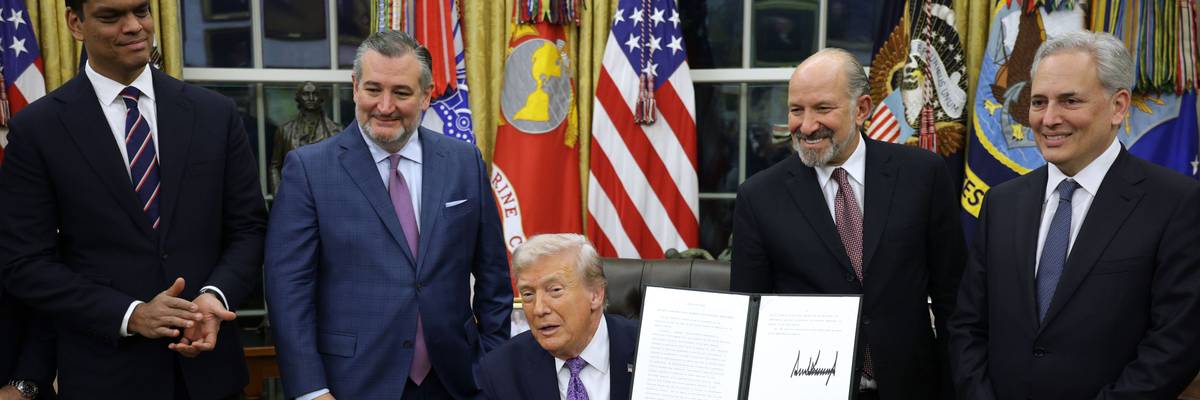
President Donald Trump displays a signed executive order as (2nd L-R) U.S. Sen. Ted Cruz (R-TX), Commerce Secretary Howard Lutnick and White House artificial intelligence (AI) and crypto czar David Sacks look on in the Oval Office of the White House on December 11, 2025 in Washington, DC.
The president is promoting a future in which accountability for the impact of artificial intelligence systems is further out of reach.
Last week, President Trump signed an executive order that proposes to challenge and dismantle a range of “cumbersome” artificial intelligence (AI) laws at state and city level in the US and replace them with a not yet defined national AI regulatory framework.
The move is supposedly an effort to “sustain and enhance the United States’ global AI dominance through a minimally burdensome national policy framework for AI.” But at what cost?
By attempting to void existing regulatory frameworks, the Trump administration is promoting a future in which many components of society are reliant on AI, but where accountability for the impact of these systems is further out of reach.
In an ideal world, a national regulatory framework governing AI would expand safeguards, transparency, and access to justice for people across the US who are harmed by algorithmic and automated systems, in a consistent and equitable way. But in the context of this administration, the reality is likely to be a regulatory vacuum.
Since taking office in January, the Trump administration has ripped up previous federal policies governing discriminatory AI, removed safeguards across government-held data, and given tech companies expansive access to sensitive personal federal data. It has also increased its financial and political stakes in the tech industry and appointed an industry leader with a personal interest in deregulation to oversee the government’s approach to AI.
We know that integrating algorithms and automation to any process creates particular risks to human rights. AI systems have led to the wrong person being imprisoned, workers mistakenly fired, and lives ended too soon, and without adequate accountability for the companies behind the tech. It is imperative that this technology is created and deployed with the utmost care.
Trump’s executive order won’t just impact AI either. It threatens to rescind federal support for internet connectivity infrastructure via the BEAD (Broadband Equity Access and Deployment) Program, and would withhold funding to states that do not revoke AI accountability laws. This could significantly restrict equitable access to affordable, reliable broadband internet services for many.
There are worthwhile, evidence-driven efforts to secure accountability for AI injustices. The administration could, for example, adopt the AI Bill of Rights. But rather than increase steps toward accountability, this executive order marks yet another step in the Trump administration’s erosion of rights.
Dear Common Dreams reader, It’s been nearly 30 years since I co-founded Common Dreams with my late wife, Lina Newhouser. We had the radical notion that journalism should serve the public good, not corporate profits. It was clear to us from the outset what it would take to build such a project. No paid advertisements. No corporate sponsors. No millionaire publisher telling us what to think or do. Many people said we wouldn't last a year, but we proved those doubters wrong. Together with a tremendous team of journalists and dedicated staff, we built an independent media outlet free from the constraints of profits and corporate control. Our mission has always been simple: To inform. To inspire. To ignite change for the common good. Building Common Dreams was not easy. Our survival was never guaranteed. When you take on the most powerful forces—Wall Street greed, fossil fuel industry destruction, Big Tech lobbyists, and uber-rich oligarchs who have spent billions upon billions rigging the economy and democracy in their favor—the only bulwark you have is supporters who believe in your work. But here’s the urgent message from me today. It's never been this bad out there. And it's never been this hard to keep us going. At the very moment Common Dreams is most needed, the threats we face are intensifying. We need your support now more than ever. We don't accept corporate advertising and never will. We don't have a paywall because we don't think people should be blocked from critical news based on their ability to pay. Everything we do is funded by the donations of readers like you. When everyone does the little they can afford, we are strong. But if that support retreats or dries up, so do we. Will you donate now to make sure Common Dreams not only survives but thrives? —Craig Brown, Co-founder |
Last week, President Trump signed an executive order that proposes to challenge and dismantle a range of “cumbersome” artificial intelligence (AI) laws at state and city level in the US and replace them with a not yet defined national AI regulatory framework.
The move is supposedly an effort to “sustain and enhance the United States’ global AI dominance through a minimally burdensome national policy framework for AI.” But at what cost?
By attempting to void existing regulatory frameworks, the Trump administration is promoting a future in which many components of society are reliant on AI, but where accountability for the impact of these systems is further out of reach.
In an ideal world, a national regulatory framework governing AI would expand safeguards, transparency, and access to justice for people across the US who are harmed by algorithmic and automated systems, in a consistent and equitable way. But in the context of this administration, the reality is likely to be a regulatory vacuum.
Since taking office in January, the Trump administration has ripped up previous federal policies governing discriminatory AI, removed safeguards across government-held data, and given tech companies expansive access to sensitive personal federal data. It has also increased its financial and political stakes in the tech industry and appointed an industry leader with a personal interest in deregulation to oversee the government’s approach to AI.
We know that integrating algorithms and automation to any process creates particular risks to human rights. AI systems have led to the wrong person being imprisoned, workers mistakenly fired, and lives ended too soon, and without adequate accountability for the companies behind the tech. It is imperative that this technology is created and deployed with the utmost care.
Trump’s executive order won’t just impact AI either. It threatens to rescind federal support for internet connectivity infrastructure via the BEAD (Broadband Equity Access and Deployment) Program, and would withhold funding to states that do not revoke AI accountability laws. This could significantly restrict equitable access to affordable, reliable broadband internet services for many.
There are worthwhile, evidence-driven efforts to secure accountability for AI injustices. The administration could, for example, adopt the AI Bill of Rights. But rather than increase steps toward accountability, this executive order marks yet another step in the Trump administration’s erosion of rights.
Last week, President Trump signed an executive order that proposes to challenge and dismantle a range of “cumbersome” artificial intelligence (AI) laws at state and city level in the US and replace them with a not yet defined national AI regulatory framework.
The move is supposedly an effort to “sustain and enhance the United States’ global AI dominance through a minimally burdensome national policy framework for AI.” But at what cost?
By attempting to void existing regulatory frameworks, the Trump administration is promoting a future in which many components of society are reliant on AI, but where accountability for the impact of these systems is further out of reach.
In an ideal world, a national regulatory framework governing AI would expand safeguards, transparency, and access to justice for people across the US who are harmed by algorithmic and automated systems, in a consistent and equitable way. But in the context of this administration, the reality is likely to be a regulatory vacuum.
Since taking office in January, the Trump administration has ripped up previous federal policies governing discriminatory AI, removed safeguards across government-held data, and given tech companies expansive access to sensitive personal federal data. It has also increased its financial and political stakes in the tech industry and appointed an industry leader with a personal interest in deregulation to oversee the government’s approach to AI.
We know that integrating algorithms and automation to any process creates particular risks to human rights. AI systems have led to the wrong person being imprisoned, workers mistakenly fired, and lives ended too soon, and without adequate accountability for the companies behind the tech. It is imperative that this technology is created and deployed with the utmost care.
Trump’s executive order won’t just impact AI either. It threatens to rescind federal support for internet connectivity infrastructure via the BEAD (Broadband Equity Access and Deployment) Program, and would withhold funding to states that do not revoke AI accountability laws. This could significantly restrict equitable access to affordable, reliable broadband internet services for many.
There are worthwhile, evidence-driven efforts to secure accountability for AI injustices. The administration could, for example, adopt the AI Bill of Rights. But rather than increase steps toward accountability, this executive order marks yet another step in the Trump administration’s erosion of rights.