SUBSCRIBE TO OUR FREE NEWSLETTER
Daily news & progressive opinion—funded by the people, not the corporations—delivered straight to your inbox.
5
#000000
#FFFFFF
To donate by check, phone, or other method, see our More Ways to Give page.
Daily news & progressive opinion—funded by the people, not the corporations—delivered straight to your inbox.
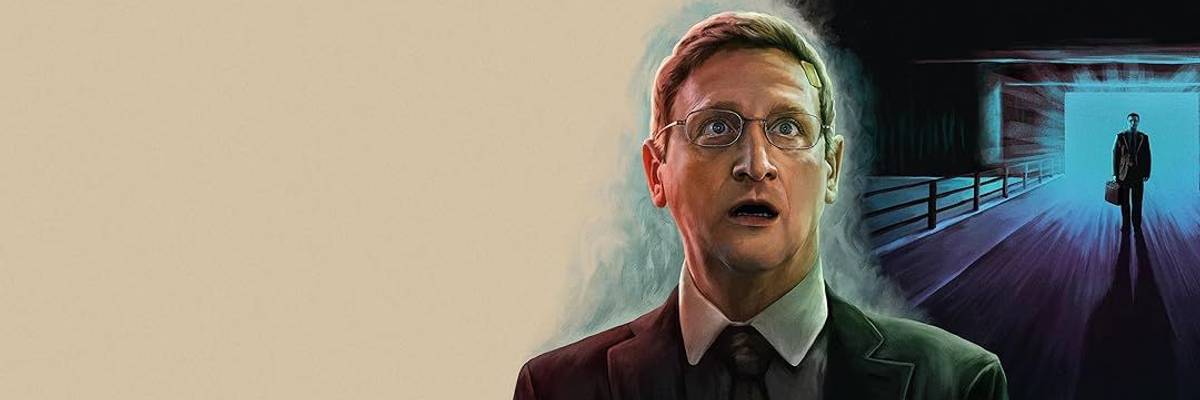
Tim Robinson stars in the HBO show "The Chair Company," a biting comedy on corporate America.
Here’s the nightmarish truth at the heart of the show about a maladjusted middle manager: It's not all in our heads.
It wouldn’t be inaccurate to say I’m a fan of Tim Robinson. But “fan” may not fully convey my regard for him, or that of many of my closest friends. It’s not a parasocial relationship we have, exactly. It’s more like we have developed what might be characterized—somewhat ridiculously, but not totally untruthfully—as a civil religion around Robinson’s work. We share a liturgy of favorite quotes, an iconography of memes, a commitment to passing these traditions on to the next generation (truly, you haven’t lived until you’ve seen a four-year-old boy shout “Let’s slop ‘em up!” while pouring a glass of water over his dinner plate).
And though my friends and I may lay it on a bit thicker than most, we’re certainly not alone in our obsession. Robinson’s contorted face—the confused grimace, the creepy grin, the manic scream—have dominated the internet since 2019; his turns of phrase, in their characteristic grammatical uncanny valley—“You sure about that’s not why?”—have become the language through which millions respond to the world around them.
What explains our fascination with this weirdo comedian? The simplest response—the guy’s stuff is super funny—provides much of the answer, of course. But I don’t think it’s the whole story. For me, at least, Robinson’s shows (and those of his longtime writing partner, Zach Kanin) hold a legitimate claim to being the contemporary art that most effectively captures the alienation and absurdity of our current moment.
Take “Darmine Doggy Door,” a sketch from the third season of Robinson and Kanin’s hit Netflix show I Think You Should Leave. What starts off looking like a classic ad parody quickly takes a turn into horror when Robinson’s character has a flashback to the incident that inspired his new dog door design: a monster crawling into his house. It turns out the “monster” was just a pig in a Richard Nixon mask, sent by a neighbor as a prank—but, as Robinson explains with increasingly delirious energy, “When you can't sleep and you see that thing, you’re not just like right away, ‘That’s a pig with a mask.’ You're like, ‘That's gonna kill me. That’s real. That lives with us on Earth. I thought I was gonna get eaten.”
Then the sketch gets to its true subject. Robinson relates that his first thought upon seeing this nightmarish apparition was, “Great, I don’t have to go to work tomorrow”—and we finally see that the real nightmare here is the implication of that unconscious response. “You’re relieved you don’t have to go to work cause you thought you were gonna get eaten? What the fuck is this world?” he says, grasping his head in disbelief. “What have they done to us?” And again, yelling at the top of his lungs and pointing directly at the camera: “What did they do to us?!” Finally, a cut to Robinson looking dejected with his hands in his pockets. He concludes the dog door commercial: “My life is nothing I thought it should be and everything I was worried it would become because for 50 seconds, I thought there was monsters on the world.” End scene.
“Darmine Doggy Door” is more explicit with its social analysis than most of Robinson’s work, in which the commentary tends to pop up chaotically here and there through the funhouse mirror of his invented worlds. But the newest show from Robinson and Kanin, HBO’s The Chair Company, which wrapped up its first season last week, expands their past moments of weirdly incisive inquiry into a longform treatment of that primal scream of a question, “What have they done to us?”
If you’re interested enough in Tim Robinson to be reading this essay, I have to assume you’re familiar with The Chair Company, but just in case, here’s the basic outline: Ron Trosper, played by Robinson, is a recently-promoted middle manager at an Ohio company that designs shopping malls. After giving a successful speech to kick off a new construction project, he returns to his seat onstage, which collapses. Ron cannot let go of this embarrassing incident—as he shouts at a customer-service representative, “I blasted through a fucking chair at work yesterday in front of all my bosses and my employees, and everybody laughed at me because I’m a fucking joke!” When Ron is unable to get in touch with Tecca, the eponymous chair company, to demand an apology, his questions grow, until he becomes convinced that he is uncovering a “vast criminal conspiracy.” Viewers are left to question whether this conspiracy actually exists or not, at least until the season’s penultimate episode. But Ron is dissatisfied with his humdrum job and fresh off a midlife crisis—he tried to start his own business doing off-road Jeep tours in suburban Ohio, which went as well as you’d expect—and so he latches onto this mystery as a chance to finally do something “important” with his life.
Hilarity, thrills, and horror ensue, alongside all sorts of sociological observations particularly visible to those of us who are partial to a little Ron Trosper-like conspiratorial thinking. Great essays have already been written on what The Chair Company has to say about the modern workplace, masculinity, and Big Tech enshittification, among other topics. But for me, the skeleton key to the show appeared in a scene about halfway through Episode 3. Ron is once again stuck on hold, trying to get through to Tecca, when he loses his temper, shouting out what could be the thesis for the entire series: “These fuckers never pick up! That’s the problem with the world today. People make garbage, and you can’t talk to anybody! You can’t complain to them, you can’t get an apology. I want to scream at ‘em!”
We’ve all been there, right? Whether it’s the gym that won’t let us cancel our membership, the airline that involuntarily bumped us, the hidden junk fees we got stuck with from our ticket purchase, the shrinkflation pushing up our grocery bills, the planned obsolescence degrading our phone and computer, the AI slop taking over our digital lives, or any of the countless other death-by-a-thousand-cut indignities that corporate America subjects us to every day. In all these scams, it’s not simply that a shitty corporation is ripping us off—what really burns the most is knowing how utterly impervious these bad actors are to any sort of accountability for their abuse. It’s certainly enough, now and then, to inspire a daydream or two about dropping everything to make them pay. But at some point we rein in our frustration and move on with our lives.
Ron Trosper doesn’t do that. He does drop everything—his job, his family commitments, and anything else that might get in the way of his pursuit of justice, his quest to “scream at ‘em.”
Now, to be clear, The Chair Company does not valorize that frenzied choice. We're definitely not supposed to see Ron as a role model. And yet (and here's where I have to give a spoiler alert: Seriously, don't read on if you haven't gotten through at least the penultimate episode—it's a lot better of a show if you don't know what the hell is going on), it cannot be denied that, ultimately, Ron was right. He wasn't being a dope. He wasn't inventing a criminal conspiracy in a desperate bid to feel like he’d done something worthwhile with his life (or at least, he wasn’t just doing that). In the end, the threads he pulled on all led somewhere; the scheme was real, and, as we get hints of in the season finale, potentially just as vast as Ron had feverishly imagined.
I was extremely pleased with The Chair Company’s reveal that there was, in fact, a conspiracy—that this wasn't just a show about a middle-aged guy’s mental breakdown, but rather a show about a man’s attempt (however maladjusted or unadvisable it might be) to get a grip on an actual scam by actual bad actors seeking to profit from other people’s misfortune. Though that choice takes us to some surreal places, it also makes The Chair Company a truer reflection of our actual reality. Because the world today is lousy with Teccas. Everywhere you look there’s graft, there's corruption, there are forces that stand to profit when we blast through a fucking chair, that line their pockets by making us into a fucking joke.
Again and again we see how impervious these forces are to accountability. Elite impunity is perhaps the defining feature of our economy and government today—and rage at that impunity, not unlike the rage motivating Ron, may be the most potent political force out there. The banks got bailed out, we got sold out, and an angry America elected and reelected an angry reality TV conman who built a movement, ostensibly, to drain that swamp—a movement that now seems to be splintering over Jeffrey Epstein, the literal embodiment of elite conspiracy.
Because here’s the nightmarish truth at the heart of The Chair Company: It's not all in our heads. It’s not just a pig in a Nixon mask—there really are monsters on the world. Robinson’s latest show lets us imagine what it would look like if we didn’t simply accept the scams of these fuckers who never pick up the phone, who refuse to apologize, who make garbage. The picture it paints of that path is not a pretty one—The Chair Company is not necessarily recommending that we follow in Ron’s disgruntled footsteps. But, by my read, it’s not necessarily saying we shouldn’t, either. Ron is maladjusted, for sure. But look at his world. Is it one he should be well-adjusted to? Is ours? I’m not so sure. Neither, I think, is Tim Robinson—and that’s part of what makes his art so special.
Dear Common Dreams reader, It’s been nearly 30 years since I co-founded Common Dreams with my late wife, Lina Newhouser. We had the radical notion that journalism should serve the public good, not corporate profits. It was clear to us from the outset what it would take to build such a project. No paid advertisements. No corporate sponsors. No millionaire publisher telling us what to think or do. Many people said we wouldn't last a year, but we proved those doubters wrong. Together with a tremendous team of journalists and dedicated staff, we built an independent media outlet free from the constraints of profits and corporate control. Our mission has always been simple: To inform. To inspire. To ignite change for the common good. Building Common Dreams was not easy. Our survival was never guaranteed. When you take on the most powerful forces—Wall Street greed, fossil fuel industry destruction, Big Tech lobbyists, and uber-rich oligarchs who have spent billions upon billions rigging the economy and democracy in their favor—the only bulwark you have is supporters who believe in your work. But here’s the urgent message from me today. It's never been this bad out there. And it's never been this hard to keep us going. At the very moment Common Dreams is most needed, the threats we face are intensifying. We need your support now more than ever. We don't accept corporate advertising and never will. We don't have a paywall because we don't think people should be blocked from critical news based on their ability to pay. Everything we do is funded by the donations of readers like you. When everyone does the little they can afford, we are strong. But if that support retreats or dries up, so do we. Will you donate now to make sure Common Dreams not only survives but thrives? —Craig Brown, Co-founder |
It wouldn’t be inaccurate to say I’m a fan of Tim Robinson. But “fan” may not fully convey my regard for him, or that of many of my closest friends. It’s not a parasocial relationship we have, exactly. It’s more like we have developed what might be characterized—somewhat ridiculously, but not totally untruthfully—as a civil religion around Robinson’s work. We share a liturgy of favorite quotes, an iconography of memes, a commitment to passing these traditions on to the next generation (truly, you haven’t lived until you’ve seen a four-year-old boy shout “Let’s slop ‘em up!” while pouring a glass of water over his dinner plate).
And though my friends and I may lay it on a bit thicker than most, we’re certainly not alone in our obsession. Robinson’s contorted face—the confused grimace, the creepy grin, the manic scream—have dominated the internet since 2019; his turns of phrase, in their characteristic grammatical uncanny valley—“You sure about that’s not why?”—have become the language through which millions respond to the world around them.
What explains our fascination with this weirdo comedian? The simplest response—the guy’s stuff is super funny—provides much of the answer, of course. But I don’t think it’s the whole story. For me, at least, Robinson’s shows (and those of his longtime writing partner, Zach Kanin) hold a legitimate claim to being the contemporary art that most effectively captures the alienation and absurdity of our current moment.
Take “Darmine Doggy Door,” a sketch from the third season of Robinson and Kanin’s hit Netflix show I Think You Should Leave. What starts off looking like a classic ad parody quickly takes a turn into horror when Robinson’s character has a flashback to the incident that inspired his new dog door design: a monster crawling into his house. It turns out the “monster” was just a pig in a Richard Nixon mask, sent by a neighbor as a prank—but, as Robinson explains with increasingly delirious energy, “When you can't sleep and you see that thing, you’re not just like right away, ‘That’s a pig with a mask.’ You're like, ‘That's gonna kill me. That’s real. That lives with us on Earth. I thought I was gonna get eaten.”
Then the sketch gets to its true subject. Robinson relates that his first thought upon seeing this nightmarish apparition was, “Great, I don’t have to go to work tomorrow”—and we finally see that the real nightmare here is the implication of that unconscious response. “You’re relieved you don’t have to go to work cause you thought you were gonna get eaten? What the fuck is this world?” he says, grasping his head in disbelief. “What have they done to us?” And again, yelling at the top of his lungs and pointing directly at the camera: “What did they do to us?!” Finally, a cut to Robinson looking dejected with his hands in his pockets. He concludes the dog door commercial: “My life is nothing I thought it should be and everything I was worried it would become because for 50 seconds, I thought there was monsters on the world.” End scene.
“Darmine Doggy Door” is more explicit with its social analysis than most of Robinson’s work, in which the commentary tends to pop up chaotically here and there through the funhouse mirror of his invented worlds. But the newest show from Robinson and Kanin, HBO’s The Chair Company, which wrapped up its first season last week, expands their past moments of weirdly incisive inquiry into a longform treatment of that primal scream of a question, “What have they done to us?”
If you’re interested enough in Tim Robinson to be reading this essay, I have to assume you’re familiar with The Chair Company, but just in case, here’s the basic outline: Ron Trosper, played by Robinson, is a recently-promoted middle manager at an Ohio company that designs shopping malls. After giving a successful speech to kick off a new construction project, he returns to his seat onstage, which collapses. Ron cannot let go of this embarrassing incident—as he shouts at a customer-service representative, “I blasted through a fucking chair at work yesterday in front of all my bosses and my employees, and everybody laughed at me because I’m a fucking joke!” When Ron is unable to get in touch with Tecca, the eponymous chair company, to demand an apology, his questions grow, until he becomes convinced that he is uncovering a “vast criminal conspiracy.” Viewers are left to question whether this conspiracy actually exists or not, at least until the season’s penultimate episode. But Ron is dissatisfied with his humdrum job and fresh off a midlife crisis—he tried to start his own business doing off-road Jeep tours in suburban Ohio, which went as well as you’d expect—and so he latches onto this mystery as a chance to finally do something “important” with his life.
Hilarity, thrills, and horror ensue, alongside all sorts of sociological observations particularly visible to those of us who are partial to a little Ron Trosper-like conspiratorial thinking. Great essays have already been written on what The Chair Company has to say about the modern workplace, masculinity, and Big Tech enshittification, among other topics. But for me, the skeleton key to the show appeared in a scene about halfway through Episode 3. Ron is once again stuck on hold, trying to get through to Tecca, when he loses his temper, shouting out what could be the thesis for the entire series: “These fuckers never pick up! That’s the problem with the world today. People make garbage, and you can’t talk to anybody! You can’t complain to them, you can’t get an apology. I want to scream at ‘em!”
We’ve all been there, right? Whether it’s the gym that won’t let us cancel our membership, the airline that involuntarily bumped us, the hidden junk fees we got stuck with from our ticket purchase, the shrinkflation pushing up our grocery bills, the planned obsolescence degrading our phone and computer, the AI slop taking over our digital lives, or any of the countless other death-by-a-thousand-cut indignities that corporate America subjects us to every day. In all these scams, it’s not simply that a shitty corporation is ripping us off—what really burns the most is knowing how utterly impervious these bad actors are to any sort of accountability for their abuse. It’s certainly enough, now and then, to inspire a daydream or two about dropping everything to make them pay. But at some point we rein in our frustration and move on with our lives.
Ron Trosper doesn’t do that. He does drop everything—his job, his family commitments, and anything else that might get in the way of his pursuit of justice, his quest to “scream at ‘em.”
Now, to be clear, The Chair Company does not valorize that frenzied choice. We're definitely not supposed to see Ron as a role model. And yet (and here's where I have to give a spoiler alert: Seriously, don't read on if you haven't gotten through at least the penultimate episode—it's a lot better of a show if you don't know what the hell is going on), it cannot be denied that, ultimately, Ron was right. He wasn't being a dope. He wasn't inventing a criminal conspiracy in a desperate bid to feel like he’d done something worthwhile with his life (or at least, he wasn’t just doing that). In the end, the threads he pulled on all led somewhere; the scheme was real, and, as we get hints of in the season finale, potentially just as vast as Ron had feverishly imagined.
I was extremely pleased with The Chair Company’s reveal that there was, in fact, a conspiracy—that this wasn't just a show about a middle-aged guy’s mental breakdown, but rather a show about a man’s attempt (however maladjusted or unadvisable it might be) to get a grip on an actual scam by actual bad actors seeking to profit from other people’s misfortune. Though that choice takes us to some surreal places, it also makes The Chair Company a truer reflection of our actual reality. Because the world today is lousy with Teccas. Everywhere you look there’s graft, there's corruption, there are forces that stand to profit when we blast through a fucking chair, that line their pockets by making us into a fucking joke.
Again and again we see how impervious these forces are to accountability. Elite impunity is perhaps the defining feature of our economy and government today—and rage at that impunity, not unlike the rage motivating Ron, may be the most potent political force out there. The banks got bailed out, we got sold out, and an angry America elected and reelected an angry reality TV conman who built a movement, ostensibly, to drain that swamp—a movement that now seems to be splintering over Jeffrey Epstein, the literal embodiment of elite conspiracy.
Because here’s the nightmarish truth at the heart of The Chair Company: It's not all in our heads. It’s not just a pig in a Nixon mask—there really are monsters on the world. Robinson’s latest show lets us imagine what it would look like if we didn’t simply accept the scams of these fuckers who never pick up the phone, who refuse to apologize, who make garbage. The picture it paints of that path is not a pretty one—The Chair Company is not necessarily recommending that we follow in Ron’s disgruntled footsteps. But, by my read, it’s not necessarily saying we shouldn’t, either. Ron is maladjusted, for sure. But look at his world. Is it one he should be well-adjusted to? Is ours? I’m not so sure. Neither, I think, is Tim Robinson—and that’s part of what makes his art so special.
It wouldn’t be inaccurate to say I’m a fan of Tim Robinson. But “fan” may not fully convey my regard for him, or that of many of my closest friends. It’s not a parasocial relationship we have, exactly. It’s more like we have developed what might be characterized—somewhat ridiculously, but not totally untruthfully—as a civil religion around Robinson’s work. We share a liturgy of favorite quotes, an iconography of memes, a commitment to passing these traditions on to the next generation (truly, you haven’t lived until you’ve seen a four-year-old boy shout “Let’s slop ‘em up!” while pouring a glass of water over his dinner plate).
And though my friends and I may lay it on a bit thicker than most, we’re certainly not alone in our obsession. Robinson’s contorted face—the confused grimace, the creepy grin, the manic scream—have dominated the internet since 2019; his turns of phrase, in their characteristic grammatical uncanny valley—“You sure about that’s not why?”—have become the language through which millions respond to the world around them.
What explains our fascination with this weirdo comedian? The simplest response—the guy’s stuff is super funny—provides much of the answer, of course. But I don’t think it’s the whole story. For me, at least, Robinson’s shows (and those of his longtime writing partner, Zach Kanin) hold a legitimate claim to being the contemporary art that most effectively captures the alienation and absurdity of our current moment.
Take “Darmine Doggy Door,” a sketch from the third season of Robinson and Kanin’s hit Netflix show I Think You Should Leave. What starts off looking like a classic ad parody quickly takes a turn into horror when Robinson’s character has a flashback to the incident that inspired his new dog door design: a monster crawling into his house. It turns out the “monster” was just a pig in a Richard Nixon mask, sent by a neighbor as a prank—but, as Robinson explains with increasingly delirious energy, “When you can't sleep and you see that thing, you’re not just like right away, ‘That’s a pig with a mask.’ You're like, ‘That's gonna kill me. That’s real. That lives with us on Earth. I thought I was gonna get eaten.”
Then the sketch gets to its true subject. Robinson relates that his first thought upon seeing this nightmarish apparition was, “Great, I don’t have to go to work tomorrow”—and we finally see that the real nightmare here is the implication of that unconscious response. “You’re relieved you don’t have to go to work cause you thought you were gonna get eaten? What the fuck is this world?” he says, grasping his head in disbelief. “What have they done to us?” And again, yelling at the top of his lungs and pointing directly at the camera: “What did they do to us?!” Finally, a cut to Robinson looking dejected with his hands in his pockets. He concludes the dog door commercial: “My life is nothing I thought it should be and everything I was worried it would become because for 50 seconds, I thought there was monsters on the world.” End scene.
“Darmine Doggy Door” is more explicit with its social analysis than most of Robinson’s work, in which the commentary tends to pop up chaotically here and there through the funhouse mirror of his invented worlds. But the newest show from Robinson and Kanin, HBO’s The Chair Company, which wrapped up its first season last week, expands their past moments of weirdly incisive inquiry into a longform treatment of that primal scream of a question, “What have they done to us?”
If you’re interested enough in Tim Robinson to be reading this essay, I have to assume you’re familiar with The Chair Company, but just in case, here’s the basic outline: Ron Trosper, played by Robinson, is a recently-promoted middle manager at an Ohio company that designs shopping malls. After giving a successful speech to kick off a new construction project, he returns to his seat onstage, which collapses. Ron cannot let go of this embarrassing incident—as he shouts at a customer-service representative, “I blasted through a fucking chair at work yesterday in front of all my bosses and my employees, and everybody laughed at me because I’m a fucking joke!” When Ron is unable to get in touch with Tecca, the eponymous chair company, to demand an apology, his questions grow, until he becomes convinced that he is uncovering a “vast criminal conspiracy.” Viewers are left to question whether this conspiracy actually exists or not, at least until the season’s penultimate episode. But Ron is dissatisfied with his humdrum job and fresh off a midlife crisis—he tried to start his own business doing off-road Jeep tours in suburban Ohio, which went as well as you’d expect—and so he latches onto this mystery as a chance to finally do something “important” with his life.
Hilarity, thrills, and horror ensue, alongside all sorts of sociological observations particularly visible to those of us who are partial to a little Ron Trosper-like conspiratorial thinking. Great essays have already been written on what The Chair Company has to say about the modern workplace, masculinity, and Big Tech enshittification, among other topics. But for me, the skeleton key to the show appeared in a scene about halfway through Episode 3. Ron is once again stuck on hold, trying to get through to Tecca, when he loses his temper, shouting out what could be the thesis for the entire series: “These fuckers never pick up! That’s the problem with the world today. People make garbage, and you can’t talk to anybody! You can’t complain to them, you can’t get an apology. I want to scream at ‘em!”
We’ve all been there, right? Whether it’s the gym that won’t let us cancel our membership, the airline that involuntarily bumped us, the hidden junk fees we got stuck with from our ticket purchase, the shrinkflation pushing up our grocery bills, the planned obsolescence degrading our phone and computer, the AI slop taking over our digital lives, or any of the countless other death-by-a-thousand-cut indignities that corporate America subjects us to every day. In all these scams, it’s not simply that a shitty corporation is ripping us off—what really burns the most is knowing how utterly impervious these bad actors are to any sort of accountability for their abuse. It’s certainly enough, now and then, to inspire a daydream or two about dropping everything to make them pay. But at some point we rein in our frustration and move on with our lives.
Ron Trosper doesn’t do that. He does drop everything—his job, his family commitments, and anything else that might get in the way of his pursuit of justice, his quest to “scream at ‘em.”
Now, to be clear, The Chair Company does not valorize that frenzied choice. We're definitely not supposed to see Ron as a role model. And yet (and here's where I have to give a spoiler alert: Seriously, don't read on if you haven't gotten through at least the penultimate episode—it's a lot better of a show if you don't know what the hell is going on), it cannot be denied that, ultimately, Ron was right. He wasn't being a dope. He wasn't inventing a criminal conspiracy in a desperate bid to feel like he’d done something worthwhile with his life (or at least, he wasn’t just doing that). In the end, the threads he pulled on all led somewhere; the scheme was real, and, as we get hints of in the season finale, potentially just as vast as Ron had feverishly imagined.
I was extremely pleased with The Chair Company’s reveal that there was, in fact, a conspiracy—that this wasn't just a show about a middle-aged guy’s mental breakdown, but rather a show about a man’s attempt (however maladjusted or unadvisable it might be) to get a grip on an actual scam by actual bad actors seeking to profit from other people’s misfortune. Though that choice takes us to some surreal places, it also makes The Chair Company a truer reflection of our actual reality. Because the world today is lousy with Teccas. Everywhere you look there’s graft, there's corruption, there are forces that stand to profit when we blast through a fucking chair, that line their pockets by making us into a fucking joke.
Again and again we see how impervious these forces are to accountability. Elite impunity is perhaps the defining feature of our economy and government today—and rage at that impunity, not unlike the rage motivating Ron, may be the most potent political force out there. The banks got bailed out, we got sold out, and an angry America elected and reelected an angry reality TV conman who built a movement, ostensibly, to drain that swamp—a movement that now seems to be splintering over Jeffrey Epstein, the literal embodiment of elite conspiracy.
Because here’s the nightmarish truth at the heart of The Chair Company: It's not all in our heads. It’s not just a pig in a Nixon mask—there really are monsters on the world. Robinson’s latest show lets us imagine what it would look like if we didn’t simply accept the scams of these fuckers who never pick up the phone, who refuse to apologize, who make garbage. The picture it paints of that path is not a pretty one—The Chair Company is not necessarily recommending that we follow in Ron’s disgruntled footsteps. But, by my read, it’s not necessarily saying we shouldn’t, either. Ron is maladjusted, for sure. But look at his world. Is it one he should be well-adjusted to? Is ours? I’m not so sure. Neither, I think, is Tim Robinson—and that’s part of what makes his art so special.