SUBSCRIBE TO OUR FREE NEWSLETTER
Daily news & progressive opinion—funded by the people, not the corporations—delivered straight to your inbox.
5
#000000
#FFFFFF
To donate by check, phone, or other method, see our More Ways to Give page.
Daily news & progressive opinion—funded by the people, not the corporations—delivered straight to your inbox.
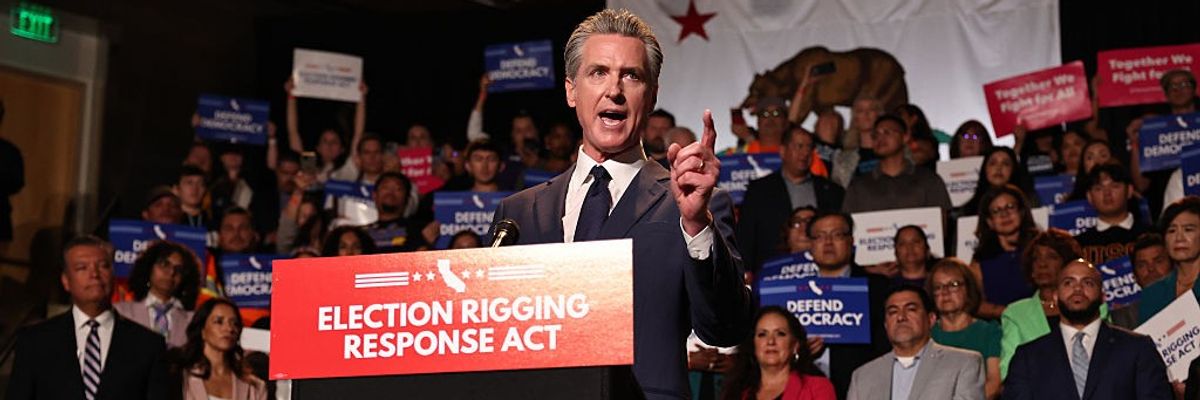
California Governor Gavin Newsom speaks about California redistricting plans at a press conference at the Democracy Center, Japanese American Museum on August 14, 2025 in Los Angeles, California. Newsom spoke about a possible California referendum on redistricting to counter the legislative effort to add five Republican House seats in the state of Texas.
A partisan redistricting arms race cannot be the only answer. We urgently need national redistricting standards that apply across the country—to red states and blue states alike.
Voters should choose their politicians, not the other way around. The Texas gerrymander and the partisan war it has triggered signal an extraordinarily dangerous period for American democracy.
Gerrymandering leads to less choice, less representation for voters, and less accountability for politicians. It also produces more polarization, as party primary voters rather than general election voters have the loudest say. And voters of color all too often suffer the most as their communities are cynically sliced and diced to engineer partisan advantage.
The phenomenon is not new. In the very first congressional election, Patrick Henry drew a House district to try to keep James Madison from being elected to Congress. Both parties eventually participated in the practice. Over the years, technology and an increasingly partisan governing style have made things worse. In last year’s election, only 37 House seats were competitive, and those were decided by 5 percentage points or less. Just 11 of those districts flipped between parties.
But what’s going on in Texas now is particularly wrong. Gov. Greg Abbott is pursuing a gerrymander to produce five new seats for Republicans, mid-decade (long after the census), at the expense of Black and Latino voters, all on orders from a sitting president. It’s a raw power grab.
For too long, when it comes to protecting voters, to quote the poet William Butler Yeats, “the best lack all conviction, while the worst are full of passionate intensity.”
It is part of an unprecedented White House push to tilt the electoral terrain in 2026 and beyond. Vice President JD Vance just met with state leaders in Indiana to urge redrawing of maps there. Florida, Missouri, and other states may follow suit. President Trump even called for a new census that would exclude undocumented immigrants. (That’s logistically impossible as well as unconstitutional.) Last week, the Brennan Center outlined how the administration aims to undermine election rules across the country.
It’s no surprise that Democrats are responding as they have across the nation: They’re outraged and have pledged to redraw maps in states they control. Gov. Gavin Newsom on Thurdsday announced a new map before California voters in November to match Texas’s harvest of Republican seats. New York Gov. Kathy Hochul vowed to “fight fire with fire.”
But ultimately, a partisan redistricting arms race cannot be the only answer. We urgently need national redistricting standards that apply across the country — to red states and blue states alike.
On this topic, in recent years, the Supreme Court has walked away from its duty. In Rucho v. Common Cause in 2019, it declared that federal judges could not protect against unfair maps. Racial discrimination is still illegal, but judges now wink and allow politicians to gerrymander so long as they claim it’s about politics, not race.
Even so, the Court noted that Congress has the constitutional power to set national standards. And just recently, it almost did.
The Freedom to Vote Act sought to bar partisan gerrymandering nationwide. It also would have banned mid-decade redistricting and set other national standards — and made it easier and faster for voters to win relief. The John R. Lewis Voting Rights Advancement Act would have strengthened protections against racially discriminatory maps. These landmark bills came achingly close to enactment in 2022. Together they would stop what is happening today, cold.
National standards, like other reforms, do not flow from hazy idealism. They reflect hard reality: Congress has the power to prohibit political abuse. President Biden did not press for these reforms until it was too late in his term. President Obama, too, did not demand action when he held power. This inaction reflected a repeated failure of imagination as well as will.
For too long, when it comes to protecting voters, to quote the poet William Butler Yeats, “the best lack all conviction, while the worst are full of passionate intensity.”
Those who want to undermine American democracy have shown that they will act with impunity. Those who profess to care about the law must respond with equal boldness. If they have the chance, they must act to unrig the system. While the Supreme Court helped get us into this mess, all eyes will be on Congress to get us out.
Dear Common Dreams reader, It’s been nearly 30 years since I co-founded Common Dreams with my late wife, Lina Newhouser. We had the radical notion that journalism should serve the public good, not corporate profits. It was clear to us from the outset what it would take to build such a project. No paid advertisements. No corporate sponsors. No millionaire publisher telling us what to think or do. Many people said we wouldn't last a year, but we proved those doubters wrong. Together with a tremendous team of journalists and dedicated staff, we built an independent media outlet free from the constraints of profits and corporate control. Our mission has always been simple: To inform. To inspire. To ignite change for the common good. Building Common Dreams was not easy. Our survival was never guaranteed. When you take on the most powerful forces—Wall Street greed, fossil fuel industry destruction, Big Tech lobbyists, and uber-rich oligarchs who have spent billions upon billions rigging the economy and democracy in their favor—the only bulwark you have is supporters who believe in your work. But here’s the urgent message from me today. It's never been this bad out there. And it's never been this hard to keep us going. At the very moment Common Dreams is most needed, the threats we face are intensifying. We need your support now more than ever. We don't accept corporate advertising and never will. We don't have a paywall because we don't think people should be blocked from critical news based on their ability to pay. Everything we do is funded by the donations of readers like you. When everyone does the little they can afford, we are strong. But if that support retreats or dries up, so do we. Will you donate now to make sure Common Dreams not only survives but thrives? —Craig Brown, Co-founder |
Voters should choose their politicians, not the other way around. The Texas gerrymander and the partisan war it has triggered signal an extraordinarily dangerous period for American democracy.
Gerrymandering leads to less choice, less representation for voters, and less accountability for politicians. It also produces more polarization, as party primary voters rather than general election voters have the loudest say. And voters of color all too often suffer the most as their communities are cynically sliced and diced to engineer partisan advantage.
The phenomenon is not new. In the very first congressional election, Patrick Henry drew a House district to try to keep James Madison from being elected to Congress. Both parties eventually participated in the practice. Over the years, technology and an increasingly partisan governing style have made things worse. In last year’s election, only 37 House seats were competitive, and those were decided by 5 percentage points or less. Just 11 of those districts flipped between parties.
But what’s going on in Texas now is particularly wrong. Gov. Greg Abbott is pursuing a gerrymander to produce five new seats for Republicans, mid-decade (long after the census), at the expense of Black and Latino voters, all on orders from a sitting president. It’s a raw power grab.
For too long, when it comes to protecting voters, to quote the poet William Butler Yeats, “the best lack all conviction, while the worst are full of passionate intensity.”
It is part of an unprecedented White House push to tilt the electoral terrain in 2026 and beyond. Vice President JD Vance just met with state leaders in Indiana to urge redrawing of maps there. Florida, Missouri, and other states may follow suit. President Trump even called for a new census that would exclude undocumented immigrants. (That’s logistically impossible as well as unconstitutional.) Last week, the Brennan Center outlined how the administration aims to undermine election rules across the country.
It’s no surprise that Democrats are responding as they have across the nation: They’re outraged and have pledged to redraw maps in states they control. Gov. Gavin Newsom on Thurdsday announced a new map before California voters in November to match Texas’s harvest of Republican seats. New York Gov. Kathy Hochul vowed to “fight fire with fire.”
But ultimately, a partisan redistricting arms race cannot be the only answer. We urgently need national redistricting standards that apply across the country — to red states and blue states alike.
On this topic, in recent years, the Supreme Court has walked away from its duty. In Rucho v. Common Cause in 2019, it declared that federal judges could not protect against unfair maps. Racial discrimination is still illegal, but judges now wink and allow politicians to gerrymander so long as they claim it’s about politics, not race.
Even so, the Court noted that Congress has the constitutional power to set national standards. And just recently, it almost did.
The Freedom to Vote Act sought to bar partisan gerrymandering nationwide. It also would have banned mid-decade redistricting and set other national standards — and made it easier and faster for voters to win relief. The John R. Lewis Voting Rights Advancement Act would have strengthened protections against racially discriminatory maps. These landmark bills came achingly close to enactment in 2022. Together they would stop what is happening today, cold.
National standards, like other reforms, do not flow from hazy idealism. They reflect hard reality: Congress has the power to prohibit political abuse. President Biden did not press for these reforms until it was too late in his term. President Obama, too, did not demand action when he held power. This inaction reflected a repeated failure of imagination as well as will.
For too long, when it comes to protecting voters, to quote the poet William Butler Yeats, “the best lack all conviction, while the worst are full of passionate intensity.”
Those who want to undermine American democracy have shown that they will act with impunity. Those who profess to care about the law must respond with equal boldness. If they have the chance, they must act to unrig the system. While the Supreme Court helped get us into this mess, all eyes will be on Congress to get us out.
Voters should choose their politicians, not the other way around. The Texas gerrymander and the partisan war it has triggered signal an extraordinarily dangerous period for American democracy.
Gerrymandering leads to less choice, less representation for voters, and less accountability for politicians. It also produces more polarization, as party primary voters rather than general election voters have the loudest say. And voters of color all too often suffer the most as their communities are cynically sliced and diced to engineer partisan advantage.
The phenomenon is not new. In the very first congressional election, Patrick Henry drew a House district to try to keep James Madison from being elected to Congress. Both parties eventually participated in the practice. Over the years, technology and an increasingly partisan governing style have made things worse. In last year’s election, only 37 House seats were competitive, and those were decided by 5 percentage points or less. Just 11 of those districts flipped between parties.
But what’s going on in Texas now is particularly wrong. Gov. Greg Abbott is pursuing a gerrymander to produce five new seats for Republicans, mid-decade (long after the census), at the expense of Black and Latino voters, all on orders from a sitting president. It’s a raw power grab.
For too long, when it comes to protecting voters, to quote the poet William Butler Yeats, “the best lack all conviction, while the worst are full of passionate intensity.”
It is part of an unprecedented White House push to tilt the electoral terrain in 2026 and beyond. Vice President JD Vance just met with state leaders in Indiana to urge redrawing of maps there. Florida, Missouri, and other states may follow suit. President Trump even called for a new census that would exclude undocumented immigrants. (That’s logistically impossible as well as unconstitutional.) Last week, the Brennan Center outlined how the administration aims to undermine election rules across the country.
It’s no surprise that Democrats are responding as they have across the nation: They’re outraged and have pledged to redraw maps in states they control. Gov. Gavin Newsom on Thurdsday announced a new map before California voters in November to match Texas’s harvest of Republican seats. New York Gov. Kathy Hochul vowed to “fight fire with fire.”
But ultimately, a partisan redistricting arms race cannot be the only answer. We urgently need national redistricting standards that apply across the country — to red states and blue states alike.
On this topic, in recent years, the Supreme Court has walked away from its duty. In Rucho v. Common Cause in 2019, it declared that federal judges could not protect against unfair maps. Racial discrimination is still illegal, but judges now wink and allow politicians to gerrymander so long as they claim it’s about politics, not race.
Even so, the Court noted that Congress has the constitutional power to set national standards. And just recently, it almost did.
The Freedom to Vote Act sought to bar partisan gerrymandering nationwide. It also would have banned mid-decade redistricting and set other national standards — and made it easier and faster for voters to win relief. The John R. Lewis Voting Rights Advancement Act would have strengthened protections against racially discriminatory maps. These landmark bills came achingly close to enactment in 2022. Together they would stop what is happening today, cold.
National standards, like other reforms, do not flow from hazy idealism. They reflect hard reality: Congress has the power to prohibit political abuse. President Biden did not press for these reforms until it was too late in his term. President Obama, too, did not demand action when he held power. This inaction reflected a repeated failure of imagination as well as will.
For too long, when it comes to protecting voters, to quote the poet William Butler Yeats, “the best lack all conviction, while the worst are full of passionate intensity.”
Those who want to undermine American democracy have shown that they will act with impunity. Those who profess to care about the law must respond with equal boldness. If they have the chance, they must act to unrig the system. While the Supreme Court helped get us into this mess, all eyes will be on Congress to get us out.