

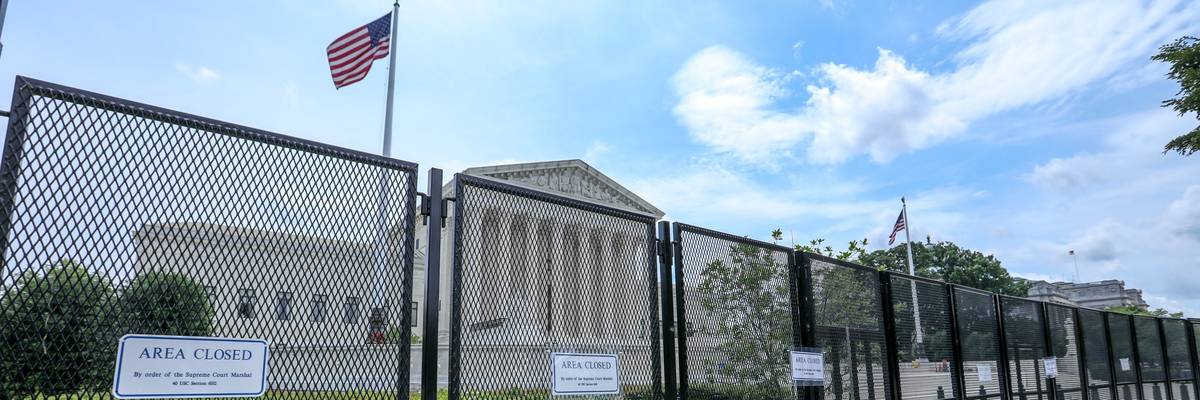
Security fencing outside of the US Supreme Court is seen on June 7, 2022 in Washington, DC.
(Photo by Yasin Ozturk/Anadolu Agency via Getty Images)
There's No Doubt: The Supreme Court Is Part of Trump's Anti-Democracy Movement
Even in the face of two laws in which Congress instructed the executive branch to do certain things, a majority of the current Supreme Court—the abominable Roberts Court—has bent over backwards to ignore those laws.
Jun 26, 2026
The real way to read the immigration decisions the Supreme Court issued on Thursday is not to see them solely as losses for immigrants to the United States or the rights of immigrants. They are much larger losses. They are losses for the authority of Congress to have its laws fully executed by a president who doesn’t agree with them.
Markwayne Mullin vs. Al Otro Lado concerns a 1917 law that requires immigration officers to inspect noncitizens who arrive at ports of entry to determine whether they may enter the United States. Congress amended the law in the Refugee Act of 1980 to allow noncitizens fleeing persecution in their home country to apply for asylum as part of this inspection process.
The act lays out a required set of procedures to guide this process. It says that a noncitizen who seeks admission to the United States “may apply for asylum.” If the noncitizen lacks valid travel documents, the officer “shall order [her] removed” unless she conveys an intention to apply for asylum or a fear of persecution, which in turn requires the officer to “refer” her for further processing of her asylum application.
This system is designed to ensure that the US government considers the application of each person seeking to come into the United States to determine who should be let in, who should be turned away, and who should be allowed to apply for asylum.
This must be seen for what it really is—a systemic effort by the six Republican appointees on the court to shrink congressional authority and enlarge the authority of the executive branch.
But on Thursday, the Supreme Court’s majority held that a president may circumvent these requirements simply by having US immigration officers stand at the border and physically block noncitizens from setting foot on US soil—even if the asylum-seeker is certain to be persecuted, or killed, if she is turned away.
What happened to the Refugee Act of 1980 and the specific procedures outlined in it? The Supreme Court ignored it.
The other decision released today, Markwayne Mullin vs. Dahlia Doe, concerns another law, part of the Immigration Act of 1990 called Temporary Protected Status. For over a decade administrations have provided humanitarian Temporary Protected Status relief to Haitian and Syrian nationals coming to the United States.
Today, the Supreme Court’s majority held that federal courts may not review the Secretary of Homeland Security’s compliance with that law. But in fact the Immigration Act of 1990 specifically allows judicial review of whether the secretary adhered to the procedures the law requires—exactly what the plaintiffs disputed.
It would be easy to see these two cases solely through the lens of immigration—and conclude that the Supreme Court’s decisions Thursday simply backed President Donald Trump and his fanatical underling Stephen Miller’s commitment to block noncitizens from the United States or to force them out. And surely these are the consequences of both of the rulings.
But the decisions are even darker and more dangerous than this. Even in the face of two laws in which Congress instructed the executive branch to do certain things, a majority of the current Supreme Court—the abominable Roberts Court—has bent over backwards to ignore those laws.
This must be seen for what it really is—a systemic effort by the six Republican appointees on the court to shrink congressional authority and enlarge the authority of the executive branch.
If there was any doubt before, there should be none now: The Supreme Court is part of the anti-democracy movement led by Trump and the billionaires behind him.
An Urgent Message From Our Co-Founder
Dear Common Dreams reader, It’s been nearly 30 years since I co-founded Common Dreams with my late wife, Lina Newhouser. We had the radical notion that journalism should serve the public good, not corporate profits. It was clear to us from the outset what it would take to build such a project. No paid advertisements. No corporate sponsors. No millionaire publisher telling us what to think or do. Many people said we wouldn't last a year, but we proved those doubters wrong. Together with a tremendous team of journalists and dedicated staff, we built an independent media outlet free from the constraints of profits and corporate control. Our mission has always been simple: To inform. To inspire. To ignite change for the common good. Building Common Dreams was not easy. Our survival was never guaranteed. When you take on the most powerful forces—Wall Street greed, fossil fuel industry destruction, Big Tech lobbyists, and uber-rich oligarchs who have spent billions upon billions rigging the economy and democracy in their favor—the only bulwark you have is supporters who believe in your work. But here’s the urgent message from me today. It's never been this bad out there. And it's never been this hard to keep us going. At the very moment Common Dreams is most needed, the threats we face are intensifying. We need your support now more than ever. We don't accept corporate advertising and never will. We don't have a paywall because we don't think people should be blocked from critical news based on their ability to pay. Everything we do is funded by the donations of readers like you. When everyone does the little they can afford, we are strong. But if that support retreats or dries up, so do we. Will you donate now to make sure Common Dreams not only survives but thrives? —Craig Brown, Co-founder |
© 2025 Robert Reich
Robert Reich is professor emeritus of public policy at Berkeley and former US secretary of labor. His latest book is the No. 1 New York Times best-seller, "Coming Up Short."
markwayne mullin
temporary protected status
asylum seekers
democracy
us congress
donald trump
supreme court
The real way to read the immigration decisions the Supreme Court issued on Thursday is not to see them solely as losses for immigrants to the United States or the rights of immigrants. They are much larger losses. They are losses for the authority of Congress to have its laws fully executed by a president who doesn’t agree with them.
Markwayne Mullin vs. Al Otro Lado concerns a 1917 law that requires immigration officers to inspect noncitizens who arrive at ports of entry to determine whether they may enter the United States. Congress amended the law in the Refugee Act of 1980 to allow noncitizens fleeing persecution in their home country to apply for asylum as part of this inspection process.
The act lays out a required set of procedures to guide this process. It says that a noncitizen who seeks admission to the United States “may apply for asylum.” If the noncitizen lacks valid travel documents, the officer “shall order [her] removed” unless she conveys an intention to apply for asylum or a fear of persecution, which in turn requires the officer to “refer” her for further processing of her asylum application.
This system is designed to ensure that the US government considers the application of each person seeking to come into the United States to determine who should be let in, who should be turned away, and who should be allowed to apply for asylum.
This must be seen for what it really is—a systemic effort by the six Republican appointees on the court to shrink congressional authority and enlarge the authority of the executive branch.
But on Thursday, the Supreme Court’s majority held that a president may circumvent these requirements simply by having US immigration officers stand at the border and physically block noncitizens from setting foot on US soil—even if the asylum-seeker is certain to be persecuted, or killed, if she is turned away.
What happened to the Refugee Act of 1980 and the specific procedures outlined in it? The Supreme Court ignored it.
The other decision released today, Markwayne Mullin vs. Dahlia Doe, concerns another law, part of the Immigration Act of 1990 called Temporary Protected Status. For over a decade administrations have provided humanitarian Temporary Protected Status relief to Haitian and Syrian nationals coming to the United States.
Today, the Supreme Court’s majority held that federal courts may not review the Secretary of Homeland Security’s compliance with that law. But in fact the Immigration Act of 1990 specifically allows judicial review of whether the secretary adhered to the procedures the law requires—exactly what the plaintiffs disputed.
It would be easy to see these two cases solely through the lens of immigration—and conclude that the Supreme Court’s decisions Thursday simply backed President Donald Trump and his fanatical underling Stephen Miller’s commitment to block noncitizens from the United States or to force them out. And surely these are the consequences of both of the rulings.
But the decisions are even darker and more dangerous than this. Even in the face of two laws in which Congress instructed the executive branch to do certain things, a majority of the current Supreme Court—the abominable Roberts Court—has bent over backwards to ignore those laws.
This must be seen for what it really is—a systemic effort by the six Republican appointees on the court to shrink congressional authority and enlarge the authority of the executive branch.
If there was any doubt before, there should be none now: The Supreme Court is part of the anti-democracy movement led by Trump and the billionaires behind him.
From Your Site Articles
- A Democracy-Killing Duo: How the Supreme Court and the Morbidly Rich Are Ruining Democracy in America ›
- SCOTUS v. Democracy: 7 Supreme Court Decisions Brought Fascism to America ›
- The Arrogant Supreme Court Is Now the Enemy Within ›
- Congress Must Fight Back Against Supreme Court's Anti-Democratic Crusade ›
- Analysis Details How Anti-Democratic Supreme Court Has 'Hit Rock Bottom' ›
- MAGA Supreme Court OKs GOP Overthrow of American Democracy ›
Robert Reich is professor emeritus of public policy at Berkeley and former US secretary of labor. His latest book is the No. 1 New York Times best-seller, "Coming Up Short."
The real way to read the immigration decisions the Supreme Court issued on Thursday is not to see them solely as losses for immigrants to the United States or the rights of immigrants. They are much larger losses. They are losses for the authority of Congress to have its laws fully executed by a president who doesn’t agree with them.
Markwayne Mullin vs. Al Otro Lado concerns a 1917 law that requires immigration officers to inspect noncitizens who arrive at ports of entry to determine whether they may enter the United States. Congress amended the law in the Refugee Act of 1980 to allow noncitizens fleeing persecution in their home country to apply for asylum as part of this inspection process.
The act lays out a required set of procedures to guide this process. It says that a noncitizen who seeks admission to the United States “may apply for asylum.” If the noncitizen lacks valid travel documents, the officer “shall order [her] removed” unless she conveys an intention to apply for asylum or a fear of persecution, which in turn requires the officer to “refer” her for further processing of her asylum application.
This system is designed to ensure that the US government considers the application of each person seeking to come into the United States to determine who should be let in, who should be turned away, and who should be allowed to apply for asylum.
This must be seen for what it really is—a systemic effort by the six Republican appointees on the court to shrink congressional authority and enlarge the authority of the executive branch.
But on Thursday, the Supreme Court’s majority held that a president may circumvent these requirements simply by having US immigration officers stand at the border and physically block noncitizens from setting foot on US soil—even if the asylum-seeker is certain to be persecuted, or killed, if she is turned away.
What happened to the Refugee Act of 1980 and the specific procedures outlined in it? The Supreme Court ignored it.
The other decision released today, Markwayne Mullin vs. Dahlia Doe, concerns another law, part of the Immigration Act of 1990 called Temporary Protected Status. For over a decade administrations have provided humanitarian Temporary Protected Status relief to Haitian and Syrian nationals coming to the United States.
Today, the Supreme Court’s majority held that federal courts may not review the Secretary of Homeland Security’s compliance with that law. But in fact the Immigration Act of 1990 specifically allows judicial review of whether the secretary adhered to the procedures the law requires—exactly what the plaintiffs disputed.
It would be easy to see these two cases solely through the lens of immigration—and conclude that the Supreme Court’s decisions Thursday simply backed President Donald Trump and his fanatical underling Stephen Miller’s commitment to block noncitizens from the United States or to force them out. And surely these are the consequences of both of the rulings.
But the decisions are even darker and more dangerous than this. Even in the face of two laws in which Congress instructed the executive branch to do certain things, a majority of the current Supreme Court—the abominable Roberts Court—has bent over backwards to ignore those laws.
This must be seen for what it really is—a systemic effort by the six Republican appointees on the court to shrink congressional authority and enlarge the authority of the executive branch.
If there was any doubt before, there should be none now: The Supreme Court is part of the anti-democracy movement led by Trump and the billionaires behind him.
From Your Site Articles
- A Democracy-Killing Duo: How the Supreme Court and the Morbidly Rich Are Ruining Democracy in America ›
- SCOTUS v. Democracy: 7 Supreme Court Decisions Brought Fascism to America ›
- The Arrogant Supreme Court Is Now the Enemy Within ›
- Congress Must Fight Back Against Supreme Court's Anti-Democratic Crusade ›
- Analysis Details How Anti-Democratic Supreme Court Has 'Hit Rock Bottom' ›
- MAGA Supreme Court OKs GOP Overthrow of American Democracy ›
markwayne mullin
temporary protected status
asylum seekers
democracy
us congress
donald trump
supreme court
We've had enough. The 1% own and operate the corporate media. They are doing everything they can to defend the status quo, squash dissent and protect the wealthy and the powerful. The Common Dreams media model is different. We cover the news that matters to the 99%. Our mission? To inform. To inspire. To ignite change for the common good. How? Nonprofit. Independent. Reader-supported. Free to read. Free to republish. Free to share. With no advertising. No paywalls. No selling of your data. Thousands of small donations fund our newsroom and allow us to continue publishing. Can you chip in? We can't do it without you. Thank you.