SUBSCRIBE TO OUR FREE NEWSLETTER
Daily news & progressive opinion—funded by the people, not the corporations—delivered straight to your inbox.
5
#000000
#FFFFFF
To donate by check, phone, or other method, see our More Ways to Give page.
Daily news & progressive opinion—funded by the people, not the corporations—delivered straight to your inbox.
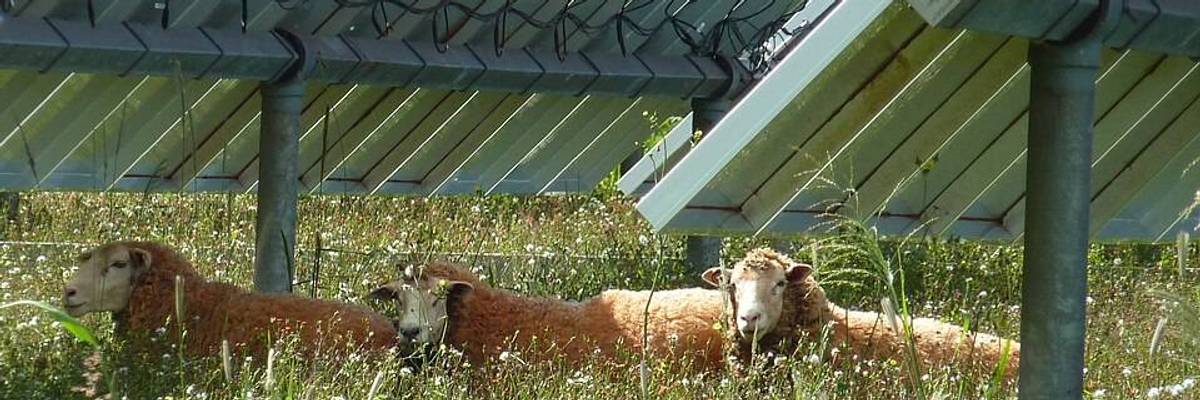
Sheep graze under solar panels in Lanai, Hawaii.
Rethinking how we use the land means American farms can stay in business, producing food and energy that remains local while we invest back into our communities.
America’s farmers are in big trouble. Despite the recent politically timed purchase of 12 million metric tons of US soybeans by China, after months of cancelled or stalled sales, the market remains volatile and uncertain. China now publicly favors cheaper Brazilian soybeans, and US soy exports to China have fallen to their lowest level in more than two decades.
The decline of this important market compounds other struggles farmers like me are facing, including falling commodity prices and rising costs. The number of farm bankruptcies remains troublingly high.
But there’s a solution that can help farmers lower their costs and reduce dependence on volatile foreign markets, while producing cheaper, cleaner energy for all Americans. It’s called agri-energy, and it offers a viable pathway to both food and energy independence.
American farmers were hurting long before the tariffs were put in place. Despite record yields, farming accounts for less than 1% of the American GDP and we have now entered an agricultural trade deficit.
When small farmers are forced to “get out,” our land is typically sold to large farm corporations, to real estate developers, or, God forbid, to the Dollar General corporation.
Any healthy economy relies on diversity, but we put all of our eggs into the corn and soy baskets long ago. Corn and soy are the top two agricultural commodities produced in the United States. This means that any shift in global markets—like the current trade war—can leave farmers with full silos and empty bank accounts.
Now, we’re scrambling to figure out how to recover our investments when we’ve already put so much money, time, and generational resources into these monocultures. Our yields might be excellent, but with corn and soy prices declining sharply relative to production costs, that may not matter much.
The Trump administration’s “solution” is to provide assistance to farmers in the form of relief checks and subsidies, which is akin to putting a Band-Aid on a bleeding femoral artery. Might look okay for a minute, but it’s not going to stop the flow (in this case, the flow of bankruptcies and foreclosures).
What we need to do is start focusing on whole-systems approaches. That’s where agri-energy comes into play.
Agri-energy, also known as agrivoltaics or dual-use solar, involves growing crops or grazing livestock under solar panels, allowing farmers to double dip on their land. By leasing their land for solar energy production, farmers get a nice bumper crop each year—with lease payments averaging $1,000 or more per acre. It’s consistent, reliable income that’s not dependent on the global commodity market.
Because solar leases are long—20 to 30 years or more—there’s more predictability and stability in this kind of setup than perhaps any other agricultural model. If a farmer is ready to lease his land and get out of farming entirely, agri-energy allows for another farmer to manage that land in his place. That’s the case for our family farm—we receive payment from the solar company for vegetation management services on other sites.
On a broader scale, practices like rotational grazing (typically the go-to on solar farms) improve soil quality and leave the land healthier than it was prior to the solar farm’s installation. The animals benefit, too, from improved forage and shade, reaching heavier finishing and weaning weights at a lower cost to the farmer. This, too, we’ve seen firsthand on the solar farms we graze.
Rethinking how we use the land means American farms can stay in business, producing food and energy that remains local while we invest back into our communities.
Some worry that agri-energy will take good land out of agriculture. But the reliable income from solar leases can actually keep farmers on the land. This is especially important for small farmers like me who were once told to “get big or get out.”
When small farmers are forced to “get out,” our land is typically sold to large farm corporations, to real estate developers, or, God forbid, to the Dollar General corporation. Remember: Prime farmland doesn’t remain farmland if it’s not farmed.
If we really want to reduce our reliance on global trade, agri-energy—not tariffs—may be the silver bullet we’re looking for.
Dear Common Dreams reader, It’s been nearly 30 years since I co-founded Common Dreams with my late wife, Lina Newhouser. We had the radical notion that journalism should serve the public good, not corporate profits. It was clear to us from the outset what it would take to build such a project. No paid advertisements. No corporate sponsors. No millionaire publisher telling us what to think or do. Many people said we wouldn't last a year, but we proved those doubters wrong. Together with a tremendous team of journalists and dedicated staff, we built an independent media outlet free from the constraints of profits and corporate control. Our mission has always been simple: To inform. To inspire. To ignite change for the common good. Building Common Dreams was not easy. Our survival was never guaranteed. When you take on the most powerful forces—Wall Street greed, fossil fuel industry destruction, Big Tech lobbyists, and uber-rich oligarchs who have spent billions upon billions rigging the economy and democracy in their favor—the only bulwark you have is supporters who believe in your work. But here’s the urgent message from me today. It's never been this bad out there. And it's never been this hard to keep us going. At the very moment Common Dreams is most needed, the threats we face are intensifying. We need your support now more than ever. We don't accept corporate advertising and never will. We don't have a paywall because we don't think people should be blocked from critical news based on their ability to pay. Everything we do is funded by the donations of readers like you. When everyone does the little they can afford, we are strong. But if that support retreats or dries up, so do we. Will you donate now to make sure Common Dreams not only survives but thrives? —Craig Brown, Co-founder |
America’s farmers are in big trouble. Despite the recent politically timed purchase of 12 million metric tons of US soybeans by China, after months of cancelled or stalled sales, the market remains volatile and uncertain. China now publicly favors cheaper Brazilian soybeans, and US soy exports to China have fallen to their lowest level in more than two decades.
The decline of this important market compounds other struggles farmers like me are facing, including falling commodity prices and rising costs. The number of farm bankruptcies remains troublingly high.
But there’s a solution that can help farmers lower their costs and reduce dependence on volatile foreign markets, while producing cheaper, cleaner energy for all Americans. It’s called agri-energy, and it offers a viable pathway to both food and energy independence.
American farmers were hurting long before the tariffs were put in place. Despite record yields, farming accounts for less than 1% of the American GDP and we have now entered an agricultural trade deficit.
When small farmers are forced to “get out,” our land is typically sold to large farm corporations, to real estate developers, or, God forbid, to the Dollar General corporation.
Any healthy economy relies on diversity, but we put all of our eggs into the corn and soy baskets long ago. Corn and soy are the top two agricultural commodities produced in the United States. This means that any shift in global markets—like the current trade war—can leave farmers with full silos and empty bank accounts.
Now, we’re scrambling to figure out how to recover our investments when we’ve already put so much money, time, and generational resources into these monocultures. Our yields might be excellent, but with corn and soy prices declining sharply relative to production costs, that may not matter much.
The Trump administration’s “solution” is to provide assistance to farmers in the form of relief checks and subsidies, which is akin to putting a Band-Aid on a bleeding femoral artery. Might look okay for a minute, but it’s not going to stop the flow (in this case, the flow of bankruptcies and foreclosures).
What we need to do is start focusing on whole-systems approaches. That’s where agri-energy comes into play.
Agri-energy, also known as agrivoltaics or dual-use solar, involves growing crops or grazing livestock under solar panels, allowing farmers to double dip on their land. By leasing their land for solar energy production, farmers get a nice bumper crop each year—with lease payments averaging $1,000 or more per acre. It’s consistent, reliable income that’s not dependent on the global commodity market.
Because solar leases are long—20 to 30 years or more—there’s more predictability and stability in this kind of setup than perhaps any other agricultural model. If a farmer is ready to lease his land and get out of farming entirely, agri-energy allows for another farmer to manage that land in his place. That’s the case for our family farm—we receive payment from the solar company for vegetation management services on other sites.
On a broader scale, practices like rotational grazing (typically the go-to on solar farms) improve soil quality and leave the land healthier than it was prior to the solar farm’s installation. The animals benefit, too, from improved forage and shade, reaching heavier finishing and weaning weights at a lower cost to the farmer. This, too, we’ve seen firsthand on the solar farms we graze.
Rethinking how we use the land means American farms can stay in business, producing food and energy that remains local while we invest back into our communities.
Some worry that agri-energy will take good land out of agriculture. But the reliable income from solar leases can actually keep farmers on the land. This is especially important for small farmers like me who were once told to “get big or get out.”
When small farmers are forced to “get out,” our land is typically sold to large farm corporations, to real estate developers, or, God forbid, to the Dollar General corporation. Remember: Prime farmland doesn’t remain farmland if it’s not farmed.
If we really want to reduce our reliance on global trade, agri-energy—not tariffs—may be the silver bullet we’re looking for.
America’s farmers are in big trouble. Despite the recent politically timed purchase of 12 million metric tons of US soybeans by China, after months of cancelled or stalled sales, the market remains volatile and uncertain. China now publicly favors cheaper Brazilian soybeans, and US soy exports to China have fallen to their lowest level in more than two decades.
The decline of this important market compounds other struggles farmers like me are facing, including falling commodity prices and rising costs. The number of farm bankruptcies remains troublingly high.
But there’s a solution that can help farmers lower their costs and reduce dependence on volatile foreign markets, while producing cheaper, cleaner energy for all Americans. It’s called agri-energy, and it offers a viable pathway to both food and energy independence.
American farmers were hurting long before the tariffs were put in place. Despite record yields, farming accounts for less than 1% of the American GDP and we have now entered an agricultural trade deficit.
When small farmers are forced to “get out,” our land is typically sold to large farm corporations, to real estate developers, or, God forbid, to the Dollar General corporation.
Any healthy economy relies on diversity, but we put all of our eggs into the corn and soy baskets long ago. Corn and soy are the top two agricultural commodities produced in the United States. This means that any shift in global markets—like the current trade war—can leave farmers with full silos and empty bank accounts.
Now, we’re scrambling to figure out how to recover our investments when we’ve already put so much money, time, and generational resources into these monocultures. Our yields might be excellent, but with corn and soy prices declining sharply relative to production costs, that may not matter much.
The Trump administration’s “solution” is to provide assistance to farmers in the form of relief checks and subsidies, which is akin to putting a Band-Aid on a bleeding femoral artery. Might look okay for a minute, but it’s not going to stop the flow (in this case, the flow of bankruptcies and foreclosures).
What we need to do is start focusing on whole-systems approaches. That’s where agri-energy comes into play.
Agri-energy, also known as agrivoltaics or dual-use solar, involves growing crops or grazing livestock under solar panels, allowing farmers to double dip on their land. By leasing their land for solar energy production, farmers get a nice bumper crop each year—with lease payments averaging $1,000 or more per acre. It’s consistent, reliable income that’s not dependent on the global commodity market.
Because solar leases are long—20 to 30 years or more—there’s more predictability and stability in this kind of setup than perhaps any other agricultural model. If a farmer is ready to lease his land and get out of farming entirely, agri-energy allows for another farmer to manage that land in his place. That’s the case for our family farm—we receive payment from the solar company for vegetation management services on other sites.
On a broader scale, practices like rotational grazing (typically the go-to on solar farms) improve soil quality and leave the land healthier than it was prior to the solar farm’s installation. The animals benefit, too, from improved forage and shade, reaching heavier finishing and weaning weights at a lower cost to the farmer. This, too, we’ve seen firsthand on the solar farms we graze.
Rethinking how we use the land means American farms can stay in business, producing food and energy that remains local while we invest back into our communities.
Some worry that agri-energy will take good land out of agriculture. But the reliable income from solar leases can actually keep farmers on the land. This is especially important for small farmers like me who were once told to “get big or get out.”
When small farmers are forced to “get out,” our land is typically sold to large farm corporations, to real estate developers, or, God forbid, to the Dollar General corporation. Remember: Prime farmland doesn’t remain farmland if it’s not farmed.
If we really want to reduce our reliance on global trade, agri-energy—not tariffs—may be the silver bullet we’re looking for.