SUBSCRIBE TO OUR FREE NEWSLETTER
Daily news & progressive opinion—funded by the people, not the corporations—delivered straight to your inbox.
5
#000000
#FFFFFF
To donate by check, phone, or other method, see our More Ways to Give page.
Daily news & progressive opinion—funded by the people, not the corporations—delivered straight to your inbox.
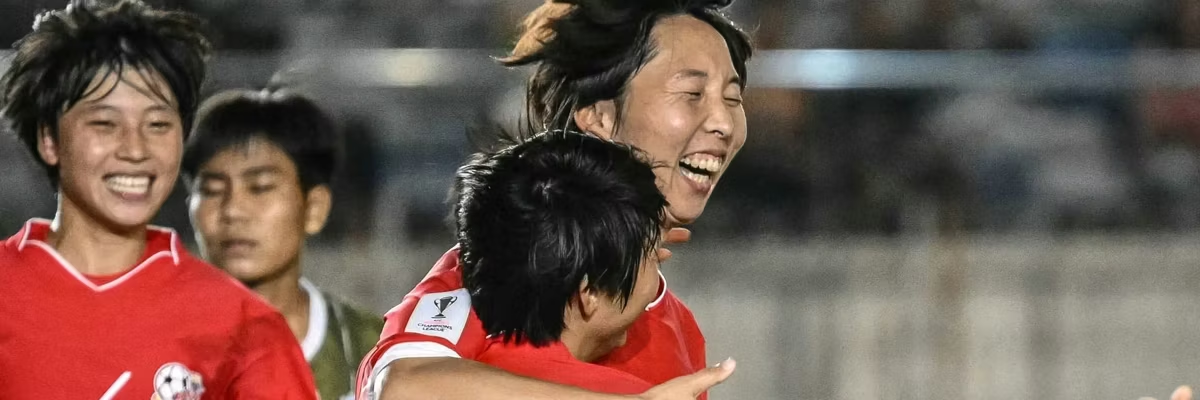
A rare inter-Korean women’s soccer match offers something the Korean Peninsula desperately needs: hope.
As the world begins turning its attention toward this summer’s FIFA World Cup, an even more meaningful soccer event is taking place this week in Korea.
Pyongyang-based Naegohyang Women’s Football Club faces Suwon FC Women in the semifinals of the Asian Football Confederation Women’s Champions League in South Korea—marking the first time North Korea has sent athletes to South Korea to compete since 2018. Some 200 South Korean civic groups have formed a 3,000-strong cheering squad for the historic inter-Korean match, and South Korea’s government set aside 300 million won ($202,000) in government funds to support the cheering squad.
For many, this may sound like a niche sports story. But Korea peace activists recognize this as one of the most hopeful openings in years.
For decades, inter-Korean relations have been defined internationally through the language of crisis: missile tests, nuclear threats, military drills, and sanctions. Diplomacy, meanwhile, has too often been treated as politically risky or naïve.
As Korean peace advocates, we know that openings are few and far between, and we cannot afford to miss this window of opportunity. Soccer may be a spectator sport, but people-led peacebuilding efforts require us all to participate.
But history tells a different story.
Time and again, engagement between North and South Korea has succeeded in reducing tensions and creating opportunities for dialogue. The last major period of inter-Korean diplomacy began not with weapons negotiations, but with athletes marching together.
At the 2018 Pyeongchang Winter Olympics, athletes from North and South Korea entered the opening ceremony side by side under the Korean Unification Flag after a series of talks between then-South Korean President Moon Jae-in and North Korean leader Kim Jong Un. The image captured global attention and helped catalyze one of the most diplomatically active periods on the peninsula in years, including inter-Korean summits at Panmunjom and unprecedented US-North Korea diplomacy.
Soccer, in particular, has long served as a bridge. North and South Korean men’s and women’s teams have faced each other numerous times since 1946—even before the Korean War officially began. North Korea also sent women footballers to compete in South Korea during the 2014 Asian Games, and North Korean athletes last traveled south in 2018 for an inter-Korean table tennis event. In their 1996 World Cup run, North Korea men’s team challenged Cold War stereotypes as they made a stunning upset victory over Italy’s team, an episode explored in the documentary The Game of Their Lives.
These exchanges allow ordinary Koreans to encounter one another—and the global community—outside the framework of hostility and forever war. Moments like this have the power to catalyze efforts for change.
As Korean American women advocating for peace in Korea, we have seen firsthand how engagement efforts can break through where militarized approaches have failed us repeatedly.
The Korean War never officially ended. Americans are often shocked to learn that the war was only temporarily suspended with a ceasefire armistice in 1953, making it the United States’ longest-running overseas conflict. For over 70 years, divided families and everyday people have borne the costs of ongoing conflict.
Relentless sanctions and isolation have failed to produce denuclearization, reconciliation, or lasting stability. Instead, they have entrenched mistrust, division, and forever war. In recent years, discussion about North Korea in the United States has become trapped between cynicism and alarmism.
This has all culminated in today’s bleak political landscape: Inter-Korean relations are deeply frozen. North Korea has renounced reunification, and under South Korea’s former administration, Seoul increasingly labeled the North a principal enemy. Communication has stalled, tensions have escalated, and diplomacy has all but disappeared.
But political landscapes can change quickly. Following the impeachment of far-right leader Yoon Suk Yeol and the election of Lee Jae-myung, Seoul has increasingly called for renewed inter-Korean dialogue with Pyeongyang, and Pyeongyang has indicated some willingness to engage.
That is why this week’s soccer match matters.
Of course, no single game or summit will solve the security crisis in Korea. But the game demonstrates the importance of engagement—especially during periods of deep political freeze. And importantly, this moment comes through women. Women have consistently been at the forefront of peacebuilding efforts on the peninsula—from family reunification advocacy to feminist peace movements calling for a formal end to the Korean War.
These developments raise the question: Will Washington continue defaulting to the same failed approach of maximum pressure and isolation, or will it support the growing desire among US voters who want an end to forever war and peace with North Korea?
As Korean peace advocates, we know that openings are few and far between, and we cannot afford to miss this window of opportunity. Soccer may be a spectator sport, but people-led peacebuilding efforts require us all to participate.
Policymakers should build upon this moment to support initiatives that lower tensions, remove the threat of nuclear war, and expand opportunities for contact between ordinary people—including cultural exchanges, athletic competitions, humanitarian cooperation, and renewed inter-Korean dialogue. This includes ending the US travel ban to North Korea, which is up for renewal this August.
Peace is not built in a single summit or event, but gradually through relationships, trust building, and repeated acts of engagement. While this week’s match in Suwon will last only 90 minutes, if we are wise enough to recognize its significance, its meaning could endure far longer.
Dear Common Dreams reader, It’s been nearly 30 years since I co-founded Common Dreams with my late wife, Lina Newhouser. We had the radical notion that journalism should serve the public good, not corporate profits. It was clear to us from the outset what it would take to build such a project. No paid advertisements. No corporate sponsors. No millionaire publisher telling us what to think or do. Many people said we wouldn't last a year, but we proved those doubters wrong. Together with a tremendous team of journalists and dedicated staff, we built an independent media outlet free from the constraints of profits and corporate control. Our mission has always been simple: To inform. To inspire. To ignite change for the common good. Building Common Dreams was not easy. Our survival was never guaranteed. When you take on the most powerful forces—Wall Street greed, fossil fuel industry destruction, Big Tech lobbyists, and uber-rich oligarchs who have spent billions upon billions rigging the economy and democracy in their favor—the only bulwark you have is supporters who believe in your work. But here’s the urgent message from me today. It's never been this bad out there. And it's never been this hard to keep us going. At the very moment Common Dreams is most needed, the threats we face are intensifying. We need your support now more than ever. We don't accept corporate advertising and never will. We don't have a paywall because we don't think people should be blocked from critical news based on their ability to pay. Everything we do is funded by the donations of readers like you. When everyone does the little they can afford, we are strong. But if that support retreats or dries up, so do we. Will you donate now to make sure Common Dreams not only survives but thrives? —Craig Brown, Co-founder |
As the world begins turning its attention toward this summer’s FIFA World Cup, an even more meaningful soccer event is taking place this week in Korea.
Pyongyang-based Naegohyang Women’s Football Club faces Suwon FC Women in the semifinals of the Asian Football Confederation Women’s Champions League in South Korea—marking the first time North Korea has sent athletes to South Korea to compete since 2018. Some 200 South Korean civic groups have formed a 3,000-strong cheering squad for the historic inter-Korean match, and South Korea’s government set aside 300 million won ($202,000) in government funds to support the cheering squad.
For many, this may sound like a niche sports story. But Korea peace activists recognize this as one of the most hopeful openings in years.
For decades, inter-Korean relations have been defined internationally through the language of crisis: missile tests, nuclear threats, military drills, and sanctions. Diplomacy, meanwhile, has too often been treated as politically risky or naïve.
As Korean peace advocates, we know that openings are few and far between, and we cannot afford to miss this window of opportunity. Soccer may be a spectator sport, but people-led peacebuilding efforts require us all to participate.
But history tells a different story.
Time and again, engagement between North and South Korea has succeeded in reducing tensions and creating opportunities for dialogue. The last major period of inter-Korean diplomacy began not with weapons negotiations, but with athletes marching together.
At the 2018 Pyeongchang Winter Olympics, athletes from North and South Korea entered the opening ceremony side by side under the Korean Unification Flag after a series of talks between then-South Korean President Moon Jae-in and North Korean leader Kim Jong Un. The image captured global attention and helped catalyze one of the most diplomatically active periods on the peninsula in years, including inter-Korean summits at Panmunjom and unprecedented US-North Korea diplomacy.
Soccer, in particular, has long served as a bridge. North and South Korean men’s and women’s teams have faced each other numerous times since 1946—even before the Korean War officially began. North Korea also sent women footballers to compete in South Korea during the 2014 Asian Games, and North Korean athletes last traveled south in 2018 for an inter-Korean table tennis event. In their 1996 World Cup run, North Korea men’s team challenged Cold War stereotypes as they made a stunning upset victory over Italy’s team, an episode explored in the documentary The Game of Their Lives.
These exchanges allow ordinary Koreans to encounter one another—and the global community—outside the framework of hostility and forever war. Moments like this have the power to catalyze efforts for change.
As Korean American women advocating for peace in Korea, we have seen firsthand how engagement efforts can break through where militarized approaches have failed us repeatedly.
The Korean War never officially ended. Americans are often shocked to learn that the war was only temporarily suspended with a ceasefire armistice in 1953, making it the United States’ longest-running overseas conflict. For over 70 years, divided families and everyday people have borne the costs of ongoing conflict.
Relentless sanctions and isolation have failed to produce denuclearization, reconciliation, or lasting stability. Instead, they have entrenched mistrust, division, and forever war. In recent years, discussion about North Korea in the United States has become trapped between cynicism and alarmism.
This has all culminated in today’s bleak political landscape: Inter-Korean relations are deeply frozen. North Korea has renounced reunification, and under South Korea’s former administration, Seoul increasingly labeled the North a principal enemy. Communication has stalled, tensions have escalated, and diplomacy has all but disappeared.
But political landscapes can change quickly. Following the impeachment of far-right leader Yoon Suk Yeol and the election of Lee Jae-myung, Seoul has increasingly called for renewed inter-Korean dialogue with Pyeongyang, and Pyeongyang has indicated some willingness to engage.
That is why this week’s soccer match matters.
Of course, no single game or summit will solve the security crisis in Korea. But the game demonstrates the importance of engagement—especially during periods of deep political freeze. And importantly, this moment comes through women. Women have consistently been at the forefront of peacebuilding efforts on the peninsula—from family reunification advocacy to feminist peace movements calling for a formal end to the Korean War.
These developments raise the question: Will Washington continue defaulting to the same failed approach of maximum pressure and isolation, or will it support the growing desire among US voters who want an end to forever war and peace with North Korea?
As Korean peace advocates, we know that openings are few and far between, and we cannot afford to miss this window of opportunity. Soccer may be a spectator sport, but people-led peacebuilding efforts require us all to participate.
Policymakers should build upon this moment to support initiatives that lower tensions, remove the threat of nuclear war, and expand opportunities for contact between ordinary people—including cultural exchanges, athletic competitions, humanitarian cooperation, and renewed inter-Korean dialogue. This includes ending the US travel ban to North Korea, which is up for renewal this August.
Peace is not built in a single summit or event, but gradually through relationships, trust building, and repeated acts of engagement. While this week’s match in Suwon will last only 90 minutes, if we are wise enough to recognize its significance, its meaning could endure far longer.
As the world begins turning its attention toward this summer’s FIFA World Cup, an even more meaningful soccer event is taking place this week in Korea.
Pyongyang-based Naegohyang Women’s Football Club faces Suwon FC Women in the semifinals of the Asian Football Confederation Women’s Champions League in South Korea—marking the first time North Korea has sent athletes to South Korea to compete since 2018. Some 200 South Korean civic groups have formed a 3,000-strong cheering squad for the historic inter-Korean match, and South Korea’s government set aside 300 million won ($202,000) in government funds to support the cheering squad.
For many, this may sound like a niche sports story. But Korea peace activists recognize this as one of the most hopeful openings in years.
For decades, inter-Korean relations have been defined internationally through the language of crisis: missile tests, nuclear threats, military drills, and sanctions. Diplomacy, meanwhile, has too often been treated as politically risky or naïve.
As Korean peace advocates, we know that openings are few and far between, and we cannot afford to miss this window of opportunity. Soccer may be a spectator sport, but people-led peacebuilding efforts require us all to participate.
But history tells a different story.
Time and again, engagement between North and South Korea has succeeded in reducing tensions and creating opportunities for dialogue. The last major period of inter-Korean diplomacy began not with weapons negotiations, but with athletes marching together.
At the 2018 Pyeongchang Winter Olympics, athletes from North and South Korea entered the opening ceremony side by side under the Korean Unification Flag after a series of talks between then-South Korean President Moon Jae-in and North Korean leader Kim Jong Un. The image captured global attention and helped catalyze one of the most diplomatically active periods on the peninsula in years, including inter-Korean summits at Panmunjom and unprecedented US-North Korea diplomacy.
Soccer, in particular, has long served as a bridge. North and South Korean men’s and women’s teams have faced each other numerous times since 1946—even before the Korean War officially began. North Korea also sent women footballers to compete in South Korea during the 2014 Asian Games, and North Korean athletes last traveled south in 2018 for an inter-Korean table tennis event. In their 1996 World Cup run, North Korea men’s team challenged Cold War stereotypes as they made a stunning upset victory over Italy’s team, an episode explored in the documentary The Game of Their Lives.
These exchanges allow ordinary Koreans to encounter one another—and the global community—outside the framework of hostility and forever war. Moments like this have the power to catalyze efforts for change.
As Korean American women advocating for peace in Korea, we have seen firsthand how engagement efforts can break through where militarized approaches have failed us repeatedly.
The Korean War never officially ended. Americans are often shocked to learn that the war was only temporarily suspended with a ceasefire armistice in 1953, making it the United States’ longest-running overseas conflict. For over 70 years, divided families and everyday people have borne the costs of ongoing conflict.
Relentless sanctions and isolation have failed to produce denuclearization, reconciliation, or lasting stability. Instead, they have entrenched mistrust, division, and forever war. In recent years, discussion about North Korea in the United States has become trapped between cynicism and alarmism.
This has all culminated in today’s bleak political landscape: Inter-Korean relations are deeply frozen. North Korea has renounced reunification, and under South Korea’s former administration, Seoul increasingly labeled the North a principal enemy. Communication has stalled, tensions have escalated, and diplomacy has all but disappeared.
But political landscapes can change quickly. Following the impeachment of far-right leader Yoon Suk Yeol and the election of Lee Jae-myung, Seoul has increasingly called for renewed inter-Korean dialogue with Pyeongyang, and Pyeongyang has indicated some willingness to engage.
That is why this week’s soccer match matters.
Of course, no single game or summit will solve the security crisis in Korea. But the game demonstrates the importance of engagement—especially during periods of deep political freeze. And importantly, this moment comes through women. Women have consistently been at the forefront of peacebuilding efforts on the peninsula—from family reunification advocacy to feminist peace movements calling for a formal end to the Korean War.
These developments raise the question: Will Washington continue defaulting to the same failed approach of maximum pressure and isolation, or will it support the growing desire among US voters who want an end to forever war and peace with North Korea?
As Korean peace advocates, we know that openings are few and far between, and we cannot afford to miss this window of opportunity. Soccer may be a spectator sport, but people-led peacebuilding efforts require us all to participate.
Policymakers should build upon this moment to support initiatives that lower tensions, remove the threat of nuclear war, and expand opportunities for contact between ordinary people—including cultural exchanges, athletic competitions, humanitarian cooperation, and renewed inter-Korean dialogue. This includes ending the US travel ban to North Korea, which is up for renewal this August.
Peace is not built in a single summit or event, but gradually through relationships, trust building, and repeated acts of engagement. While this week’s match in Suwon will last only 90 minutes, if we are wise enough to recognize its significance, its meaning could endure far longer.