SUBSCRIBE TO OUR FREE NEWSLETTER
Daily news & progressive opinion—funded by the people, not the corporations—delivered straight to your inbox.
5
#000000
#FFFFFF
To donate by check, phone, or other method, see our More Ways to Give page.
Daily news & progressive opinion—funded by the people, not the corporations—delivered straight to your inbox.
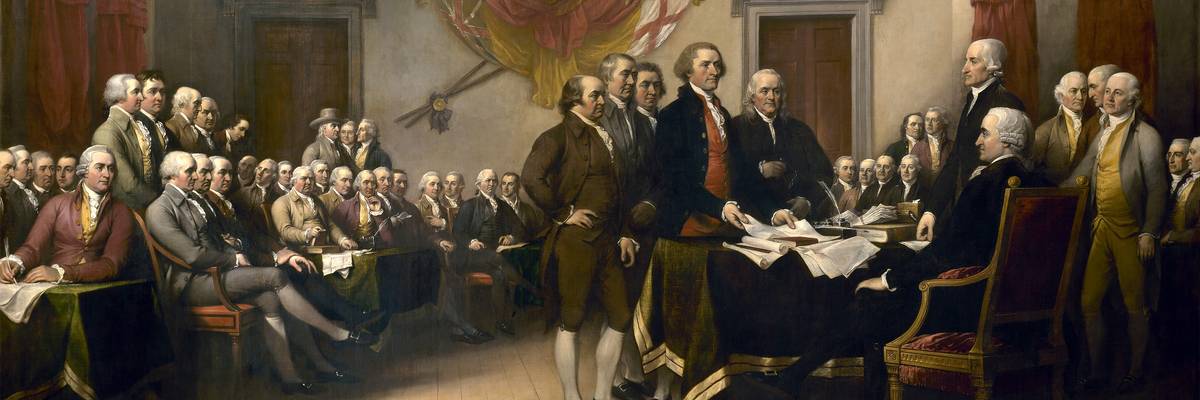
The “founding fathers” were men of means who put their security, their considerable comfort, at risk for a greater good.
In both 1776 and the mid-20th century, our most financially fortunate found themselves in relatively equal societies, and shared a sense of responsibility to the greater good.
Over ten generations have come and gone since 1776. Yet the giants of 1776 still fascinate us. Books about Benjamin Franklin, Thomas Jefferson, and George Washington still regularly dot our bestseller lists.
What so attracts us to these “founding fathers,” these men of means who put their security, their considerable comfort, at risk for a greater good? Maybe the contrast with what we see all around us.
Today’s men of means display precious little selfless behavior. Our CEOs, bankers, and private equity kingpins remain totally fixated on their own corporate and personal bottom lines. They don’t lead the nation. They steal from it.
In both 1776 and 1976 America, the top 1% overall took less than 10% of the nation’s income. The top 1% share today, economist Emmanuel Saez details, is running at over double that level, well over 20%.
So who can blame the rest of us for daydreaming about a time when a significant chunk of our elite showed a real sense of responsibility to something grander than the size of their individual fortunes?
Actually, suggests University of Michigan sociologist Mark Mizruchi, we don’t have to go back to 1776 to find Americans of ample means who cared about “the needs of the larger society.” We had this sort of elite, he argues in The Fracturing of the American Corporate Elite, right in the middle of the 20th century.
Many of America’s top corporate leaders, Mizruchi writes, spent the years right after World War II engaged in public-spirited debate over how best to put the Great Depression behind us and build a prosperity that worked for everyone.
These corporate leaders didn’t try to gut the social safety net the New Deal of the 1930s had created. They supported efforts to stretch this safety net even wider. In the postwar years, major corporate executives helped expand Social Security and increase federal aid to education six-fold. They even accepted high federal income tax rates on high incomes—their incomes.
Mizruchi takes care not to go overboard here. Corporate leaders of the mid-20th-century years regularly did do battle, at various times and on various issues, with unions and other groups that spoke directly for average Americans. But these corporate leaders also did display, notes Mizruchi, “an ethic of responsibility.” They compromised. They tried to offer solutions. They behaved, on the whole, far more admirably than the union-busters, tax-dodgers, and bailout artists who top Americans biggest banks and corporations today.
What explains why our corporate elite behaved so much better back in the post-war years? Mizruchi explores a variety of factors. In the 1950s and 1960s, for one, our corporate elite had to share the political center stage with a strong and vital labor movement. Today’s corporate leaders face a much weaker labor presence.
This weaker labor presence has allowed wealth and power to concentrate ferociously at America’s economic summit. We have become, over recent decades, a fundamentally much more unequal nation.
This inequality, in turn, may be the key to understanding why corporate leaders after World War II much more resembled the elite of 1776 than our own contemporary corporate movers and shakers. In both 1776 and the mid-20th century, our most financially fortunate found themselves in relatively equal societies.
On the eve of the American revolution, as researchers have documented, England’s 13 American colonies had a much more equal distribution of income and wealth than the nations of Europe.
In the years right after World War II, the United States enjoyed a similar epoch of relative equality. Corporate CEOs in the 1950s only made 20 to 30 times what their workers made, not the nearly 400 times more that top corporate execs routinely rake in today.
In both 1776 and 1976 America, the top 1% overall took less than 10% of the nation’s income. The top 1% share today, economist Emmanuel Saez details, is running at over double that level, well over 20%.
Did this relative equality of revolutionary America and America right after World War II help shape how elites interacted with their societies? That certainly seems plausible. More equal societies, after all, have narrower gaps between those at the economic summit and everyone else. The narrower the gap in any society, the easier for all—elite and average alike—to feel invested in their society and share a sense of responsibility for its future.
The takeaway for our Fourth of July, 2023 edition? If we want to rekindle that spirit of 1776, not just daydream about it, our course stands clear. We need to create a more equal America.
Dear Common Dreams reader, It’s been nearly 30 years since I co-founded Common Dreams with my late wife, Lina Newhouser. We had the radical notion that journalism should serve the public good, not corporate profits. It was clear to us from the outset what it would take to build such a project. No paid advertisements. No corporate sponsors. No millionaire publisher telling us what to think or do. Many people said we wouldn't last a year, but we proved those doubters wrong. Together with a tremendous team of journalists and dedicated staff, we built an independent media outlet free from the constraints of profits and corporate control. Our mission has always been simple: To inform. To inspire. To ignite change for the common good. Building Common Dreams was not easy. Our survival was never guaranteed. When you take on the most powerful forces—Wall Street greed, fossil fuel industry destruction, Big Tech lobbyists, and uber-rich oligarchs who have spent billions upon billions rigging the economy and democracy in their favor—the only bulwark you have is supporters who believe in your work. But here’s the urgent message from me today. It's never been this bad out there. And it's never been this hard to keep us going. At the very moment Common Dreams is most needed, the threats we face are intensifying. We need your support now more than ever. We don't accept corporate advertising and never will. We don't have a paywall because we don't think people should be blocked from critical news based on their ability to pay. Everything we do is funded by the donations of readers like you. When everyone does the little they can afford, we are strong. But if that support retreats or dries up, so do we. Will you donate now to make sure Common Dreams not only survives but thrives? —Craig Brown, Co-founder |
Over ten generations have come and gone since 1776. Yet the giants of 1776 still fascinate us. Books about Benjamin Franklin, Thomas Jefferson, and George Washington still regularly dot our bestseller lists.
What so attracts us to these “founding fathers,” these men of means who put their security, their considerable comfort, at risk for a greater good? Maybe the contrast with what we see all around us.
Today’s men of means display precious little selfless behavior. Our CEOs, bankers, and private equity kingpins remain totally fixated on their own corporate and personal bottom lines. They don’t lead the nation. They steal from it.
In both 1776 and 1976 America, the top 1% overall took less than 10% of the nation’s income. The top 1% share today, economist Emmanuel Saez details, is running at over double that level, well over 20%.
So who can blame the rest of us for daydreaming about a time when a significant chunk of our elite showed a real sense of responsibility to something grander than the size of their individual fortunes?
Actually, suggests University of Michigan sociologist Mark Mizruchi, we don’t have to go back to 1776 to find Americans of ample means who cared about “the needs of the larger society.” We had this sort of elite, he argues in The Fracturing of the American Corporate Elite, right in the middle of the 20th century.
Many of America’s top corporate leaders, Mizruchi writes, spent the years right after World War II engaged in public-spirited debate over how best to put the Great Depression behind us and build a prosperity that worked for everyone.
These corporate leaders didn’t try to gut the social safety net the New Deal of the 1930s had created. They supported efforts to stretch this safety net even wider. In the postwar years, major corporate executives helped expand Social Security and increase federal aid to education six-fold. They even accepted high federal income tax rates on high incomes—their incomes.
Mizruchi takes care not to go overboard here. Corporate leaders of the mid-20th-century years regularly did do battle, at various times and on various issues, with unions and other groups that spoke directly for average Americans. But these corporate leaders also did display, notes Mizruchi, “an ethic of responsibility.” They compromised. They tried to offer solutions. They behaved, on the whole, far more admirably than the union-busters, tax-dodgers, and bailout artists who top Americans biggest banks and corporations today.
What explains why our corporate elite behaved so much better back in the post-war years? Mizruchi explores a variety of factors. In the 1950s and 1960s, for one, our corporate elite had to share the political center stage with a strong and vital labor movement. Today’s corporate leaders face a much weaker labor presence.
This weaker labor presence has allowed wealth and power to concentrate ferociously at America’s economic summit. We have become, over recent decades, a fundamentally much more unequal nation.
This inequality, in turn, may be the key to understanding why corporate leaders after World War II much more resembled the elite of 1776 than our own contemporary corporate movers and shakers. In both 1776 and the mid-20th century, our most financially fortunate found themselves in relatively equal societies.
On the eve of the American revolution, as researchers have documented, England’s 13 American colonies had a much more equal distribution of income and wealth than the nations of Europe.
In the years right after World War II, the United States enjoyed a similar epoch of relative equality. Corporate CEOs in the 1950s only made 20 to 30 times what their workers made, not the nearly 400 times more that top corporate execs routinely rake in today.
In both 1776 and 1976 America, the top 1% overall took less than 10% of the nation’s income. The top 1% share today, economist Emmanuel Saez details, is running at over double that level, well over 20%.
Did this relative equality of revolutionary America and America right after World War II help shape how elites interacted with their societies? That certainly seems plausible. More equal societies, after all, have narrower gaps between those at the economic summit and everyone else. The narrower the gap in any society, the easier for all—elite and average alike—to feel invested in their society and share a sense of responsibility for its future.
The takeaway for our Fourth of July, 2023 edition? If we want to rekindle that spirit of 1776, not just daydream about it, our course stands clear. We need to create a more equal America.
Over ten generations have come and gone since 1776. Yet the giants of 1776 still fascinate us. Books about Benjamin Franklin, Thomas Jefferson, and George Washington still regularly dot our bestseller lists.
What so attracts us to these “founding fathers,” these men of means who put their security, their considerable comfort, at risk for a greater good? Maybe the contrast with what we see all around us.
Today’s men of means display precious little selfless behavior. Our CEOs, bankers, and private equity kingpins remain totally fixated on their own corporate and personal bottom lines. They don’t lead the nation. They steal from it.
In both 1776 and 1976 America, the top 1% overall took less than 10% of the nation’s income. The top 1% share today, economist Emmanuel Saez details, is running at over double that level, well over 20%.
So who can blame the rest of us for daydreaming about a time when a significant chunk of our elite showed a real sense of responsibility to something grander than the size of their individual fortunes?
Actually, suggests University of Michigan sociologist Mark Mizruchi, we don’t have to go back to 1776 to find Americans of ample means who cared about “the needs of the larger society.” We had this sort of elite, he argues in The Fracturing of the American Corporate Elite, right in the middle of the 20th century.
Many of America’s top corporate leaders, Mizruchi writes, spent the years right after World War II engaged in public-spirited debate over how best to put the Great Depression behind us and build a prosperity that worked for everyone.
These corporate leaders didn’t try to gut the social safety net the New Deal of the 1930s had created. They supported efforts to stretch this safety net even wider. In the postwar years, major corporate executives helped expand Social Security and increase federal aid to education six-fold. They even accepted high federal income tax rates on high incomes—their incomes.
Mizruchi takes care not to go overboard here. Corporate leaders of the mid-20th-century years regularly did do battle, at various times and on various issues, with unions and other groups that spoke directly for average Americans. But these corporate leaders also did display, notes Mizruchi, “an ethic of responsibility.” They compromised. They tried to offer solutions. They behaved, on the whole, far more admirably than the union-busters, tax-dodgers, and bailout artists who top Americans biggest banks and corporations today.
What explains why our corporate elite behaved so much better back in the post-war years? Mizruchi explores a variety of factors. In the 1950s and 1960s, for one, our corporate elite had to share the political center stage with a strong and vital labor movement. Today’s corporate leaders face a much weaker labor presence.
This weaker labor presence has allowed wealth and power to concentrate ferociously at America’s economic summit. We have become, over recent decades, a fundamentally much more unequal nation.
This inequality, in turn, may be the key to understanding why corporate leaders after World War II much more resembled the elite of 1776 than our own contemporary corporate movers and shakers. In both 1776 and the mid-20th century, our most financially fortunate found themselves in relatively equal societies.
On the eve of the American revolution, as researchers have documented, England’s 13 American colonies had a much more equal distribution of income and wealth than the nations of Europe.
In the years right after World War II, the United States enjoyed a similar epoch of relative equality. Corporate CEOs in the 1950s only made 20 to 30 times what their workers made, not the nearly 400 times more that top corporate execs routinely rake in today.
In both 1776 and 1976 America, the top 1% overall took less than 10% of the nation’s income. The top 1% share today, economist Emmanuel Saez details, is running at over double that level, well over 20%.
Did this relative equality of revolutionary America and America right after World War II help shape how elites interacted with their societies? That certainly seems plausible. More equal societies, after all, have narrower gaps between those at the economic summit and everyone else. The narrower the gap in any society, the easier for all—elite and average alike—to feel invested in their society and share a sense of responsibility for its future.
The takeaway for our Fourth of July, 2023 edition? If we want to rekindle that spirit of 1776, not just daydream about it, our course stands clear. We need to create a more equal America.