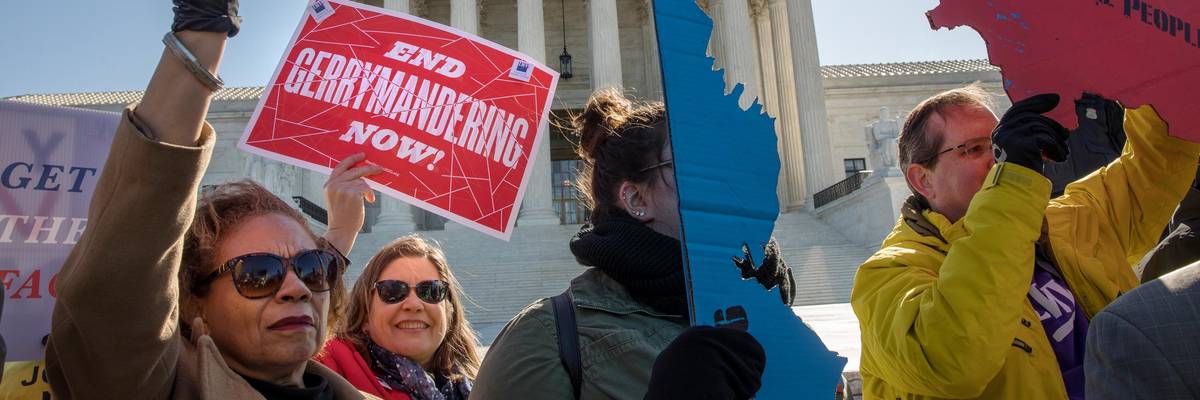
People rally against gerrymandering in front of the U.S. Supreme Court on March 26, 2019.
The US Supreme Court's Incoherent, Idiotic, and Racist Rulings on Gerrymandering
The Court may be ready to scuttle remaining portions of the Voting Rights Act by giving states the ability to racially gerrymander by claiming that they’re only engaging in partisan gerrymandering. It's outrageous.
“We are witnessing right now a massive and unabashed assault on voting rights unlike anything we’ve ever seen since the Jim Crow era. This is Jim Crow in new clothes.” —Sen. Raphael Warnock
Were it not for the Republican-dominated U.S. Supreme Court majority, the clown show by the House of Representatives’ narrow 5-member Republican majority might never have come about. Instead, there would likely be a slim House Democratic majority, Hakeem Jeffries would be Speaker, there would have been no crisis over raising the debt limit, no danger of the government shutting down in mid-November and aid to Ukraine and Israel would already have passed.
As Slate reported a week before the 2022 election, “To a degree that’s absolutely unprecedented in modern times, the midterms will be [and were] conducted with illegal maps—all of which were approved or imposed by Republican-controlled courts. Put simply, Republican-appointed judges may have already guaranteed GOP control over the House before a single ballot was cast.” Slate was proven all too right. We can thank John Roberts and his right-wing SCOTUS colleagues for the chaos in the House.
SCOTUS has incoherently created two conflicting standards for determining whether federal courts can find that gerrymandering abridged the constitutional rights of American citizens. In Rucho v. Common Cause (2018) a slim 5-4 Republican majority held that gerrymandering designed to benefit one political party over the other may not be decided by Federal Courts, enabling partisan state legislatures to pick their own voters with no meaningful remedy. At the same time, it still permits Federal courts to overturn gerrymandering done for purposes of racial discrimination. But with African Americans overwhelming voting Democratic, SCOTUS has permitted state legislatures to gerrymander in order to increase their party’s legislative and congressional majorities by claiming they’re doing it for partisan reasons without any clear standards as to how to tell the difference between partisan gerrymandering and racial gerrymandering.
If SCOTUS rules for South Carolina, it will effectively gut protections against racial gerrymandering by letting states claim that their motivation was party advantage, not racial disadvantage.
As constitutional lawyer David Gans stated, “The bottom line is it would be much harder to bring a racial gerrymandering claim where a state is saying that it sorted voters to achieve a partisan end, even if it used race as a means to do so.”
Now SCOTUS is seriously considering making it more difficult to prove in court that a gerrymander was done for racial reasons (which remains illegal) as opposed to partisan reasons (which SCOTUS has ruled may not be challenged in Federal court.)
In Alexander v. South Carolina Conference of the NAACP, the South Carolina legislature moved 30,000 black voters out of the Charleston congressional district, thus making it all but certain that Republicans would win the House seat in the district. (Ironically, the District in question elected Republican Nancy Mace, a supporter of Jim Jordan for Speaker). The Federal District Court unanimously ruled that this was an unconstitutional racial gerrymander and “made a mockery of the districting principle of constituent consistency.”
South Carolina appealed to SCOTUS, asserting that this was a partisan gerrymander designed to help Republicans and not a racial gerrymander designed to disenfranchise Black voters.
During oral arguments on October 15, 2023, Republican Justices expressed sympathy for South Carolina’s argument, and may be on the verge of overturning the lower Federal Court and ruling it partisan, not a racial, gerrymander, and thus A-OK. Justice Alito asked 37 questions along these lines, compared to only 28 questions from the other 8 Justices combined. Alito had written in a previous opinion, joined by Roberts, that courts must “presume the good faith” of legislatures in redistricting cases.” To presume that partisan legislatures act “in good faith” when their own political survival is at stake is a laughable conclusion and borders on idiotic.
Chief Justice Roberts stated that the lower court’s ruling is “all resting on circumstantial evidence…[T]hat would be breaking new ground in our voting rights jurisprudence,” seeming to suggest that Roberts is prepared to overturn the lower court’s factual findings (which SCOTUS is not supposed to do) because its decision was allegedly based on circumstantial evidence (which is permissible).
But in deciding whether a gerrymander is partisan or racial, there is rarely smoking gun evidence like the legislature stating directly it was making its redistricting decisions in order to disenfranchise African Americans. If SCOTUS rules for South Carolina, it will effectively gut protections against racial gerrymandering by letting states claim that their motivation was party advantage, not racial disadvantage.
This case shows the absurdity of SCOTUS’ Rucho decision that the constitutionality of a partisan gerrymander is non-judiciable for Federal Courts, because there are no clear standards to determine if a partisan gerrymander occurred, but there are standards to determine if a racial gerrymander occurred. In this case, South Carolina actually admits that gerrymandering occurred to help Republicans win more seats, but claims that the gerrymandering could not be questioned by Federal Courts under Rucho because it was partisan and not racial.
Much of the oral arguments were consumed with debating how to determine if a gerrymander is racial or partisan. South Carolina’s attorney agreed that “race and politics can’t be disentangled.” But this just demonstrates the incoherence, indeed stupidity, of Rucho. Remember that Rucho did not find that partisan gerrymandering is constitutional—It merely found that the standards for determining if there is partisan gerrymandering are too unclear for Federal courts to decide one way or the other.
South Carolina is freely admitting to gerrymandering. It is trying to get SCOTUS to force the NAACP to jump through hoops to prove the gerrymander is racial. Legal coherence can only be achieved by SCOTUS revising its Rucho holding and finding that where the evidence shows that partisan gerrymandering occurred, or is even openly admitted by defendants, then it’s unconsitutional and judiciable. Anything less allows states to lie that their reason for gerrymandering is partisan and not racial and then receive a judicial get-out-of-jail-free card to continue to gerrymander anyway.
Civil rights advocates fought and literally died to get the Voting Rights Act of 1965 enacted. The Roberts Court has scuttled much of that law, ruling in Shelby County v. Holder that Section 4 of the Act requiring Justice Department preclearance of changes to voting rights in states with a history of racial discrimination is unconstitutional. Now SCOTUS may be ready to scuttle the rest of the Act by giving states the ability to racially gerrymander by claiming that they’re only engaging in partisan gerrymandering.
Republican Supreme Court Justices may wear black robes rather than white robes and pointed hats, but they may be as effective as Klan members in denying African Americans the right to elect their own representatives.
We are at a crossroads
This country and this world are at a monumental crossroads. In a few short weeks, US voters will have an opportunity to beat back the forces of fascism and confront the billionaires who are rigging the economy, our media system, and our democracy, making it increasingly impossible for ordinary people to get by. We’re not just talking about the election. We’re talking about what must be done once these fascist elements are vanquished from power. We need a bolder set of solutions than what either major party has so far been willing to offer and a working-class movement ready to fight like hell for it. Trump didn't emerge from nowhere. The conditions that fueled MAGA authoritarianism were created by decades of radical neoliberal economic policies and a corrupt political system dominated by corporate interests. They slashed taxes on the super-rich, promising that the benefits would trickle down. They said giveaways to the corporate titans would make life more affordable for the rest of us. It was all bullshit. And when a bitter, betrayed populace searches for someone to blame, right-wing demagogues have little trouble finding scapegoats. People know when they're being lied to, but you won't hear any of this from the corporate media. Only independent journalism—powered and funded by people who believe in building a better world—can deliver truly trustworthy daily news. Our Fall Campaign is underway, and we need your help. To power our newsroom through the rest of the year, we need to raise $125,000 by midnight on October 31. So if you share our vision, please contribute whatever you can to sustain our work. |
“We are witnessing right now a massive and unabashed assault on voting rights unlike anything we’ve ever seen since the Jim Crow era. This is Jim Crow in new clothes.” —Sen. Raphael Warnock
Were it not for the Republican-dominated U.S. Supreme Court majority, the clown show by the House of Representatives’ narrow 5-member Republican majority might never have come about. Instead, there would likely be a slim House Democratic majority, Hakeem Jeffries would be Speaker, there would have been no crisis over raising the debt limit, no danger of the government shutting down in mid-November and aid to Ukraine and Israel would already have passed.
As Slate reported a week before the 2022 election, “To a degree that’s absolutely unprecedented in modern times, the midterms will be [and were] conducted with illegal maps—all of which were approved or imposed by Republican-controlled courts. Put simply, Republican-appointed judges may have already guaranteed GOP control over the House before a single ballot was cast.” Slate was proven all too right. We can thank John Roberts and his right-wing SCOTUS colleagues for the chaos in the House.
SCOTUS has incoherently created two conflicting standards for determining whether federal courts can find that gerrymandering abridged the constitutional rights of American citizens. In Rucho v. Common Cause (2018) a slim 5-4 Republican majority held that gerrymandering designed to benefit one political party over the other may not be decided by Federal Courts, enabling partisan state legislatures to pick their own voters with no meaningful remedy. At the same time, it still permits Federal courts to overturn gerrymandering done for purposes of racial discrimination. But with African Americans overwhelming voting Democratic, SCOTUS has permitted state legislatures to gerrymander in order to increase their party’s legislative and congressional majorities by claiming they’re doing it for partisan reasons without any clear standards as to how to tell the difference between partisan gerrymandering and racial gerrymandering.
If SCOTUS rules for South Carolina, it will effectively gut protections against racial gerrymandering by letting states claim that their motivation was party advantage, not racial disadvantage.
As constitutional lawyer David Gans stated, “The bottom line is it would be much harder to bring a racial gerrymandering claim where a state is saying that it sorted voters to achieve a partisan end, even if it used race as a means to do so.”
Now SCOTUS is seriously considering making it more difficult to prove in court that a gerrymander was done for racial reasons (which remains illegal) as opposed to partisan reasons (which SCOTUS has ruled may not be challenged in Federal court.)
In Alexander v. South Carolina Conference of the NAACP, the South Carolina legislature moved 30,000 black voters out of the Charleston congressional district, thus making it all but certain that Republicans would win the House seat in the district. (Ironically, the District in question elected Republican Nancy Mace, a supporter of Jim Jordan for Speaker). The Federal District Court unanimously ruled that this was an unconstitutional racial gerrymander and “made a mockery of the districting principle of constituent consistency.”
South Carolina appealed to SCOTUS, asserting that this was a partisan gerrymander designed to help Republicans and not a racial gerrymander designed to disenfranchise Black voters.
During oral arguments on October 15, 2023, Republican Justices expressed sympathy for South Carolina’s argument, and may be on the verge of overturning the lower Federal Court and ruling it partisan, not a racial, gerrymander, and thus A-OK. Justice Alito asked 37 questions along these lines, compared to only 28 questions from the other 8 Justices combined. Alito had written in a previous opinion, joined by Roberts, that courts must “presume the good faith” of legislatures in redistricting cases.” To presume that partisan legislatures act “in good faith” when their own political survival is at stake is a laughable conclusion and borders on idiotic.
Chief Justice Roberts stated that the lower court’s ruling is “all resting on circumstantial evidence…[T]hat would be breaking new ground in our voting rights jurisprudence,” seeming to suggest that Roberts is prepared to overturn the lower court’s factual findings (which SCOTUS is not supposed to do) because its decision was allegedly based on circumstantial evidence (which is permissible).
But in deciding whether a gerrymander is partisan or racial, there is rarely smoking gun evidence like the legislature stating directly it was making its redistricting decisions in order to disenfranchise African Americans. If SCOTUS rules for South Carolina, it will effectively gut protections against racial gerrymandering by letting states claim that their motivation was party advantage, not racial disadvantage.
This case shows the absurdity of SCOTUS’ Rucho decision that the constitutionality of a partisan gerrymander is non-judiciable for Federal Courts, because there are no clear standards to determine if a partisan gerrymander occurred, but there are standards to determine if a racial gerrymander occurred. In this case, South Carolina actually admits that gerrymandering occurred to help Republicans win more seats, but claims that the gerrymandering could not be questioned by Federal Courts under Rucho because it was partisan and not racial.
Much of the oral arguments were consumed with debating how to determine if a gerrymander is racial or partisan. South Carolina’s attorney agreed that “race and politics can’t be disentangled.” But this just demonstrates the incoherence, indeed stupidity, of Rucho. Remember that Rucho did not find that partisan gerrymandering is constitutional—It merely found that the standards for determining if there is partisan gerrymandering are too unclear for Federal courts to decide one way or the other.
South Carolina is freely admitting to gerrymandering. It is trying to get SCOTUS to force the NAACP to jump through hoops to prove the gerrymander is racial. Legal coherence can only be achieved by SCOTUS revising its Rucho holding and finding that where the evidence shows that partisan gerrymandering occurred, or is even openly admitted by defendants, then it’s unconsitutional and judiciable. Anything less allows states to lie that their reason for gerrymandering is partisan and not racial and then receive a judicial get-out-of-jail-free card to continue to gerrymander anyway.
Civil rights advocates fought and literally died to get the Voting Rights Act of 1965 enacted. The Roberts Court has scuttled much of that law, ruling in Shelby County v. Holder that Section 4 of the Act requiring Justice Department preclearance of changes to voting rights in states with a history of racial discrimination is unconstitutional. Now SCOTUS may be ready to scuttle the rest of the Act by giving states the ability to racially gerrymander by claiming that they’re only engaging in partisan gerrymandering.
Republican Supreme Court Justices may wear black robes rather than white robes and pointed hats, but they may be as effective as Klan members in denying African Americans the right to elect their own representatives.
- 'Justice Is Delayed' as Judges OK Rigged South Carolina Map for Elections ›
- Opinion | With South Carolina Ruling, Alito May as Well Fly a Confederate Flag | Common Dreams ›
- Opinion | The Supreme Court Just Created a Safe Harbor for Partisan Gerrymandering | Common Dreams ›
- Opinion | The Supreme Court’s Whites-First Reasoning on Gerrymandering | Common Dreams ›
“We are witnessing right now a massive and unabashed assault on voting rights unlike anything we’ve ever seen since the Jim Crow era. This is Jim Crow in new clothes.” —Sen. Raphael Warnock
Were it not for the Republican-dominated U.S. Supreme Court majority, the clown show by the House of Representatives’ narrow 5-member Republican majority might never have come about. Instead, there would likely be a slim House Democratic majority, Hakeem Jeffries would be Speaker, there would have been no crisis over raising the debt limit, no danger of the government shutting down in mid-November and aid to Ukraine and Israel would already have passed.
As Slate reported a week before the 2022 election, “To a degree that’s absolutely unprecedented in modern times, the midterms will be [and were] conducted with illegal maps—all of which were approved or imposed by Republican-controlled courts. Put simply, Republican-appointed judges may have already guaranteed GOP control over the House before a single ballot was cast.” Slate was proven all too right. We can thank John Roberts and his right-wing SCOTUS colleagues for the chaos in the House.
SCOTUS has incoherently created two conflicting standards for determining whether federal courts can find that gerrymandering abridged the constitutional rights of American citizens. In Rucho v. Common Cause (2018) a slim 5-4 Republican majority held that gerrymandering designed to benefit one political party over the other may not be decided by Federal Courts, enabling partisan state legislatures to pick their own voters with no meaningful remedy. At the same time, it still permits Federal courts to overturn gerrymandering done for purposes of racial discrimination. But with African Americans overwhelming voting Democratic, SCOTUS has permitted state legislatures to gerrymander in order to increase their party’s legislative and congressional majorities by claiming they’re doing it for partisan reasons without any clear standards as to how to tell the difference between partisan gerrymandering and racial gerrymandering.
If SCOTUS rules for South Carolina, it will effectively gut protections against racial gerrymandering by letting states claim that their motivation was party advantage, not racial disadvantage.
As constitutional lawyer David Gans stated, “The bottom line is it would be much harder to bring a racial gerrymandering claim where a state is saying that it sorted voters to achieve a partisan end, even if it used race as a means to do so.”
Now SCOTUS is seriously considering making it more difficult to prove in court that a gerrymander was done for racial reasons (which remains illegal) as opposed to partisan reasons (which SCOTUS has ruled may not be challenged in Federal court.)
In Alexander v. South Carolina Conference of the NAACP, the South Carolina legislature moved 30,000 black voters out of the Charleston congressional district, thus making it all but certain that Republicans would win the House seat in the district. (Ironically, the District in question elected Republican Nancy Mace, a supporter of Jim Jordan for Speaker). The Federal District Court unanimously ruled that this was an unconstitutional racial gerrymander and “made a mockery of the districting principle of constituent consistency.”
South Carolina appealed to SCOTUS, asserting that this was a partisan gerrymander designed to help Republicans and not a racial gerrymander designed to disenfranchise Black voters.
During oral arguments on October 15, 2023, Republican Justices expressed sympathy for South Carolina’s argument, and may be on the verge of overturning the lower Federal Court and ruling it partisan, not a racial, gerrymander, and thus A-OK. Justice Alito asked 37 questions along these lines, compared to only 28 questions from the other 8 Justices combined. Alito had written in a previous opinion, joined by Roberts, that courts must “presume the good faith” of legislatures in redistricting cases.” To presume that partisan legislatures act “in good faith” when their own political survival is at stake is a laughable conclusion and borders on idiotic.
Chief Justice Roberts stated that the lower court’s ruling is “all resting on circumstantial evidence…[T]hat would be breaking new ground in our voting rights jurisprudence,” seeming to suggest that Roberts is prepared to overturn the lower court’s factual findings (which SCOTUS is not supposed to do) because its decision was allegedly based on circumstantial evidence (which is permissible).
But in deciding whether a gerrymander is partisan or racial, there is rarely smoking gun evidence like the legislature stating directly it was making its redistricting decisions in order to disenfranchise African Americans. If SCOTUS rules for South Carolina, it will effectively gut protections against racial gerrymandering by letting states claim that their motivation was party advantage, not racial disadvantage.
This case shows the absurdity of SCOTUS’ Rucho decision that the constitutionality of a partisan gerrymander is non-judiciable for Federal Courts, because there are no clear standards to determine if a partisan gerrymander occurred, but there are standards to determine if a racial gerrymander occurred. In this case, South Carolina actually admits that gerrymandering occurred to help Republicans win more seats, but claims that the gerrymandering could not be questioned by Federal Courts under Rucho because it was partisan and not racial.
Much of the oral arguments were consumed with debating how to determine if a gerrymander is racial or partisan. South Carolina’s attorney agreed that “race and politics can’t be disentangled.” But this just demonstrates the incoherence, indeed stupidity, of Rucho. Remember that Rucho did not find that partisan gerrymandering is constitutional—It merely found that the standards for determining if there is partisan gerrymandering are too unclear for Federal courts to decide one way or the other.
South Carolina is freely admitting to gerrymandering. It is trying to get SCOTUS to force the NAACP to jump through hoops to prove the gerrymander is racial. Legal coherence can only be achieved by SCOTUS revising its Rucho holding and finding that where the evidence shows that partisan gerrymandering occurred, or is even openly admitted by defendants, then it’s unconsitutional and judiciable. Anything less allows states to lie that their reason for gerrymandering is partisan and not racial and then receive a judicial get-out-of-jail-free card to continue to gerrymander anyway.
Civil rights advocates fought and literally died to get the Voting Rights Act of 1965 enacted. The Roberts Court has scuttled much of that law, ruling in Shelby County v. Holder that Section 4 of the Act requiring Justice Department preclearance of changes to voting rights in states with a history of racial discrimination is unconstitutional. Now SCOTUS may be ready to scuttle the rest of the Act by giving states the ability to racially gerrymander by claiming that they’re only engaging in partisan gerrymandering.
Republican Supreme Court Justices may wear black robes rather than white robes and pointed hats, but they may be as effective as Klan members in denying African Americans the right to elect their own representatives.
- 'Justice Is Delayed' as Judges OK Rigged South Carolina Map for Elections ›
- Opinion | With South Carolina Ruling, Alito May as Well Fly a Confederate Flag | Common Dreams ›
- Opinion | The Supreme Court Just Created a Safe Harbor for Partisan Gerrymandering | Common Dreams ›
- Opinion | The Supreme Court’s Whites-First Reasoning on Gerrymandering | Common Dreams ›