SUBSCRIBE TO OUR FREE NEWSLETTER
Daily news & progressive opinion—funded by the people, not the corporations—delivered straight to your inbox.
5
#000000
#FFFFFF
To donate by check, phone, or other method, see our More Ways to Give page.
Daily news & progressive opinion—funded by the people, not the corporations—delivered straight to your inbox.
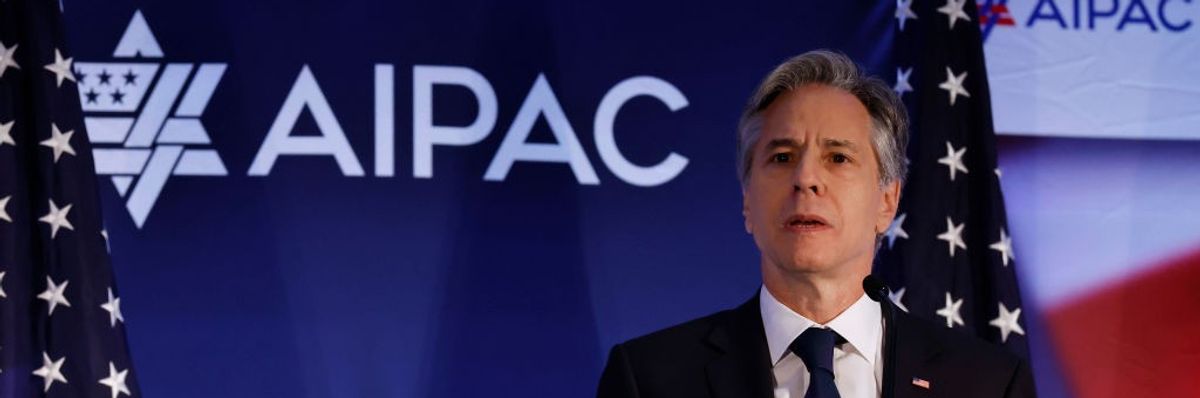
U.S. Secretary of State Antony Blinken addresses the American Israel Public Affairs Committee (AIPAC) annual policy summit Grand Hyatt on June 05, 2023 in Washington, D.C.
On every other issue, it is conventional wisdom that campaign contributions influence politicians. It is risible to pretend that only when it comes to Israel is that never the case.
Earlier this spring, the Biden Administration withdrew its nomination of James Cavallaro—a Yale law instructor—to the Inter-American Commission on Human Rights after a tweet emerged in which Cavallaro accused the hawkishly pro-Israel U.S. House Minority Leader Hakeem Jeffries, a New York Democrat, of being “Bought. Purchased. Controlled” by the American Israel Public Affairs Committee, or AIPAC.
According to watchdog group OpenSecrets, Rep. Jeffries’ single largest donor in the last election was Pro-Israel America ($213,450). Three of his top five contributors were pro-Israel groups, the others being NorPAC ($99,150), and AIPAC ($66,990). In aggregate, pro-Israel donations trailed only Wall Street contributions. On every other issue, it is conventional wisdom that campaign contributions influence politicians. It is risible to pretend that only when it comes to Israel is that never the case. Cavallaro was partaking in mundane political barbs when he mocked Jeffries for being a tool of an influential lobby.
To draw a connection between pro-Israel donations and the often slavish support for Israel exhibited by many American politicians is simply recognizing the obvious. AIPAC and the newly formed Democratic Majority for Israel (DMFI) know that money buys clout in politics. That’s why DMFI and the AIPAC-backed United Democracy Project super PAC were launched to arrest growing support for Palestinian human rights among liberal Democrats. Simply put, would donors part with millions of dollars if congressional policies on Israel were not subject to political pressure?
The fact that AIPAC’s PAC and the DMFI were launched to arrest growing support for Palestinian human rights underscores the importance both assign to pro-Israel campaign contributions.
Alas, nothing is ever so straightforward in American discussions on Israel. When Rep. Ilhan Omar (D-Minn.) stated that U.S. congressional support for Israel was due to AIPAC’s “Benjamins,” she was roundly accused of antisemitism as if AIPAC’s lobbying clout did not influence Capitol Hill.
And that is where former pro-Palestinian congressional candidate Nina Turner found herself after DMFI spent just under $2 million to defeat Turner and help elect her pro-Israel opponent. (Much of DMFI’s money comes from Republican donors.) In her concession speech, Turner lambasted outside money (i.e. super PACs) as “evil money,” which in turn led the misnamed Anti-Defamation League to accuse Turner of “echo[ing] long-standing antisemitic tropes.” It is standard practice for pro-Israel lobbies to flex their influence but, at the same time, attempt to shield themselves from scrutiny by falsely accusing their detractors of playing on antisemitic tropes about Jews and power.
Political support for Israel is not solely about campaign contributions, as Zionist sentiments are genuinely held, especially among Evangelical Christians who form the backbone of the Republican Party. However, criticism of Israel in Congress declined in the 1980s as groups like AIPAC grew influential. Moreover, the fact that AIPAC’s PAC and the DMFI were launched to arrest growing support for Palestinian human rights underscores the importance both assign to pro-Israel campaign contributions.
And those contributions are significant. In the last midterm election, right-wing pro-Israel donors and super PACs spent tens of millions in campaign contributions to defeat candidates and politicians critical of Israel and prop up those in sync with their views. (Left-wing pro-Israel groups, such as J Street or Americans for Peace Now, make contributions but trail behind their right-wing counterparts.)
Rep. Ritchie Torres (D-N.Y.) has made a name for himself as a vociferous “progressive” champion of Israel. OpenSecrets reports Torres’s biggest donor as AIPAC ($131,008). Torres and Jeffries are hardly unique in building campaign war chests with pro-Israel donations.
Contributions to candidates are only part of the story. Super PACs run their own TV and mailer campaigns. In the last election, United Democracy Project spent nearly $33 million.
Not surprisingly, AIPAC scored notable victories in the midterms, as reported by Open Secrets. United Democracy Project spent $4 million in opposition to five-time incumbent Rep. Donna Edwards (D-Md.). Edwards lost her primary to challenger Glenn Ivey, who received $1.7 million in support from the super PAC. In a post-election press release, AIPAC called Edwards a “detractor of the U.S.-Israel relationship who was heavily backed by some of the most vocal and persistent critics of the Jewish state.”
The super PAC also spent $4.2 million to help defeat Rep. Andy Levin (D-Mich.), a Jewish-American champion for Palestinian human rights. The United Democracy Project deployed more money in the primary than the combined campaign budgets of the former congressman and his opponent. The super PAC poured $2.4 million into North Carolina’s 4th Congressional District to successfully support Valerie Foushee against pro-Palestinian American Muslim Nida Allam. DMFI spent $6,240,441 in the last election targeting pro-Palestinian Democrats running for office or reelection. And NorPAC spent $1,916,071.
Witnessing an avalanche of pro-Israel money help sink a campaign, including those of incumbents, probably makes many aspiring and serving public officials think twice before criticizing Israel. It is not antisemitic to say so.
Dear Common Dreams reader, It’s been nearly 30 years since I co-founded Common Dreams with my late wife, Lina Newhouser. We had the radical notion that journalism should serve the public good, not corporate profits. It was clear to us from the outset what it would take to build such a project. No paid advertisements. No corporate sponsors. No millionaire publisher telling us what to think or do. Many people said we wouldn't last a year, but we proved those doubters wrong. Together with a tremendous team of journalists and dedicated staff, we built an independent media outlet free from the constraints of profits and corporate control. Our mission has always been simple: To inform. To inspire. To ignite change for the common good. Building Common Dreams was not easy. Our survival was never guaranteed. When you take on the most powerful forces—Wall Street greed, fossil fuel industry destruction, Big Tech lobbyists, and uber-rich oligarchs who have spent billions upon billions rigging the economy and democracy in their favor—the only bulwark you have is supporters who believe in your work. But here’s the urgent message from me today. It's never been this bad out there. And it's never been this hard to keep us going. At the very moment Common Dreams is most needed, the threats we face are intensifying. We need your support now more than ever. We don't accept corporate advertising and never will. We don't have a paywall because we don't think people should be blocked from critical news based on their ability to pay. Everything we do is funded by the donations of readers like you. When everyone does the little they can afford, we are strong. But if that support retreats or dries up, so do we. Will you donate now to make sure Common Dreams not only survives but thrives? —Craig Brown, Co-founder |
Earlier this spring, the Biden Administration withdrew its nomination of James Cavallaro—a Yale law instructor—to the Inter-American Commission on Human Rights after a tweet emerged in which Cavallaro accused the hawkishly pro-Israel U.S. House Minority Leader Hakeem Jeffries, a New York Democrat, of being “Bought. Purchased. Controlled” by the American Israel Public Affairs Committee, or AIPAC.
According to watchdog group OpenSecrets, Rep. Jeffries’ single largest donor in the last election was Pro-Israel America ($213,450). Three of his top five contributors were pro-Israel groups, the others being NorPAC ($99,150), and AIPAC ($66,990). In aggregate, pro-Israel donations trailed only Wall Street contributions. On every other issue, it is conventional wisdom that campaign contributions influence politicians. It is risible to pretend that only when it comes to Israel is that never the case. Cavallaro was partaking in mundane political barbs when he mocked Jeffries for being a tool of an influential lobby.
To draw a connection between pro-Israel donations and the often slavish support for Israel exhibited by many American politicians is simply recognizing the obvious. AIPAC and the newly formed Democratic Majority for Israel (DMFI) know that money buys clout in politics. That’s why DMFI and the AIPAC-backed United Democracy Project super PAC were launched to arrest growing support for Palestinian human rights among liberal Democrats. Simply put, would donors part with millions of dollars if congressional policies on Israel were not subject to political pressure?
The fact that AIPAC’s PAC and the DMFI were launched to arrest growing support for Palestinian human rights underscores the importance both assign to pro-Israel campaign contributions.
Alas, nothing is ever so straightforward in American discussions on Israel. When Rep. Ilhan Omar (D-Minn.) stated that U.S. congressional support for Israel was due to AIPAC’s “Benjamins,” she was roundly accused of antisemitism as if AIPAC’s lobbying clout did not influence Capitol Hill.
And that is where former pro-Palestinian congressional candidate Nina Turner found herself after DMFI spent just under $2 million to defeat Turner and help elect her pro-Israel opponent. (Much of DMFI’s money comes from Republican donors.) In her concession speech, Turner lambasted outside money (i.e. super PACs) as “evil money,” which in turn led the misnamed Anti-Defamation League to accuse Turner of “echo[ing] long-standing antisemitic tropes.” It is standard practice for pro-Israel lobbies to flex their influence but, at the same time, attempt to shield themselves from scrutiny by falsely accusing their detractors of playing on antisemitic tropes about Jews and power.
Political support for Israel is not solely about campaign contributions, as Zionist sentiments are genuinely held, especially among Evangelical Christians who form the backbone of the Republican Party. However, criticism of Israel in Congress declined in the 1980s as groups like AIPAC grew influential. Moreover, the fact that AIPAC’s PAC and the DMFI were launched to arrest growing support for Palestinian human rights underscores the importance both assign to pro-Israel campaign contributions.
And those contributions are significant. In the last midterm election, right-wing pro-Israel donors and super PACs spent tens of millions in campaign contributions to defeat candidates and politicians critical of Israel and prop up those in sync with their views. (Left-wing pro-Israel groups, such as J Street or Americans for Peace Now, make contributions but trail behind their right-wing counterparts.)
Rep. Ritchie Torres (D-N.Y.) has made a name for himself as a vociferous “progressive” champion of Israel. OpenSecrets reports Torres’s biggest donor as AIPAC ($131,008). Torres and Jeffries are hardly unique in building campaign war chests with pro-Israel donations.
Contributions to candidates are only part of the story. Super PACs run their own TV and mailer campaigns. In the last election, United Democracy Project spent nearly $33 million.
Not surprisingly, AIPAC scored notable victories in the midterms, as reported by Open Secrets. United Democracy Project spent $4 million in opposition to five-time incumbent Rep. Donna Edwards (D-Md.). Edwards lost her primary to challenger Glenn Ivey, who received $1.7 million in support from the super PAC. In a post-election press release, AIPAC called Edwards a “detractor of the U.S.-Israel relationship who was heavily backed by some of the most vocal and persistent critics of the Jewish state.”
The super PAC also spent $4.2 million to help defeat Rep. Andy Levin (D-Mich.), a Jewish-American champion for Palestinian human rights. The United Democracy Project deployed more money in the primary than the combined campaign budgets of the former congressman and his opponent. The super PAC poured $2.4 million into North Carolina’s 4th Congressional District to successfully support Valerie Foushee against pro-Palestinian American Muslim Nida Allam. DMFI spent $6,240,441 in the last election targeting pro-Palestinian Democrats running for office or reelection. And NorPAC spent $1,916,071.
Witnessing an avalanche of pro-Israel money help sink a campaign, including those of incumbents, probably makes many aspiring and serving public officials think twice before criticizing Israel. It is not antisemitic to say so.
Earlier this spring, the Biden Administration withdrew its nomination of James Cavallaro—a Yale law instructor—to the Inter-American Commission on Human Rights after a tweet emerged in which Cavallaro accused the hawkishly pro-Israel U.S. House Minority Leader Hakeem Jeffries, a New York Democrat, of being “Bought. Purchased. Controlled” by the American Israel Public Affairs Committee, or AIPAC.
According to watchdog group OpenSecrets, Rep. Jeffries’ single largest donor in the last election was Pro-Israel America ($213,450). Three of his top five contributors were pro-Israel groups, the others being NorPAC ($99,150), and AIPAC ($66,990). In aggregate, pro-Israel donations trailed only Wall Street contributions. On every other issue, it is conventional wisdom that campaign contributions influence politicians. It is risible to pretend that only when it comes to Israel is that never the case. Cavallaro was partaking in mundane political barbs when he mocked Jeffries for being a tool of an influential lobby.
To draw a connection between pro-Israel donations and the often slavish support for Israel exhibited by many American politicians is simply recognizing the obvious. AIPAC and the newly formed Democratic Majority for Israel (DMFI) know that money buys clout in politics. That’s why DMFI and the AIPAC-backed United Democracy Project super PAC were launched to arrest growing support for Palestinian human rights among liberal Democrats. Simply put, would donors part with millions of dollars if congressional policies on Israel were not subject to political pressure?
The fact that AIPAC’s PAC and the DMFI were launched to arrest growing support for Palestinian human rights underscores the importance both assign to pro-Israel campaign contributions.
Alas, nothing is ever so straightforward in American discussions on Israel. When Rep. Ilhan Omar (D-Minn.) stated that U.S. congressional support for Israel was due to AIPAC’s “Benjamins,” she was roundly accused of antisemitism as if AIPAC’s lobbying clout did not influence Capitol Hill.
And that is where former pro-Palestinian congressional candidate Nina Turner found herself after DMFI spent just under $2 million to defeat Turner and help elect her pro-Israel opponent. (Much of DMFI’s money comes from Republican donors.) In her concession speech, Turner lambasted outside money (i.e. super PACs) as “evil money,” which in turn led the misnamed Anti-Defamation League to accuse Turner of “echo[ing] long-standing antisemitic tropes.” It is standard practice for pro-Israel lobbies to flex their influence but, at the same time, attempt to shield themselves from scrutiny by falsely accusing their detractors of playing on antisemitic tropes about Jews and power.
Political support for Israel is not solely about campaign contributions, as Zionist sentiments are genuinely held, especially among Evangelical Christians who form the backbone of the Republican Party. However, criticism of Israel in Congress declined in the 1980s as groups like AIPAC grew influential. Moreover, the fact that AIPAC’s PAC and the DMFI were launched to arrest growing support for Palestinian human rights underscores the importance both assign to pro-Israel campaign contributions.
And those contributions are significant. In the last midterm election, right-wing pro-Israel donors and super PACs spent tens of millions in campaign contributions to defeat candidates and politicians critical of Israel and prop up those in sync with their views. (Left-wing pro-Israel groups, such as J Street or Americans for Peace Now, make contributions but trail behind their right-wing counterparts.)
Rep. Ritchie Torres (D-N.Y.) has made a name for himself as a vociferous “progressive” champion of Israel. OpenSecrets reports Torres’s biggest donor as AIPAC ($131,008). Torres and Jeffries are hardly unique in building campaign war chests with pro-Israel donations.
Contributions to candidates are only part of the story. Super PACs run their own TV and mailer campaigns. In the last election, United Democracy Project spent nearly $33 million.
Not surprisingly, AIPAC scored notable victories in the midterms, as reported by Open Secrets. United Democracy Project spent $4 million in opposition to five-time incumbent Rep. Donna Edwards (D-Md.). Edwards lost her primary to challenger Glenn Ivey, who received $1.7 million in support from the super PAC. In a post-election press release, AIPAC called Edwards a “detractor of the U.S.-Israel relationship who was heavily backed by some of the most vocal and persistent critics of the Jewish state.”
The super PAC also spent $4.2 million to help defeat Rep. Andy Levin (D-Mich.), a Jewish-American champion for Palestinian human rights. The United Democracy Project deployed more money in the primary than the combined campaign budgets of the former congressman and his opponent. The super PAC poured $2.4 million into North Carolina’s 4th Congressional District to successfully support Valerie Foushee against pro-Palestinian American Muslim Nida Allam. DMFI spent $6,240,441 in the last election targeting pro-Palestinian Democrats running for office or reelection. And NorPAC spent $1,916,071.
Witnessing an avalanche of pro-Israel money help sink a campaign, including those of incumbents, probably makes many aspiring and serving public officials think twice before criticizing Israel. It is not antisemitic to say so.